ITER Questions and Answers
Q: What is ITER?
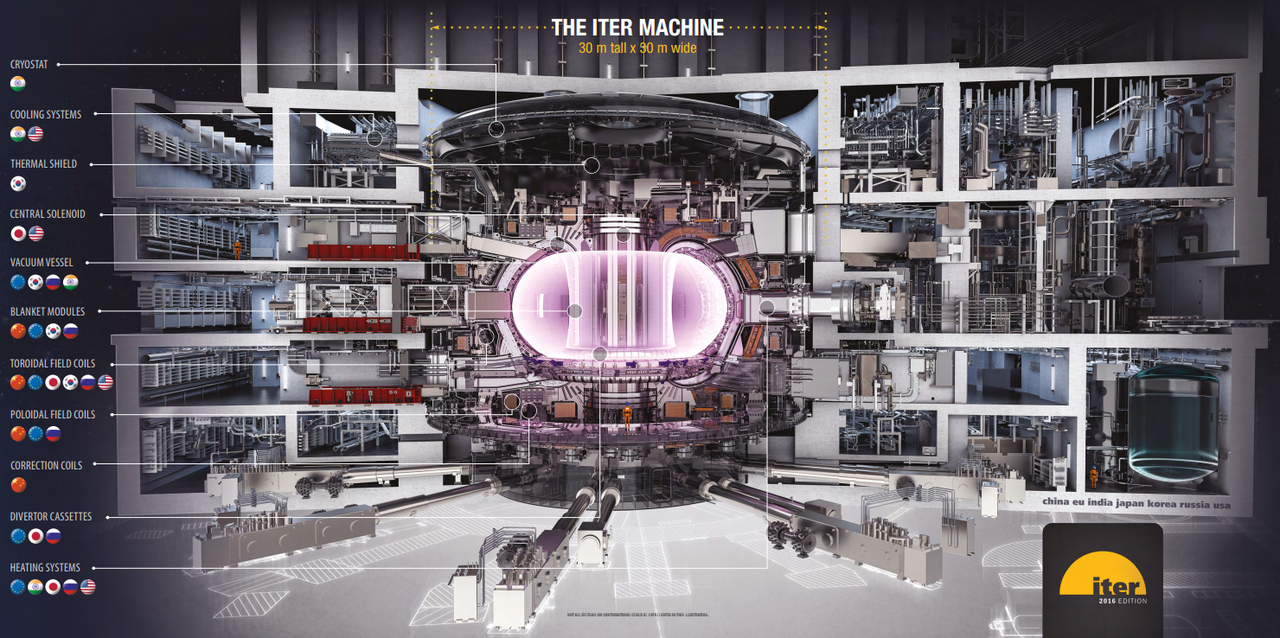
A: ITER (ITER, International Thermonuclear Experimental Reactor) is an experimental thermonuclear reactor based on the tokamak concept. Design in several approaches (different options) went from 1992 to 2007, construction - from 2009 to the present (and continues). The ITER Tokamak will be approximately twice as large as its predecessors in all sizes, about 10 times larger and heavier, 15 times more expensive, and 25 times more powerful in terms of fusion power. Q: What are his goals? A: The set of ITER main tasks can be ranked as follows:
Q: And what is the power of ITER?
A: Let's start with the fact that ITER will not generate electricity - all the heat will simply be discharged into the cooling towers of the cooling system. The turbine turned out to be poorly compatible with impulse modes of operation, which are mastered for tokamaks today (about them below) and the interests of scientists. Therefore, it turns out that ITER has quite a lot of capacity, let's list them:
The power discharged into the cooling tower by all heat sources, the maximum is 1150 megawatts.
The power released in the plasma in different modes of tokamak from 250 to 700 megawatts.
Of these, the thermonuclear reaction power is 200 to 630 megawatts, and the rest is embedded by plasma heating systems.
At the same time, ITER itself consumes significant power from the “socket” - about 600 megawatts at the time of burning (or as it is called - a shot) plasma and about 110 megawatts during preparation.
Even more energy circulates in the power supply system of superconducting magnets - because of the need to change the current in magnets during a plasma shot in a system of magnets - reactive compensation walks about 2 gigawatts of reactive power. From the “socket”, this system consumes about 250 megawatts of 600 total consumption.
Thus, it turns out that although from the physical point of view of ITER, its thermonuclear power is 10 times higher than the heating power, from an engineering point of view, ITER does not even reach one. However, this is connected more likely not with a fundamental impossibility, but with cost optimization - for the time being it is more profitable to make tokamak pulsed and not generating energy.
Q: What does pulsed mean? How long will the “impulse” in ITER last?
A: One of the important components of plasma confinement in a tokamak is the ring current that flows in this plasma. Initially, for simplicity, it was always supported by the principle of a transformer — if we place a large coil (called a central solenoid or inductor) in the center of a tokamak, and we begin to change the current in it, then secondary current will flow through the plasma (as in the transformer). This mode is called inductive. However, it is possible to maintain the plasma current for a limited time - while the central solenoid spreads from the maximum to the minimum value of the current in itself (in the case of ITER this will be from +55 kiloampere to -55 kiloampere. Unfortunately, to reverse the process, you need to change the direction of the plasma current what it takes too much energy to make it reasonable).
There is the possibility of maintaining the plasma current using radio frequency systems and neutral beam injectors, up to a completely non-inductive mode, when the central solenoid is not activated. Such regimes have been demonstrated on tokamaks and will be implemented at ITER. The mixture of inductive and non-inductive mode is expectedly called hybrid.
In the first stage, ITERu will have access to hybrid modes with a capacity of up to 400 megawatts for a duration of 1000 seconds. After the upgrade, the neutral-beam injector and the lower hybrid radio-frequency heating are completely non-inductive, up to hourly “pulses” of burning at a power of 400 megawatts — and here the buffers of the cryosystem and the cooling system act as constraints .
Q: ITER will not have a turbogenerator to generate electricity? But really there are no other ways to get electricity from the energy of thermonuclear burning?
A: As I noted above, ITER does not have a turbogenerator mainly for reasons of not wanting to bring energy generation problems into an engineering-physical installation.
There are other options besides the classical steam turbine circuit. However, it must be remembered that 86% of the deuterium-tritium thermonuclear reaction energy is carried away by neutrons, and energy can only be extracted from them by braking them in a piece of material that heats up from it. It turns out that for deuterium-tritium, the only options with high efficiency are heat engines - be it a steam turbine installation or a gas turbine or steam-gas plant.
For other types of thermonuclear reactions, the distribution of energy leaving channels from plasma is different. If you look at the 3 main alternatives to deuterium-tritium (DT): DD, DHe3, pB11 - here electromagnetic radiation becomes the main channel of loss - from microwave radio waves to hard X-rays in the case of pB11. Theoretically, at least some of the energy can be obtained using some kind of analog solar cells (photovoltaics), but today this topic is poorly understood. Another mechanism may be the selection of a portion of hot plasma and the direct conversion of its energy into electricity. Devices capable of doing this exist and have been tested on plasma devices (the open Gamma-10 trap). However, the engineering perspectives of this approach and compatibility with the need for plasma control are not yet clear.
Q: And what about the fuel supply? Tritium is an artificial element with a half-life of 12 years, where will ITER take it?
A: Today in the world the main producers of tritium are heavy-water CANDU reactors, from which about 2 kg of tritium are extracted per year. ITER will require 3 kg to charge all of its tritium subsystems, and approximately 1 kg for each year of operation. Those. while tritium consumes only ITER and CANDU is working - there are no problems. However, if thermonuclear reactors on the DT tokakmak principle continue to develop, they will need tritium self-sufficiency, for which ITER will work out blanket technology, in which the Li 6 isotope will share the neutron flux from the plasma to produce tritium.
Q: And when will ITER finally be built and run? And how much does it cost?
A: The project of an international thermonuclear reactor for a long time could not get out of the discussions, improvements and alterations, and only in the last couple of years has the construction and production of components gained momentum. Today, the beginning of the assembly of the reactor in the mine is scheduled for 3 quarter of 2019, and the end and the first launch - in December 2025. However, the first launch will be on a “bare” machine, devoid of the main part of the diagnostic systems (study) and plasma heating and the ability to work with tritium. After the first plasma, ITER will have to be upgraded in fragments for another 8-10 years, depending on funding, in order to get to the standard set of equipment and finally ignite a 500 MW thermonuclear reaction.
The cost of ITER, in turn, is a very complex matter. The idea is to sum up the expenses of the participants, but not all of them are reliably known, besides financing is carried out according to a complex scheme - the bulk of money is spent on developing and producing equipment that each country has committed to deliver to the project in kind, and some of it is transferred to the common »For the work of the international agency ITER, which is engaged in the design of the machine part, coordination, assembly, etc. Total costs are now estimated at 22 billion euros, which automatically puts ITER in first place in terms of value among scientific installations.
Q: It seems like thermonuclear reactors have problems with the resistance of materials. Are there any estimates of how many hours / years of operation of the reactor at full power will survive without special structural damage to the reactor wall (tokamak torus) of special steel?
A: Thermonuclear plasma is dangerous for nearby structures (the inner walls of the chamber and the divertor, etc.) due to EM radiation and neutron flux. Electromagnetic radiation is absorbed by intensely cooled metal surfaces, and threatens to overheat (warping, melting, etc.) only in the event of a cooling failure.
The neutron flux is more complicated: the instantaneous flux is very hard due to the high energy of neutrons (14 times higher than in a fast reactor), and a fairly high fluence (neutron flux density), only 10 times lower than the peak in a nuclear reactor.
But at the same time, the integral value during the operation is not so great - ITER is pulsed and experimental, and this is important for assessing the degree of damage to the material.
As a result, the survivability of the first wall (and this is the main part exposed to electromagnetic and neutron loads) is 5 years, and is determined not by structural damage as such, but mainly by plasma erosion and degradation of the copper heat sink base (here it is just due to neutrons) . For comparison, the load on the first wall before removal is 0.3 SNA (displacements per atom is a unit of damaging dose), and the load, say, of the VVER-1000 barrier before removal is 30 SNA, the load of the shells fuel rods in the fast reactor - 60 d.a. and in promising materials - 100+ d.n.a.
However, when commercially interesting parameters of a fusion reactor are reached, damage to internal structures by plasma radiation becomes decisive. A new IFMIF laboratory is under construction in Japan to search for new materials..
Q: Explain about the five-year resource of the first wall. What then? Or 40 years we build 5 years we exploit?
A: The first wall and the diverter (which will have a lifespan of 10-15 years) are replaceable. Replacement will be carried out by a robotic maintenance system .
Q: It is said that ITER provides clean energy, i.e. no radiation like nuclear reactors. But if there are neutrons, then in theory is it not?
A: ITER will be a nuclear-hazardous object, but noticeably less dangerous than nuclear reactors. I have a special article comparing these two types.
A: ITER (ITER, International Thermonuclear Experimental Reactor) is an experimental thermonuclear reactor based on the tokamak concept. Design in several approaches (different options) went from 1992 to 2007, construction - from 2009 to the present (and continues). The ITER Tokamak will be approximately twice as large as its predecessors in all sizes, about 10 times larger and heavier, 15 times more expensive, and 25 times more powerful in terms of fusion power. Q: What are his goals? A: The set of ITER main tasks can be ranked as follows:

- Demonstrate the possibility of controlled thermonuclear fusion with burning time and industrial scale power.
- In practice, facing and solving engineering issues of creating an industrial-scale thermonuclear reactor - with all the banality it is one of the most important and complex tasks of ITER, without which it is impossible to understand the prospects for the development of thermonuclear power plants in general.
- Investigate the remaining issues in plasma physics of tokamaks, incl. it is possible to find some of its features that will simplify the creation of industrial fusion reactors.
- In practice, to develop and test the technology of tritium blanket breeding is an absolutely necessary detail for tokamaks who are guided by the thermonuclear reaction of the deuterium and tritium fusion.
- Gain experience in organizing the construction and operation of thermonuclear reactors / power plants
Q: And what is the power of ITER?
A: Let's start with the fact that ITER will not generate electricity - all the heat will simply be discharged into the cooling towers of the cooling system. The turbine turned out to be poorly compatible with impulse modes of operation, which are mastered for tokamaks today (about them below) and the interests of scientists. Therefore, it turns out that ITER has quite a lot of capacity, let's list them:
The power discharged into the cooling tower by all heat sources, the maximum is 1150 megawatts.
The power released in the plasma in different modes of tokamak from 250 to 700 megawatts.
Of these, the thermonuclear reaction power is 200 to 630 megawatts, and the rest is embedded by plasma heating systems.
At the same time, ITER itself consumes significant power from the “socket” - about 600 megawatts at the time of burning (or as it is called - a shot) plasma and about 110 megawatts during preparation.
Even more energy circulates in the power supply system of superconducting magnets - because of the need to change the current in magnets during a plasma shot in a system of magnets - reactive compensation walks about 2 gigawatts of reactive power. From the “socket”, this system consumes about 250 megawatts of 600 total consumption.
Thus, it turns out that although from the physical point of view of ITER, its thermonuclear power is 10 times higher than the heating power, from an engineering point of view, ITER does not even reach one. However, this is connected more likely not with a fundamental impossibility, but with cost optimization - for the time being it is more profitable to make tokamak pulsed and not generating energy.
Q: What does pulsed mean? How long will the “impulse” in ITER last?
A: One of the important components of plasma confinement in a tokamak is the ring current that flows in this plasma. Initially, for simplicity, it was always supported by the principle of a transformer — if we place a large coil (called a central solenoid or inductor) in the center of a tokamak, and we begin to change the current in it, then secondary current will flow through the plasma (as in the transformer). This mode is called inductive. However, it is possible to maintain the plasma current for a limited time - while the central solenoid spreads from the maximum to the minimum value of the current in itself (in the case of ITER this will be from +55 kiloampere to -55 kiloampere. Unfortunately, to reverse the process, you need to change the direction of the plasma current what it takes too much energy to make it reasonable).
There is the possibility of maintaining the plasma current using radio frequency systems and neutral beam injectors, up to a completely non-inductive mode, when the central solenoid is not activated. Such regimes have been demonstrated on tokamaks and will be implemented at ITER. The mixture of inductive and non-inductive mode is expectedly called hybrid.
In the first stage, ITERu will have access to hybrid modes with a capacity of up to 400 megawatts for a duration of 1000 seconds. After the upgrade, the neutral-beam injector and the lower hybrid radio-frequency heating are completely non-inductive, up to hourly “pulses” of burning at a power of 400 megawatts — and here the buffers of the cryosystem and the cooling system act as constraints .
Q: ITER will not have a turbogenerator to generate electricity? But really there are no other ways to get electricity from the energy of thermonuclear burning?
A: As I noted above, ITER does not have a turbogenerator mainly for reasons of not wanting to bring energy generation problems into an engineering-physical installation.
There are other options besides the classical steam turbine circuit. However, it must be remembered that 86% of the deuterium-tritium thermonuclear reaction energy is carried away by neutrons, and energy can only be extracted from them by braking them in a piece of material that heats up from it. It turns out that for deuterium-tritium, the only options with high efficiency are heat engines - be it a steam turbine installation or a gas turbine or steam-gas plant.
For other types of thermonuclear reactions, the distribution of energy leaving channels from plasma is different. If you look at the 3 main alternatives to deuterium-tritium (DT): DD, DHe3, pB11 - here electromagnetic radiation becomes the main channel of loss - from microwave radio waves to hard X-rays in the case of pB11. Theoretically, at least some of the energy can be obtained using some kind of analog solar cells (photovoltaics), but today this topic is poorly understood. Another mechanism may be the selection of a portion of hot plasma and the direct conversion of its energy into electricity. Devices capable of doing this exist and have been tested on plasma devices (the open Gamma-10 trap). However, the engineering perspectives of this approach and compatibility with the need for plasma control are not yet clear.
Q: And what about the fuel supply? Tritium is an artificial element with a half-life of 12 years, where will ITER take it?
A: Today in the world the main producers of tritium are heavy-water CANDU reactors, from which about 2 kg of tritium are extracted per year. ITER will require 3 kg to charge all of its tritium subsystems, and approximately 1 kg for each year of operation. Those. while tritium consumes only ITER and CANDU is working - there are no problems. However, if thermonuclear reactors on the DT tokakmak principle continue to develop, they will need tritium self-sufficiency, for which ITER will work out blanket technology, in which the Li 6 isotope will share the neutron flux from the plasma to produce tritium.
Q: And when will ITER finally be built and run? And how much does it cost?
A: The project of an international thermonuclear reactor for a long time could not get out of the discussions, improvements and alterations, and only in the last couple of years has the construction and production of components gained momentum. Today, the beginning of the assembly of the reactor in the mine is scheduled for 3 quarter of 2019, and the end and the first launch - in December 2025. However, the first launch will be on a “bare” machine, devoid of the main part of the diagnostic systems (study) and plasma heating and the ability to work with tritium. After the first plasma, ITER will have to be upgraded in fragments for another 8-10 years, depending on funding, in order to get to the standard set of equipment and finally ignite a 500 MW thermonuclear reaction.
The cost of ITER, in turn, is a very complex matter. The idea is to sum up the expenses of the participants, but not all of them are reliably known, besides financing is carried out according to a complex scheme - the bulk of money is spent on developing and producing equipment that each country has committed to deliver to the project in kind, and some of it is transferred to the common »For the work of the international agency ITER, which is engaged in the design of the machine part, coordination, assembly, etc. Total costs are now estimated at 22 billion euros, which automatically puts ITER in first place in terms of value among scientific installations.
Q: It seems like thermonuclear reactors have problems with the resistance of materials. Are there any estimates of how many hours / years of operation of the reactor at full power will survive without special structural damage to the reactor wall (tokamak torus) of special steel?
A: Thermonuclear plasma is dangerous for nearby structures (the inner walls of the chamber and the divertor, etc.) due to EM radiation and neutron flux. Electromagnetic radiation is absorbed by intensely cooled metal surfaces, and threatens to overheat (warping, melting, etc.) only in the event of a cooling failure.
The neutron flux is more complicated: the instantaneous flux is very hard due to the high energy of neutrons (14 times higher than in a fast reactor), and a fairly high fluence (neutron flux density), only 10 times lower than the peak in a nuclear reactor.
But at the same time, the integral value during the operation is not so great - ITER is pulsed and experimental, and this is important for assessing the degree of damage to the material.
As a result, the survivability of the first wall (and this is the main part exposed to electromagnetic and neutron loads) is 5 years, and is determined not by structural damage as such, but mainly by plasma erosion and degradation of the copper heat sink base (here it is just due to neutrons) . For comparison, the load on the first wall before removal is 0.3 SNA (displacements per atom is a unit of damaging dose), and the load, say, of the VVER-1000 barrier before removal is 30 SNA, the load of the shells fuel rods in the fast reactor - 60 d.a. and in promising materials - 100+ d.n.a.
However, when commercially interesting parameters of a fusion reactor are reached, damage to internal structures by plasma radiation becomes decisive. A new IFMIF laboratory is under construction in Japan to search for new materials..
Q: Explain about the five-year resource of the first wall. What then? Or 40 years we build 5 years we exploit?
A: The first wall and the diverter (which will have a lifespan of 10-15 years) are replaceable. Replacement will be carried out by a robotic maintenance system .
Q: It is said that ITER provides clean energy, i.e. no radiation like nuclear reactors. But if there are neutrons, then in theory is it not?
A: ITER will be a nuclear-hazardous object, but noticeably less dangerous than nuclear reactors. I have a special article comparing these two types.