June 27, 2016 at 06:11
China's new family of launch vehicles

Last Saturday, the first launch of the middle-class Chinese launch vehicle Great Voyage-7 was successfully completed. This is the second rocket of the new family. And the secrecy of the Chinese cosmonautics gave us a surprise - it turns out that one of the payloads of this experimental launch was the model of a new manned spacecraft.
Put things in order
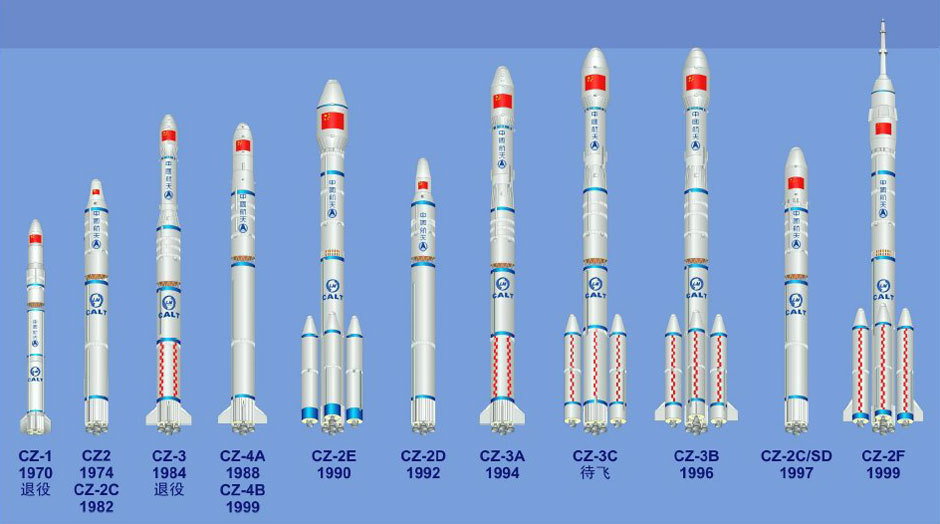
Under the general name "Great Campaign" (hereinafter referred to as CZ, Changzheng or LM), the Chinese combined a variety of missiles, so you need to put some order in place with the notation. The Great Campaign 1
light rocket launched the first Chinese satellite, and version 1D was offered for commercial launches. There were no customers, so the CZ-1 was launched only two times, and the CZ-1D tested three warheads three times. The Great March 2 is a family of missiles in itself. Light versions -2A, C, D (up to three tons in low orbit) and medium versions E (9200 kg per DOE) and F (8400 kg per DOE) were developed. CZ-2E no longer flies, and -2F is the workhorse of the Chinese manned program. The Great Campaign 3
it is a subfamily of light-medium-class launch vehicles, from 5 to 13 tons into low orbit. The more lifting options B and C are used to put satellites into geostationary orbit.
The Great March 4, in various versions, displays 4-4.2 tons into low orbit and is used for launches into polar orbit.
All of the above missiles use heptyl and amyl as a fuel pair. Heptyl (asymmetric dimethylhydrazine) is a substance of the highest hazard class, poison, carcinogen, mutagen, teratogen and, in general, rare muck. Amyl (nitrogen tetroxide) is a little less nasty, poisonous just like chlorine, and plants grow better from it. These components were convenient for military intercontinental missiles, because they could be stored in liquid form at room temperature, and the missile could start at any second. They are also very convenient in space, because they do not require special thermal insulation. And if several hundred kilograms of poison on the upper stage, satellite, interplanetary spacecraft or spacecraft can still be survived, then hundreds of tons of heptyl and amyl in the first stages of launch vehicles are already overkill. They are also more expensive than oxygen and kerosene, and require the production of special plants, which also have to take safety measures so as not to poison the staff and those living in the district. Therefore, as in the case of our Proton, the days of these missiles are coming to an end. And in their place will come more environmentally friendly missiles:
The Great Campaign 11 is a new solid fuel carrier rocket of the light class, first flying in 2015 and having a payload of 700 kg in low orbit.
And, finally, a new family of oxygen-kerosene missiles:
“The Great Campaign-6” - a light class carrier rocket (one ton into the polar orbit, some into the low Earth orbit). It flew for the first time in September 2015.
The Great March 7, a medium-class launch vehicle, 13.5 tons into low orbit, flew for the first time on Saturday.
The Great Voyage 5 is a heavy launch vehicle, 25 tons into low orbit, the first flight is expected in the second half of this year.
In addition, it is known that the CZ-9 is a project of a super-heavy rocket with a carrying capacity of 130 tons.
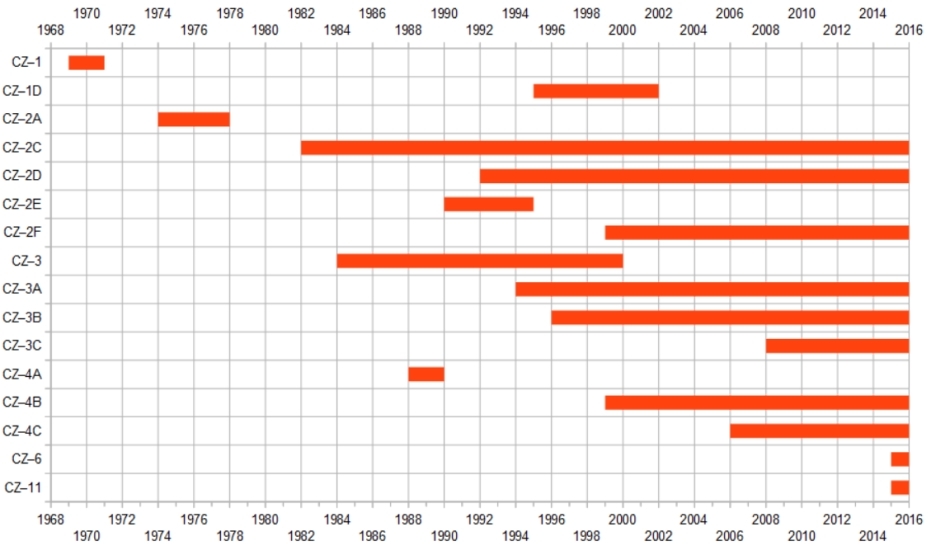
And this diagram shows the years of service of each type of missile.
Relatives on engines
Why can these three missiles belong to the same family? The fact is that they use the same engines. Since the 2000s, China has been developing closed-loop liquid-propellant rocket technology. As a result, two oxygen-kerosene engines were created: YF-100 and YF-115.
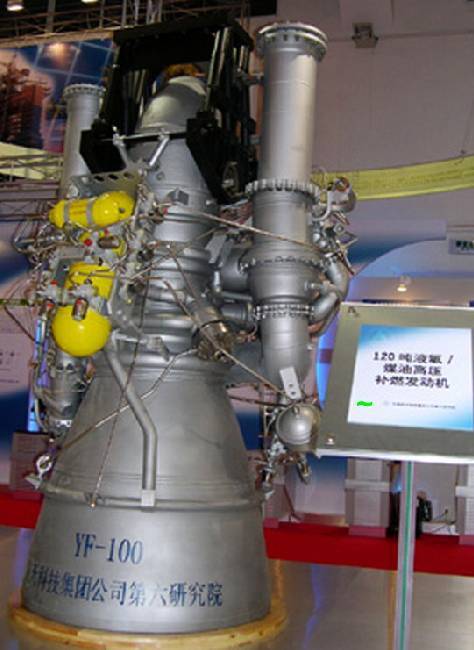
YF-100 is a 136-ton engine in vacuum. They say that Yuzhnoye Design Bureau (Ukraine) in the early 90s sold documentation to the Zenit RD-120 second-stage engine to China, and the Chinese began making closed-loop rocket engines on its basis. Even if this was really the case, the YF-100 is not a direct copy, its thrust is noticeably greater than 85 tons of the RD-120, and the specific impulse is lower.
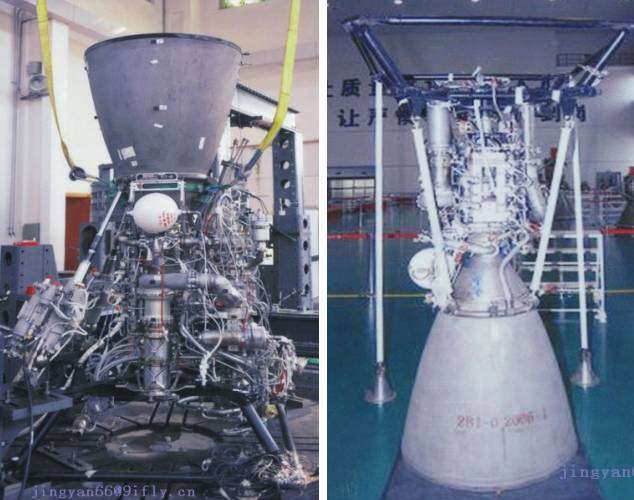
Yf-115- an engine with a thrust of 15 tons, with a specific impulse of 341 seconds, higher than the YF-100 (335 seconds) and lower than the RD-120 (350 seconds).
The use of a closed cycle, in which the exhaust from the gas generator is fed into the combustion chamber, made it possible to obtain high values of specific impulse, which put these engines at a good world level. For comparison, the highest specific impulse of oxygen-kerosene engines is RD-0124 (359 seconds), and the specific impulse of Merlin Vacuum on the SpaceX website is set to 348 seconds.
The Great Campaign 6
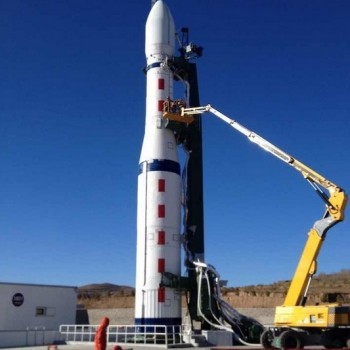
If you put one YF-100 on the first stage, one YF-115 on the second stage and add the third stage to bring the payload to the sun-synchronous orbit, then we get the CZ-6 launch vehicle. Small, with a launch mass of only 103 tons and a maximum diameter of 3.35 m, Velikiy Pod-6 was designed for easy transportation:
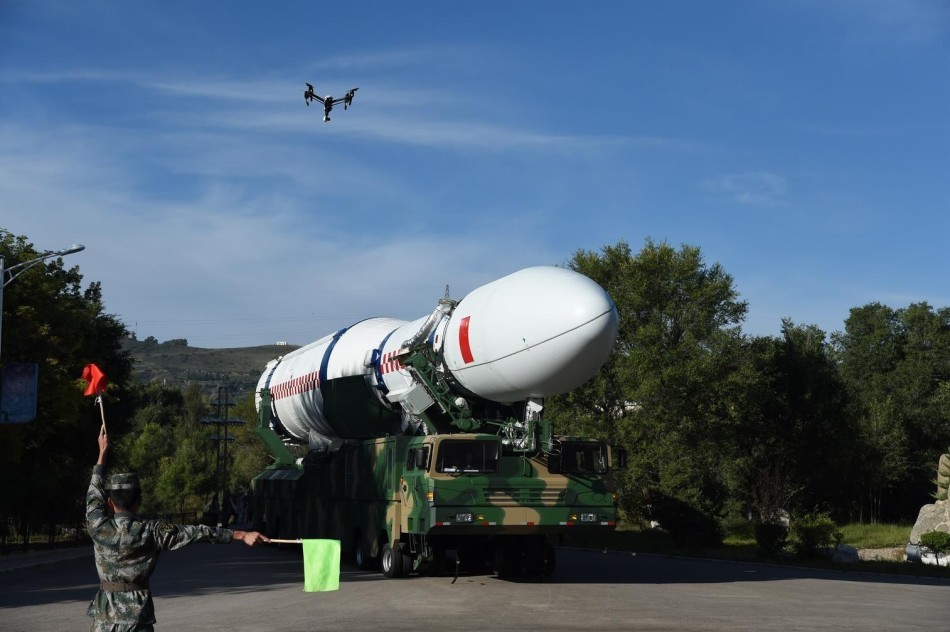
And easy maintenance:
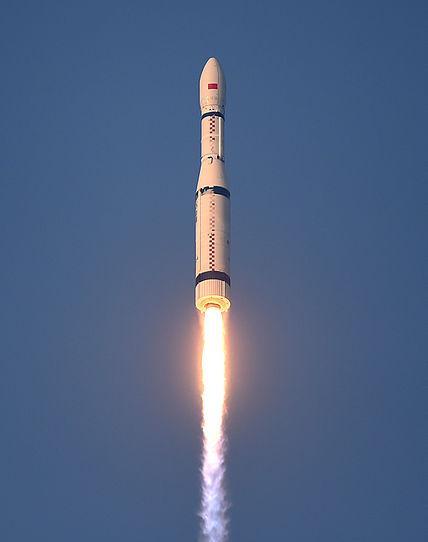
On September 15, the CZ-6 successfully launched 20 small satellites into a sun-synchronous orbit:
The Great Campaign 7
If we take 2 YF-100s to the central block (second stage), add four side blocks (first stage) with one YF-100 on each, and put four YF-115s on the third stage, we get “Great Campaign 7”. The launch mass of 594 tons will allow to raise 13.5 tons into a low orbit. The maximum diameter of the block of 3.35 m makes it easy to transport the rocket by road from the port:

Then assemble it in the assembly and testing complex and take it to the start:
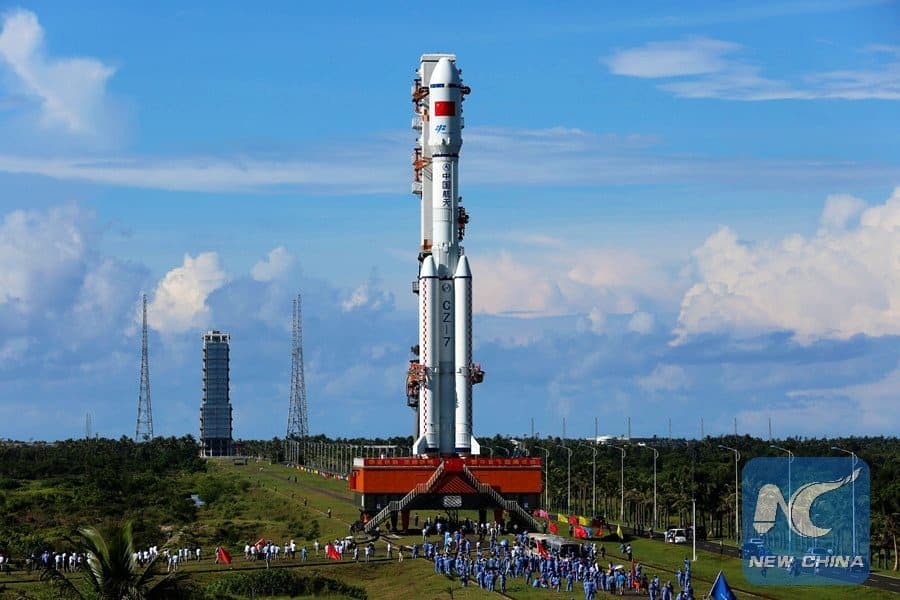
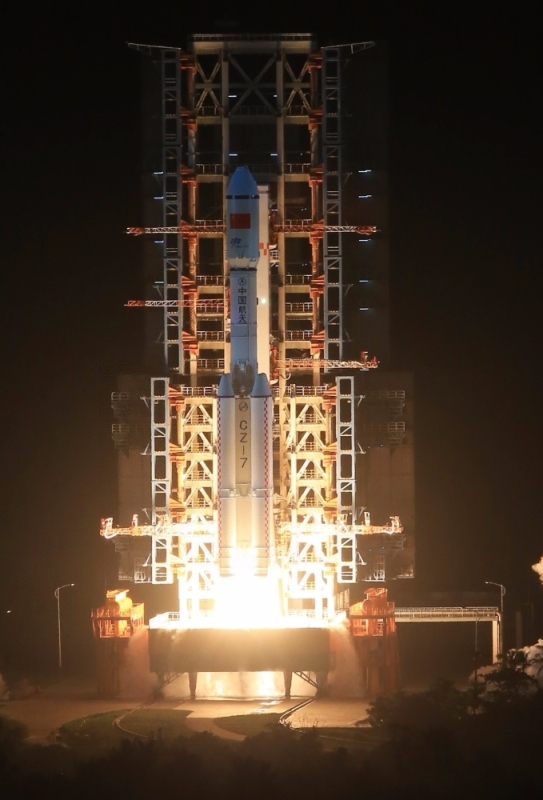
Photo of the Saturday launch:
Video:
It is very curious that the rocket is essentially closer to a two-stage one. From the video it follows that the second stage is reset only 14 seconds after the separation of the four blocks of the first stage, it is very unusual and very inefficient. Maybe the YF-100 can’t work for more than three minutes?
The Great Campaign 5
And finally, if we take the first stage of four blocks with two YF-100s on each, and put oxygen-hydrogen engines (YF-75 and YF-77) on the second and third stages, we get the Great Campaign-5 rocket »With a loading capacity of 25 tons in a low orbit. About her it is known that the second and third stage will have a diameter of 5.2 m, and the launch mass of the rocket is estimated at 867 tons. Already have a photo of the export of the rocket model to the start:

Unknown ship
Twenty hours after launch, the main payload landed, and it turned out that this is a test apparatus from which they will develop either a cargo or a manned ship.
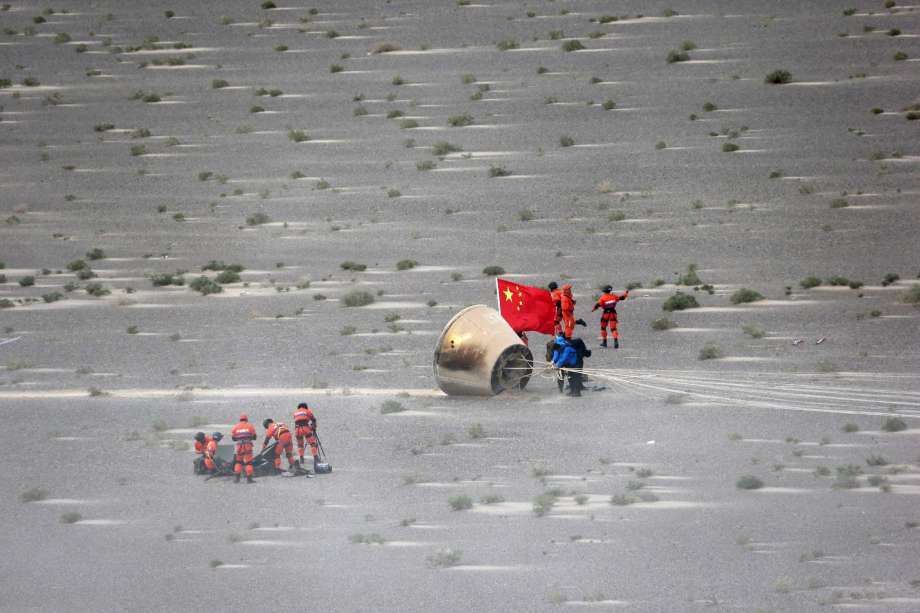
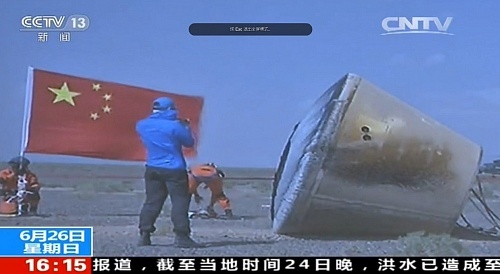
Because of Chinese secrecy, it is completely incomprehensible yet how it is called and how it will be further tested. Judging by the size, this is most likely a large-scale model, smaller than the original. Also, judging by the photos and videos, most likely in this flight the model did not have soft landing engines (or another system to mitigate the impact on the ground), which should be on a full-size ship.
Conclusion
Separately, it is worth mentioning the phrase that slipped in one of the interviews that in the five-year period of 2016-2021 missiles of this family will be launched one and a half hundred, which gives an annual number of 30 launches. In this case, China will compete for first place in the number of launches per year (in this parameter, Russia has been the leader in recent years, but the United States is starting to breathe in the back of the head with launches of "new private traders"). A separate question is where and what kind of payload will China find on these launches?