Scientists were able to control the speed of a beetle by implanting electrodes into its muscles.
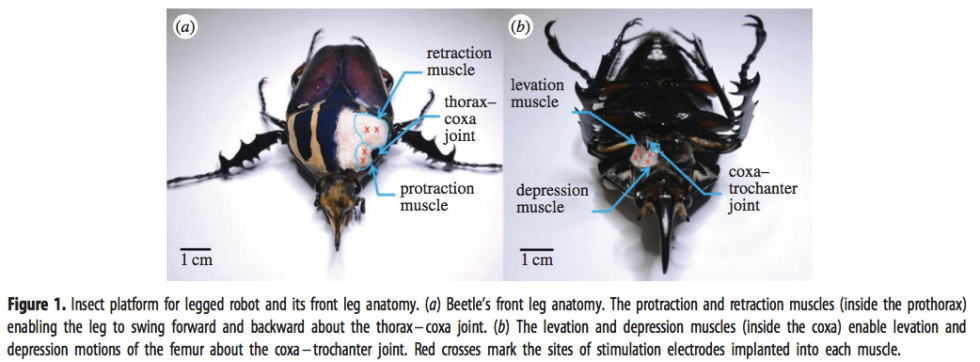
Engineers from Nanyang Technological University demonstrated in their work the creation of a biobot from a bronze beetle. Implants and microcircuits allow not only to control the movement of an insect, but also for the first time are able to change the speed of its movement.
Speed control is carried out by direct connection of the electrodes to the insect's neuromuscular synapses. Unlike previous experiments on the construction of biobots based on cockroaches, where electrical impulses asked only the direction of movement, in this case they affect the degree of contraction of the corresponding muscles.
Scientists report that from a technical point of view, it is much easier to make a cyborg on a ready-made, living “platform” of a beetle than to try to emulate all of its movements using a complex device (although such research is, of course, also being conducted ). Energy consumption is minimized, there is no need for a complex sensor system, etc. Of the drawbacks of using live beetles, scientists note a limited temperature regime for the functioning of cyborgs and a short lifetime.
So far, scientists have connected electrodes only to the front paws of insects, but this has already produced interesting results. Studying various options for the movement of beetles, scientists could, alternating impulses, even cause them to have different gaits that ordinary beetles do not use.
Scientists hope that these studies will help create highly efficient cyborgs based on insects suitable for various tasks - from spying to finding victims of natural disasters. The future plans - the use of all six insect paws for even more complete control over its movements.
In terms of creating more simple insect-based cyborgs, good progress has already been achieved. In 2012, scientists demonstrated a radio-controlled cockroach ; in a couple of years, the company Backyard Brains, using crowdfunding, created a kit for everyone who wanted to create such a biobot at home . And this year, the craftsmen have already written instructions on how to make a controlled cockroachwith the help of the popular single-board Arduino.