
Why bomb Mars?
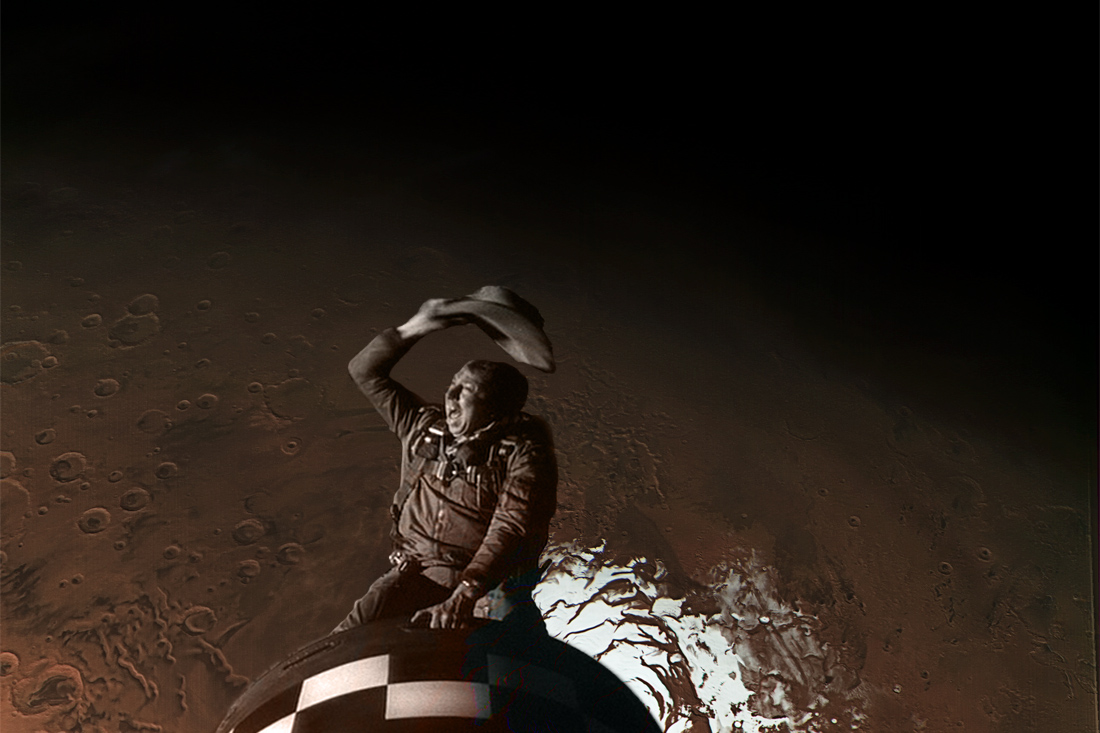
Last Friday, American industrialist Ilon Musk, on the air of an evening comedy show, shared the idea that a nuclear bombardment of the Martian poles could make the Red Dry and Cold Planet more comfortable for humans. Almost all world and Russian media rushed to discuss the idea, but almost no one tried to look at the situation in the context of modern scientific knowledge about Mars. And today we will consider the latest scientific evidence and determine whether or not to bomb.
Actually, the idea of bombing the Martian poles for terraforming - creating an earth-like planet - is a little less than the time since the invention of thermonuclear bombs. An alternative is to drop an asteroid or comet at the poles. This idea is described in Wikipedia in the corresponding article, so it is not clear why the media clutched at it only after the words of Mask. Most likely he got them from the book of the futurist Michio Kaku “Physics of the Future”. Although, we must admit that this concept has been outdated for ten years.
Scientists from the 19th century knew about the existence of Martian ice polar caps. Then their seasonal variability was already observed and imagined how the thawing polar ice filled the Martian irrigation channels. Those. believed that this ice is water. Then, by the middle of the 20th century, even using telescopes, we determined approximately the composition of the atmosphere and the average temperatures of Mars. It turned out that the atmosphere is carbon dioxide, very rarefied and cold. After that I had to come to terms with the fact that at the poles lies frozen carbon dioxide known as “ dry ice”". It got this name because it immediately transforms from a solid state into a gaseous state in Earth pressure, ie, sublimates. Under Martian pressure, water ice has similar properties, but it needs a higher temperature for sublimation. Carbon dioxide evaporates at -77 degrees Celsius, and water at +1 C. Only in the deepest depressions of Mars, where atmospheric pressure is slightly higher, can water maintain a liquid state in the range of several degrees above zero.
The first spacecraft clarified the composition of the Martian atm ospers, surface temperature, and the composition of polar ice, and only confirmed the guesses - the polar cap seemed carbon dioxide. At the same time, humanity succeeded in developing nuclear weapons. Then the idea arose to bomb the Martian poles.

The idea of terraforming emerged simple and logical: nuclear bombs / thrown asteroids / giant mirror reflectors melt polar carbon dioxide ice => the atmosphere increases density => carbon dioxide - the greenhouse means it gets warmer, and the pressure above => the soil thaws and again, thanks to the increased pressure, flow rivers, it rains. After this, a relatively fast period of heating the planet, you will have to send unicellular algae to Mars and wait several thousand years until they create an atmosphere suitable for us to live. PROFIT
But in 2003, the European spacecraft Mars Express flew to Mars, and ruined the whole picture. In 2005, he deployed his MARSIS radar and “enlightened” the northern and southern polar caps. It turned out that permanent ice deposits that do not change during the changing seasons are frozen water.

And dry ice at the poles is a thin crust freezing in winter. This was previously guessed, but did not know the ratio of carbon dioxide and water ice. It is useless to bombard water - it requires too high a temperature for thawing, and has a freezing temperature too high for Mars. Even if we evaporate the polar ice, the water will condense in the upper atmosphere, freeze and fall out in the snow. In addition, water clouds and snow cover effectively reflect sunlight, therefore, by evaporating the polar water you can get snowfalls that will further freeze the atmosphere of Mars, because the rays of the sun will be reflected instead of being absorbed by the ground.

There is water on Marsand not a little. The thickness of water deposits in the north exceeds one and a half kilometers, and in the south reaches three and a half. Seasonal ice freezing in winter is really carbon dioxide, but in winter the thickness of this layer at the north pole does not exceed three meters, and at the south - eight meters. In summer, all seasonal carbon dioxide evaporates at one pole and is deposited at the other. Due to the peculiarities of the elongated orbit of Mars, winter in the southern hemisphere is shorter, but colder, therefore there is more ice there than water and carbon dioxide.

When carbon dioxide freezes at the south pole, the atmospheric pressure on the planet drops by a third of its maximum value. The average pressure on Mars is 7.1 millibars. Earth pressure about 1 bar, the prefix "miles" means 1/1000, i.e. Mars has approximately 1/150 Earth pressure. Even if we can heat both Martian poles at the same time, it is unlikely that the pressure on Mars will approach 10 mbar, or 1% of the earth.
If we need a planet with an atmosphere suitable not even for life, but for a more or less secure existence, the pressure on Mars should be increased at least ten times, then the so-called “ Armstrong limit ” is a pressure of 60 mbar, below which water boils at the temperature of the human body. And it is better to increase the pressure on Mars by 50 times - so the conditions will come closer to what is on Everest - we can’t breathe, but at least we can change the spacesuit to a warm jacket.
Back to the real world. In 2005, the American spacecraft MRO flew to Mars. He also had a radar, although not as long-range as the Mars Express. He could not see the bottom near the southern polar cap, but managed to consider something interesting for fans of the bombing. Buried carbon dioxide deposits were found
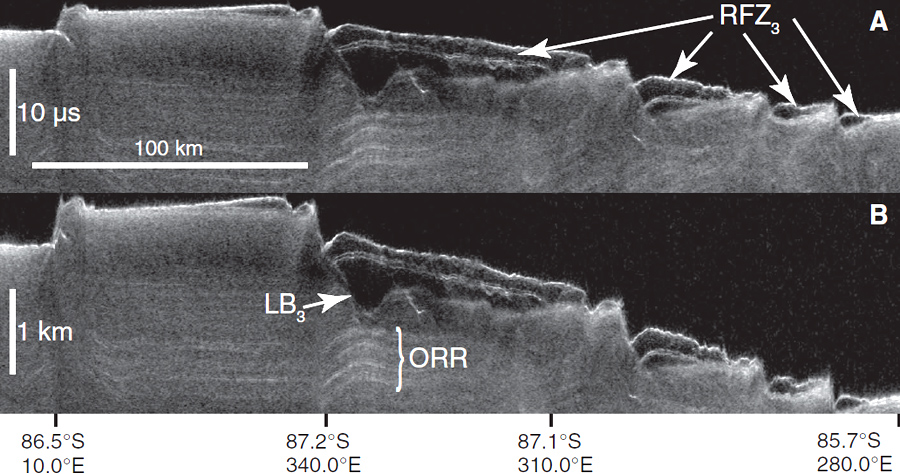
in the upper part of the polar cap . In summer, they do not evaporate due to the fact that they are partially covered by water ice and they are located in the central, coldest part of the polar cap. Although little by little the evaporation of carbon dioxide reserves still occurs, therefore, on the surface they have a characteristic "cheese" relief.

After evaluating the radar data with the depth and satellite imagery with the spread of the “cheese” relief, scientists concluded that 9.5 to 12 thousand cubic kilometers of ice lie on the south pole of Mars. It sounds solid, but if these deposits are evaporated, then the density of the atmosphere will increase by 4-5 mbar or 80%. That is, it will not even double, but we need ten or fifty times more, not 5 mbar, but 60 or 350! Even if we melt all the carbon dioxide ice of Mars for the human body, the actual conditions will still not change and will be close to the absolute vacuum.
Then is there any point in melting the stored carbon dioxide ice? In principle, there is, this will slightly facilitate the process of landing spacecraft that can more effectively slow down the atmosphere. It will turn out to take a few kilograms of payload more. At the bottom of the deepest depressions, where atmospheric pressure will be higher than everywhere, it will be a little easier for people to work in spacesuits and to build long-term buildings. Those. From the point of view of further exploration and settlement of the planet, any additional drop of gas (or rather, a cubic kilometer of " hard gas ") will be useful. But all the same, these are locks, spacesuits, frost and the eternal danger of depressurization.
By the way, if such a bombing had been stipulated in the book "Martian", then the described plot would be at least a little closer to reality. Then it would be possible to justify the powerful storm with which the narrative begins, and the relative ease of movement in the spacesuit .
Now let’s think about another question: can humanity even melt these unfortunate 12.5 thousand cubic kilometers of dry ice in principle? What happens if we drop the most powerful bomb ever created in human history?

This question has been asked subscribers of the Outer Space community . The answers turned out to be slightly different, but the divergence was due to introductory ones: someone considered the cost of evaporating dry ice at ground pressure, and someone in Martian. The answer was rechecked by " Severe techie ." And here's what happened:kuz'kin’s mother "into the very thickness of the ice, not allowing the energy of the explosion to dissipate to the sides, and there we’ll blow it up ...
That explosion will allow us to evaporate 353 million tons of dry ice. Or 0.23 cubic kilometers. I recall that the deposits contain up to 12.5 thousand cubic meters of ice. That is, to vaporize all known deposits of dry ice on Mars (and increase the existing atmosphere density by 1.8 times instead of the desired 10 or 50 times), we need 55 thousand (!) “King-bombs.” There are no so many thermonuclear charges on Earth physically, and if I were, I would be seriously worried about the future of humanity a.
Moreover, one Kuz'kina mother weighed 26.5 tons. Now there is no rocket that could deliver so much to Mars at a time. Perhaps a future American SLS could. But to build 55 thousand superheavy missiles will not be mastered by any economy in the world. Even the world will not master.
Therefore, all discussions about how our scientists
However, answering the question of whether or not to bomb, I would answer in the affirmative. Yes, I would drop a couple of nuclear, or better thermonuclear bombs on Mars. One, more powerful, would have thrown to the south pole - for the sake of experiment. See how much gas is actually released, what processes will occur in the atmosphere, how long they will be observed. Conduct the first stage of applied terraforming - a full-scale experiment.
Another couple, or better four charges, drop to the equator, equidistant from each other. Of course, at first, fill the surface of Mars with seismic sensors, and climate stations. This will allow us to carry out seismic sounding of the bowels of the planet, thanks to which we will learn much more about its deep structure than is now known. In principle, you can do without bombs, just place the sensors and wait for a larger asteroid to fall, but the wait can be delayed, and all the explosions will be planned and in the right place.
Mankind is already technically ready to implement such an experiment. Russia alone can realize it on its own. Roscosmos even had a joint project with the Finnish Meteorological Institute - MetNet"(Mars-No.) Not the bombing, but the network of climate and seismic stations on Mars. And it’s not even officially closed, although, according to rumors, the money has already run out.

Make 2-3 such metnets, send it to Mars, and you will only have to agree at the UN to lift a moratorium on conducting nuclear tests in space for a short time.This project will be relatively inexpensive even compared to the cost of the Curiosity rover, not to mention the cost of human flight.All technologies are ready or can be prepared in less than 10 years - to bombard a simple task, that's enough for one to missile warhead missile RS-20V "Voivode" - and scientific exhaust will be no less than a dozen expensive missions.
For the Martian ecologists, I will remind you that 2474 nuclear and thermonuclear explosions were carried out on Earth, and nothing, we live somehow, and Martians will survive, if at all.
In the next issue of Applied Terraforming, we’ll talk about where the planet’s atmosphere goes and what the magnetic field matters. If you have something to say about this, wait for the next issue, but for now stock up on proofs.