The history of sound cinema. From Mono to Dolby Atmos
Sound effects have become an integral part of modern films, their realism is constantly being improved, and what we hear in movies now is the result of the painstaking work of many people for 90 years. We will talk about how we came to this and why you should watch “Mission Impossible” in a cinema equipped with Dolby Atmos in this article.
For the first time, a multi-channel recording for playing a movie was used in 1941 for Disney's "Fantasia" cartoon. The sound engineers then made a huge step in the sound reproduction format by switching from mono to three-channel audio (2 fronts and a center), recorded on film by optical means.
Why was this step huge? Sound in the cinema and so appeared relatively recently. The first film with synchronized speech phonogram was the musical film "Jazz Singer", released in 1927, and the first phrase of the protagonist "Wait a minute! You haven’t heard anything yet! ”Has become a symbol of the new era of sound cinema. Now imagine how the audience of that time reacted to a new sound. If earlier we heard the same sound from all the speakers, now we could clearly position the right and left parts of the audio picture.
But the further development of multi-channel sound was suspended for 10 years, the main reason for which was the 2nd World War.
A new impetus to the development of multichannel was the active improvement of tape recording. The first tape recorders were captured, brought from Germany, and the very name “tape recorder” is the household name of the AEG Magnetopfon model.

Further, the development of multi-channel audio continued in the United States. The first multi-track tape recorder was invented by the famous musician Les Paul (the inventor of the electric guitar, without which it is impossible to imagine modern music), he was the first to record on a mono tape recorder.

In cinema, the first surround sound formats were recorded using a tape recorder, instead of an optical track, a magnetic layer was applied to the film, and the projectors were equipped with tape heads for reproducing sound tracks. In the future, due to the growing popularity of cinema and experiments in film formats, the industry switched to a wide format - widescreen Cinemascope on 35mm film with anamorphic (during shooting and playback) and 70mm film instead of 35mm. Large screens required appropriate sound design. At that time, two main audio formats were used in cinemas: for Cinemascope (4 channels - left front, right front, center and surround, located as a solid array at the back and sides of the audience) from 20th Century Fox and Todd AO for 70 mm (already had 6 channels
An interesting fact: the Central channel became necessary due to the large size of the cinema, when dialogs for the audience on the right and left sounded off-center. The central speaker provided a clear positioning of all reproduced speech. Subsequently, the central channel retained the working name “dialog”.

The soundtrack of that time was very different from modern ones, although in fact the number of channels did not change. The thing is that at that stage the development of technology was very complicated, and high-quality sound effects in those days were not so in demand. The formats themselves were also not so widespread, since the equipment for playing them was very expensive and only the most successful movie theaters could afford it.
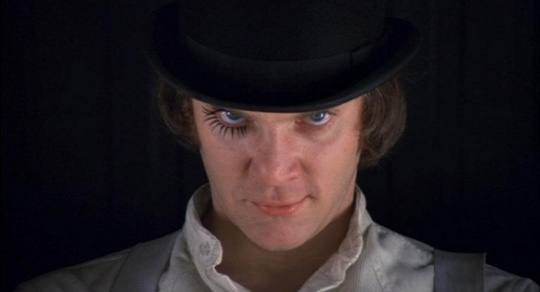
In the mid-70s, Dolby came onto the scene, having originally earned a name for itself in Dolby A and Dolby B noise reduction systems for professional and amateur sound recordings. But success in this area, the creator of the company Ray Dolby was not enough and he turned his eyes to the cinema. In 1971, the first film appeared, when recording the soundtrack to which the Dolby A noise reduction system was used - it became the "sensational" then A Clockwork Orange. This technology has significantly expanded the dynamic range of reproduced frequencies in the audio accompaniment of the film.
In 1974, Dolby introduced the world to a new recording format Dolby Stereo, which is still used in sound recording (it’s not alone, of course).

The concept of Stereo of those days is significantly different from how it is understood now, today it is a designation of two-channel audio. For multichannel, the term surround sound is used, which appeared, by the way, precisely due to the introduction of multichannel sound technologies in home theater systems. In those days, the term Stereo denoted surround sound. This format again returned to the film an optical soundtrack for four existing channels. The sound of the front channels during this decoding remained unchanged, surround audio effects were obtained by subtracting the left front from the right (by phase reversal) and filtering the signal in the range below 100 Hz and above 7 kHz.
A small snag appeared with the central channel, because the classical sound of the central channel is a mixture of the sound of the right and left front with an increase in volume by 3 dB. That is, the sound of the voice was heard in the frontal pairs, but quieter by 3D. Dolby used a smart system for improving channel separation, depending on the situation: if the dialogue sounded in silence, the sounds of the front channels were muffled additionally, and if the conversation was with the music (using the previous method, the music was hard to hear, and it also increased volume in the pauses between the speech) for the synergy of the two sound tracks, the sound was mixed in the antiphase of the right channel to the left and vice versa. Naturally clear positioning of sound effects in recordings with Dolby technologies did not appear immediately, it was quite difficult to clearly position and separate the dominant soundtrack and special effects. But the company was constantly improving film processors and technologies, and the sound quality in the new format reached unprecedented heights.
The film “Star Wars”, 1976, brought great popularity to this format. Having shown in this film the highest quality of audio and video effects, at that time, the film gained immense popularity and promoted the use of Dolby Stereo in cinema. George Lucas, in principle, made a huge contribution to the world of recording, but more on that later.
At that time, home television was already actively developing, cinemas began to be visited less frequently, but recording rental versions of the film was not cheap and was of poor quality. Dolby Stereo significantly reduced the cost of home cinema, making it available to the general public.

To support high-quality sound in cinema, Dolby introduces rigorous certification of movie theaters, and the company logo becomes a decoy for the viewer, since such a sound could not be realized at home.

In the future, digging Dolby got to wide screens, bringing to the world the first 5.1 systems that are used today.
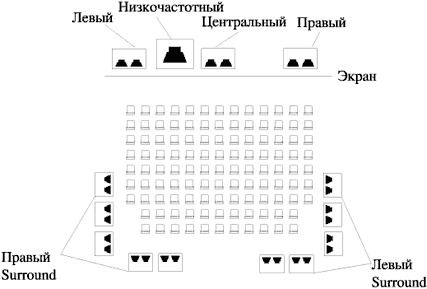
The presence of separate speakers for reproducing the bass signal was a new breakthrough in special effects, producing thundering realistic explosions and effects (the first 5.1-format film was Francis Ford Coppola's Apocalypse Today).

But still, the popularity of large-format films began to decline, so a large number of films with this type of soundtrack were not created.
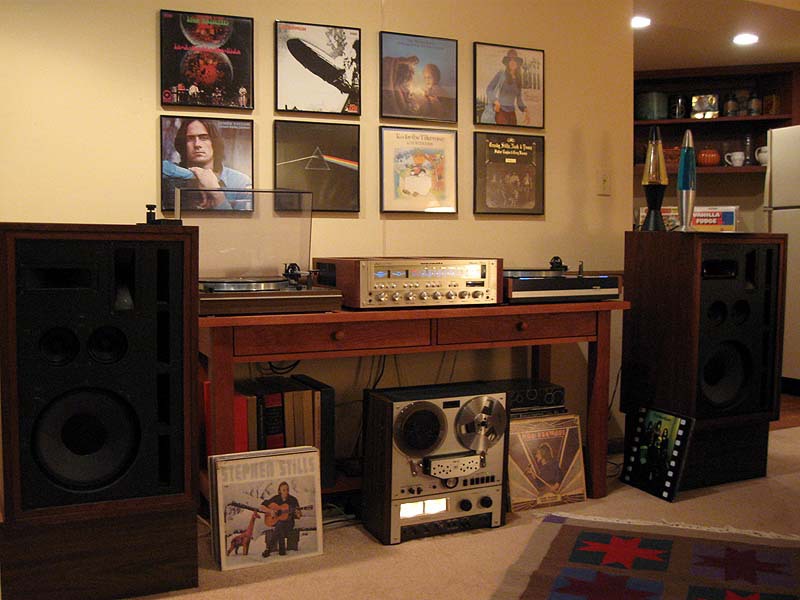
A new round of film sound development began in the 80s, it was at this time that home video was actively developing and a laser video disc appeared. Also widespread are home Hi-Fi stereo systems. In 1982, Dolby released the Dolby Surround decoder capable of decoding 3 channels (left + right front and surround). For most listeners, this was enough, but due to the growing popularity of large diagonal TVs, from 27 ", a Dolby Surround Pro Logic decoder was introduced in 1987, which can extract 4-channel sound from a two-channel phonogram. So the first home Hi-Fi-themed cinemas that quickly captured the market and made luxury goods a commonplace.
In the 90s, digital recording began to develop actively, the CDS format with a digital audio track instead of an analogue was released, metadata was marked using pixels on film strip. But due to the level of technology, the problem of sound loss associated with errors in the audio track often appeared.

In 1992, the second year at the premiere of the film "Batman Returns" was introduced a new digital recording format Dolby Digital, widely used in our time. This format used duplicated digital and analog audio tracks (as backup) and was able to get rid of problems with audio interruption. This format was developed as universal for various media and has become one of the mandatory DVD burners.

In 1999, Dolby, together with THX and Skywalker Sound Studios, developed a new Dolby Surround EX format specifically for the first episode of the Star Wars prequel - Phantom Menace. This format allowed recording sound in 6.1 format, which gave the sound engineer an additional palette of sound picture.

About THX is worth telling separately. THX is not a sound recording format, it is a common standard for sound reproducing devices so that when playing back the sound is the same as the sound engineer heard.
The story of its appearance is also interesting. When George Lucas made the movie "The Return of the Jedi" from the first Star Wars trilogy, a movie screening was held at the cinema. The result did not satisfy the director, since all the ideas regarding sound effects equipment of that time could not reproduce physically. Then the company THX was created named after the first film of Lucas "THX 1138". The developers were tasked with developing strict rules for movie theaters so that the soundtrack during playback does not differ from the one that the sound engineer hears, while the quality should be maximum. The company also created a high-quality crossover, analogues of which at that time were not on the market. THX certification was required to go through both recording studios and movie theaters.

In 1993, another popular format, DTS (Digital Theater Systems), was created for the film Jurassic Park. This format plays the audio track synchronously with the video, but from a separate laser carrier. In home formats, DTS uses a fundamentally different coding system, this system allows you to play sound, taking into account the characteristics of human hearing, as well as record up to 8 independent tracks. Despite the fact that the principles of coding in systems are different, the name is used the same thing, most likely for marketing purposes.

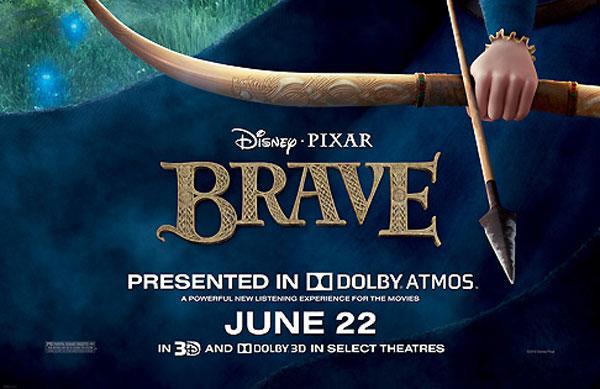
And finally, I want to talk about a new sound format for home theaters - Dolby Atmos, which was first presented in 2012. If we can consider the distribution of ordinary sound in classical multi-channel audio systems as two-dimensional, horizontal (sound on the right, left, front, rear), then Atmos allows for fully three-dimensional sound using the vertical plane. This technology makes it possible for sound effects to exist independently of each other, since they are not reduced by the sound engineer once and for all, but exist separately and are processed by a special processor. Dolby Atmos cinemas are complemented by ceiling speakers and additional subwoofers. The first film in this audio format was the 3D cartoon "Brave."
But this is not all, this format is also embedded in home theater systems. Hi-Fi manufacturers such as Onkyo, Yamaha, Marantz, Denon, Pioneer have already released receivers that support this decoder. To make Atmos cinema at home, it is not necessary to build ceiling speakers, manufacturers of speakers and receivers are already releasing an additional set of speakers, which is installed on the front pair and works by reflecting sound from the ceiling.

I myself was lucky enough to test the home system on Dolby Atmos, the presentation of which was held in a conference room, not specially prepared for the demonstration. They showed a video about tropical forests. I managed to hear very interesting and realistic effects: firstly, the effect of the rain drops falling from above, that is, the sound of the falling spread from top to bottom. But what I liked most was the effect of a flying bird. On the screen, a hummingbird flew overhead and then in an arc went back along the left side of the scene. I clearly heard the position of the bird in space, that is, not only to the right or left, but also above the head or at face level. The sound is very realistic. If you manage to combine this sound technology with a helmet like Oculus, you can get the full effect of participating in a movie as a result.
Muscovites can appreciate Atmos technology today by watching the movie Mission Impossible in one of the 3 Formula Kino cinemas or in one of the 6 Luxor cinemas .
And if you want to build a home system with Dolby Atmos, then we recommend that you look at this kit:
- Onkyo TX-NR636 receiver
- Speakers for Dolby Atmos Onkyo SKH-410
- And any Hi-Fi 5.0 speakers
How to assemble and configure this equipment To create a home theater, I’ll cover the next article.
History of multi-channel sound
For the first time, a multi-channel recording for playing a movie was used in 1941 for Disney's "Fantasia" cartoon. The sound engineers then made a huge step in the sound reproduction format by switching from mono to three-channel audio (2 fronts and a center), recorded on film by optical means.
Why was this step huge? Sound in the cinema and so appeared relatively recently. The first film with synchronized speech phonogram was the musical film "Jazz Singer", released in 1927, and the first phrase of the protagonist "Wait a minute! You haven’t heard anything yet! ”Has become a symbol of the new era of sound cinema. Now imagine how the audience of that time reacted to a new sound. If earlier we heard the same sound from all the speakers, now we could clearly position the right and left parts of the audio picture.
But the further development of multi-channel sound was suspended for 10 years, the main reason for which was the 2nd World War.
A new impetus to the development of multichannel was the active improvement of tape recording. The first tape recorders were captured, brought from Germany, and the very name “tape recorder” is the household name of the AEG Magnetopfon model.
Further, the development of multi-channel audio continued in the United States. The first multi-track tape recorder was invented by the famous musician Les Paul (the inventor of the electric guitar, without which it is impossible to imagine modern music), he was the first to record on a mono tape recorder.
Sound in theaters
In cinema, the first surround sound formats were recorded using a tape recorder, instead of an optical track, a magnetic layer was applied to the film, and the projectors were equipped with tape heads for reproducing sound tracks. In the future, due to the growing popularity of cinema and experiments in film formats, the industry switched to a wide format - widescreen Cinemascope on 35mm film with anamorphic (during shooting and playback) and 70mm film instead of 35mm. Large screens required appropriate sound design. At that time, two main audio formats were used in cinemas: for Cinemascope (4 channels - left front, right front, center and surround, located as a solid array at the back and sides of the audience) from 20th Century Fox and Todd AO for 70 mm (already had 6 channels
An interesting fact: the Central channel became necessary due to the large size of the cinema, when dialogs for the audience on the right and left sounded off-center. The central speaker provided a clear positioning of all reproduced speech. Subsequently, the central channel retained the working name “dialog”.
The soundtrack of that time was very different from modern ones, although in fact the number of channels did not change. The thing is that at that stage the development of technology was very complicated, and high-quality sound effects in those days were not so in demand. The formats themselves were also not so widespread, since the equipment for playing them was very expensive and only the most successful movie theaters could afford it.
Dolby
In the mid-70s, Dolby came onto the scene, having originally earned a name for itself in Dolby A and Dolby B noise reduction systems for professional and amateur sound recordings. But success in this area, the creator of the company Ray Dolby was not enough and he turned his eyes to the cinema. In 1971, the first film appeared, when recording the soundtrack to which the Dolby A noise reduction system was used - it became the "sensational" then A Clockwork Orange. This technology has significantly expanded the dynamic range of reproduced frequencies in the audio accompaniment of the film.
In 1974, Dolby introduced the world to a new recording format Dolby Stereo, which is still used in sound recording (it’s not alone, of course).
The concept of Stereo of those days is significantly different from how it is understood now, today it is a designation of two-channel audio. For multichannel, the term surround sound is used, which appeared, by the way, precisely due to the introduction of multichannel sound technologies in home theater systems. In those days, the term Stereo denoted surround sound. This format again returned to the film an optical soundtrack for four existing channels. The sound of the front channels during this decoding remained unchanged, surround audio effects were obtained by subtracting the left front from the right (by phase reversal) and filtering the signal in the range below 100 Hz and above 7 kHz.
A small snag appeared with the central channel, because the classical sound of the central channel is a mixture of the sound of the right and left front with an increase in volume by 3 dB. That is, the sound of the voice was heard in the frontal pairs, but quieter by 3D. Dolby used a smart system for improving channel separation, depending on the situation: if the dialogue sounded in silence, the sounds of the front channels were muffled additionally, and if the conversation was with the music (using the previous method, the music was hard to hear, and it also increased volume in the pauses between the speech) for the synergy of the two sound tracks, the sound was mixed in the antiphase of the right channel to the left and vice versa. Naturally clear positioning of sound effects in recordings with Dolby technologies did not appear immediately, it was quite difficult to clearly position and separate the dominant soundtrack and special effects. But the company was constantly improving film processors and technologies, and the sound quality in the new format reached unprecedented heights.
The film “Star Wars”, 1976, brought great popularity to this format. Having shown in this film the highest quality of audio and video effects, at that time, the film gained immense popularity and promoted the use of Dolby Stereo in cinema. George Lucas, in principle, made a huge contribution to the world of recording, but more on that later.
At that time, home television was already actively developing, cinemas began to be visited less frequently, but recording rental versions of the film was not cheap and was of poor quality. Dolby Stereo significantly reduced the cost of home cinema, making it available to the general public.
To support high-quality sound in cinema, Dolby introduces rigorous certification of movie theaters, and the company logo becomes a decoy for the viewer, since such a sound could not be realized at home.
In the future, digging Dolby got to wide screens, bringing to the world the first 5.1 systems that are used today.
The presence of separate speakers for reproducing the bass signal was a new breakthrough in special effects, producing thundering realistic explosions and effects (the first 5.1-format film was Francis Ford Coppola's Apocalypse Today).
But still, the popularity of large-format films began to decline, so a large number of films with this type of soundtrack were not created.
Home theaters
A new round of film sound development began in the 80s, it was at this time that home video was actively developing and a laser video disc appeared. Also widespread are home Hi-Fi stereo systems. In 1982, Dolby released the Dolby Surround decoder capable of decoding 3 channels (left + right front and surround). For most listeners, this was enough, but due to the growing popularity of large diagonal TVs, from 27 ", a Dolby Surround Pro Logic decoder was introduced in 1987, which can extract 4-channel sound from a two-channel phonogram. So the first home Hi-Fi-themed cinemas that quickly captured the market and made luxury goods a commonplace.
In the 90s, digital recording began to develop actively, the CDS format with a digital audio track instead of an analogue was released, metadata was marked using pixels on film strip. But due to the level of technology, the problem of sound loss associated with errors in the audio track often appeared.
Dolby digital
In 1992, the second year at the premiere of the film "Batman Returns" was introduced a new digital recording format Dolby Digital, widely used in our time. This format used duplicated digital and analog audio tracks (as backup) and was able to get rid of problems with audio interruption. This format was developed as universal for various media and has become one of the mandatory DVD burners.
Dolby Surround EX
In 1999, Dolby, together with THX and Skywalker Sound Studios, developed a new Dolby Surround EX format specifically for the first episode of the Star Wars prequel - Phantom Menace. This format allowed recording sound in 6.1 format, which gave the sound engineer an additional palette of sound picture.
Thx
About THX is worth telling separately. THX is not a sound recording format, it is a common standard for sound reproducing devices so that when playing back the sound is the same as the sound engineer heard.
The story of its appearance is also interesting. When George Lucas made the movie "The Return of the Jedi" from the first Star Wars trilogy, a movie screening was held at the cinema. The result did not satisfy the director, since all the ideas regarding sound effects equipment of that time could not reproduce physically. Then the company THX was created named after the first film of Lucas "THX 1138". The developers were tasked with developing strict rules for movie theaters so that the soundtrack during playback does not differ from the one that the sound engineer hears, while the quality should be maximum. The company also created a high-quality crossover, analogues of which at that time were not on the market. THX certification was required to go through both recording studios and movie theaters.
DTS
In 1993, another popular format, DTS (Digital Theater Systems), was created for the film Jurassic Park. This format plays the audio track synchronously with the video, but from a separate laser carrier. In home formats, DTS uses a fundamentally different coding system, this system allows you to play sound, taking into account the characteristics of human hearing, as well as record up to 8 independent tracks. Despite the fact that the principles of coding in systems are different, the name is used the same thing, most likely for marketing purposes.
Dolby atmos
And finally, I want to talk about a new sound format for home theaters - Dolby Atmos, which was first presented in 2012. If we can consider the distribution of ordinary sound in classical multi-channel audio systems as two-dimensional, horizontal (sound on the right, left, front, rear), then Atmos allows for fully three-dimensional sound using the vertical plane. This technology makes it possible for sound effects to exist independently of each other, since they are not reduced by the sound engineer once and for all, but exist separately and are processed by a special processor. Dolby Atmos cinemas are complemented by ceiling speakers and additional subwoofers. The first film in this audio format was the 3D cartoon "Brave."
But this is not all, this format is also embedded in home theater systems. Hi-Fi manufacturers such as Onkyo, Yamaha, Marantz, Denon, Pioneer have already released receivers that support this decoder. To make Atmos cinema at home, it is not necessary to build ceiling speakers, manufacturers of speakers and receivers are already releasing an additional set of speakers, which is installed on the front pair and works by reflecting sound from the ceiling.
I myself was lucky enough to test the home system on Dolby Atmos, the presentation of which was held in a conference room, not specially prepared for the demonstration. They showed a video about tropical forests. I managed to hear very interesting and realistic effects: firstly, the effect of the rain drops falling from above, that is, the sound of the falling spread from top to bottom. But what I liked most was the effect of a flying bird. On the screen, a hummingbird flew overhead and then in an arc went back along the left side of the scene. I clearly heard the position of the bird in space, that is, not only to the right or left, but also above the head or at face level. The sound is very realistic. If you manage to combine this sound technology with a helmet like Oculus, you can get the full effect of participating in a movie as a result.
Muscovites can appreciate Atmos technology today by watching the movie Mission Impossible in one of the 3 Formula Kino cinemas or in one of the 6 Luxor cinemas .
And if you want to build a home system with Dolby Atmos, then we recommend that you look at this kit:
- Onkyo TX-NR636 receiver
- Speakers for Dolby Atmos Onkyo SKH-410
- And any Hi-Fi 5.0 speakers
How to assemble and configure this equipment To create a home theater, I’ll cover the next article.