July 3, 2015 at 14:53
[Testing] 960 gigabyte Kingston KC310 SSD
Hello Giktayms! I continue a good tradition, when, following the announcement and press release, a full review of the device appears on our blog. This time we will focus on the Kingston KC310 solid-state drive with a capacity of 960 gigabytes. Such volumes already allow you to fully compete with classic hard drives in terms of data storage and will still give an advantage in speed. What else is new? Under the cut - performance testing and an overview of features.
Traditionally a few words about packaging. The disk comes in a regular cardboard blister with a plastic insert. No frills for which the user would have to pay.
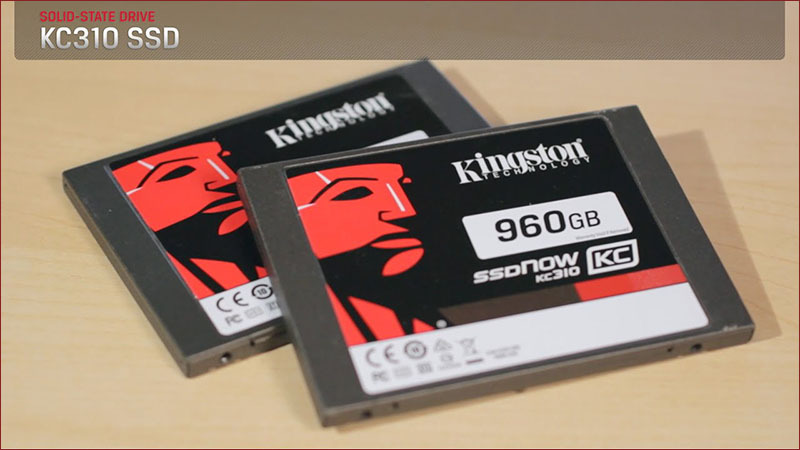
There is a second option for supplying the same disk: it will include a metal adapter for mounting in a 3.5-inch bay, a SATA cable, an external container for connecting a USB disk, a software disk and a set of fasteners.


Kingston KC310 960 Gb is the only representative of its line. The disk is built on an eight-channel controller Phison PS3110-S10.

The memory is equipped with 8 Toshiba MLC 19nm chips with the marking TH58TFT0DFKBA8J, with a capacity of 128 gigabytes each. Thus, the total disk capacity is equal to 1024 gigabytes, of which not the entire volume is available to the user, but only 894 gigabytes (960 194 670 592 bytes), the rest is reserved for the backup area.

The cache memory with a capacity of 1 gigabyte is organized by two chips from Nanya - NT5CC256M16CP-DI. You won’t surprise anyone with a cache of this size; in capacious and productive solid-state drives, this is already a standard.

The controller supports data protection technology in case of power failure, which is implemented on the software part, of course, the TRIM command is supported.
The official specifications of the drive suggest a speed of sequential read / write at 550/520 MB / s, while working with random blocks of 4K size - up to 96000/88000 IOPS.
The DWPD parameter is set at 0.66, that is, it is recommended to write no more than 600 gigabytes of data per day to the disk. The total amount of recorded information for Kingston KC310 is 681 terabytes.
MTBF is 1 million hours, or 41,666 days, or 114 years, that is, you can work with this drive for a very long time.
The KC310 series drives (currently only one model) have power-off protection based on firmware. To maintain data integrity in the event of an unexpected power outage, the drive transfers and stores data from the cache to NAND.
Read more about the protection mechanism: Phison

controllers have built-in circuits to maintain data integrity in the event of an unexpected loss of solid state drive power. SmartFlush technology constantly moves data from the cache (non-volatile memory) to NAND (non-volatile memory) to prevent the loss of important information.
The cache clear command (E7h) is also supported by Phison controllers. It is used to clear the write cache, and until the data from the cache is written to memory or an error occurs, a message about the execution of the command will not be received and a new write to the cache will begin.
Let's move on to the practical part. Running a little ahead into the future, I’ll say that there are several more tests of large solid-state drives next, so in the first post of the series I will give the results that I will make reference and will start from them in the future, as from the basic ones.
The testing methodology is quite simple:
Before the tests, the amount of information that is twice as large as the disk capacity is written to the disk; after each test, a pause of half an hour is made to correctly execute the TRIM command.
A synthetic test to assess the correctness of the manufacturer's stated speeds. Actually, most of the data indicated on the boxes of SSD drives of different manufacturers was obtained using ATTO Disk Benchmark.

This test allows you to evaluate the operation of the drive in four modes: linear read / write, read / write blocks in 4K, linear read / write at a queue depth of 32 teams, read / write blocks in 4K at a queue depth of 32 teams.

The most advanced of the tests. I will conduct several testing options:
The first graph: The

second graph:

The third graph

The fourth graph

Based on these graphs, it can be argued that the greater the queue of requests to the Kingston KC310 controller, the more confident the drive feels. Performance problems are observed only with single requests in small blocks.
In the PC Mark 8 test suite, it is possible to conduct performance restoration tests under continuous load.
The scheme of the package is as follows:
First, the disk (unformatted, without partitions) is filled twice in blocks of 128 KB.
Then the degradation phase follows:
The disk is filled with random blocks of different sizes from 4 KB to 1 MB. Because the blocks are not aligned, disk performance drops sharply.
The first tests begin 10 minutes after filling the disk with random blocks.
After passing the test, the filling process is repeated. Before each new test, a pause is made, which is five minutes longer than the previous one, that is, 15 minutes, 20 minutes and so on. This is repeated eight times.
After this, tests of the stable phase begin. The script is repeated five times, a pause of 5 minutes is made between runs without additional load.
This is followed by the performance recovery phase, when a five-minute pause is made between the scenarios to practice disk wipe.
Several applications are being tested in the package; I chose Adobe Photoshop (a heavy script).
I give four graphs: average access time, read speed, write speed, total disk speed.

As you can see, the disk access time increases as the load increases.


The read speed is almost not subject to change with increasing load, but the recording and, as a result, the overall performance of the disk fall against the background of “bullying” on the disk, but then the graph returns to the state of an almost new disk.
It’s nice to know that capacious solid-state drives do not just appear, but are already firmly occupying places in desktop systems and servers. Performance Kingston KC310 is sufficient to solve most problems, thanks to the Phison controllers, which have established themselves as an inexpensive and productive solution. The KC310 also has data protection mechanisms in the event of a power failure. Only the price plays against - at the moment, Kingston KC310 costs more than 42,000 rubles in Russian retail . In the following articles of the series, I will consider Kingston Savage and Kingston V310 drives of the same volume.
Thanks for watching, stay with Kingston at Geektimes.ru!
There is a second option for supplying the same disk: it will include a metal adapter for mounting in a 3.5-inch bay, a SATA cable, an external container for connecting a USB disk, a software disk and a set of fasteners.
Kingston KC310 960 Gb is the only representative of its line. The disk is built on an eight-channel controller Phison PS3110-S10.
The memory is equipped with 8 Toshiba MLC 19nm chips with the marking TH58TFT0DFKBA8J, with a capacity of 128 gigabytes each. Thus, the total disk capacity is equal to 1024 gigabytes, of which not the entire volume is available to the user, but only 894 gigabytes (960 194 670 592 bytes), the rest is reserved for the backup area.
The cache memory with a capacity of 1 gigabyte is organized by two chips from Nanya - NT5CC256M16CP-DI. You won’t surprise anyone with a cache of this size; in capacious and productive solid-state drives, this is already a standard.
The controller supports data protection technology in case of power failure, which is implemented on the software part, of course, the TRIM command is supported.
The official specifications of the drive suggest a speed of sequential read / write at 550/520 MB / s, while working with random blocks of 4K size - up to 96000/88000 IOPS.
The DWPD parameter is set at 0.66, that is, it is recommended to write no more than 600 gigabytes of data per day to the disk. The total amount of recorded information for Kingston KC310 is 681 terabytes.
MTBF is 1 million hours, or 41,666 days, or 114 years, that is, you can work with this drive for a very long time.
The KC310 series drives (currently only one model) have power-off protection based on firmware. To maintain data integrity in the event of an unexpected power outage, the drive transfers and stores data from the cache to NAND.
Read more about the protection mechanism: Phison
controllers have built-in circuits to maintain data integrity in the event of an unexpected loss of solid state drive power. SmartFlush technology constantly moves data from the cache (non-volatile memory) to NAND (non-volatile memory) to prevent the loss of important information.
The cache clear command (E7h) is also supported by Phison controllers. It is used to clear the write cache, and until the data from the cache is written to memory or an error occurs, a message about the execution of the command will not be received and a new write to the cache will begin.
Let's move on to the practical part. Running a little ahead into the future, I’ll say that there are several more tests of large solid-state drives next, so in the first post of the series I will give the results that I will make reference and will start from them in the future, as from the basic ones.
The testing methodology is quite simple:
Before the tests, the amount of information that is twice as large as the disk capacity is written to the disk; after each test, a pause of half an hour is made to correctly execute the TRIM command.
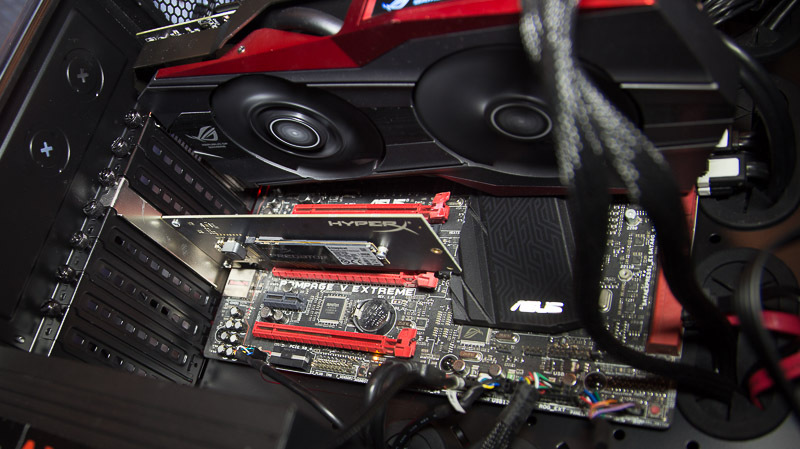
Test stand
- Processor: Intel Core i7-5960X
- Motherboard: ASUS Rampage V Extreme
- RAM: HyperX Fury DDR4-2133 32 Gb (4 * 8 Gb)
- System SSD: HyperX Predator PCI-E SSD 480 Gb
- Video card: ASUS Radeon R9 290X Matrix
- Power Supply: Corsair AX1200i, 1200W
- Operating System: Windows 8.1 Professional (64-bit)
A set of test applications:
- ATTO disk benchmark 2.4.7
- Crystal Disk Mark 3.0.3
- IOMeter 1.1.0
ATTO disk benchmark 2.4.7
A synthetic test to assess the correctness of the manufacturer's stated speeds. Actually, most of the data indicated on the boxes of SSD drives of different manufacturers was obtained using ATTO Disk Benchmark.
Crystal Disk Mark 4.0.3
This test allows you to evaluate the operation of the drive in four modes: linear read / write, read / write blocks in 4K, linear read / write at a queue depth of 32 teams, read / write blocks in 4K at a queue depth of 32 teams.
IOMeter 1.1.0
The most advanced of the tests. I will conduct several testing options:
- linear reading and writing (blocks of 256 kilobytes in size, request depth - 16),
- random reading and writing of blocks of 4 KB with a request queue of 16 (the result will be in MB / s).
- random reading and writing of blocks of 4 KB at the request queue 4 (the result will be in MB / s).
- random reading and writing of blocks of 4 KB at the request queue 1 (the result will be in MB / s).
The first graph: The
second graph:
The third graph
The fourth graph
Based on these graphs, it can be argued that the greater the queue of requests to the Kingston KC310 controller, the more confident the drive feels. Performance problems are observed only with single requests in small blocks.
Performance Recovery Tests
In the PC Mark 8 test suite, it is possible to conduct performance restoration tests under continuous load.
The scheme of the package is as follows:
First, the disk (unformatted, without partitions) is filled twice in blocks of 128 KB.
Then the degradation phase follows:
The disk is filled with random blocks of different sizes from 4 KB to 1 MB. Because the blocks are not aligned, disk performance drops sharply.
The first tests begin 10 minutes after filling the disk with random blocks.
After passing the test, the filling process is repeated. Before each new test, a pause is made, which is five minutes longer than the previous one, that is, 15 minutes, 20 minutes and so on. This is repeated eight times.
After this, tests of the stable phase begin. The script is repeated five times, a pause of 5 minutes is made between runs without additional load.
This is followed by the performance recovery phase, when a five-minute pause is made between the scenarios to practice disk wipe.
Several applications are being tested in the package; I chose Adobe Photoshop (a heavy script).
I give four graphs: average access time, read speed, write speed, total disk speed.
As you can see, the disk access time increases as the load increases.
The read speed is almost not subject to change with increasing load, but the recording and, as a result, the overall performance of the disk fall against the background of “bullying” on the disk, but then the graph returns to the state of an almost new disk.
Final thoughts
It’s nice to know that capacious solid-state drives do not just appear, but are already firmly occupying places in desktop systems and servers. Performance Kingston KC310 is sufficient to solve most problems, thanks to the Phison controllers, which have established themselves as an inexpensive and productive solution. The KC310 also has data protection mechanisms in the event of a power failure. Only the price plays against - at the moment, Kingston KC310 costs more than 42,000 rubles in Russian retail . In the following articles of the series, I will consider Kingston Savage and Kingston V310 drives of the same volume.
Thanks for watching, stay with Kingston at Geektimes.ru!