The saga of LED lamps. Lamps from IKEA
Hello! Today we’ll finally talk about light bulbs under the IKEA brand, the parameters of which I was asked to measure in the comments to previous articles.
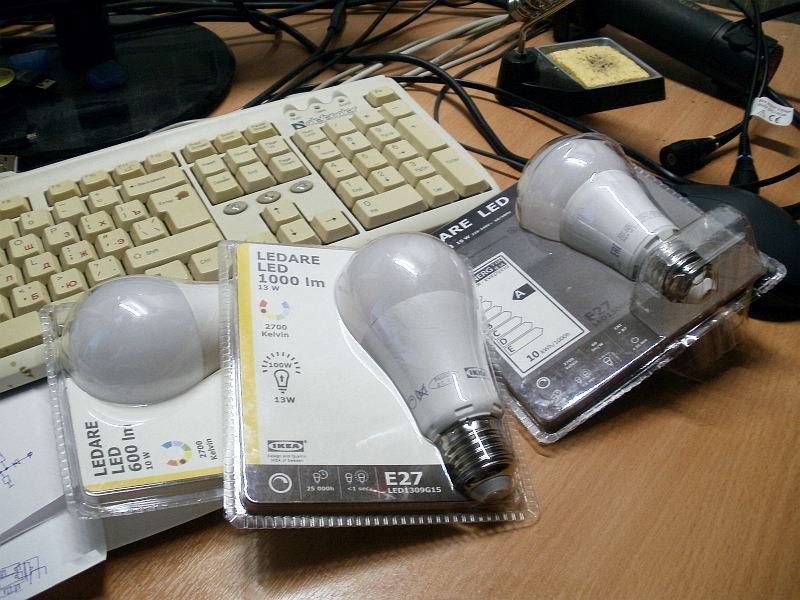
So, I finally drove to this store, bought some lamps from the assortment and measured them. I will not torment, here are the results:
It can be seen that the power factor of the lamp from IKEA can be praised - it is almost perfect. The power is also basically close to the declared one (although for one of the lamps it differs by 20%). However, I cannot praise the ripple factor in any way, because the overall rating is “so-so”. This is especially true of a thirteen-watt lamp, which is an analogue of a hundred-watt incandescent lamp and, obviously, a direct competitor (from the already considered) twelve-watt lamp from Gauss LED, which I discussed in one of the previous articles .
In light of this, I can immediately say that personally I would pay 100 p. the difference in price, took Gauss with a ripple factor of less than 1% and would be calm for his eyes. Let even 20% seem to fit into SNiP, but it must be borne in mind that the electrolytic capacitors in the ballast will inevitably degrade (especially since its working conditions are quite difficult), and with time the ripples will increase. Obviously, by the time Gauss reaches the limit of 20%, the lamps in question will be already quite bad. This proposition is true, especially since, as we will see, the capacitors in IKEA lamps are the same as in Gauss.
True, there is one important point that I forgot to say about - these lamps are dimmable, and for dimmable lamps, a ripple factor of even 20% is an outstanding result. However, this does not change the overall picture. Twenty percent is very mediocre.
Let's take a look at some lamp and see what's inside. Judging by the fact that the parameters of all three lamps are almost the same (especially in terms of power factor), the circuitry is also most likely not different. So I chose the lamp for structural analysis arbitrarily (took LED1306G10).

As it turned out later, the light-scattering dome can certainly be removed using a non-destructive method, but at first I, of course, did not know this, and simply cut off part of it.

The matrix is connected to the driver by a connector. I already saw such a method in Gauss lamps, and in the same place I said that it is beautiful, but raises doubts about the resistance of such a solution to moisture.
Here I should distract myself and praise the IKEA lamp developers for the design - in general, it is really very thought out. Everything is arranged as follows:

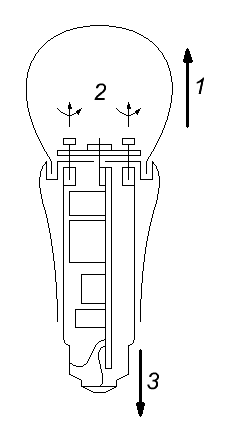
To disassemble the lamp, you must first remove the diffuser, then unscrew the two screws on the LED matrix, after which the matrix is separated from the housing, and the driver glass is simply removed from it. The case itself is aluminum, the contact area of the matrix with it is large - the heat sink promises to be very good. The design is excellent and creates all conditions for one hundred percent maintainability. But alas, the driver is flooded with a compound, for which reason it is completely impossible to get one without irreversible damage.


Capacitors, as I noted above, are Aishi brands, as in the Gauss LED 12W lamp.

Ballast is assembled on a Marvell 88EM8183 chip . A typical circuit of its inclusion looks like this:
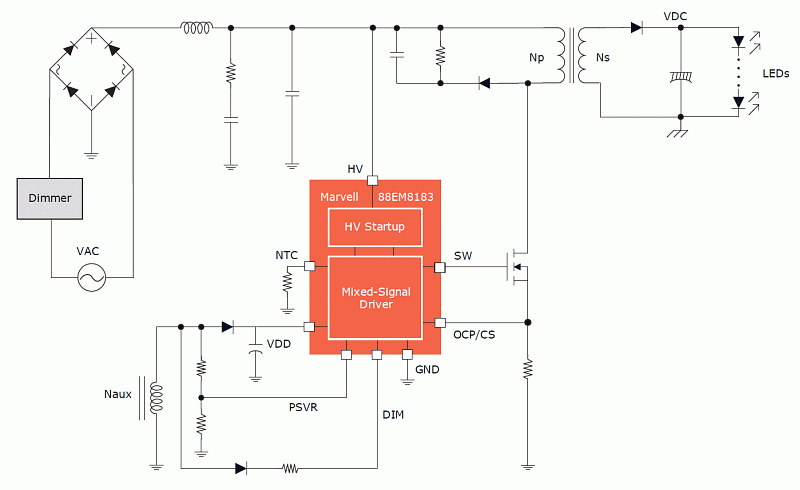
This is a flyback converterwith current control on the primary side and tricky power factor correction algorithms (which is really noticeable in parameters).
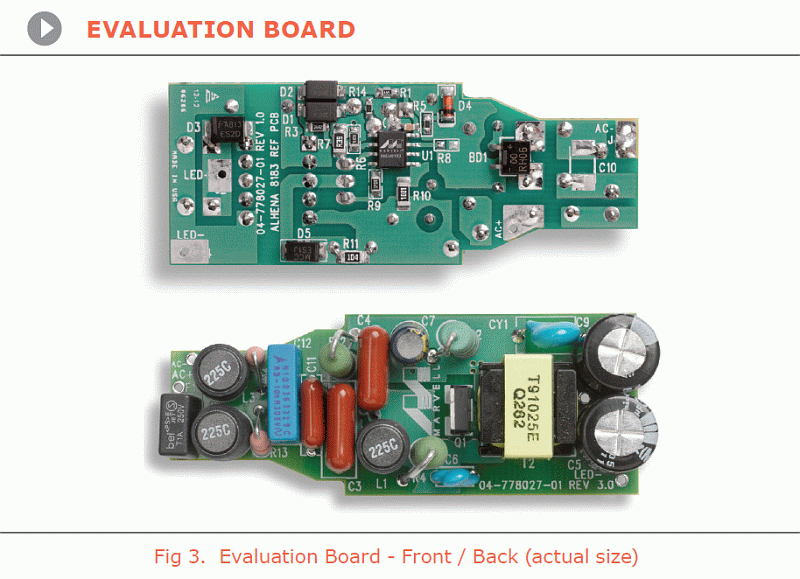
The ballast board is very similar to the support design proposed in the documentation:
In general, my impressions are very mixed.
On the one hand, the design of the lamp is thought out and, frankly, I was impressed enough. However, the impression is destroyed by the ballast flooded with the compound and the tightly glued diffuser. It was worth making the last one unscrewed (the construction allows it!), And did not fill the ballast (it rests on the rails anyway), and I would call this solution ideal, especially considering that the heat sink is very well made here. It could have turned out to be a completely maintainable lamp with an excellent temperature regime of LEDs! However, alas. What is the use of a conveniently removable driver unit if it still cannot be repaired? So alas, a potentially excellent design does not give any advantages.
On the one hand, the lamp is dimmable, and at the same time it has an outstanding ripple coefficient of 20% for dimmable lamps. But 20% is in any case at the acceptable border, and taking into account aging it is very bad at all (27% - initially beyond any acceptable border).
On the one hand, the power factor is ideal - 0.95. On the other hand, I think that lamps should still be designed primarily for the convenience of people, and only then - the mains, so the above disadvantages bring this plus to nothing.
In general, something like this: if you need a more or less decent dimmable, namely dimmable, lamp, then this is a good choice. If the goal of dimming is not worth it, then Gauss or ASD is a much better choice. The difference in price is minimal, and the parameters are generally better.
So, I finally drove to this store, bought some lamps from the assortment and measured them. I will not torment, here are the results:
| Name | The code | cos (φ) | P meas | K p | Generally |
| LEDARE LED 1000lm 13W 2700K | LED1309G15 | 0.95 | 12.5 | 19 | So-so |
| LEDARE LED 600lm 10W 2700K | LED1339G10 | 0.92 | 8 | 20 | So-so |
| LEDARE LED 600lm 10W 2700K | LED1306G10 | 0.96 | 9.2 | 27 | poorly |
It can be seen that the power factor of the lamp from IKEA can be praised - it is almost perfect. The power is also basically close to the declared one (although for one of the lamps it differs by 20%). However, I cannot praise the ripple factor in any way, because the overall rating is “so-so”. This is especially true of a thirteen-watt lamp, which is an analogue of a hundred-watt incandescent lamp and, obviously, a direct competitor (from the already considered) twelve-watt lamp from Gauss LED, which I discussed in one of the previous articles .
In light of this, I can immediately say that personally I would pay 100 p. the difference in price, took Gauss with a ripple factor of less than 1% and would be calm for his eyes. Let even 20% seem to fit into SNiP, but it must be borne in mind that the electrolytic capacitors in the ballast will inevitably degrade (especially since its working conditions are quite difficult), and with time the ripples will increase. Obviously, by the time Gauss reaches the limit of 20%, the lamps in question will be already quite bad. This proposition is true, especially since, as we will see, the capacitors in IKEA lamps are the same as in Gauss.
True, there is one important point that I forgot to say about - these lamps are dimmable, and for dimmable lamps, a ripple factor of even 20% is an outstanding result. However, this does not change the overall picture. Twenty percent is very mediocre.
Let's take a look at some lamp and see what's inside. Judging by the fact that the parameters of all three lamps are almost the same (especially in terms of power factor), the circuitry is also most likely not different. So I chose the lamp for structural analysis arbitrarily (took LED1306G10).
As it turned out later, the light-scattering dome can certainly be removed using a non-destructive method, but at first I, of course, did not know this, and simply cut off part of it.
The matrix is connected to the driver by a connector. I already saw such a method in Gauss lamps, and in the same place I said that it is beautiful, but raises doubts about the resistance of such a solution to moisture.
Here I should distract myself and praise the IKEA lamp developers for the design - in general, it is really very thought out. Everything is arranged as follows:
To disassemble the lamp, you must first remove the diffuser, then unscrew the two screws on the LED matrix, after which the matrix is separated from the housing, and the driver glass is simply removed from it. The case itself is aluminum, the contact area of the matrix with it is large - the heat sink promises to be very good. The design is excellent and creates all conditions for one hundred percent maintainability. But alas, the driver is flooded with a compound, for which reason it is completely impossible to get one without irreversible damage.
Capacitors, as I noted above, are Aishi brands, as in the Gauss LED 12W lamp.
Ballast is assembled on a Marvell 88EM8183 chip . A typical circuit of its inclusion looks like this:
This is a flyback converterwith current control on the primary side and tricky power factor correction algorithms (which is really noticeable in parameters).
The ballast board is very similar to the support design proposed in the documentation:
In general, my impressions are very mixed.
On the one hand, the design of the lamp is thought out and, frankly, I was impressed enough. However, the impression is destroyed by the ballast flooded with the compound and the tightly glued diffuser. It was worth making the last one unscrewed (the construction allows it!), And did not fill the ballast (it rests on the rails anyway), and I would call this solution ideal, especially considering that the heat sink is very well made here. It could have turned out to be a completely maintainable lamp with an excellent temperature regime of LEDs! However, alas. What is the use of a conveniently removable driver unit if it still cannot be repaired? So alas, a potentially excellent design does not give any advantages.
On the one hand, the lamp is dimmable, and at the same time it has an outstanding ripple coefficient of 20% for dimmable lamps. But 20% is in any case at the acceptable border, and taking into account aging it is very bad at all (27% - initially beyond any acceptable border).
On the one hand, the power factor is ideal - 0.95. On the other hand, I think that lamps should still be designed primarily for the convenience of people, and only then - the mains, so the above disadvantages bring this plus to nothing.
In general, something like this: if you need a more or less decent dimmable, namely dimmable, lamp, then this is a good choice. If the goal of dimming is not worth it, then Gauss or ASD is a much better choice. The difference in price is minimal, and the parameters are generally better.
Bonus and thanks
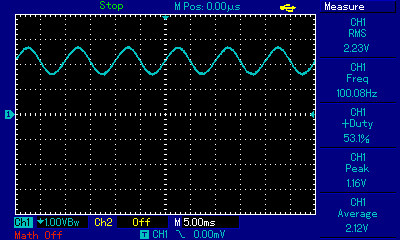
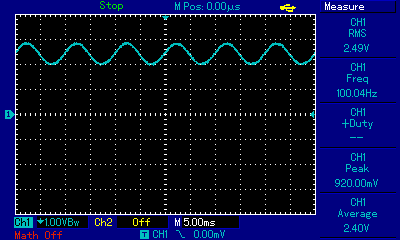
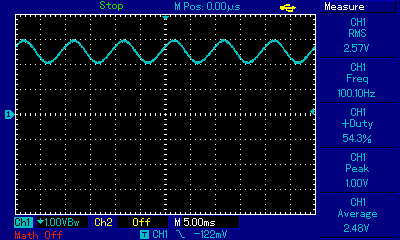
Bonus: oscillograms of pulsations of lamps.
LED1306G10:
LED1309G15:
LED1339G10:
In conclusion, the author would like to thank people without whose support and understanding this publication could not take place, namely,
Seriously, I wouldn’t have reached IKEA alone.
LED1306G10:
LED1309G15:
LED1339G10:
In conclusion, the author would like to thank people without whose support and understanding this publication could not take place, namely,
- his supervisor - for immeasurable patience and understanding of the passion of his graduate student for untwisting light bulbs in the midst of writing a master's thesis,
- as well as the wonderful girl who made the author a company on a trip across the city to IKEA for three bulbs, motivated him in every way and provided valuable moral assistance in the process of preparing the article.
Seriously, I wouldn’t have reached IKEA alone.