
 January 15, 2015 at 17:53
Project Ara: Latest News on Google Modular Smartphone
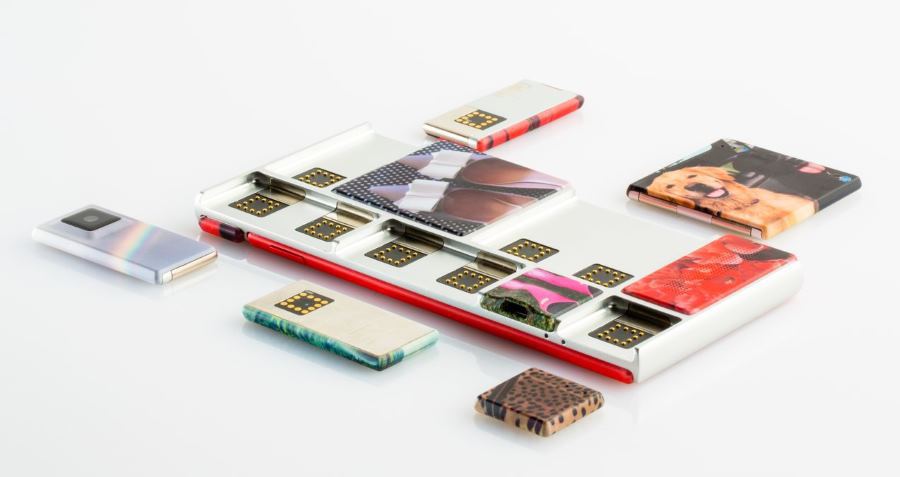
Today, Google in the person of Paul Eremenko introduced a series of updates for the modular smartphone Project Ara. In particular, the situation has now become clear with what the commercial version of the device will be, and where you can wait for the device to appear on sale.
In addition, the company introduced a roadmap for further development of the project. As far as you can understand, Project Ara has already ceased to be just a concept, a toy, and is gradually turning into a very real device, which some journalists even managed to hold in their hands.
Currently, the project team is working on a prototype called Spiral 2. Here you can see several antennas to improve signal reception, improved power consumption, unification of modules.

Spiral 2 still has some problems with signal degradation, as well as minor problems with mounting modules. In order to avoid abrasion of parts of the modules, developers will place components at intervals of 150 microns. All improvements will be implemented in the version of Spiral 3.

Project Ara Roadmap
Now most of the company's plans have been implemented, starting in 2013, and the project is entering the finish line.

Spiral 3 will work with the hardware platform from Rockchip , while developers are provided with an updated version of the SDK. The smartphone will be able to work in LTE 4G networks.
At this stage, the project team has already created 11 core modules for the smartphone. By the end of 2015, the number of components will increase to 30. The main unit is the Nvidia Tegra K1 with a Marvell PXA1928 chip, plus a display with a resolution of 1280 * 720 pixels (the dimensions of the display are not called). The developers also offer a camera module with a 5 MP matrix, a battery module, various communication modules (including 3G, WiFi, Bluetooth) and a module with a micro-USB port. An atmospheric pollution detector module will also be available (although the module’s functionality is also not disclosed). It can be assumed that this module will determine the concentration of carbon monoxide (carbon monoxide), the concentration of carbon dioxide and some other compounds.
The project team also plans to create a comprehensive ecosystem for the device, including individual applications and modules. Thus, the smartphone will be able to offer its users extensive functionality and features.
Where could I buy?
The device will go on sale first in Puerto Rico . The developers explain this choice by the fact that in this country there is a sufficiently developed network of cellular cellular infrastructure, plus there are no complicated certification procedures for the device (all procedures will be completed later in order to launch sales in the USA and Europe).
The device will be sold from two operators supporting 4G LTE (Open Mobile and Claro operators). At the same time, it will be possible to buy the device not in stationary stores, but in mobile points of sale, which will be installed in various places throughout the country. The points will be equipped with sublimation and 3D printers so that the buyer can customize the device and the modules for it (if the buyer wishes).


