April 9, 2015 at 12:51
Every engineer dreams of making an S-90
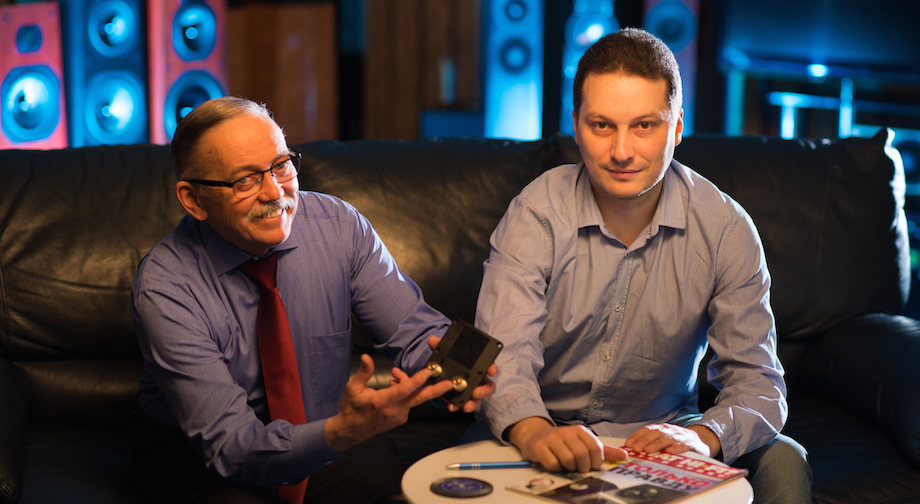
Yuri Fomin (left) and Artem Faermark (right) / Photo by Stereo.ru
Today we decided to publish a transcript of the 20th anniversary issue of the show “Sound”, in which Timofey (@timshick) will meet with the founder and CEO of Audiomania, Artem Faermark , which will open for readers (transcript) and listeners (podcast) the door to the world of production of acoustics.
Other Podcast Issues
- [ read ] [ listen ] Who may be interested in the development of acoustics;
- [ read ] [ listen ] Music lovers, network players and built-in acoustics;
- [ read ] [ listen ] Every engineer dreams of making an S-90;
- [ read ] [ listen ] In simple words about headphones and DACs;
- [ read ] [ listen ] Talking about vinyl: Myths, opinions and current situation;
- [ read ] [ listen ] Answers to questions from listeners of the podcast “Sound”;
- [ read ] [ listen ] We discuss the nature of the different sounds of acoustics;
- [ read ] [ listen ] Acoustics for background sounding of premises;
- [ read ] [ listen ] Answers to questions from podcast listeners;
- [ read ] [ listen ] We talk about home theaters;
- [ read ] [ listen ] Interiors for sound;
- [ read ] [ listen ] Interfaces and cables;
- [ read ] [ listen ] In simple words about digital and analog sound;
- [ read ] [ listen ] Home acoustics and answers to questions;
- [ read ] [ listen ] Engineer's opinion: How to create your own ecosystem of sound;
- [ read ] [ listen ] Quality of audio systems: Is it worth trusting “beautiful graphics” and reviews in the press;
- [ read ] [ listen ] Answers to questions of listeners;
Timofei Shikolenkov: Last year, Audiomania announced that it turned out to have its own production, its own brand. For many, this was a surprise. Especially for competitors, I think. Today we decided to talk a little bit more about how it all worked out, where it all came from, how it all came about. A bit of history, because the story, as it turned out, is already quite large, despite the fact that it was covered in secrets. It began, as I understand it, in 2008.
Therefore, today we are talking with Artyom Faermark, who is also an ideological inspirer of the Arslab project. Part-time because he is the CEO of Audiomania. Artem, tell me how it all began, how and why.
Artem Faermark:To begin with, it all started a little earlier. More likely in 2000. Since we were selling audio equipment, of course, the idea was immediately born: “Why not do something your own ...” Slowly, we started to develop this idea. But it took quite a while, we went a long way. It all started with our trips to China and the understanding that you can effectively do some interesting and at the same time quite high-quality things in China, despite the fact that many people have always had some negative attitude to Chinese goods. The reality at that time was such that 90% of the goods were made there.
Of course, we did not succeed immediately. We developed some kind of connection with the manufacturers of speakers, manufacturers of cases. And in 2008, rather, even earlier, in 2007, we began introducing into production at two Chinese plants. One made us the speakers, the second made the body and the final assembly. However, in 2008 we went into crisis with this project, and it stalled a bit.
But, nevertheless, everything worked out for us, and the first Arslab acoustics, already serial, entered the market. Then the project developed quite smoothly, but we came to another problem related to the fact that demand began to fall, and in China we could all produce only in very large quantities. One hundred, two hundred, three hundred, five hundred units of the same color of one model. The market did not need so much.
In 2011, we decided that we needed to find production in Europe. At that moment, we met our good, in the future, partners, Baltic Audio Box in Latvia, which was just the manufacturer of the enclosures. We started preparing mass production there, but, unfortunately, this company took on too many obligations, and in 2012 they went bankrupt. It was a shock for us, a shock, because we prepared the production for assembly; since they only manufactured cases, we hired people, opened a company, created jobs that were ready for the assembly of equipment, but were not ready for the production of cases.
After some thought, we decided that we were a little tired of these throwings, and decided to invest, including in the production of our own buildings. They hired all the most sensible staff from this company, and quite successfully [started to work], because we had very good specialists. For four to six months, we made production, a complete closed cycle for the production of cases. And, accordingly, by 2013 we were able to start our own European assembly of acoustics. The question is always asked: “Why is this done?” Many companies or many of the founders of companies often say that they did this because they went and searched for some kind of “their” sound and could not find it anywhere.
Timothy Shikolenkov:This is a classic story of brand founders that “I played drums or some musical instrument at school or at an institute”. Classics of the genre. Each founder always says that he bought some speakers, and the sound did not suit him. And he began to look for his own, made his own, called his friends, friends said: “Wow, that's cool! You need to show it to the world and start selling. ” So, in my opinion, the story of 90% of the brands representing acoustics in the world is being read.
Artem Faermark:Our message in this matter was slightly different. In our opinion, at the moment, the biggest problem of the acoustic market is a very strong stratification. There is a very inexpensive and, frankly, insufficiently high-quality product, and the next step is already a very expensive product. In the middle there is practically no acoustics that would have the attributes of a serious enough High-End, and at the same time it would cost, say, moderate money.
Timofei Shikolenkov: Is it possible to combine High-End and moderate money? Somehow it is very difficult to fit into the head. In any case, people who, especially at exhibitions, see a poster that says “High-End should not be expensive,” say: “How so? High-end should be expensive. Otherwise, it's not High-End. ”
Artem Faermark:Yes, of course, there is such a legend. In principle, it is justified. A sufficiently serious approach is needed in the design, selection of the element base and the manufacture of cases. This is all not simple and quite expensive. But if a company, like ours, has its own retail channel, has sufficiently large sales opportunities, then it has the opportunity, say, to reduce costs in the supplier line. That is, we do not have an intermediary, such as distributors or dealers. We produce acoustics ourselves. And we sell it ourselves. In principle, we allow ourselves to “invest” in the same product much more for the same money, let’s say so.
Timothy Shikolenkov:It turns out that the retail price of all the others consists of a large number, in a good way, of components not needed by the consumer, but necessary, because it does not work out differently.
Artem Faermark: This is a difficult question, whether they are necessary or not. We never said that we make any kind of acoustics superior to other brands. There are a lot of speakers. They all have a different character. Each finds its own consumer. It's just that our acoustics are much better in terms of price-quality ratio. But this does not mean that everyone will like it. Some may like some other brands, both more expensive and cheaper.
Any acoustics is a definite choice of the consumer, by his ear, by his musical preferences. The only thing, we really can afford to use more expensive components, complex and high-quality cases, high-quality paints, use natural veneer instead of films, because we have our own production. Product class is generally higher.
Timofei Shikolenkov: What is the complexity of the production of cases? It seems that this is just a drawer that was made of plywood, painted, varnished, cut a hole for the speakers.
Artem Faermark:This is not entirely true. This is a very complex multi-stage production, consisting of dozens of different processes. Just to put together a box you will never succeed. To make a high-quality serial product, you need quite serious equipment, like ours, this is the German CNC-MACHINE equipment, painting equipment, spray booths.

Photo Stereo.ru
For example, in order for a good varnished product to be of the quality we are used to, it takes at least twenty days in a special drying chamber. This requires several layers of paint, four to eight, several stages of polishing, grinding. This is a very laborious process. Plus it requires a certain humidity in the room, respectively, you must have equipment that supports this humidity. All this is not so easy to do "on the knee", but, most likely, it is simply impossible.
Timothy Shikolenkov: That is, it is generally impossible?
Artem Faermark:Probably possible. But so far I have not encountered handicrafts made, as they say, on a knee that would have a long service life, did not fall apart after six to eight months, from which layers of paint, varnish, and veneer would not loose. This is a fairly technological production, which requires certain conditions and knowledge and skills of the staff.
Timofei Shikolenkov: It turns out that the announcements on the forums “I will design acoustics for you now” are cunning that will never reach the production level.
Artem Faermark:To design, yes, but to make - I doubt it. The listeners probably didn’t see it, but very often we came across model products that [we] bring. They can sound interesting, they can have an interesting crossover circuitry, a good cable inside. But the appearance still remains artisanal. It’s like spoons and boards from the market.
Timothy Shikolenkov: I see. Then, if you do not mind, try to return again at a time when production was in China. At the time of moving, if I may say so, production to Europe, the lineup was completely changed. What is the reason for this?
Artem Faermark:We had a model rad that existed since 2008 and, in principle, it required updating. Plus, during this period we met one very good manufacturer, a company from Denmark based in China. She combined two very important signs for us. This is a completely European approach, European engineering, and even the engineers are Danish in China, but the production is in China. They could give us a production price, that is, the price that allows us to produce a quality product with an acceptable price. This is Wavecor, led by Allan [Isaksen] from Denmark. He worked in many well-known companies: Scan-Speak, Vifa. Perhaps this does not tell anyone, but they are one of the most famous brands of dynamic heads.
During this period, we developed with him the dynamics that we needed. And we decided to introduce them already in the new production, completely and completely switch to its loudspeakers, which allowed us to make a fundamental leap in the quality of the products that we released. Despite the fact that we left the previous name, as it was Classic 3, it remained Classic 3, for example, either Classic 2, or Classic 1, but the quality has fundamentally changed. It was a different approach to the production of speakers, a different approach to the production of crossovers.
Crossovers began to be made manually, not on thin circuit boards, as was the case in China. That was not bad. But the main problem with China is that the one who collects the final products does not always understand the complexity of the approach. For example, why you need to put certain wires, why you need to use certain solders, why you need to use certain printed circuit boards, what you need to pay attention to, etc.
At the moment, we have completely acoustic production, and acoustics work on it, that is, people who understand all the tasks in the complex: what are the requirements for the crossover, what are the requirements for the element base, what are the requirements for internal wiring, what are the requirements for the internal filling with damping materials etc. In China, despite the fact that our products were very good, there was no thorough control that we have come to now.
Timothy Shikolenkov: Tell us a little about the Emotion line . I know that there is some kind of story that was not told to anyone. How did this acoustics get its name? And, as far as I know, this name should have been different.
Artyom Faermark: Yes. In 2014, we decided to make the line a little higher thanClassic , use other speakers, other crossover details. What was the reason for this? I will say that I really love compact systems with very good bass.
Timofei Shikolenkov: Is this possible?
Artem Faermark: Yes, of course. Wavecor made very good speakers for us, just four inches. This is a very small speaker. This speaker is smaller than a pack of milk, with very good low-frequency performance. We decided to use them in the line of acoustics that we wanted to call Сompact. When we made pre-production samples, put them in a laboratory in Latvia, turned them on, we sat and just listened to music.
Usually we listen to several test tracks, then turn it off and check the box that the product is accepted. Here we spent almost the whole evening listening to music on this system, changing discs, discussing something all the time. So lured us by the sound. In the end, at the end of the day, we decided that it was cool and so emotional that we would call this line Emotion.
Timofei Shikolenkov: Recently at the exhibition “What Hi-Fi Show” a new model was presented, which stood out very much from the general background. She was not like any of those that are used to seeing the regulars of these exhibitions. I'm talking about the Old school model . Tell me a little bit about where the idea of this column came from, how it was born, what happened, did it work out?
Artem Faermark:As one friend of mine says: “Every engineer dreams of making an S-90.” An engineer, say, a Soviet school. Make something legendary. The idea is that so many people like the big open sound. To achieve it, you need to use, as we call it, the achievements of the “old school”. This is a wide panel of the speaker system, this is the use of a large speaker for low frequency and this is the use of a closed case, not a bass reflex.
We had an idea for such a system, and we designed it for a long time. I had to apply other speakers. Part of Wavecor did not suit us, and we had to use Morel tweeters. We really wanted this column to stand out. The first column we made is orange. We showed it at an exhibition in Munich. And only the lazy did not hug her and did not take a picture.

Artyom Faermark (right) / Photo by Stereo.ru
What did I like? Guys passed by - huge bikers, in leather jackets with shoulder-length hair - they joyfully poked a finger at her, ran up, stood on both sides, leaned on her and took photos for a long time beside her. The audience was thrilled. Returning to the system, she has a cool sound, an open, real old-school sound that should appeal to both the young generation and people who like unusual cool things, and people who remember the “old” sound.
Of course, this system is built on modern speakers, it has nothing to do with technology with speakers and speakers that were forty-fifty years ago. This is a modern product, but with a touch of retro. It has controls, it has a very interesting logo. Of course, someone might say that it is such an easy kitsch, but, nevertheless, it is very popular with the audience for which it is intended.
How was the name born? At first we wanted to give a neutral name. Then somehow we drove, and one of the cars we had was a Skoda Superb, on it we transported something big in the Baltic states, and I thought that our column like the Skoda Superb was big, reliable, cool and cool. Therefore, he suggested that our column be called Superb too. And this will just “resonate” a little with the name “S-90”. Such a small pun, so that those who knew the story, it was a little amusing.
Timothy Shikolenkov: I know that besides this model is planned even larger in size?
Artem Faermark:Yes, there is more. Superb-900. This is for those who love even more sound! We have not yet launched it into the series, because it is so heavy that it is quite problematic to produce it. Therefore, everyone is waiting for this moment and are afraid to approach it.
Timothy Shikolenkov: And what about the prices? Now the price is almost the most frequently discussed story. Now all prices have skyrocketed in rubles, and all have retained their income. What is happening with Arslab pricing now?
Artem Faermark:Initially, we had the task of maintaining an attractive price, since we did not change or raise prices for models since 2008. But in 2015 we had to change prices, because the goods are manufactured in Europe, and all components are imported. We reasonably approached the change in prices, counted everything ten times, looked at where we can reduce our costs.
With a sufficiently high volume of production, we reduce the cost of components, because we buy not a hundred or two hundred pieces, but a thousand. And we reached the price somewhere in the middle, that is, we were able not to rise to the price that was in the currency, but to raise the price tag to reasonable limits.
Timofei Shikolenkov: It turns out that the acoustics were affordable, and now it is even more accessible?
Artem Faermark:In rubles, of course, it has become less affordable, but if counted in euros, it has fallen in price by thirty percent.
Timothy Shikolenkov: You talked about the exhibition in Munich. Is it realistic to sell this acoustics to other countries as soon as production reaches the level that is sufficient to meet demand in Russia?
Artem Faermark: Yes, we are thinking about it, but this is not an easy question. It is associated with marketing and a huge offer of various brands in Europe. There are hundreds of local manufacturers. And it is not so easy to enter the market, even with an attractive price. This requires a long existence of the brand in the market.
If for Russia this is already a pretty big story that an eraser can’t easily wipe off for more than five years, then in Europe we will be newcomers. We have small sales, but these are mostly acquaintances who know that we are doing something and tell their friends who are interested. Sometimes they ask us: “Could we buy some column from yours?” Yes, please. A certain number of these columns are in Europe, but only by familiar ones.
Timofei Shikolenkov: The Hi-Fi & High End Show exhibition is coming soon, which has traditionally been held in Moscow for many years from April 9 to 12. What will be presented on it? And will Arslab be represented at this exhibition?
Artem Faermark:Yes, of course. This is a key brand for us and beloved by all of us, and suffered, let’s say so. Therefore, we will exhibit, I think, a complete lineup. Perhaps something new, if we manage to prepare a surprise for some interesting, and the current lineup in all its glory. We have two rooms, and we will try to rebuild everything interestingly and efficiently, unlike other people at the exhibition, who often do not care what they exhibit.
We are very sensitive to this, because this is our brainchild. We will try to do it very cool. Therefore, I think everyone should come. This event is held once a year, it is very interesting and eventful. I think that anyone is interested. And, of course, we need to visit us.
Timothy Shikolenkov:I add that a free invitation can always be obtained at stores of Audiomania [or here ]. And once again I remind you that the exhibition will be held from April 9 to 12 in Moscow at the Aquarium Hotel near the Crocus, this is part of the Crocus [Crocus Expo]. Come, it will be interesting!