March 16, 2015 at 08:59
Chess 3D show: Kasparov VS Fritz
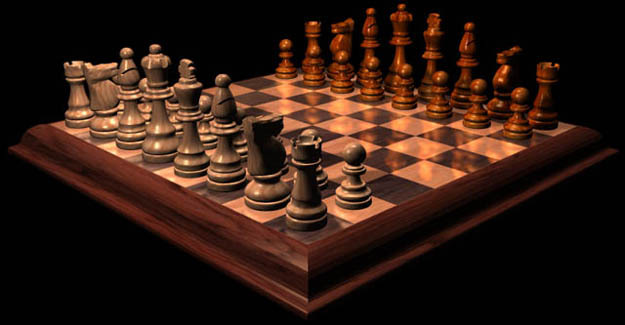
After a difficult match with the Israeli chess program Deep Junior , in the same 2003, Kasparov had to fight another electronic rival.
The ex-world champion was offered to cross swords with an old acquaintance - a very strong Fritz chess program. In addition, a year earlier, Fritz played a draw match with Vladimir Kramnik, who at that time was the world champion among people. The program also performed well at the world championships among its fellow minds, although it became the world champion only once - back in 1995.

The creators of Fritz together with X3D Technologies offered a know-how in the form of a 3D-interface of the program. For a deep immersion in chess nirvana, it was proposed to replace the good old tree with a detailed stereo image of the board and figures.
The game was supposed to be in 3D glasses, the figures had to be rearranged by voice commands. You can control the board (rotate, move closer, move away) using a special joystick.
In the photo: view of the board on the monitor without 3D glasses. →

To promote a new product, it was decided in November 2003 to hold this match. A completely solid hardware was attached to the revolutionary interface. The program pondered the moves using 4 Intel Xeon processors with a frequency of 2.8 GHz. This allowed us to process almost 4 million positions per second. Visualization of the highest quality was provided by a designer monitor.
The match was again held in New York. For four demonstration meetings, Kasparov was offered a solid jackpot - 150 thousand dollars. If he managed to win a general victory in the match, then the grandmaster would receive another 50 thousand from above, with a draw - 25.
Thus, the prize money in the event of a defeat ($ 150,000) did not differ significantly from a victory ($ 200,000) or a draw ($ 175,000). The main thing, as they say, is not victory, but participation. Especially if the event is not so much sports as advertising.
1st party. Kasparov - X3D Fritz. ½: ½

Given the short distance of the match, Kasparov did not stand on ceremony with the robot and rushed to attack in white. Already on the first moves, the white g- pawn resolutely rushed forward into two fields at once. On move 20, Harry won the quality while continuing to build up the most dangerous initiative. The electronic grandmaster walked along the edge of the abyss, but he did not cross the invisible line separating it from falling into the abyss. With the remaining forces, the machine organized an eternal check and a combat draw was fixed (see diagram).
Kasparov was not satisfied with the level of his own game, believing that, in principle, he could bring the party to victory.
“I just could not fully adapt to the new conditions of the game - to make moves with my voice, to see everything in a three-dimensional image. Despite this, my position was better, and during the game several times a situation arose where I could increase my advantage. It seems to me that the computer has somewhat overestimated its capabilities. ”
2nd party. X3D Fritz - Kasparov. 1-0

Kasparov, playing black, easily leveled his position and made the last preparations before attacking the enemy king. However, the assault on the enemy citadel was disrupted by a gross yawn. In the diagram you can see the consequences. Garik unsuccessfully crossed the rook from the f7 field to the neighboring g7 and the reckoning for inattention immediately followed - the white rook immediately knocked down the infantryman to e5 . This is not a sacrifice, but a simple tactical blow - if the black pawn takes an impudent rook, the white queen takes an equivalent piece on f8 . This chess technique is called “ X-ray ”. Black's position fell down and after a few moves the man stopped the clock.
Kasparov explained his oversight by 3D damned glasses. Garik was not used to unusual conditions for the second batch. No matter how plausible the virtual board and pieces looked, they still were not perceived as real. In addition, the eyes were tired of the device.
3rd party. Kasparov - X3D Fritz. 1-0

Kasparov knows how to quickly recoup and in the next game he caught a computer on an unprofitable debut version.
On the diagram, the position after the 41st move of black, which can be called as “ Suvorov ’s passage through the Alps ”. A pawn "mountain range" stretches across the entire board, at the very edge of the board, the penetration of the white army through a narrow pass into the territory of the enemy is prepared. Black is unable to prevent the invasion. Kasparov equalized.
“There is still a lot of positions that machines simply do not understand. Unfortunately, it is difficult to compete with the machine as an account - it remains for us to find such positions and lure programs into them. ”
4th party. X3D Fritz - Kasparov. ½: ½

The last fight was short. On the diagram, the most effective moment of the meeting is that the parties simultaneously threaten each other with obscenities. How would you play here (White's move), dear reader?
The computer played correctly and after 3 moves the game and the match ended in a draw.
In general, both sides were satisfied with the overall draw. Kasparov, in his own words, was “glad to play just a good match,” and it’s nice to earn almost 44 thousand dollars for each game.

In the photo: Garry Kasparov and
The creators of X3D Fritz marketing dividends squeezed out of the match to the maximum. It took more than a million dollars to organize the competition, but sales paid for all expenses.
Although the organizers threatened that they would annually hold stereo battles with the world's leading grandmasters, there were no other notable competitions in three-dimensional format. Still, the second game for chess players seemed to be enough argument to refrain from such experiments. In subsequent years, there were still Fritz's matches with world champions (Kramnik, Kasymdzhanov), however, the board and pieces were ordinary.

One of the promotional photos of the event. On the right is Katy Horne - "Miss New York 2003", as well as part-time opera soprano and
This is my final article about Garry Kasparov’s struggle with collective artificial intelligence. The commercial match in 3D chess was the last duel of the illustrious chess player with the strongest of gaming robots. In a year and a half Kasparov will officially announce the end of his sports career.
And then the chess confrontation between people and machines will become completely irrelevant - my co-author Rom77 will tell about this in the epilogue , to whom I convey the final word:
“ After Kasparov. Computer Chess - Results and Prospects . ”
Additionally
Match table
| 1 | 2 | 3 | 4 | Result | Glasses | |
|---|---|---|---|---|---|---|
| Garry Kasparov | ½ | 0 | 1 | ½ | +1, –1, = 2 | 2 |
| X3D Fritz | ½ | 1 | 0 | ½ | +1, –1, = 2 | 2 |
Debut Statistics
Slavic defense - 1, 3
Spanish party - 2
Queen's gambit - 4
You can view all games, game after game, at ChessGames .
Fritz program page on Russian Wikipedia . Article about the match on the English Wikipedia .
On YouTube you can find the archive of the broadcast of the 4th game ( 1st part , 2nd part ), as well as watch a short report on the match from the Vesti program.
All articles in the series
Kasparov - Deep Thought. One-goal game
First offenders. Fritz and Genius
Kasparov vs. Deep Blue. Part I:
Kasparov's Black Box vs. Deep Blue. Part II: The Philadelphia experiment of
Kasparov against Deep Blue. Part III: Inter-Match
Kasparov vs. Deep Blue. Part IV: The New York Secrets of
Kasparov vs. Deep Junior. Return to New York
3D Chess Show: Kasparov VS Fritz
After Kasparov. Computer Chess - Results and Prospects
First offenders. Fritz and Genius
Kasparov vs. Deep Blue. Part I:
Kasparov's Black Box vs. Deep Blue. Part II: The Philadelphia experiment of
Kasparov against Deep Blue. Part III: Inter-Match
Kasparov vs. Deep Blue. Part IV: The New York Secrets of
Kasparov vs. Deep Junior. Return to New York
3D Chess Show: Kasparov VS Fritz
After Kasparov. Computer Chess - Results and Prospects