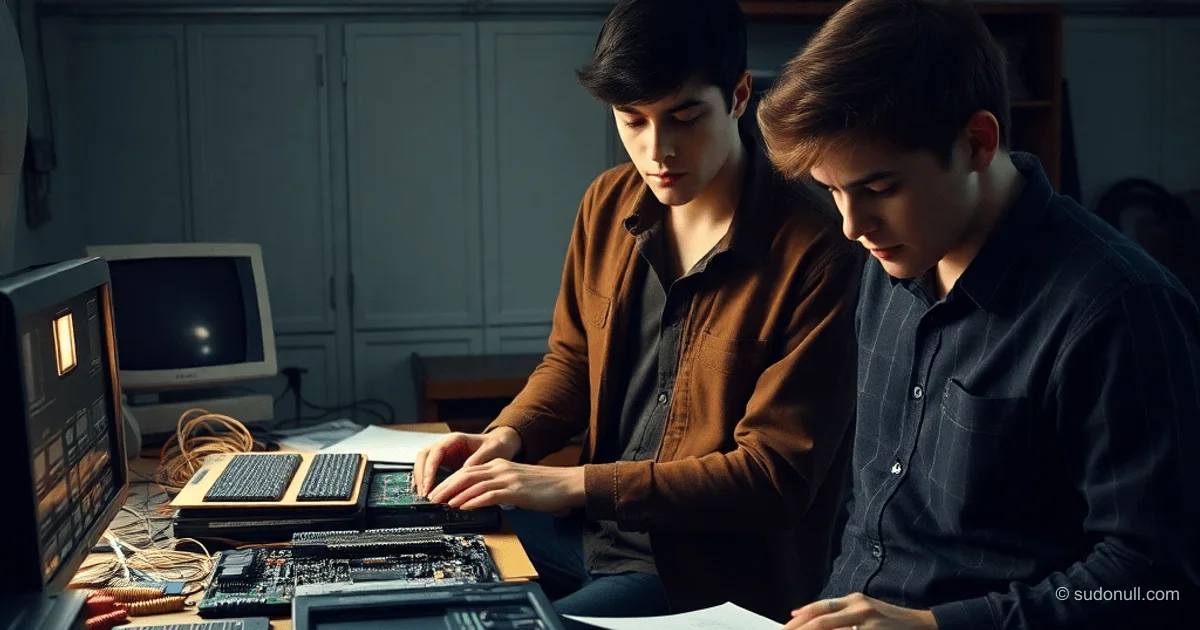
Apple's Early Years: From Garage Experiments to the First Computer
Steve Jobs and Steve Wozniak met in 1971 through their mutual friend Bill Fernandez. All three grew up in Cupertino and shared a passion for electronics. Fernandez recalls how they built simple devices—buzzers, blinking lights—using defective parts companies gave them for free. Wozniak brought a box of Signetics integrated circuits, and the trio sorted them by catalog number, dreaming of building a computer.
In Fernandez’s garage, they assembled a rudimentary computer from a workbench. They tried connecting a teletype terminal—but the power supply burned out in front of a reporter. That was their first hands-on experience collaborating on hardware.
The Little Blue Box: Their First Business
A 1971 Esquire article by Ron Rosenbaum about phone phreaks inspired Wozniak. He built a digital tone generator for making free long-distance calls—more precise than any analog version available. Jobs and Wozniak sold these ‘blue boxes,’ earning their first real money. Wozniak took pride in the frequency accuracy, calling it a more technically demanding project than anything Apple would later build.
This taught them how to merge engineering excellence with smart monetization.
Atari and HP: The Foundation Years
In 1973, Wozniak joined Hewlett-Packard as an engineer working on calculators—but at home, he built a TV terminal for ARPANET and a Pong clone for his television. In 1974, Jobs landed a job at Atari: Nolan Bushnell hired him as a technician for his tenacity and soldering skills, despite his eccentricity. Jobs worked nights, thinking creatively and unconventionally.
Atari gave Jobs deep insight into game hardware; HP and Wozniak’s side projects sharpened his understanding of networking protocols.
Homebrew Computer Club and the Apple I
The Homebrew Computer Club—a gathering of hobbyists moderated by Lee Felsenstein—spurred Wozniak to design the Apple I: a fully assembled motherboard featuring a MOS 6502 processor, 4 KB RAM, and a video interface. It shipped without a case, but included a keyboard and BASIC in ROM. Its first order? Fifty units from Byte Shop at $500 each.
On April 1, 1976, Ronald Wayne—Jobs’s former colleague—joined to formalize the Apple Computer Company partnership.
- Key Apple I specs: MOS 6502 @1 MHz, 256×192 video output, 8 KB ROM with BASIC.
- Price: $666.66 per assembled unit.
- First dealer: Byte Shop, Paul Terrell.
Funding and Growth
Mike Markkula of Intel invested $250,000, becoming Apple’s third co-founder. Regis McKenna crafted the company’s iconic branding. Bill Fernandez became Apple’s first employee; Chris Espinosa remains with the company to this day.
VisiCalc—developed by Dan Bricklin and Bob Frankston—became the killer app that propelled the Apple II to mainstream success.
Why It Matters
- Jobs focused on product vision and marketing; Wozniak mastered hardware engineering.
- Their success came from a rare blend of timing, boldness, and unwavering belief in personal computing.
- Early projects like the blue box honed critical technical and entrepreneurial skills.
- The Homebrew Computer Club acted as a vital innovation catalyst.
- Markkula’s investment transformed a garage operation into a scalable business.
— Editorial Team










No comments yet.