The most difficult couples of English times
We figured out the grammar in the previous article , now let's see what difficulties a student faces, for whom Russian is their native language. Just note that it is useless to compare languages: Russian and English belong to different groups. The argument "but in Russian is not so!", Unfortunately, is useless. Naturally, not so, because Russian is the Slavic language, and English is Germanic. We can only try to draw parallels, but the rules will never be the same.
At the Beginner level, students usually go through the grammar of these times and the basic rule: Present Simple is used for actions that occur regularly, and Present Continuous - for those that are now. Fair, but the higher the level, the greater the difference between times.
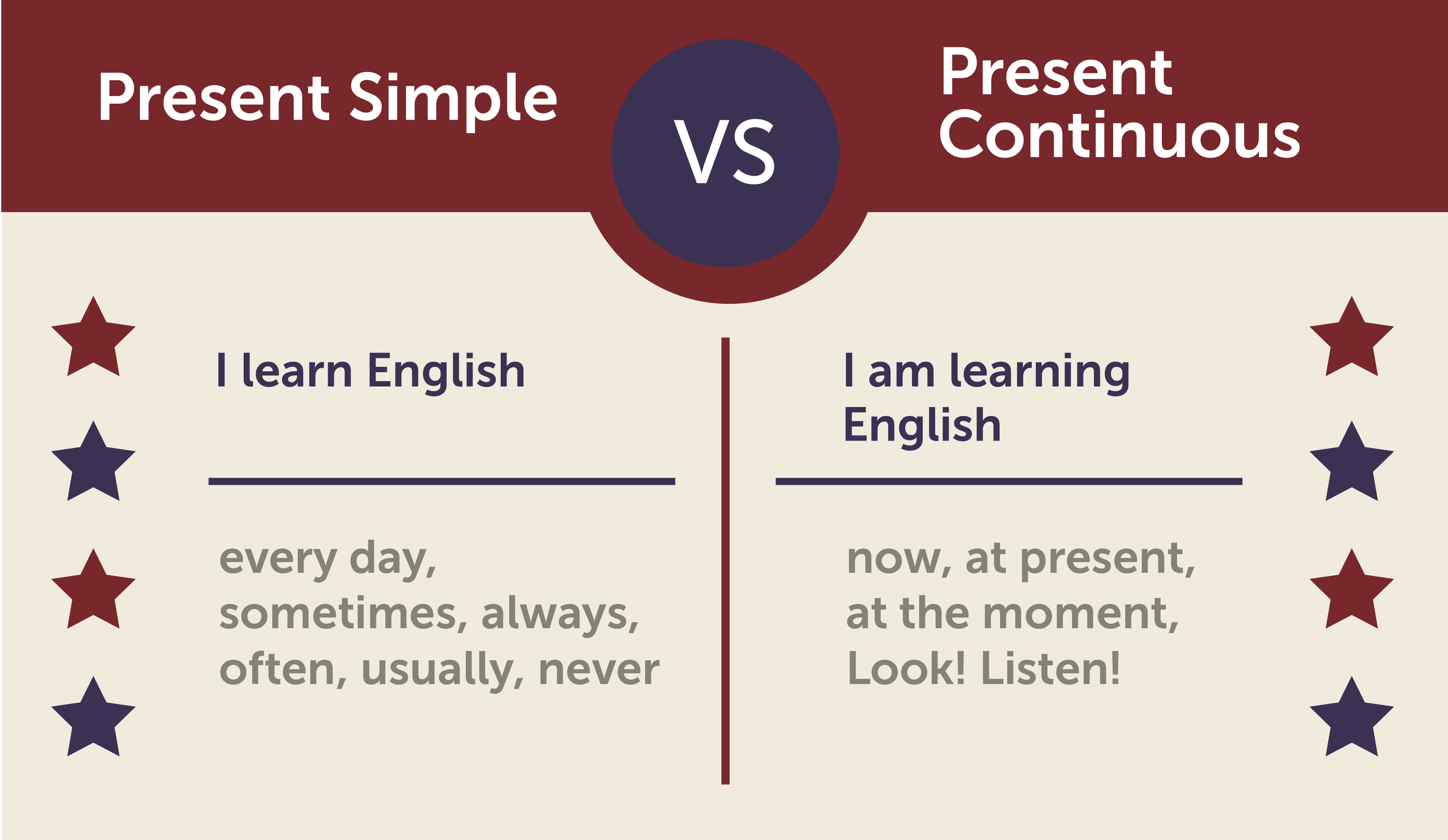
Present Simple is really used to indicate activities that occur regularly every day. It can be your habit, as well as your emotions, status, condition and profession. All verbs of personal perception such as love, see, like, believe, understand, hateetc. are static, that is, you cannot love someone right now, and tomorrow stop loving. Or believe in something now, and after an hour stop believing. So these verbs can only be used in Present Simple . Of course, there are exceptions to the rules: for example, the same slogan McDonalds with its unforgettable “I'm loving it” or colloquial options like “I'm seeing and I'm liking” . But such examples have nothing to do with classical grammar. In the end, you can also write “with ashypkame” for stylistic reasons. By the way, it will not be out of place here to note that it is better to eradicate the holy faith of Russian students in the infallibility of carriers from the very first lessons. Only a small percentage of native speakers speak perfect language, just like in Russia.
Returning to Present Simple, it can also be noted that occasionally at this time books are written where the story seems to be happening in the past, but all the actions of the characters are written in the present tense. In such cases, Present Simple has even been given a special name - narrative present, historic present or dramatic present.
And Present Simple can be used in the meaning of the future. For example, right now you are going to the airport, your departure in three hours. For you, these “in three hours” are the future, and for the aircraft - the standard schedule, according to which it regularly flies. So instead of “My plane will depart at 6 PM” it’s correct to say “My plane departs at 6 PM”In principle, everything here is similar to Russian. We also often say, “I will fly out at 6 in the evening,” and not “cure”.
Well-known and scientific facts are also described in Present Simple , hence its use in both parts of the conditional sentence of the zero type: “If you heat ice, it melts” . This is a scientific fact, and under this condition the result is always the same, so Present Simple is appropriate in both parts of the sentence. A big problem for Russian students is the first type of conditional sentences, where you need to use Present Simple in the first part and Future Simplein the second. The fact is that in Russian in such sentences the future tense will be present in both parts: "Until you do your homework, I will not let you go for a walk." And in English, the conditional part will always be in Present Simple: "Unless you do your homework, I won't let you go out . "
Instructions and imperative are also written in Present Simple : “Open your books, please”, “Do not get up until the plane lands” .
Present Continuous is used for activities that are happening right now. However, the matter is not limited to this. You can easily say “I'm living in Moscow now”, only for the carrier it will sound not as “I live in Moscow”, but as “I temporarily live in Moscow”, because Present Continuous is used to indicate temporary actions. That is, in our example, you came to Moscow on a business trip, for example, or for some kind of project work. You will not be there long and return to yourself. In 99% of cases, you will say “I'm staying at *** hotel” and not “I stay” because you are there temporarily and not permanently.
Present Continuous is used to describe temporary habits and trends. For example, "She's eating lots of salty snacks these days" (because, for example, she is pregnant and wants salty, but she will not always be pregnant), or "Nowadays a lot of people are studying English"(this is a trend, which, of course, can last quite a long time, but still not forever).
Present Continuous can also be used in the meaning of the future, and even here there is a slight coincidence with the Russian language. If you are sure that you will meet friends tonight, then you say: “We are meeting today” (in the present tense). In English the same thing. If something happens with absolute probability, then you need to use Present Continuous : “I'm meeting John tonight” .
The main mistakes of Russian-speaking students for this pair of times:
The main difference between the two times lies in their name. Present Perfect is the present, and Past Simple is the past. But for a Russian student, this is just hell. “I read the book” - what's the difference, I just read it, ten years ago, or basically read it? In Russian, no, but in English there is a difference. Therefore, by the way, many prefer the American version of the language: Present Perfect is rarely used there. In some states, you can already hear sentences like “I never did that in my life” that go against what students learn in courses or on their own. But still, to clear our conscience, we will study the difference between these times.
Past simple- simple past tense. We use it only in one case: when our action began and ended in the past. Temporary markers of this time indicate the completion of an action, for example, yesterday, in 1955, 40 years ago . That is, there is no connection with the present, and the action cannot be repeated. Many argue, they say, “I have graduated from the university” , it has a connection with the present, I’m still alive. But you could graduate from a particular university once. And this one happened in the past.
Irregular verbs present the greatest difficulty at this time. A universal recipe and magical ways to memorize these verbs, without applying effort, does not exist. All Germanic languages sin by the presence of irregular verbs, and even if you grieve decide to quit English and start German, then we have bad news for you. Verbs will have to be learned, and you will also need to remember that the negative and question will use the auxiliary verb did, which takes on the form of the verb. That is, if did is present in the sentence, the semantic verb will stand in the first form.
Present Perfect is used in several cases:
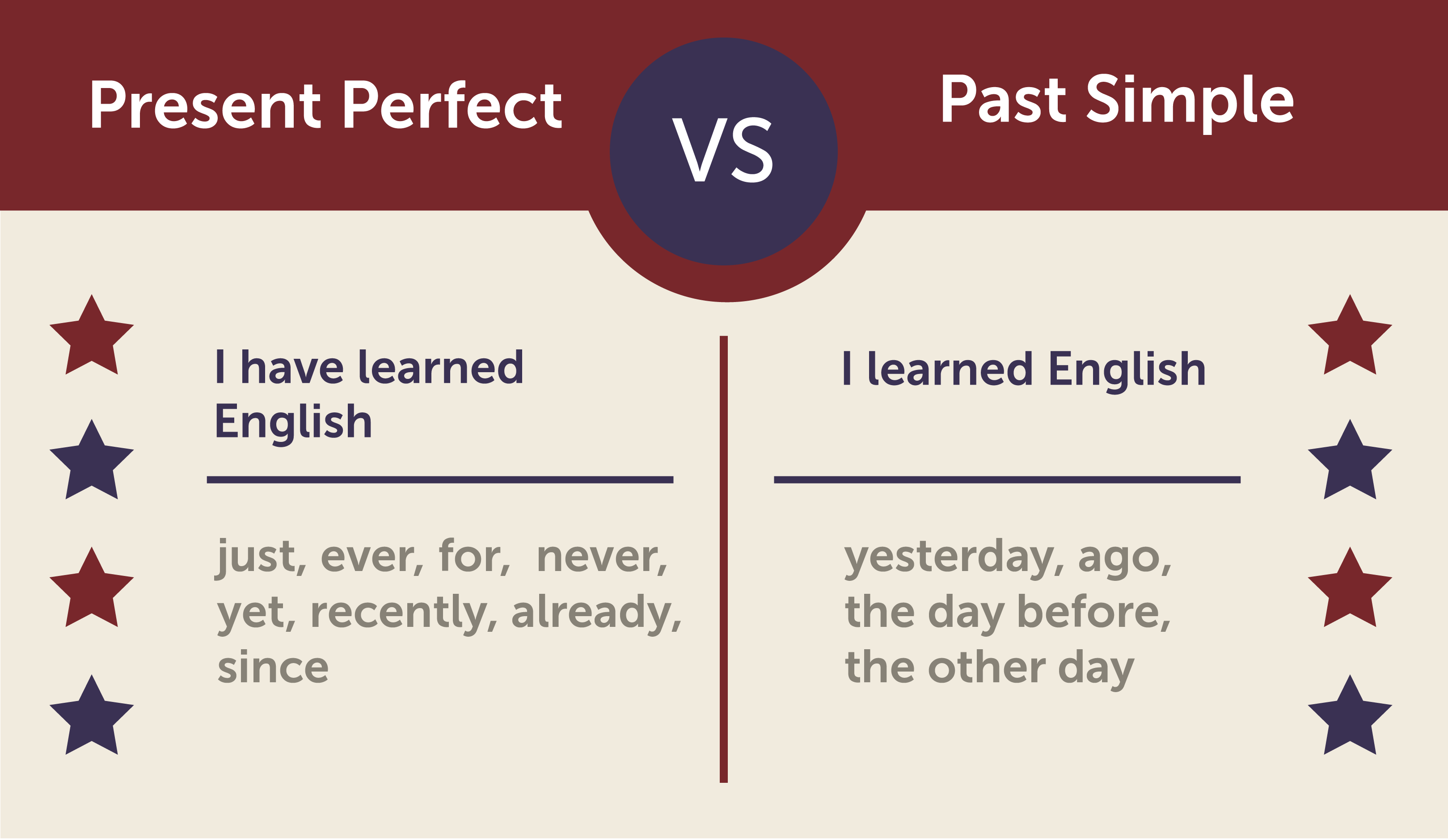
Between Past Simple and Present Perfec t there is a significant difference in terms of temporary markers. All Past Simple markers, as we noted above, give an accurate moment in the past. And Present Perfect markers are pretty blurry: recently, lately, already, ever, yet . They do not give an exact indication of the time.
Since there is no future tense category in English, there are many ways to designate this very future tense. Mostly students struggle with Future Simple and one of its most common synonyms to be going to . The first thing to remember here is the fact that to be going to is a separate construct, not a Present Continuous form of time . This designation means "going to do something", "have the intention to do something." And with time, Future Simple and the phrase to be going to have similarities.
So, for future facts, we can use Future Simple and be going to . There is no difference between "Jackson will turn 10 next year"and "Jackson is going to turn 10 next year . " Both formulations can be used for so-called predictions - predictions or consequences of something. For example, we can say “We'll be late for the train if we don't hurry” and “We're going to be late for the train if we don't hurry” .

But then the differences begin. To be going to is used for your hypotheses about the future, which are based on some fact from the present. Let us illustrate with an example: “Look at the sky! It's going to rain in a few minutes . " That is, you now see the clouds, and make your assumption based on this fact. Also to be going to will be used for pre-planned actions, for example:"I need some apples because I'm going to bake an apple pie . " First you decided to bake a pie, and now you want to buy apples.
Future Simple is also used for your predictions and assumptions, but most often they are based not on obvious facts, but on your feelings. Future Simple will be used after the words probably, maybe, hopefully and the phrases I think, I don't think, I'm sure, most likely , etc. We also use a simple future tense when the action we are about to take is spontaneous. “Wait, I'll help you with the boxes” - right now I decide to help with the boxes. Future Simple is used for promises ( I won't tell him, I promise ), requests (Will you do it for me, please? ), as well as consent or disagreement to do something ( I'm mad at him and I won't help him or He won't eat his greens ).

When studying different ways of expressing the future in English, we recommend listening to podcasts as often as possible or watching videos in English with native speakers and noting when they use what designs and why. It is important to understand the difference in values, because the rules are very unsteady and can not be combined with Russian (because we still have a future tense).
On Puzzle English you can find movies, TV shows, podcasts, lectures and other useful materials for learning English. Learn English with us.
1. Present Simple vs Present Continuous
At the Beginner level, students usually go through the grammar of these times and the basic rule: Present Simple is used for actions that occur regularly, and Present Continuous - for those that are now. Fair, but the higher the level, the greater the difference between times.
Present Simple is really used to indicate activities that occur regularly every day. It can be your habit, as well as your emotions, status, condition and profession. All verbs of personal perception such as love, see, like, believe, understand, hateetc. are static, that is, you cannot love someone right now, and tomorrow stop loving. Or believe in something now, and after an hour stop believing. So these verbs can only be used in Present Simple . Of course, there are exceptions to the rules: for example, the same slogan McDonalds with its unforgettable “I'm loving it” or colloquial options like “I'm seeing and I'm liking” . But such examples have nothing to do with classical grammar. In the end, you can also write “with ashypkame” for stylistic reasons. By the way, it will not be out of place here to note that it is better to eradicate the holy faith of Russian students in the infallibility of carriers from the very first lessons. Only a small percentage of native speakers speak perfect language, just like in Russia.
Returning to Present Simple, it can also be noted that occasionally at this time books are written where the story seems to be happening in the past, but all the actions of the characters are written in the present tense. In such cases, Present Simple has even been given a special name - narrative present, historic present or dramatic present.
And Present Simple can be used in the meaning of the future. For example, right now you are going to the airport, your departure in three hours. For you, these “in three hours” are the future, and for the aircraft - the standard schedule, according to which it regularly flies. So instead of “My plane will depart at 6 PM” it’s correct to say “My plane departs at 6 PM”In principle, everything here is similar to Russian. We also often say, “I will fly out at 6 in the evening,” and not “cure”.
Well-known and scientific facts are also described in Present Simple , hence its use in both parts of the conditional sentence of the zero type: “If you heat ice, it melts” . This is a scientific fact, and under this condition the result is always the same, so Present Simple is appropriate in both parts of the sentence. A big problem for Russian students is the first type of conditional sentences, where you need to use Present Simple in the first part and Future Simplein the second. The fact is that in Russian in such sentences the future tense will be present in both parts: "Until you do your homework, I will not let you go for a walk." And in English, the conditional part will always be in Present Simple: "Unless you do your homework, I won't let you go out . "
Instructions and imperative are also written in Present Simple : “Open your books, please”, “Do not get up until the plane lands” .
Present Continuous is used for activities that are happening right now. However, the matter is not limited to this. You can easily say “I'm living in Moscow now”, only for the carrier it will sound not as “I live in Moscow”, but as “I temporarily live in Moscow”, because Present Continuous is used to indicate temporary actions. That is, in our example, you came to Moscow on a business trip, for example, or for some kind of project work. You will not be there long and return to yourself. In 99% of cases, you will say “I'm staying at *** hotel” and not “I stay” because you are there temporarily and not permanently.
Present Continuous is used to describe temporary habits and trends. For example, "She's eating lots of salty snacks these days" (because, for example, she is pregnant and wants salty, but she will not always be pregnant), or "Nowadays a lot of people are studying English"(this is a trend, which, of course, can last quite a long time, but still not forever).
Present Continuous can also be used in the meaning of the future, and even here there is a slight coincidence with the Russian language. If you are sure that you will meet friends tonight, then you say: “We are meeting today” (in the present tense). In English the same thing. If something happens with absolute probability, then you need to use Present Continuous : “I'm meeting John tonight” .
The main mistakes of Russian-speaking students for this pair of times:
- lack of ending –s in the 3rd person singular for Present Simple . Recommendation: in addition to texts about yourself, write texts about each other and make sure that all verbs have the correct ending.
- confusion with auxiliary verbs. For Present Simple, an auxiliary verb is required in denial and question. It is impossible to create a negation and a question without do / does in modern English. The option of using “ain't” to create negation is colloquial, and it significantly reduces your status in the eyes of the speaker if you suddenly give such a proposal at an official meeting. Practical advice: first study the classical grammar, and then swarm in the wilds of slang and colloquial forms. It is better to sound a little pathetic than as a not very educated member of society.
At higher levels, you can experiment with the addition of the verb do to strengthen the meaning of "really," "and really," "really" in affirmative sentences:"But I do exercise every day and keep my diet! Just does not It SEEM to work! » .
For Present Continuous, the auxiliary verb is required in ALL sentences, without the verb to be not a single time of the Continuous scale is built. Any sentence like “I working now” is a mistake. - misuse of the verb to be in Present Simple . If your proposal conveys a state or emotions, you need the verb to be. If you have an action verb, then to be is no longer needed. We say "I know him," not "I am know him . " This error can be corrected through consistent work: first with the forms of the verb to be (that is, all sentences include only it), and then with verbs of action.
- adding –ing wherever you want. “I working in a big company” is wrong, but you work there regularly, every day. So, right “I work ”.
Present Perfect vs Past Simple
The main difference between the two times lies in their name. Present Perfect is the present, and Past Simple is the past. But for a Russian student, this is just hell. “I read the book” - what's the difference, I just read it, ten years ago, or basically read it? In Russian, no, but in English there is a difference. Therefore, by the way, many prefer the American version of the language: Present Perfect is rarely used there. In some states, you can already hear sentences like “I never did that in my life” that go against what students learn in courses or on their own. But still, to clear our conscience, we will study the difference between these times.
Past simple- simple past tense. We use it only in one case: when our action began and ended in the past. Temporary markers of this time indicate the completion of an action, for example, yesterday, in 1955, 40 years ago . That is, there is no connection with the present, and the action cannot be repeated. Many argue, they say, “I have graduated from the university” , it has a connection with the present, I’m still alive. But you could graduate from a particular university once. And this one happened in the past.
Irregular verbs present the greatest difficulty at this time. A universal recipe and magical ways to memorize these verbs, without applying effort, does not exist. All Germanic languages sin by the presence of irregular verbs, and even if you grieve decide to quit English and start German, then we have bad news for you. Verbs will have to be learned, and you will also need to remember that the negative and question will use the auxiliary verb did, which takes on the form of the verb. That is, if did is present in the sentence, the semantic verb will stand in the first form.
Present Perfect is used in several cases:
- to indicate life experience. If you are completely alive and able to repeat the trick with the reading of “Crime and Punishment,” the sentence will be in Present Perfect: “I have read“ Crime and Punishment ” . Best of all, this case of using Present Perfect is illustrated by the verb “happened” - it means I was and can visit again. Compare: “I have been to France many times” and “I was in France last summer” . In the first case, you have "visited and can visit again", in the second case you have a time limit: you were there last summer and that’s it. After all, the past summer can not be repeated.
- for an obvious result. In the sense that we see the result with our own eyes. For example, “Oh, you've painted the walls! The room looks so much fresher now . " That is, the walls may have been painted yesterday, but I'm interested in the result of the action: now the walls are painted. In the American version, Present Perfect is practically not used in such cases.
- if the time period is not completed. "I've already moved twice this year . " Since this year , we still have this year. And if the period is not completed, then it will not work to go back in time, we are still in the present. Fortunately for Russian students, Americans here also refused to use Present Perfect .
- action not completed. For example, “I've worked here for 6 years . ” Why not “work” ? Because there is a reference to the beginning - 6 years. We can say “I work here” (for example, a new security guard at the entrance to the office stopped you and asked where you were going), but without reference to the moment the action began. But “I worked here for six six years” - this is Present Perfect. However, if we want to emphasize that we have been working for 6 years and are working there right now, we can use Present Perfect Continuous: “I've been working here for 6 years” .
Between Past Simple and Present Perfec t there is a significant difference in terms of temporary markers. All Past Simple markers, as we noted above, give an accurate moment in the past. And Present Perfect markers are pretty blurry: recently, lately, already, ever, yet . They do not give an exact indication of the time.
Forms of the future. Future Simple vs be going to
Since there is no future tense category in English, there are many ways to designate this very future tense. Mostly students struggle with Future Simple and one of its most common synonyms to be going to . The first thing to remember here is the fact that to be going to is a separate construct, not a Present Continuous form of time . This designation means "going to do something", "have the intention to do something." And with time, Future Simple and the phrase to be going to have similarities.
So, for future facts, we can use Future Simple and be going to . There is no difference between "Jackson will turn 10 next year"and "Jackson is going to turn 10 next year . " Both formulations can be used for so-called predictions - predictions or consequences of something. For example, we can say “We'll be late for the train if we don't hurry” and “We're going to be late for the train if we don't hurry” .
But then the differences begin. To be going to is used for your hypotheses about the future, which are based on some fact from the present. Let us illustrate with an example: “Look at the sky! It's going to rain in a few minutes . " That is, you now see the clouds, and make your assumption based on this fact. Also to be going to will be used for pre-planned actions, for example:"I need some apples because I'm going to bake an apple pie . " First you decided to bake a pie, and now you want to buy apples.
Future Simple is also used for your predictions and assumptions, but most often they are based not on obvious facts, but on your feelings. Future Simple will be used after the words probably, maybe, hopefully and the phrases I think, I don't think, I'm sure, most likely , etc. We also use a simple future tense when the action we are about to take is spontaneous. “Wait, I'll help you with the boxes” - right now I decide to help with the boxes. Future Simple is used for promises ( I won't tell him, I promise ), requests (Will you do it for me, please? ), as well as consent or disagreement to do something ( I'm mad at him and I won't help him or He won't eat his greens ).
When studying different ways of expressing the future in English, we recommend listening to podcasts as often as possible or watching videos in English with native speakers and noting when they use what designs and why. It is important to understand the difference in values, because the rules are very unsteady and can not be combined with Russian (because we still have a future tense).
On Puzzle English you can find movies, TV shows, podcasts, lectures and other useful materials for learning English. Learn English with us.