Liquid metal: pitfalls. A look through the eyes of a chemist
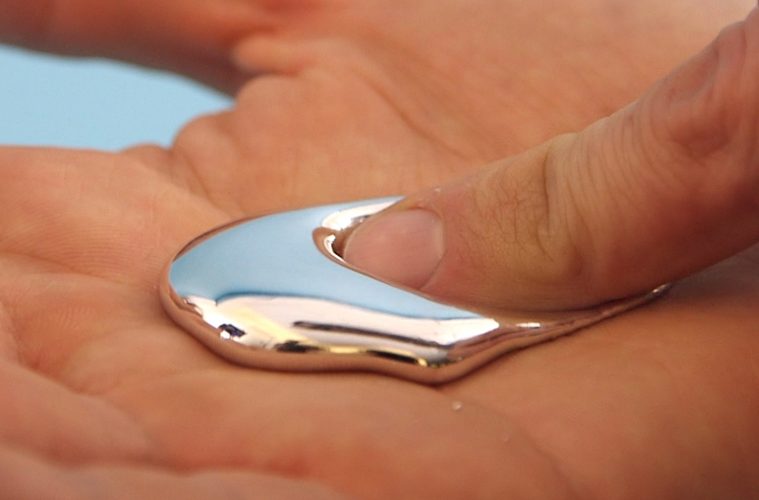
Write this article me post help NotSlow Not so scary liquid metal . Everything is simple there: he insured against short circuit, applied with a thin layer, screwed it on and enjoy the low temperatures. But is everything really good?
First you need to find out what kind of liquid metal it is. Among pure metals, the only one that can be liquid at room temperature is mercury. In their right mind, no one will now use mercury as a thermal interface due to its extreme toxicity and volatility. The other two become liquid already at the temperature of the human body - these are cesium and gallium. Cesium is “fluoride vice versa” in its chemical activity, it ignites and explodes from the slightest trace of air and moisture, and even destroys glass. Gallium remains (it’s precisely at the CPDV). At room temperature, gallium is still solid, but with some other low-melting metals it forms eutectics melting at 20.5 ° С (gallium-tin) and even 15.3 ° С (gallium-indium). Even lower - in the region of 5 ° С - the triple eutectic of gallium-indium-tin melts (62, 25 and 13%, respectively).
Based on this, pitfalls are also clear. The first of them is the absolute incompatibility of gallium-containing alloys with aluminum !
At a time when chemistry lessons at the school were certainly accompanied by a demonstration of experiments, there was among them experience in the amalgamation of aluminum. Aluminum was covered with a layer of mercury and it immediately began to oxidize violently, crumbling right before our eyes. Mercury protected aluminum from the formation of an oxide layer and it was already formed on the surface of the amalgam, but was not able to stop oxidation, since it did not stay on the surface of the liquid as a continuous layer, cracked, and a fresh, non-oxidized surface of the amalgam opened in the cracks.
The gallium alloy acts in exactly the same way, with the only difference being that it is capable of literally impregnating aluminum through and through, penetrating into intergranular spaces. Aluminum, impregnated with liquid gallium, not only oxidizes in the eyes, but also crumbles in the hands.
So LM should be kept away from aluminum. And this applies not only to aluminum radiators: a random drop of “liquid metal” can destroy the laptop case, if it is made of aluminum alloy, or any other aluminum part. At least the case of a capacitor. Moreover, this drop is a classic catalyst - it does its dirty work without diverging itself.
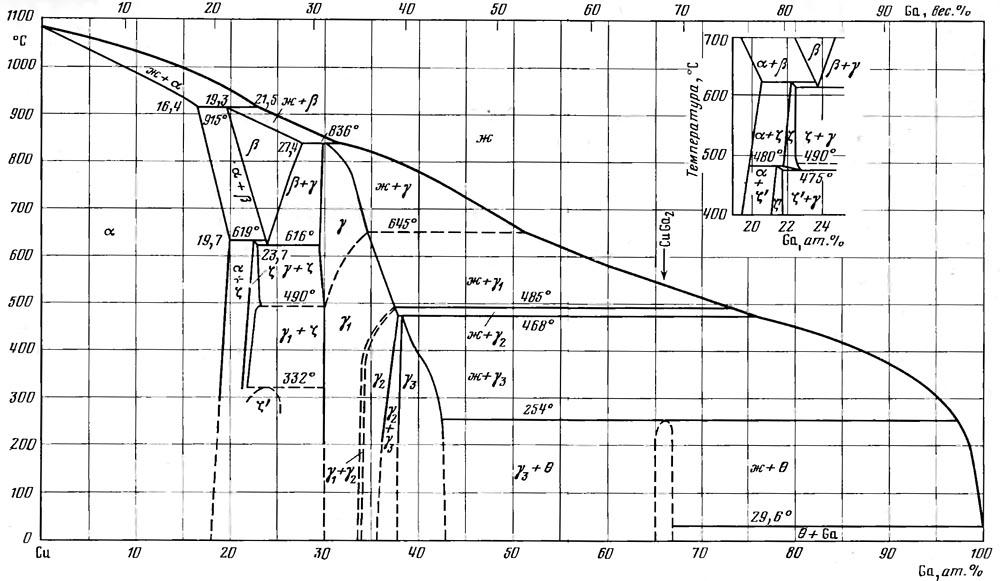
But copper is not indifferent to gallium. In the figure above, I presented a Tx diagram of a copper-gallium system (from the reference book “State diagrams of binary metal systems” edited by Lyakishev), which shows countless intermetallic compounds. As soon as gallium comes in contact with copper, they immediately begin to form. Liquid gallium (this also applies to its alloys) generally very readily wets both metals and non-metals, and a clear chemical affinity greatly contributes to this. So the "liquid metal" will simply be absorbed into copper, forming a crust of intermetallic compounds at the interface between metals. The latter are not metals from a physical point of view, they are refractory, brittle and have poor heat and electrical conductivity, but the main thing is that “liquid metal” will be spent on their formation and will simply leave the gap. Many of those those who tried in the case of LM, it is reported that over time it ceases to work, and having removed the radiator, they found that the liquid metal “evaporated”. He could not evaporate - the noticeable vapor pressure at his components appears only over a thousand degrees - he simply absorbed into the copper, reacted with it. The nickel coating on copper helps to eliminate this phenomenon, although it is an additional obstacle to heat.
By the way, the absorbency of gallium and its alloys in metals also applies to soldered joints - remember that little droplet that can destroy an aluminum case? So, the same droplet that gets on the solder will make it brittle, and the soldering unreliable. At some point, this will “work.” Therefore, personally, I would keep the "liquid metal" as far away as possible from any electronics.
And the last thing to write about: "liquid metal", alas, is not harmless. According to some data, gallium is comparable in toxicity with arsenic, its second component, indium, is also a toxic heavy metal. Unlike mercury, gallium-based alloys are still absolutely non-volatile at ordinary temperatures, so it will not work to poison them in vapors, however, because of their ability to easily stick to everything in the world, these alloys are incredibly oily. Soiling them with hands, for example, is easier than a lung, and washing them to the end is very difficult. Then it all gets into your mouth. Therefore, we work with “liquid metal” and everything that came into contact with it only in rubber gloves and separately from food, drink and smoking . And yes, never do as on the CPDV!