
EPON / GPON networks. Is the choice obvious?
The penetration of the Internet in cities with millionaires, according to the POF at the beginning of 2015, already amounted to 80%. The network covers residents of almost all apartment buildings. Overseas are only residents of the private sector. For telecom operators, it is the development of private households that can become an option to expand their subscriber base, but here it is not so simple. Taking this segment through FTTB networks is not so easy, DSL is hopelessly outdated, Wi-Fi is fast and legal only in glossy avenues. But xPON managed to fall in price literally to indecent. We will dwell on it in more detail.
Benefits of using xPONToday it is more obvious than ever: from one point of presence, you can connect all houses within a radius of several kilometers without installing active communication centers. With a sharp drop in the price of technology, this option becomes acceptable for many companies.
Before dwelling on xPON use cases (examples of EPON or GPON equipment), it is worth emphasizing that vendors such as BDCOM, Eltex and HUAWEI have long been providing devices that work on both branches of PON development. The difference in price tags, speeds and capabilities between them is not important. Unless up to 64 subscriber devices are connected to EPON per port, and GPON allows you to connect 128 subscribers. At the same time, EPON chips have already appeared on the market, allowing you to include up to 128 ONUs per port. Now only Eltex has a solution in their TurboGepon, and even then, with differences from the standard, however, attributing this feature to real problems does not make much sense.
And that's why. A budget that relies on a solution with 128 ONUs should be great for high-rise buildings, but there are some nuances. Typical penetration typically reaches 10-15%. Moreover, it is impossible to predict in advance the places of the appearance of subscribers. Personally, it is impossible to personally pull the wiring to each new client - PON is very sensitive to the quality of welding and installation.
Consider the wiring diagram for a typical high-rise building.

The scheme using optical division 1: 128
In order to make it comfortable to use “division by 128” for EPON, it is necessary to take end dividers with a margin - then the apartment capacity will be covered by 50%. For example, on the floor where 8 apartments are located, a divider of 4 is placed. In another option, we put a divider of 8 through each floor.
At the house level, the average statistics will still give a result - there will be no more than 25% of actually connected subscribers of the number of apartments in the house, which gives 64 clients from the PON port. The GPON port in this case will remain only half loaded.
Private sector
The residential sector, built up with low-rise construction, as a whole has no cardinal differences from high-rise buildings. As an example, take the small town of Sysert in the Sverdlovsk region. The private sector makes up most of the development. The wiring in this area was made to cover taking into account the penetration of 50%. An eight-core cable is used as a trunk.

Just a few years ago, such areas did not attract the attention of companies. Low density coupled with long distances made the construction of the network expensive and unprofitable. To do everything at once, with a margin as in a multi-apartment building, is long and expensive. Therefore, work is carried out from case to case, with different cables and, more importantly, with different hands. As a result, the optical budget does not withstand the "division by 128". And if so, then when choosing between GPON and EPON, there is not much difference.

Dividers
There are no fundamental differences in the variety of dividers. All of them are visible in the figures below.
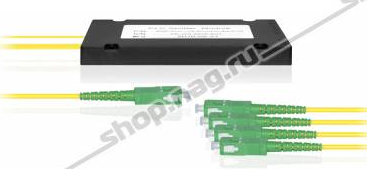
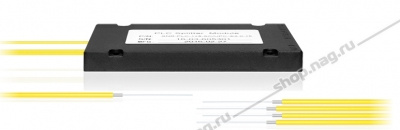
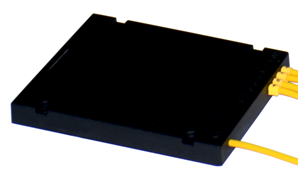
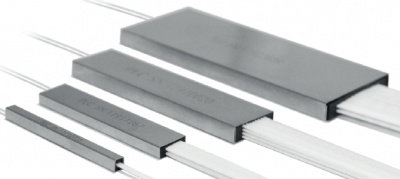
Here are the most popular models and estimated prices for them:

What does it look like in couplings?
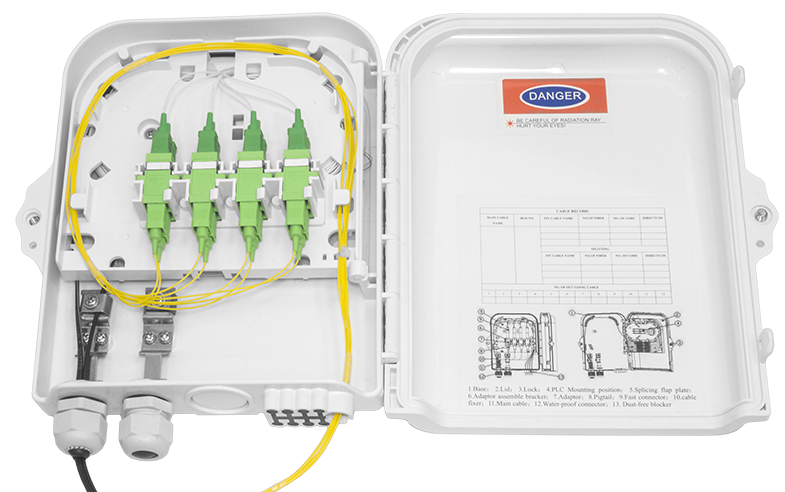
This is how the passage coupling with the installed divider of the first level 1: 8 looks like.

If there is a need, then two dividers can be placed in the coupling. In this situation, the inclusion of nearby subscribers allows you to do without a junction box.
Here is an example with dividers of the first level 1: 8 and at the same time a divider of the second level 1: 8

This placement implies sealing the output of subscriber cables using improvised means.

If you use a junction box, then everything looks even easier.
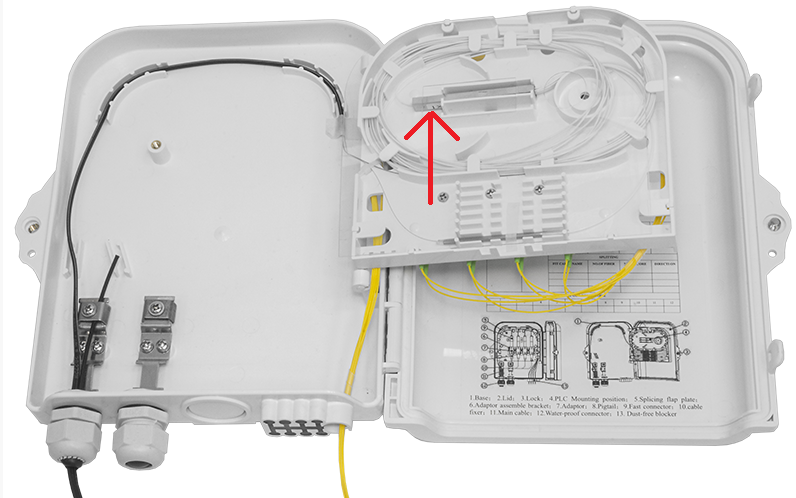
Type of connection of subscriber endings.
An example of connecting a subscriber with a straight through coupling

Speed
The size of the subscriber’s appetite for consumption traffic significantly depends on the social profile. Understand how much the table below will help.
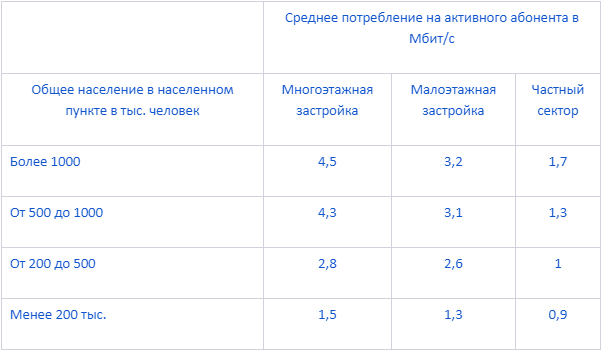
I would also like to analyze traffic consumption when using the IPTV service. Almost every operator on average provides its subscribers 150-200 channels. The total traffic at the same time easily reaches the mark of 1000 Mbps. Downloading to one PON port is determined only by the number of channels that the subscriber watches from a specific port. Statistics tell us that their number does not exceed 20. The proportion of “heavy” HD channels will be approximately 50% of this number.
The bitrate for HD will be considered 15 Mbit / s, the bitrate for SD-channels - 5 Mbit / s. Let's calculate the final consumption: 10 * 15 + 10 * 5 = 200 Mbps. The total average consumption for one PON port at 100% activity of all clients (including inclusion divided by 64) will be 64 * 4.5 Mbit / s + 200 Mbit / s = 488 Mbit / s. When you enable 128 clients - 128 * 4.5 Mbit / s + 200 Mbit / s = 776 Mbit / s. This is loading a single port in the most optimistic scenario, when all clients are connected and active.
As you can see from the speed calculations, EPON is quite enough, and although GPON speed is higher, it does not give us any real advantage. Accordingly, in this case, there is no particular difference between the varieties of technology.
Initial investment
As a rule, a network is built either by laying highways with the organization of customer dividing points, or by the “carpet” method. In the first embodiment, nodes arise randomly and are organized by installers performing work. There are many disadvantages. One of them is a high level of attenuation. A sample of 20 providers allows us to say that the attenuation with this approach ranges from 24 to 30+ dB when building a network with a division of 1:64. In this case, it will be hardly possible to get a working network with a coefficient of 1: 128.
In the second case, equipment is immediately installed in the area, based on an optimistic penetration rate. This allows you to properly organize the main level, make high-quality installation and get real attenuation close to the calculated one. With this option of building a network, it is easy to achieve a division of 1: 128 into one PON port.
In the first variant of building a network, equipment is purchased at the expense of money received for connecting a subscriber. Therefore, preference will be given to equipment with low cost. What are the solutions in terms of price?
The choice between EPON and GPON in rubles
We will compare the price using an example of a four-port solution. We will compare the average market price in rubles as of November 1, 2016.
EPON:

BDCOM P3310C with two PSUs and four SFP-modules PX-20 + , will cost ~ 70,000 rubles.
GPON:

Eltex - LTP-4X with two power supplies and four SFP-modules C +, will cost ~ 125 000 rubles.

Huawei - MA5608T with AC / DC PSU, 8 GPON ports with eight SFP + C + modules will cost ~ 160,000 rubles.
As ONU / ONT, we will consider single-port models as the most budget and popular ones.
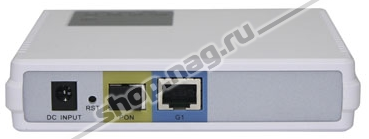
BDCOM P1501C1 will cost ~ 2046 rubles.

Eltex NTU-1 will cost ~ 2533 rubles.

Huawei HG8310Mwill cost ~ 2150 rubles.
We calculate the cost per client using the formula Scl = (Solt / Qp / N) + Sont, where:
Solt is the cost of OLT, Sont is the cost of ONT, Qp is the number of PON ports, N is the number of clients from one PON port.
The number of ports for Huawei will be considered equal to 4, to lead to a single configuration. For clarity, the results are summarized in the table:

From the table it is clearly seen that in terms of price, EPON is more profitable compared to GPON solutions.
Consider perspectives
When constructing an xPON network, it must be taken into account that not all hardware is compatible with each other. That is why some vendors prohibit the use of competitor equipment, along with their own. Therefore, for a number of other reasons, it is better to stop your choice on equipment for which joint work with alternative iron of another “company” will not become a stumbling block.
A great example is the EPON BDCOM devices. Compatible with other vendors supporting the CTC 2 specification. Those who have already worked with OLT BDCOM are aware of alternative ONU modelswho successfully work together with OLT. Together with Huawei's OLT, ONUs from ZTE, Fiberhome and others are working successfully. At the time of writing, OLT from Eltex did not allow working with third-party ONUs. Perhaps this will change in the future, but now it is worth paying attention to.
Traffic consumption is growing every year and the moment when xPON speed is no longer enough is already coming. However, 10G xPON solutions are available on the market (10G xPON should be understood as XG-PON and 10G-EPON ), which provide 10G downstream and 2.5G upstream traffic. Since 10G xPON uses different wavelengths for operation, a phased transfer of clients from xPON to 10G xPON is possible. The wavelength distributions for different generations of PON can be clearly seen in the figure below.

A gradual transition from xPON to 10G xPON is possible with the installation of an additional OLT that supports 10G xPON or an additional board (if you use a chassis, for example, Huawei). Using the filters, add the signal from the ports of the new device to the existing xPON network and distribute the new ONUs to 10G xPON clients. Unfortunately, the current price of 10G xPON is almost ten times higher than the usual price, which creates serious obstacles for mass implementation. Therefore, most likely, the transition to 10G xPON in the next five years is possible only in high-rise buildings.
This refers not to the “clean” 10G xPON, but to the combined mode of operation. This is due to the fact that 10% of subscribers generate 90% of the traffic, therefore it is economically feasible to transfer them to a new PON, as well as legal entities. persons. It is also possible to use 10G xPON at the aggregation level. In this situation, instead of the often used ring with STP, a ring of two independent cables is built to obtain a 1 + 1 (type B) circuit. This method allows for non-volatile, two-beam connection of each switch.
Despite the fact that China has begun a massive transition to XG-PON (which has created a shortage of EML lasers for two years now, which everyone who orders CWDM or DWDM modules over 40km has felt) in Russia, in our opinion, the prospects for using 10G xPON in sectors of low-rise and private homes in the next 5 years are unlikely. In this segment, the cost of equipment is most important and a multiple increase in price is unacceptable. In the event of a lack of xPON speed, operators will prefer to switch to a 32-user connection scheme per port. TWDM PON technology will help to do this without changing the cable infrastructure. TWDM PON technology allows you to organize multiple PON channels in one fiber using different wavelengths. Especially for this, the ranges 1270-1280 / 1570-1580 nm, 1535-1540 / 1553-1558 and 1535-1540 / 1570-1580 nm are distinguished.
To summarize the above, let’s try to figure out how fair some common statements are:
- GPON is faster than EPON. Of course, the maximum allowable downstream speed in GPON is greater, however, if you connect 128 clients per beam, then the specific speed for one client will be equal to the option with EPON, while the upstream speed will be even less. In addition, above we examined the traffic consumption that is typical for different types of clients and got the necessary speed that both EPON and GPON can provide. For this reason, we will consider a draw.
- GPON is more functional than EPON. GPON's capabilities are wider, but if you drop TDM transmission, as the distribution of E1 is extremely low. At GPON, through the use of detailed settings for speeds and priorities for each GEM port, you can better manage services and traffic for them. However, this significantly complicates the setup and for small operators that do not have a configuration management system integrated with billing, this is more a minus than a plus. As for the widely used functionality, it is equally represented in both versions.
- GPON allows you to connect 128 clients to one port, which makes it ultimately cheaper. In the comparison section “EPON and GPON in rubles”, we were able to see that EPON is cheaper than GPON solutions, even if 128 clients from one PON port are included.