May 12, 2017 at 17:59
Intel Itanium processor officially died
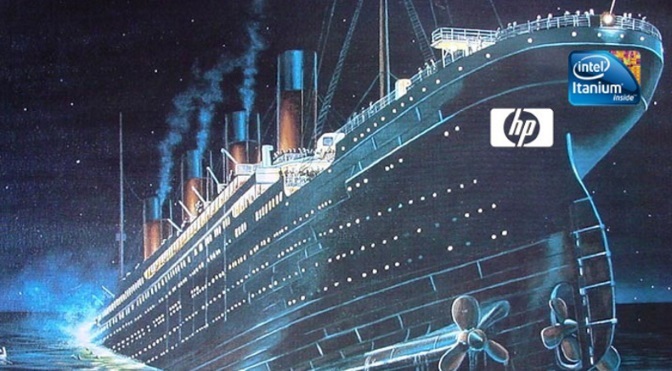
The Intel Itanium processor is a microprocessor based on the IA-64 architecture (EPIC), developed jointly by Intel and Hewlett-Packard and introduced on May 29, 2001, that is, almost 16 years ago. Due to unsuccessful marketing and low sales, this processor with huge ambitions was ironically called Itanic, consonant with the famous transatlantic liner.
At the time, the architecture of IA-64 was called revolutionary. It was supposed to replace x86 in 64-bit servers and desktop computers. But something went wrong. Years of development and promotion cost billions of dollars to Intel and Hewlett-Packard, but now their torment has come to an end. On Thursday, May 11, 2017, Intel began supplying the Itanium 9700 chip (codenamed Kittson) - this is officially and finally the last chip of the Itanium family, confirmedIntel representatives.
Intel support has been declining in recent decades, so these processors gradually left the scene. Server manufacturers stopped releasing new models on Itanium, software updates also stopped, and Intel itself openly encouraged customers to
switch to Xeon processors with x86 architecture, so the final farewell to the Itanium line was not surprising. Well, Intel can now fully focus on Xeon - a successful family that is booming.
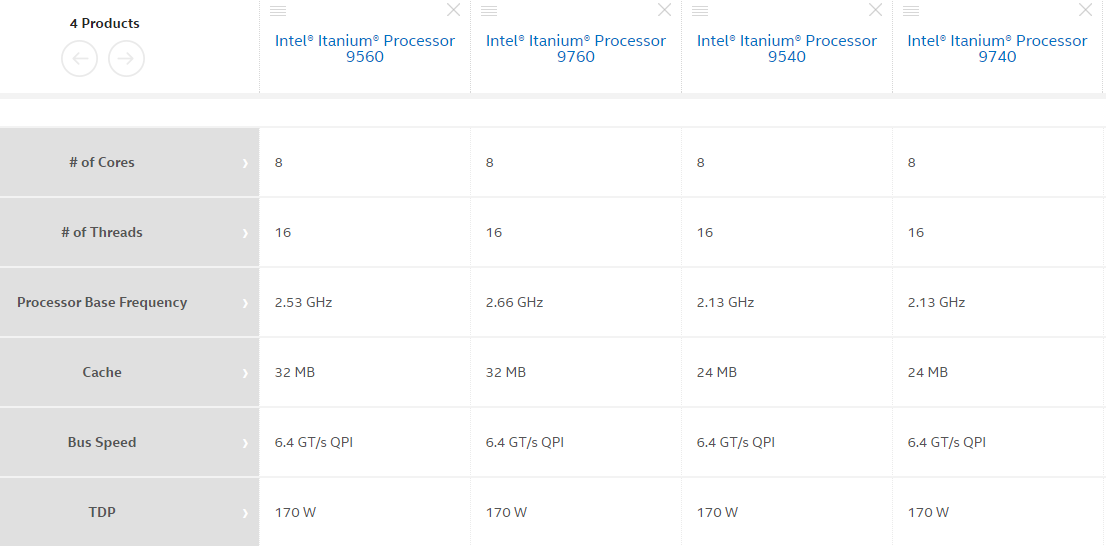
The Itanium 9700 model, based on the 32 nm process technology, is a small update to the previous model, code-named Poulson, which was designed for high-performance servers under Unix and was released in 2012. As you can see from the table, the difference between Poulson and Kittson is really small.
The only major buyer of these processors is Hewlett Packard Enterprise, which will upgrade its Integrity i6 servers. These servers run under the HP-UX operating system. The Itanium 9700 is compatible with Poulson, so upgrading is easy. Integrity i6 servers with new processors sell for as low as $ 14,500.
In the 90s, the Itanium processor was developed by Intel in conjunction with Hewlett-Packard. The latter was looking for a way to upgrade its aging PA-RISC architecture and adapt it to modern 64-bit server chips that can run traditional old OSs like Unix. At that time, Intel was just looking for a way to enter the high-performance server market - and the partners found each other. Together, they proposed an alternative in this market to existing mainframe architectures such as Oracle / Sun SPARC and IBM Power. At first, it seemed like an innovative technology that could succeed.
HP and Intel engineers have suggested that VLIW's EPIC (Explicitly Parallel Instruction Computing) microprocessor architecture ("Computing with explicit parallelism of machine instructions")able to overcome the inherent limitations of RISC and help increase processor performance without increasing the clock speed, executing more and more instructions per cycle, while the instruction scheduler, branch prediction, etc. were removed from the processor and transferred to the compiler. In theory, this was supposed to free up space for additional execution modules on the microcircuit and increase parallel performance. But in practice, this did not work. Truly effective compilers have not been created. In addition, EPIC was so radically different from other architectures that ARM and x86 can be considered twin brothers in comparison with it.
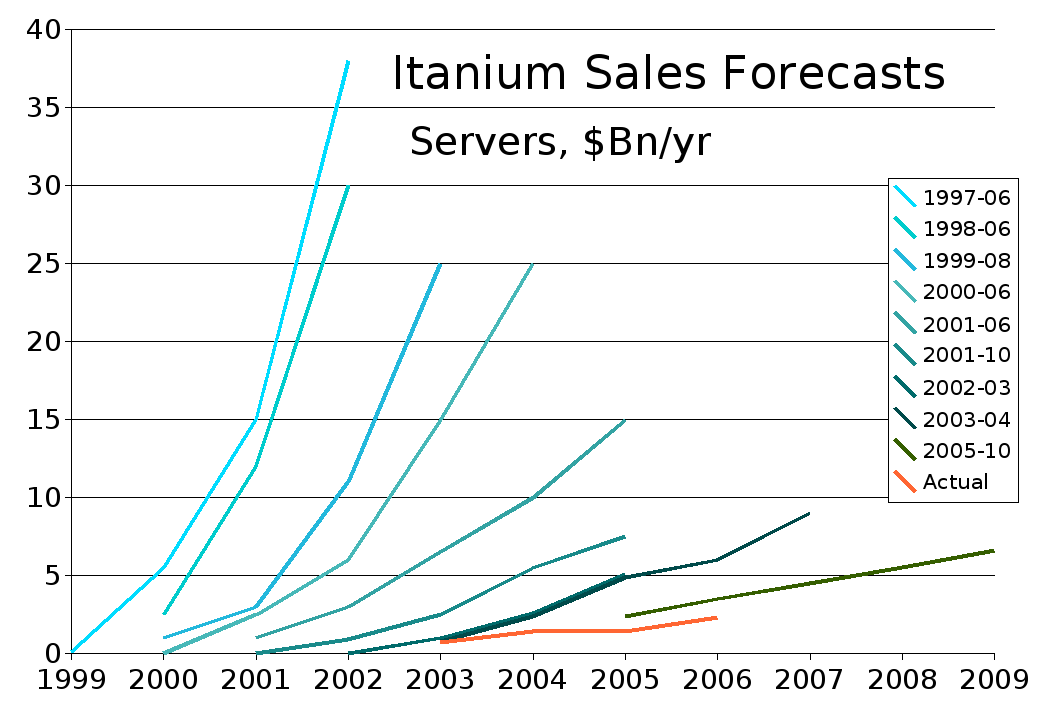
Before the release in 2001, the IA-64 architecture was presented as revolutionary. The illustration shows what Itanium sales forecasts were made in different years, and orange shows the real sales volume after the fact.
The first Itanium family processors were incredibly power hungry. They needed powerful cooling. Processors were expensive and difficult to manufacture. And they entered the market many years later than planned.
Intel initially wanted to release a consumer version of IA-64 for desktop computers, but this never happened, and the market quickly changed when in 2003 AMD released the first 64-bit processors based on x86 architecture (Opteron on AMD K8 architecture with AMD64 instruction set ), while Intel then had only 32-bit. Intel had to catch up with its 64-bit version of x86 (Intel even implemented a set of instructions from AMD, which is now known as x86-64), and the development of Itanium then faded into the background. Instead, on the contrary, 64-bit processors based on x86 architecture began to conquer the market of high-performance servers.
The most powerful blow under the breath Itanium received in 2010 from Microsoft. She thenannounced that Windows Server 2008 R2 will be the latest Itanium-based server OS . In March 2011, Oracle also announced the termination of any software development for Itanium . Moreover, in a statement to Oracle there was a direct complaint to Intel's management, which "made it clear that their strategic goal is the x86 microprocessor, and that Itanium is at the end of its life cycle." After that, HP sued Oracle, demanding continued support for Oracle software for users of its servers under HP-UX.
In the end, Xeon processors even caught up with Itanium in functionality. So, in the 15-core Xeon E7 v2 (2012), Intel implemented some unique Itanium features. By that time, HP had also made it easier for customers to migrate from Itanium servers to Xeon x86 servers. It became clear that the curtailment of Itanium production was not far off. But it was not so simple, because many customers who purchased this equipment required support and did not want to abandon Itanium. So HP continued to produce servers, and the Itanium processor family lived a little longer than planned.
HPE announces that Itanium server support will continue until 2025, with the latest HP-UX 11i v3 2017 update coming out in June.
To summarize, Itanium was one of the interesting experiments with microprocessor architecture, and it lasted much longer than others managed. Many say x86 architecture is outdated. And Intel itself has repeatedly tried to replace it. Itanium is another such attempt, but x86 is still on horseback.