Racing vertically. How, why and where are the elevators of Lakhta Center going
To get to the highest inhabited floors of the Lakhta Center is a matter of seconds. On the shuttle elevator, the journey to the observation deck takes 45 seconds. 45 seconds - and you are already above the city, above the clouds, over the St. Petersburg rain and fog. Is it possible to regret that the trip ended so quickly? Yes, because the elevator is so lucky that you don’t want to leave it. Other elevators that make up the Lakhta Center vertical transport system also differ from their counterparts in terms of structure, carrying capacity, and functionality. Let's take a closer look at them.
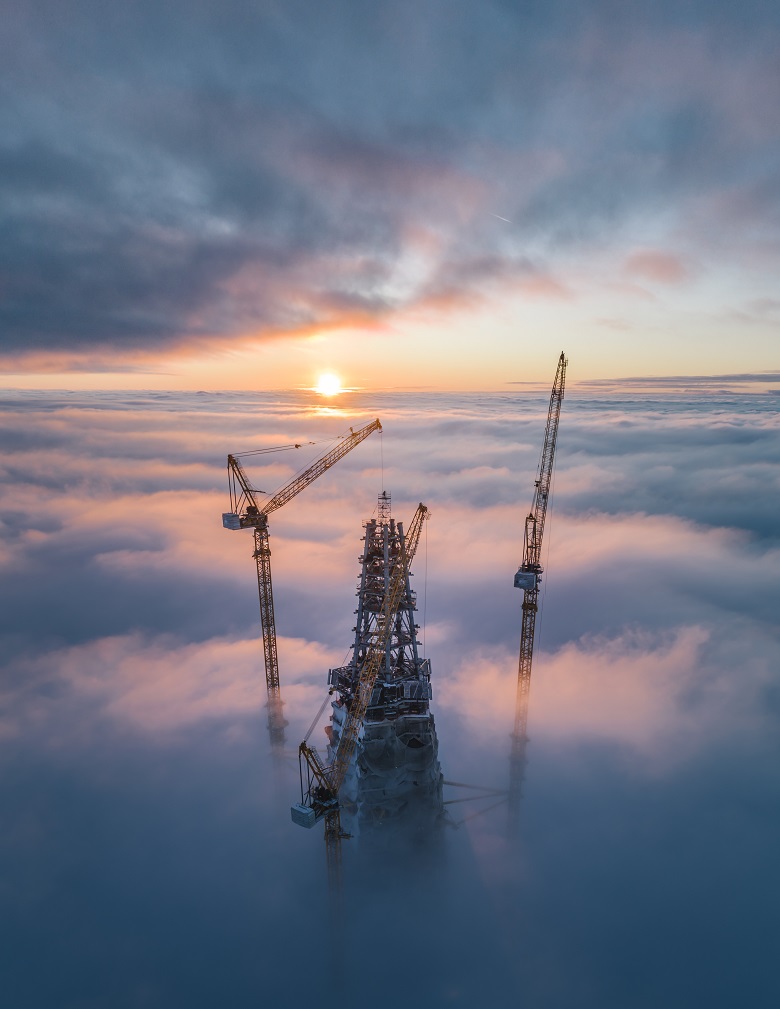
Not obvious side functionality of the Lakhta Center elevators - trips for sunny weather. Photo by Mikhail Proskalov
There will be 40 elevators in the tower. All rolling stock is grouped into three transport zones.
Six two-level elevators - Double Deck will serve the lower zone from the 1st to the 32nd floors. Elevators of the middle group can be reached from the 31st to the 52nd - they do not stop on the floors of the lower zone. In addition, up to 51-52 floors will go four more double elevator express trains, which can generally be reached only at the final stops. Finally, at the upper level from the 51st to the 80th floor, five more double lifts ply. Transport zones will be interconnected by two-story skylobby interchanges.

Interchange floors - skylobby. In addition to the main function, they play the role of foyer recreation
However, this is not the whole vertical transport complex of the supertoll. The flagship is a tourist high-speed express train departing from the 3rd floor and finishing at the 83rd floor, that is, at the first level of the observation platform (elevation height 344.4 m). Intermediate stop - restaurant on the 75th floor. (Clickable) How to understand such a complex system of transport zones and transfers, especially if a person is for the first time at the Lakhta Center?

No need to figure it out. In front of the elevator hall, visitors to the tower will be greeted by the terminals of the PORT automatic group control system. It is enough to press the button of the desired floor on the touch screen, and the system will indicate which elevator of which group you need to go through. In the cabs there will be no control panels with buttons at all - only hidden remote controls for personnel. Everything is ruled by PORT.
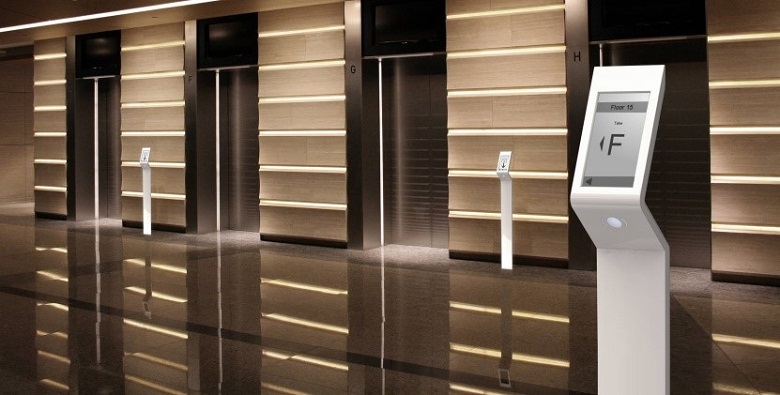
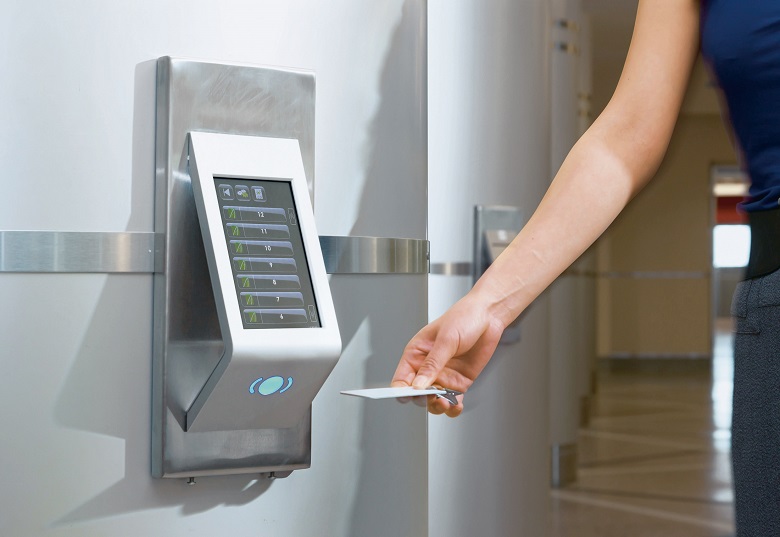
Schindler PORT Technology
It is easy to imagine which lines would accumulate in the elevator halls if the elevators worked traditionally. After all, the total population of the Lakhta Center tower is about 5 thousand people.
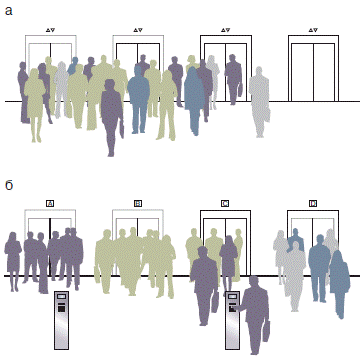
Selection of the floor of the destination with the traditional control system (a) and with the control system with the choice of the destination floor (b)
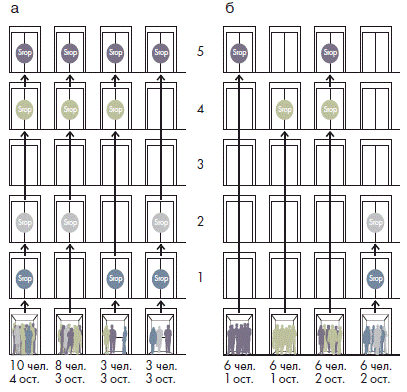
The operation scheme of the elevator group with the traditional control system (a) and with the control system with the choice of the destination floor (b)
Thanks to automation, the waiting time for passenger elevators does not exceed 29 seconds. Together with the trip itself, the time required to reach the floors of the lower and middle zones will be within 80-100 seconds, and to the upper - 100-150 seconds.
The speed of the elevators themselves varies in different altitude zones of the Lakhta Center skyscraper - from 4 to 7 m / s for the bulk of the cabins and reaches 8 m / s - for example, in the case of a tourist express train. This, of course, is not a record figure, but it is far from 1-1.6 m / s, with which elevators of ordinary residential skyscrapers move. In defense of the latter - they also took a significant step from 0.71 m / s the speed of elevators of Soviet times.
The Lakhta Center transport system uses elevators with two cabs rigidly fixed one above the other (Double Deck). This design allows you to double the throughput. This is a powerful plus that outweighs all the disadvantages of a “two-deck” solution.
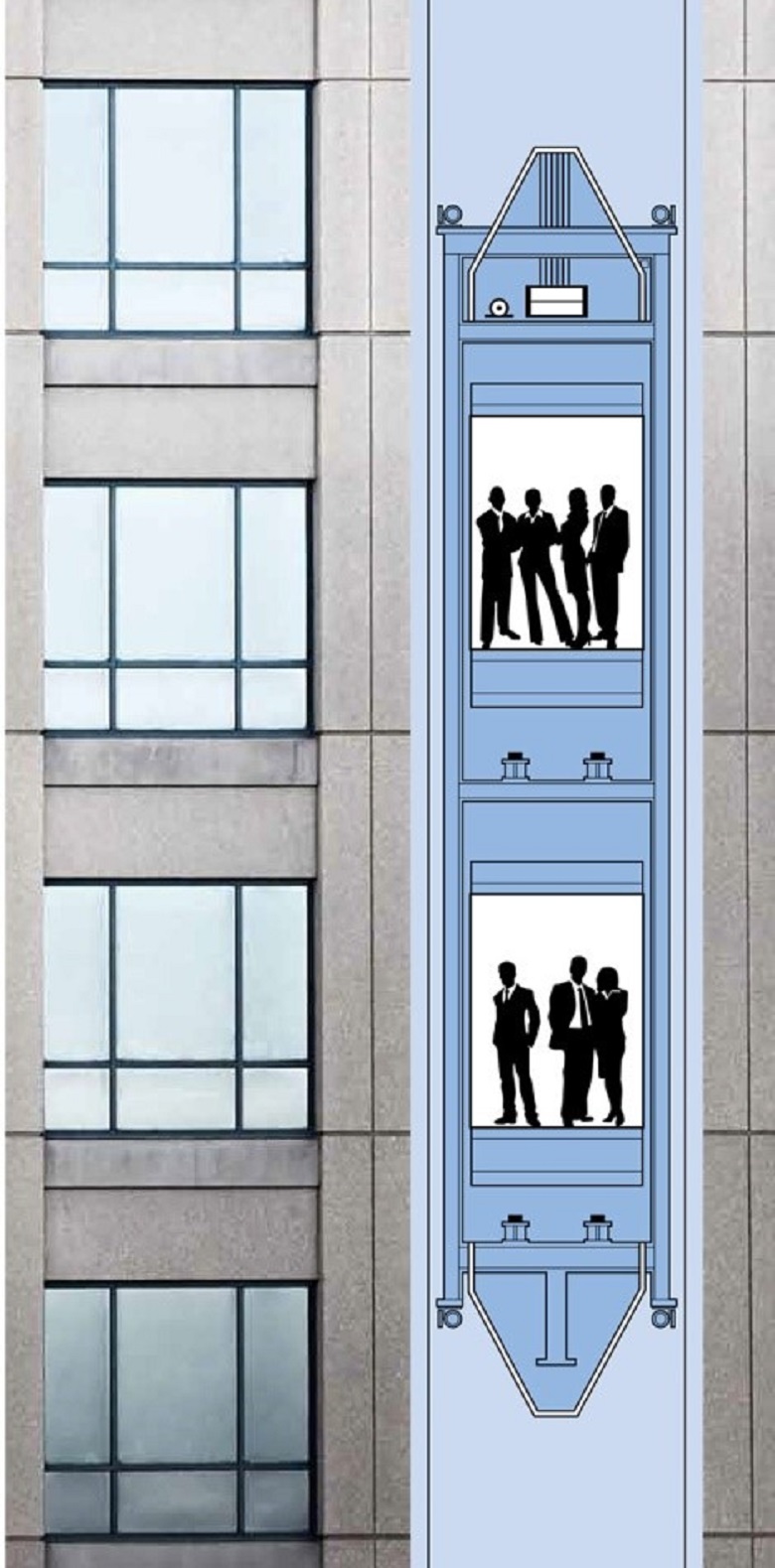
In the world there are only about a hundred buildings where cabs of this type are used. All of them are designed individually - due to the different sizes of the elevator shafts, the engine room and other specific features of buildings.
Double-deck lifts are a heavy, large-tonnage “fleet” that operates effectively during peak hours. In addition, not only increased carrying capacity, but also a reduced number of stops - landing / disembarkation takes place from two floors at once.
Special thanks to the two-level elevators for saving usable space and reducing construction volumes due to the compact placement of cabins one above the other. A single-decker cabin of similar size and carrying capacity would require double the size of the elevator shaft. Imagine the required size of the building core in this case?
But the beautiful Double Deck also has disadvantages.
Of the "little things" - the size of the double-decker winches occupy a comparatively larger percentage of the engine room area.
Here's an example of an twin elevator winch: The

capacity of the cabin lifted by this winch is 1800 kg, speed - 6 m / s. The weight of the winch itself is 6 tons.
And here is the Double Deck elevator winch:
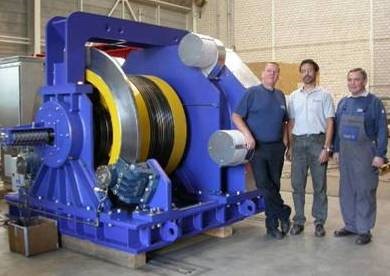
Lift for two cabs with a carrying capacity of 1800 kg each, lifting speed - 10 m / s, winch weight - 18 tons!
But this is the main thing: interchange floors are needed in order to carry out landing and disembarkation from a two-level cabin at the final stops. Remember the double-decker skylobby? Here is the reason for their appearance.
As a result, the installation of at least one two-level cabin dooms the fact that the other elevators of this group will be Double Deck. It makes no sense to build a two-story interchange space to put just a couple of two-deckers. For example, in the Lakhta Center of elevators of this type - fifteen.
Yes, the elevators in Lakhta Center are quiet and smooth, due to the use of roller shoes - the cabin does not slide along the rails, but rolls.

Correspondents of TC St. Petersburg for the experiment put a coin on the edge in the cabin of a similar elevator. It can be seen that even at the time of launch it stands as glued.
In the comments there were questions about whether elevator cables are being used now and there were suggestions that they are no longer needed, since the cabin is traveling on rails. This is not so - the cables have not yet disappeared, on the gif you can see the system of steel ropes.
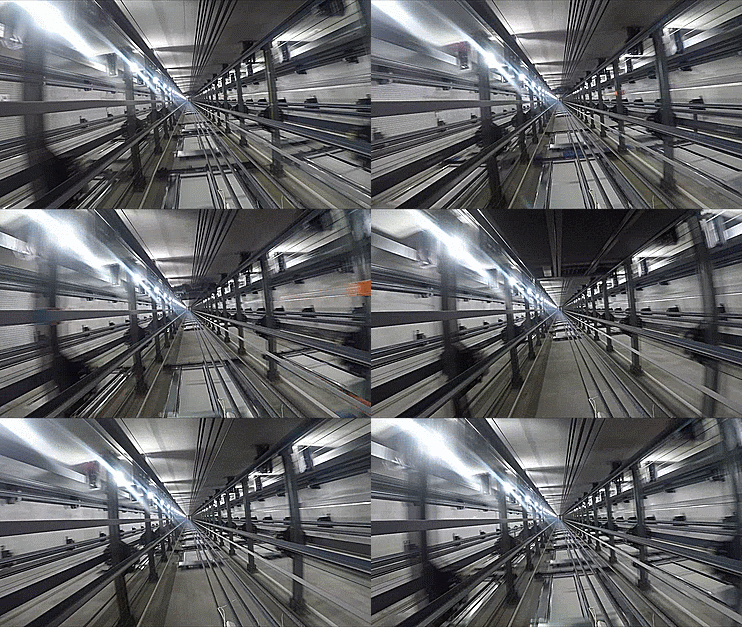
Ride in the elevator shaft
There are no technical problems with the length of the cable for the elevators of the skyscraper either - the question of the weight and length of the rope so far arises an insoluble task only in the case of a cosmolift. The tower of the Lakhta Center, although high, still has not grown to insoluble tasks.
Of course, elevators in Lakhta are state-of-the-art equipment, in terms of energy consumption they correspond to class A. An interesting element is winches with energy recovery during braking, which returns up to 30% of electricity to the system.

Particular attention in the design of the vertical transport system was paid to safety. All high-speed and high-speed elevators are located inside the main supporting structure of the tower - the rigid body of the core, in the space of the skyscraper most protected from any cataclysms.
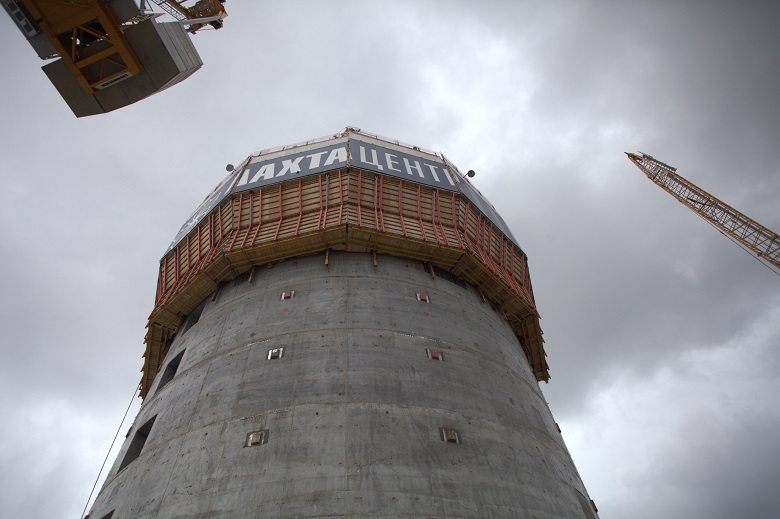
Supermassive core - a place where will be located the elevators Complex

Scheme
Outside the nucleus - only panoramic elevators that travel in mines glass frame between the levels of lookouts and Compact Cargo - carrying capacity of 100 kg - designed to serve the kitchens of restaurants and so earned the nickname "borschevozy".

The tension of all cables holding each cab is controlled by special sensors that stop the elevator when at least one cable is loosened. But even if you imagine a unrealistic situation: all the cables broke at the same time, the electronics refused and the cab switched to uncontrolled descent mode, then ... nothing bad will happen. Remember catchers and overspeed sensors invented two centuries ago. They are still working. And even spectacular fountains of sparks during braking, as in popular action movies, will not be - due to special ceramic pads.
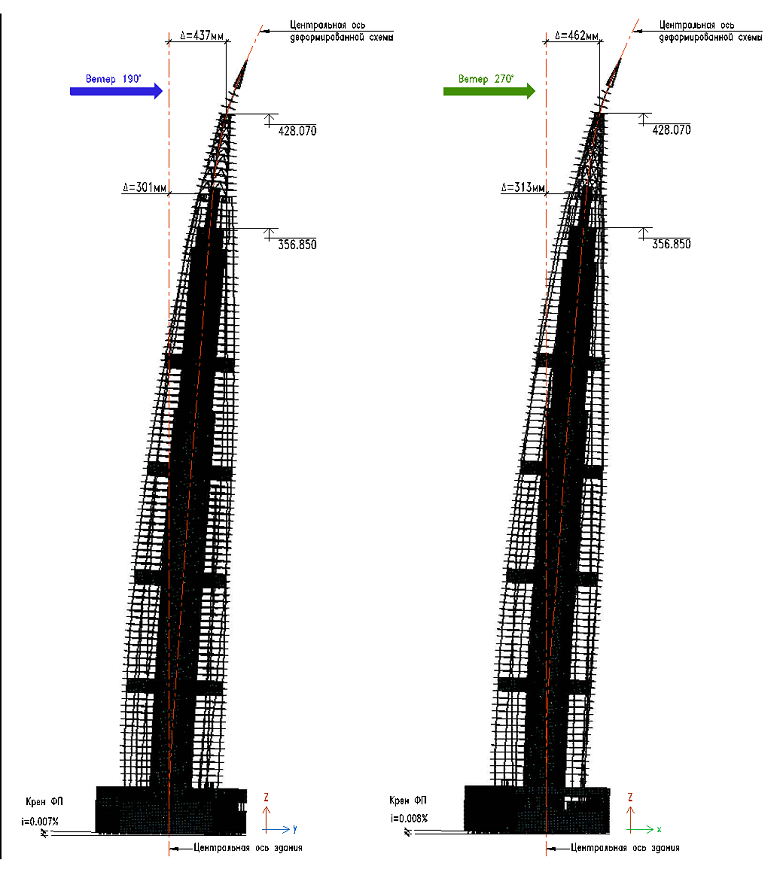
The elevator control system even tracks the angle of deviation of the building from the vertical, and when the critical value is exceeded, it turns off the elevators.
But all this is extreme situations, the probability of which is calculated in fractions of a percent. But technological difficulties arose in the process of designing a vertical transport system for a skyscraper regularly, and rather non-standard solutions were used to solve them.
For example, to combat the piston effect in express elevator shafts, when a cabin moving at high speed creates powerful vertical air currents in front of it, it was necessary to provide special openings between adjacent shafts.
To reduce the influence of the draft effect that arises in the mine due to temperature and pressure differences, protective membranes are installed that cover the entire section of the mine.
Sometimes an elevator is more than a means of getting from point A to point B. Here, for example, is an exceptional story that simply cannot be passed on:

On the gif - a tour in the office of a Czech industrialist Tomas Bati. The office itself is located in the elevator. Dad used it so that he could work alongside the employees of his shoe factory — today with lawyers, tomorrow with engineers, the day after tomorrow in a cutting shop ... That’s for sure - dad.
But back to the Lakhta Center.
There is a special group of super important elevators in the skyscraper. In life, they look and work like ordinary elevators. But in the event of an emergency, they become a good tool to combat the elimination of the incident.
In the comments, earlier opinions were expressed that a fire in a skyscraper is a special case: firefighters cannot throw a ladder and come to the aid “out of the window”.
There are really no such ladders: 90 meters is the ceiling and it is unlikely that they will ever grow back. But there are no restrictions for “storming” - they are served from the window below - to the window above.
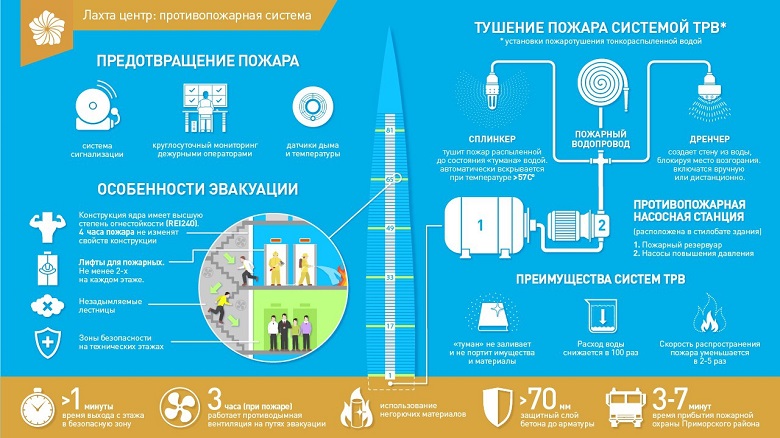
The main ways of evacuating some and coming to the aid of others are non-smoke stairs in the core of the tower. The core, having the highest existing fire resistance limit, is a reliable and safe escape route. As for the offensive, with a hypothetical fire at the very top of the tower, a hike up will take some time.
In extreme conditions, when minutes of the road, special elevators come to the rescue. They, like their lifting comrades, when they receive a “fire” signal, descend to the first floor and drop off passengers, not responding to anyone else's calls. But firefighters have a special unified key for controlling special cabs.
There are several such elevators in the tower of a skyscraper, including one moving at a speed of 8 m / s and delivering even to the very top in less than a minute.
The shafts of the fire-fighting elevators have special vestibules where, in the case of an emergency, air is blown up - this prevents the entry of fire and combustion products directly to the elevators.
Firefighters first get into the vestibule, and only from there - into rooms where there is a fire. If it is not possible to get out of the vestibule, firefighters in the elevator can go down to the floor below and then climb the undisturbed stairs in the core. (Clickable) There are other special elevators. For example, a separate elevator is designed to transport IT equipment to the server. And guaranteed the most popular in the near future - a shuttle to the observation platform of the Lakhta Center. Its walls are equipped with LED panels, and a short 45-second ride on it itself promises to be an adventure. This kind of attraction is arranged in one of the elevators of the WTC tower - you can see the whole history of the construction of New York.
Even an inveterate elevator-claustrophobe with pleasure will travel in such an elevator
. Unfortunately, the details of what will be shown during the shuttle ride to the Lakhta Center have not yet been disclosed. One good thing is to wait just a short while.
***
The first part of the article about elevators - Express to the clouds. How the vertical transport system works in modern skyscrapers.
***
Advised on the preparation of the material: Alexander Sergeyevich Orlov - head of the vertical transport department at Lakhta Center, Alexander Vitalyevich Gladilin - chief fire safety specialist at the Lakhta Center and Andrey Korolev - project manager for the Lakhta Center vertical transport team at Samsung C&T. Thank you for your help.
Not obvious side functionality of the Lakhta Center elevators - trips for sunny weather. Photo by Mikhail Proskalov
Elevator fleet
There will be 40 elevators in the tower. All rolling stock is grouped into three transport zones.
Six two-level elevators - Double Deck will serve the lower zone from the 1st to the 32nd floors. Elevators of the middle group can be reached from the 31st to the 52nd - they do not stop on the floors of the lower zone. In addition, up to 51-52 floors will go four more double elevator express trains, which can generally be reached only at the final stops. Finally, at the upper level from the 51st to the 80th floor, five more double lifts ply. Transport zones will be interconnected by two-story skylobby interchanges.
Interchange floors - skylobby. In addition to the main function, they play the role of foyer recreation
However, this is not the whole vertical transport complex of the supertoll. The flagship is a tourist high-speed express train departing from the 3rd floor and finishing at the 83rd floor, that is, at the first level of the observation platform (elevation height 344.4 m). Intermediate stop - restaurant on the 75th floor. (Clickable) How to understand such a complex system of transport zones and transfers, especially if a person is for the first time at the Lakhta Center?

How to find the right elevator
No need to figure it out. In front of the elevator hall, visitors to the tower will be greeted by the terminals of the PORT automatic group control system. It is enough to press the button of the desired floor on the touch screen, and the system will indicate which elevator of which group you need to go through. In the cabs there will be no control panels with buttons at all - only hidden remote controls for personnel. Everything is ruled by PORT.
Schindler PORT Technology
It is easy to imagine which lines would accumulate in the elevator halls if the elevators worked traditionally. After all, the total population of the Lakhta Center tower is about 5 thousand people.
Selection of the floor of the destination with the traditional control system (a) and with the control system with the choice of the destination floor (b)
The operation scheme of the elevator group with the traditional control system (a) and with the control system with the choice of the destination floor (b)
100 seconds to the clouds
Thanks to automation, the waiting time for passenger elevators does not exceed 29 seconds. Together with the trip itself, the time required to reach the floors of the lower and middle zones will be within 80-100 seconds, and to the upper - 100-150 seconds.
The speed of the elevators themselves varies in different altitude zones of the Lakhta Center skyscraper - from 4 to 7 m / s for the bulk of the cabins and reaches 8 m / s - for example, in the case of a tourist express train. This, of course, is not a record figure, but it is far from 1-1.6 m / s, with which elevators of ordinary residential skyscrapers move. In defense of the latter - they also took a significant step from 0.71 m / s the speed of elevators of Soviet times.
About two-deckers
The Lakhta Center transport system uses elevators with two cabs rigidly fixed one above the other (Double Deck). This design allows you to double the throughput. This is a powerful plus that outweighs all the disadvantages of a “two-deck” solution.
In the world there are only about a hundred buildings where cabs of this type are used. All of them are designed individually - due to the different sizes of the elevator shafts, the engine room and other specific features of buildings.
Double-deck lifts are a heavy, large-tonnage “fleet” that operates effectively during peak hours. In addition, not only increased carrying capacity, but also a reduced number of stops - landing / disembarkation takes place from two floors at once.
Special thanks to the two-level elevators for saving usable space and reducing construction volumes due to the compact placement of cabins one above the other. A single-decker cabin of similar size and carrying capacity would require double the size of the elevator shaft. Imagine the required size of the building core in this case?
But the beautiful Double Deck also has disadvantages.
Of the "little things" - the size of the double-decker winches occupy a comparatively larger percentage of the engine room area.
Here's an example of an twin elevator winch: The
capacity of the cabin lifted by this winch is 1800 kg, speed - 6 m / s. The weight of the winch itself is 6 tons.
And here is the Double Deck elevator winch:
Lift for two cabs with a carrying capacity of 1800 kg each, lifting speed - 10 m / s, winch weight - 18 tons!
But this is the main thing: interchange floors are needed in order to carry out landing and disembarkation from a two-level cabin at the final stops. Remember the double-decker skylobby? Here is the reason for their appearance.
As a result, the installation of at least one two-level cabin dooms the fact that the other elevators of this group will be Double Deck. It makes no sense to build a two-story interchange space to put just a couple of two-deckers. For example, in the Lakhta Center of elevators of this type - fifteen.
Is the ride comfortable
Yes, the elevators in Lakhta Center are quiet and smooth, due to the use of roller shoes - the cabin does not slide along the rails, but rolls.
Correspondents of TC St. Petersburg for the experiment put a coin on the edge in the cabin of a similar elevator. It can be seen that even at the time of launch it stands as glued.
In the comments there were questions about whether elevator cables are being used now and there were suggestions that they are no longer needed, since the cabin is traveling on rails. This is not so - the cables have not yet disappeared, on the gif you can see the system of steel ropes.
Ride in the elevator shaft
There are no technical problems with the length of the cable for the elevators of the skyscraper either - the question of the weight and length of the rope so far arises an insoluble task only in the case of a cosmolift. The tower of the Lakhta Center, although high, still has not grown to insoluble tasks.
Elevator will return electricity
Of course, elevators in Lakhta are state-of-the-art equipment, in terms of energy consumption they correspond to class A. An interesting element is winches with energy recovery during braking, which returns up to 30% of electricity to the system.
Safest place
Particular attention in the design of the vertical transport system was paid to safety. All high-speed and high-speed elevators are located inside the main supporting structure of the tower - the rigid body of the core, in the space of the skyscraper most protected from any cataclysms.
Supermassive core - a place where will be located the elevators Complex
Scheme
Outside the nucleus - only panoramic elevators that travel in mines glass frame between the levels of lookouts and Compact Cargo - carrying capacity of 100 kg - designed to serve the kitchens of restaurants and so earned the nickname "borschevozy".
If the cable breaks
The tension of all cables holding each cab is controlled by special sensors that stop the elevator when at least one cable is loosened. But even if you imagine a unrealistic situation: all the cables broke at the same time, the electronics refused and the cab switched to uncontrolled descent mode, then ... nothing bad will happen. Remember catchers and overspeed sensors invented two centuries ago. They are still working. And even spectacular fountains of sparks during braking, as in popular action movies, will not be - due to special ceramic pads.
The elevator control system even tracks the angle of deviation of the building from the vertical, and when the critical value is exceeded, it turns off the elevators.
But all this is extreme situations, the probability of which is calculated in fractions of a percent. But technological difficulties arose in the process of designing a vertical transport system for a skyscraper regularly, and rather non-standard solutions were used to solve them.
For example, to combat the piston effect in express elevator shafts, when a cabin moving at high speed creates powerful vertical air currents in front of it, it was necessary to provide special openings between adjacent shafts.
To reduce the influence of the draft effect that arises in the mine due to temperature and pressure differences, protective membranes are installed that cover the entire section of the mine.
Special Lifts
Sometimes an elevator is more than a means of getting from point A to point B. Here, for example, is an exceptional story that simply cannot be passed on:
On the gif - a tour in the office of a Czech industrialist Tomas Bati. The office itself is located in the elevator. Dad used it so that he could work alongside the employees of his shoe factory — today with lawyers, tomorrow with engineers, the day after tomorrow in a cutting shop ... That’s for sure - dad.
But back to the Lakhta Center.
There is a special group of super important elevators in the skyscraper. In life, they look and work like ordinary elevators. But in the event of an emergency, they become a good tool to combat the elimination of the incident.
In the comments, earlier opinions were expressed that a fire in a skyscraper is a special case: firefighters cannot throw a ladder and come to the aid “out of the window”.
There are really no such ladders: 90 meters is the ceiling and it is unlikely that they will ever grow back. But there are no restrictions for “storming” - they are served from the window below - to the window above.
The main ways of evacuating some and coming to the aid of others are non-smoke stairs in the core of the tower. The core, having the highest existing fire resistance limit, is a reliable and safe escape route. As for the offensive, with a hypothetical fire at the very top of the tower, a hike up will take some time.
In extreme conditions, when minutes of the road, special elevators come to the rescue. They, like their lifting comrades, when they receive a “fire” signal, descend to the first floor and drop off passengers, not responding to anyone else's calls. But firefighters have a special unified key for controlling special cabs.
There are several such elevators in the tower of a skyscraper, including one moving at a speed of 8 m / s and delivering even to the very top in less than a minute.
The shafts of the fire-fighting elevators have special vestibules where, in the case of an emergency, air is blown up - this prevents the entry of fire and combustion products directly to the elevators.
Firefighters first get into the vestibule, and only from there - into rooms where there is a fire. If it is not possible to get out of the vestibule, firefighters in the elevator can go down to the floor below and then climb the undisturbed stairs in the core. (Clickable) There are other special elevators. For example, a separate elevator is designed to transport IT equipment to the server. And guaranteed the most popular in the near future - a shuttle to the observation platform of the Lakhta Center. Its walls are equipped with LED panels, and a short 45-second ride on it itself promises to be an adventure. This kind of attraction is arranged in one of the elevators of the WTC tower - you can see the whole history of the construction of New York.
_1.jpg)
Even an inveterate elevator-claustrophobe with pleasure will travel in such an elevator
. Unfortunately, the details of what will be shown during the shuttle ride to the Lakhta Center have not yet been disclosed. One good thing is to wait just a short while.
***
The first part of the article about elevators - Express to the clouds. How the vertical transport system works in modern skyscrapers.
***
Advised on the preparation of the material: Alexander Sergeyevich Orlov - head of the vertical transport department at Lakhta Center, Alexander Vitalyevich Gladilin - chief fire safety specialist at the Lakhta Center and Andrey Korolev - project manager for the Lakhta Center vertical transport team at Samsung C&T. Thank you for your help.