October 5, 2017 at 18:07
Ask Ethan: What is Space-Time?
- Transfer
Everyone heard about things related to understanding the structure of the Universe: the Schrödinger cat, the twin paradox, E = mc 2 . But, despite 100 years of its existence, the general theory of relativity - Einstein's greatest achievement - remains mysterious for everyone, from ordinary people to undergraduate and graduate students studying physics. This week our reader wants to clarify this question:
Could you somehow write a story explaining to the average person about the metric used in general relativity?
Before getting to the "metric", we will start from the very beginning and discuss our concepts related to the Universe.
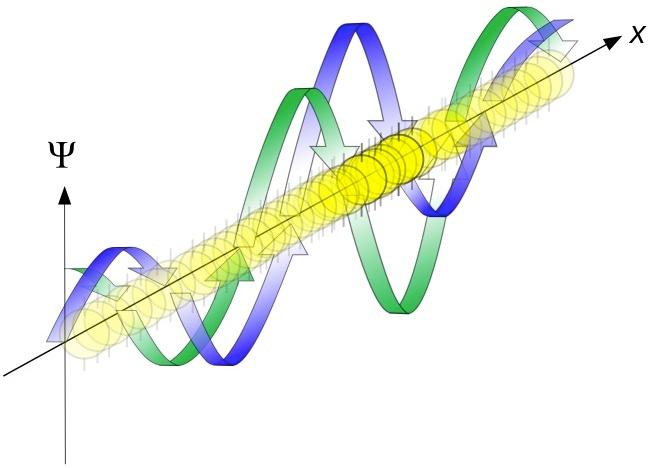
Quantums, whether it's waves, particles, or something in between, have their defining properties. But they need a scene in which they interact and tell the story of the universe.
At a fundamental level, the Universe consists of quanta - entities with physical properties like mass, charge, momentum, etc. - able to interact with each other. A quantum can be a particle, a wave, or something in an intermediate state, depending on how you view it. Two or more quanta can bind together, forming such complex structures as protons, atoms, molecules, and even people. Quantum physics may still be a young science, founded for the most part in the 20th century, but the idea that the Universe consists of invisible entities interacting with each other was born 2,000 years ago, no later than Democritus Abdersky .
But, regardless of what the Universe is made of, its components need a scene on which they can move in order to interact.
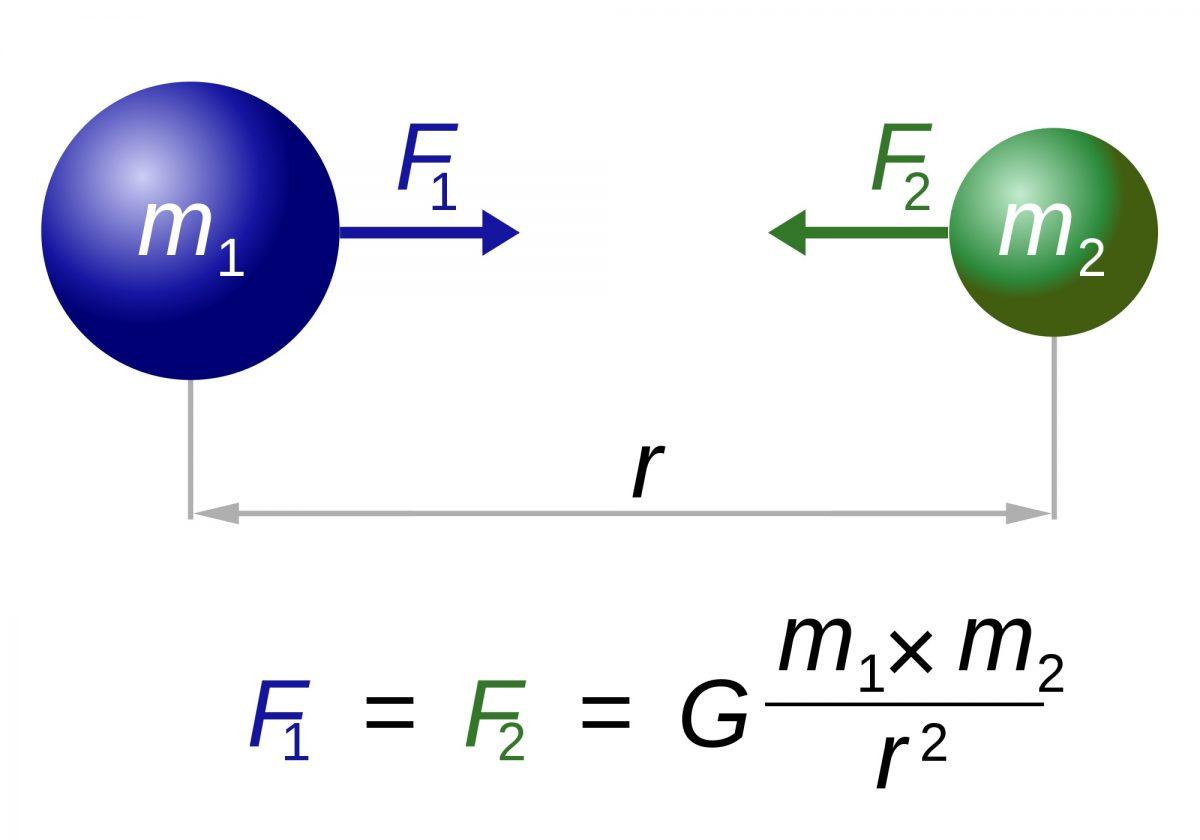
Newton's law of universal gravitation was replaced by Einstein's general theory of relativity, and was based on the concept of instantaneous interaction at a distance.
In Newton’s universe, the scene was a flat, empty, absolute space. The space was fixed, reminiscent of a Cartesian lattice - a three-dimensional structure with x, y and z axes. Time always passed at a certain speed and was also absolute. For any observer, particles, waves, quanta, space and time were perceived everywhere the same. But by the end of the 19th century, it was clear that Newton's concept had flaws. Particles moving almost at the speed of light felt time (it slowed down), and space (it contracted) differently compared to a particle that did not move slowly or not at all. The energy and momentum of the particle suddenly began to depend on the frame of reference, which implied that space and time were not absolute - the way you perceive the Universe depends on how you move.
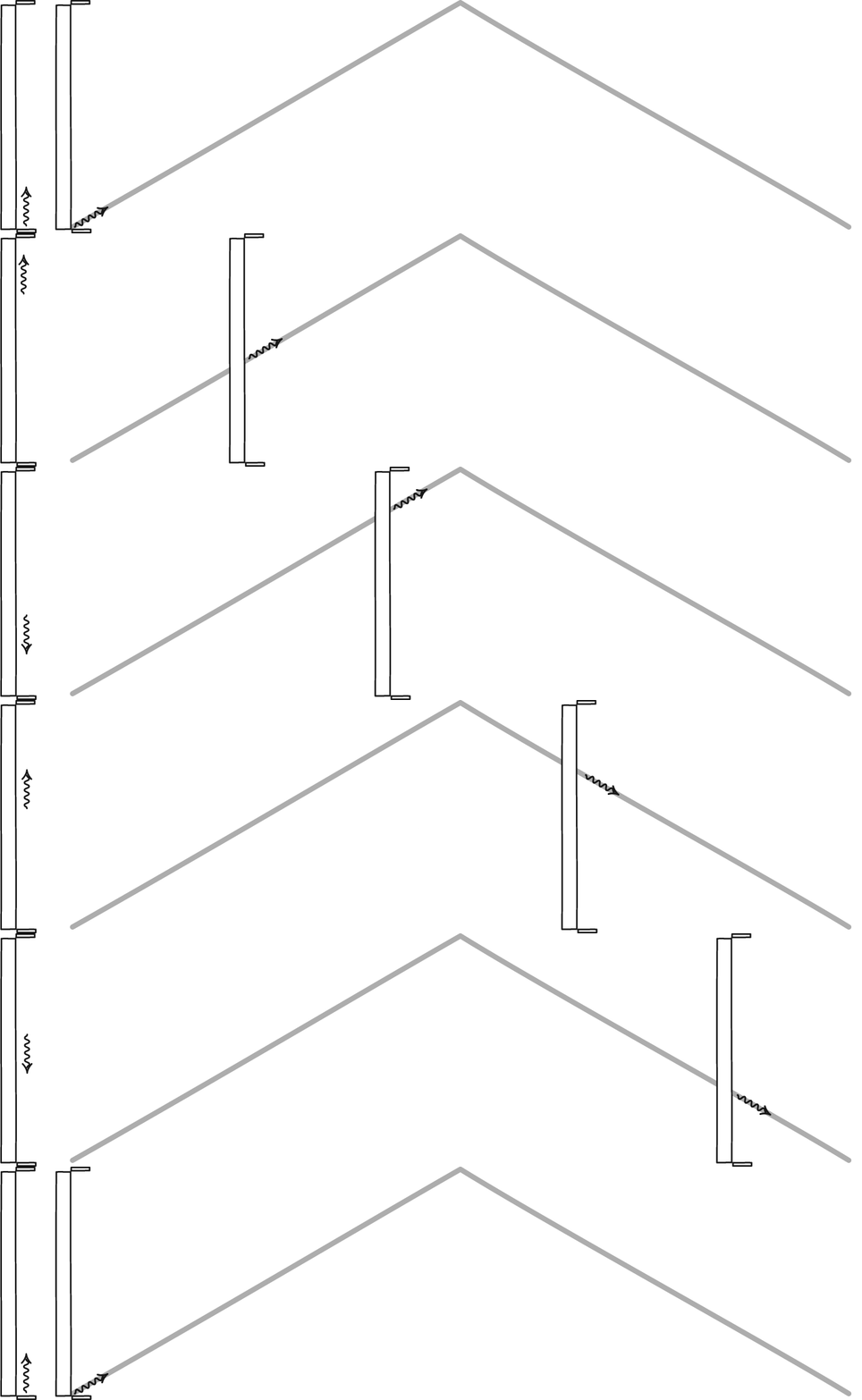
The light clock operates at different speeds for different observers moving relative to each other, due to the constancy of the speed of light.
The special theory of relativity came from here: some things were invariant, for example, the rest mass of a particle or the speed of light, while others are transformed depending on how you move through space and time. In 1907, Einstein's former professor, German Minkowski, made a brilliant breakthrough: he showed that space and time can be expressed in one formula. In one fell swoop, he developed a space-time formalism. This gave the particles a scene through which one can move through the universe and interact with each other. But gravity did not enter there. The scene he developed - still known as the Minkowski space - describes the entire SRT, and provides the basis for most of the quantum calculations that we carry out.
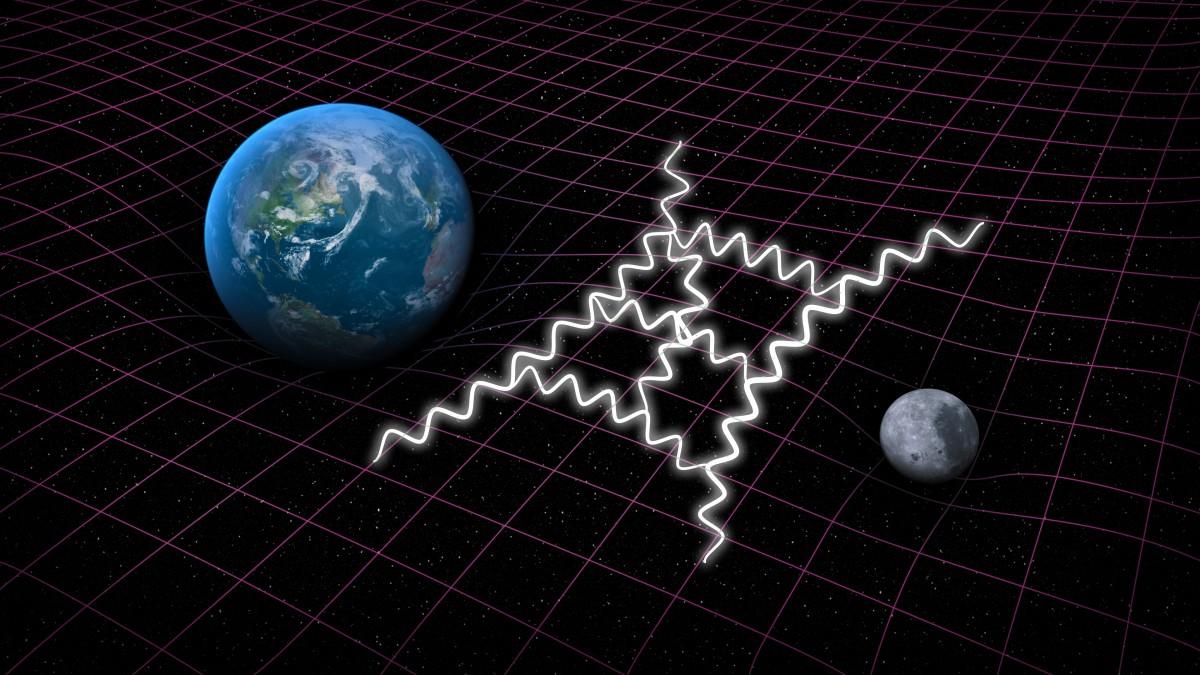
Typically, quantum field theory calculations are carried out in flat space, but GR goes further and introduces curved space. There, such calculations turn out to be much more complicated.
If gravity did not exist, Minkowski space-time would give us everything we need. Space-time would be simple, undistorted, and would simply give matter a scene in order to move and interact. It would be possible to accelerate only through interaction with another particle. But gravity is present in our Universe, and it was Einstein’s principle of equivalence that told us that if you don’t know what accelerates you, then gravity acts on you just like any other acceleration.

The same behavior of a ball falling on the floor in an accelerating rocket and on Earth is a demonstration of the Einstein principle of equivalence.
It was this revelation and its mathematical connection with Minkowski's space-time that led to the appearance of GR. The main difference between the Minkowski space in STR and the curved space that appears in GR is the mathematical formalism, known as the metric tensor. It is sometimes called the Einstein metric tensor or the Riemannian metric. Riemann was a nineteenth-century mathematician (a former student of Gauss — perhaps the greatest mathematician), and he built a formalism that describes the existence of fields, lines, arches, distances in an arbitrarily curved space of any dimension. It took Einstein (and his assistants) almost ten years to cope with the complexities of mathematics - but they did everything and we got GTR. This theory describes our Universe with three spatial and one temporal dimensions in which gravity exists.
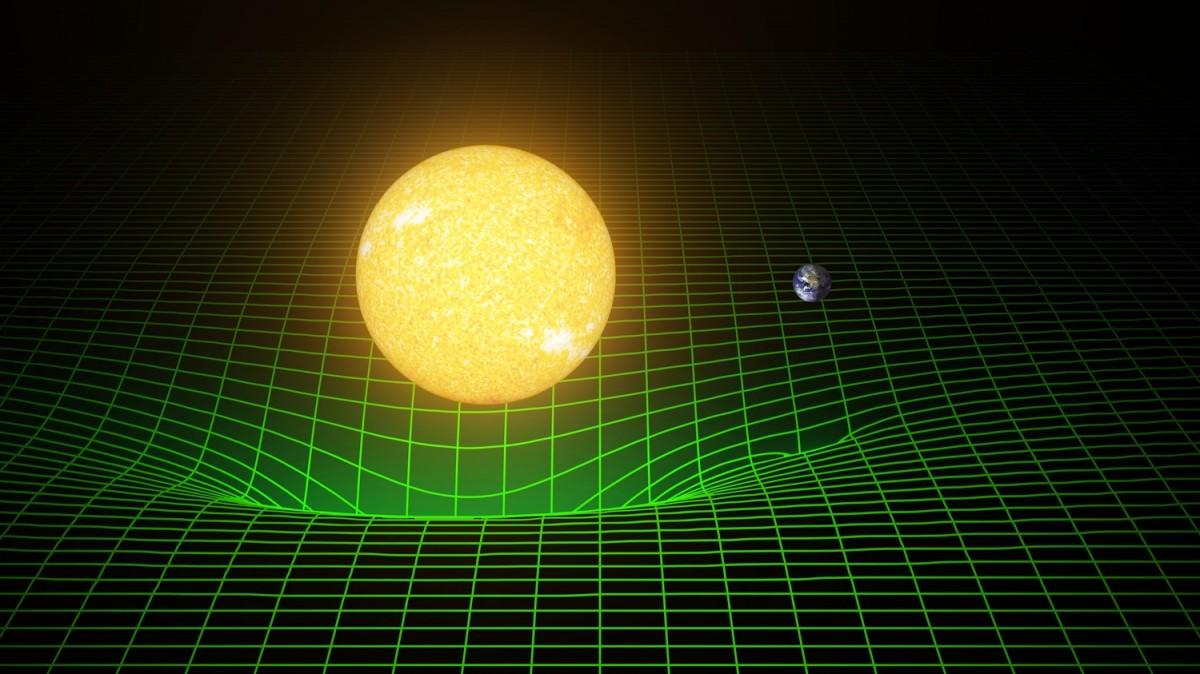
The curvature of spacetime by gravitational masses
The metric tensor defines the curvature of space-time. Its curvature depends on matter, energy and the stresses they have. The contents of the universe determines its curvature of space-time. It is also true that the curvature of the Universe determines how matter and energy will move through it. We like to believe that a moving object will continue to move - Newton's first law. We imagine this as a straight line, but curved space tells us that instead of it, the object moves along a geodesic curve - in a certain way, a curved line corresponding to unaccelerated movement. The irony is that this curve is not necessarily straight, which is the shortest path between two points. Even on a cosmic scale, one can see how the curvature of space-time manifests itself in the presence of extraordinary masses that can distort the light coming from them, which can sometimes lead to the reproduction of images.
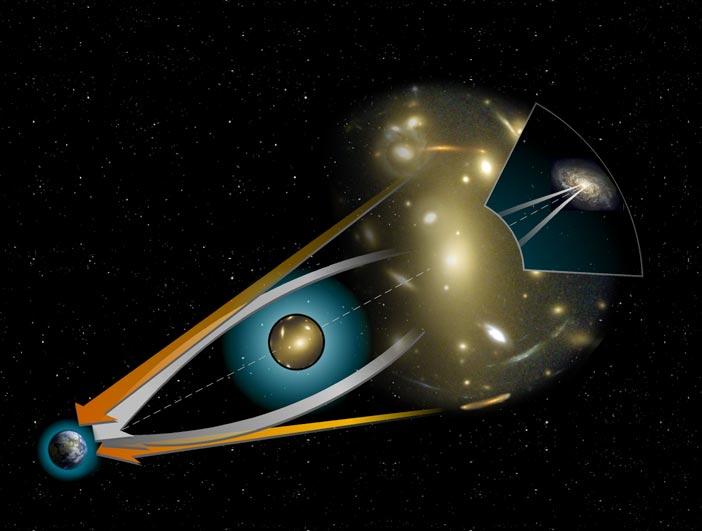
Illustration of gravitational lensing and curvature by a mass of starlight
Many different aspects of physics contribute to the metric tensor in GR. We imagine gravity as a result of the influence of masses: the location and magnitude of different masses determines the gravitational interaction. In GR, this corresponds to the mass density, and really contributes - but only as one of the 16 components of the metric tensor! It has pressure-related components (radiation pressure, vacuum pressure, pressures created by rapidly moving particles), and three additional aspects (one for each spatial dimension) that contribute. And finally, there are six more components that talk about how volumes change and deform in the presence of masses and tidal forces, as well as how these forces distort the shape of a moving body. This applies to everything

All masses move in space-time relative to each other, and emit gravitational waves - ripples of space-time itself
You may have noticed that 1 + 3 + 6 ≠ 16, and 10; and you are observant! The metric tensor, even if it is an entity of dimension 4 x 4, but it is symmetrical, that is, it has four diagonal components (density and pressure) and six independent components that are not on the diagonal (volume and strain components). The six remaining components not lying on the diagonal are uniquely determined by symmetry. The metric speaks about the relationship between matter and the energy of the universe and the curvature of space-time. The unique capabilities of general relativity indicate that if you know where all matter and energy are in the Universe and what they do, you can determine the entire evolutionary history of the Universe - past, present and future.
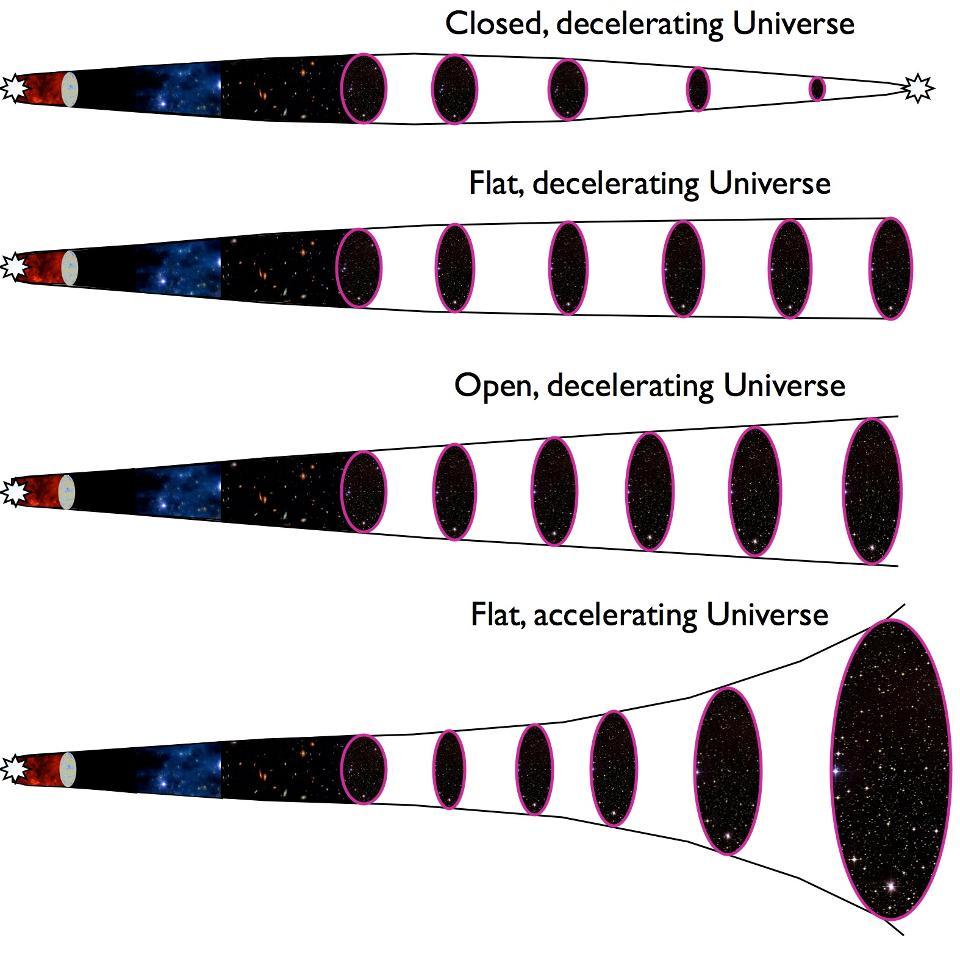
Four probable fate of the universe. The lowest option matches the data best: A universe with dark energy
That is how the area in which I work, cosmology, and the division of theoretical physics began! The discovery of the expanding Universe, its emergence from the Big Bang and the dominance of dark energy, which will lead to its cold and empty fate - all this can be understood only in the context of the general theory of relativity, which means understanding the key interaction between matter / energy and space-time . The Universe is a play that unfolds with each interaction of one particle with another, and space-time is the scene on which this play takes place. You need to remember only one key counter-intuitive thing - the scene is not unchanged for everyone, but itself evolves along with the universe.
Ethan Siegel - astrophysicist, science popularizer, author of the Starts With A Bang! He wrote the books “Beyond the Galaxy” [ Beyond The Galaxy ], and “Tracknology: the science of Star Trek” [ Treknology ].