February 8, 2017 at 19:48
Atom C2XXX chip bug will begin to appear after 18 months of operation: equipment from Cisco and other companies will suffer
 The Intel Atom C2000 processor family has a bug that cripples Cisco and other manufacturers' devices (the exact list of products is known for Cisco, but not for other companies: check which chip is installed on your hardware). The bug acts like a time bomb, manifesting itself not immediately, but only after about 1.5 years of active use or later.
 At a conference for investors on the basis of IV quarter. 2016 Intel Chief Financial Officer Robert Swan (Robert Swan) mentioned a problem with one of the products in the IV quarter. 2016, which affected financial performance. The financier did not say what specific product he was talking about. But all the secret sooner or later becomes apparent.
Robert Swan told investors about the “quality problem,” because of which “the percentage of product failure slightly increased under certain conditions and time frames.” To do this, I had to allocate a certain reserve, which slightly affected the indicators (in the 4th quarter the gross margin decreased by two percentage points to 63%, but the bug in the processors was not the only reason, so you can not write it off only on it). "We think that we will limit it [damage] relatively well with a small change in the architecture that we work with with our customers."

What is this bug? Since Intel does not disclose information, you have to figure it out on your own, but with the help of common sense and logic, you can get to the bottom of the truth.
Coincidentally, just last week, Cisco issued a warningabout a problem with the clock signal in some of their devices, including routers, switches, and other equipment. As it became known, a bug is present in a specific component of "one of the suppliers." As a result, in some devices, the clock signal decays with time. According to Cisco, all problematic devices should work normally at first, but will gradually begin to fail after about 18 months of operation. The number of failures will increase depending on the duration of operation. When this particular component fails, the device will cease to function, it will be impossible to turn it on or repair it, unless the processor is re-soldered.
List of devices that may fail after 18 months of operation:
| Optical networks | FN-64230 | NCS1K-CNTLR |
| Routers | FN-64231 | NCS 5500 Cards |
| FN-64252 | Integrated Services Industrial Routers IR809 / IR829 | |
| FN-64253 | ISR4331, ISR4321, ISR4351 and UCS-E120 | |
| Security | FN-64228 | ASA 5506, ASA 5506W, ASA 5506H, ASA 5508 and ASA 5516 |
| FN-64250 | Cisco ISA 3000 Industrial Security Appliance | |
| Meraki Notification | MX 84 | |
| Switches | FN-64251 | Nexus 9000 Series N9K-C9504-FM-E / N9K-C9508-FM-E / N9K-X9732C-EX |
| Meraki Notification | MS350 Series |
Judging by the popularity of Cisco products, a large amount of equipment can suffer. There is information among networkers that Cisco managers are already phoning customers and proactively replacing equipment that has not yet failed.
“This component is also used by other companies,” Cisco said in a warning, again without giving the name of the component or the supplier company.
However, one could already guess about the supplier company.
In January 2017, Intel released updated specifications for the Intel Atom C2000 processor family, which pointed to a “new” synchronization signal problem. This is stated on page 34 of the specification update in note AVR54.
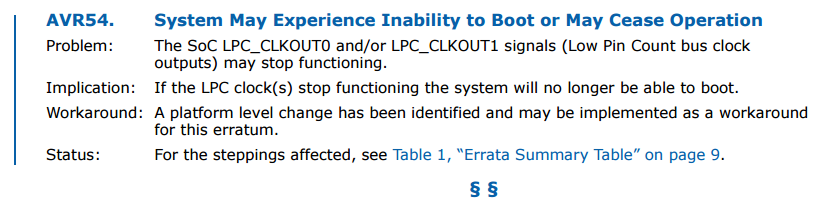
It is written that the signals LPC_CLKOUT0 and / or LPC_CLKOUT1 (output clock signals of the Low Pin Count bus ) may stop functioning. In this case, the device will no longer be able to boot, since other electronics do not work without synchronization. It is indicated that a platform-level fix can be implemented to solve the problem.
An Intel representative explained this problem as "degradation of a chip element under high load after several years of use." Degradation occurs so often that it does not meet Intel's quality standards, he said.
It should be noted that neither Intel nor Cisco has yet to officially confirm that the proactive replacement of Cisco devices is caused by a component problem in the Atom C2000, but the picture is very clear. An Intel representative agreed neither to confirm nor deny this information.
The documentation states that the B0 stepping in Atom C2XX processors is a bad component, these are:
C2308, C2338, C2350, C2358, C2508, C2518, C2530, C2538, C2550, C2558, C2718, C2730, C2738, C2750 and C2758 .
They have been on sale since 2013.
Numerous devices from other manufacturers work on the Atom C2XX processors, including ASRock Rack (C2550D4I and C2750D4I), Aaeon, Dell, HP, Infortrend, iXsystems (FreeNAS Mini), Lanner, NEC, Newisys, Netgate, Netgear, Quanta, Seagate (NAS Pro), Sophos (UTM firewall SG 125), Supermicro, Synology, ZNYX Networks.
It's a shame if the equipment fails just after the warranty period, as if it had been planned.