June 27, 2016 at 12:38
Capacitors for Dummies
- Transfer
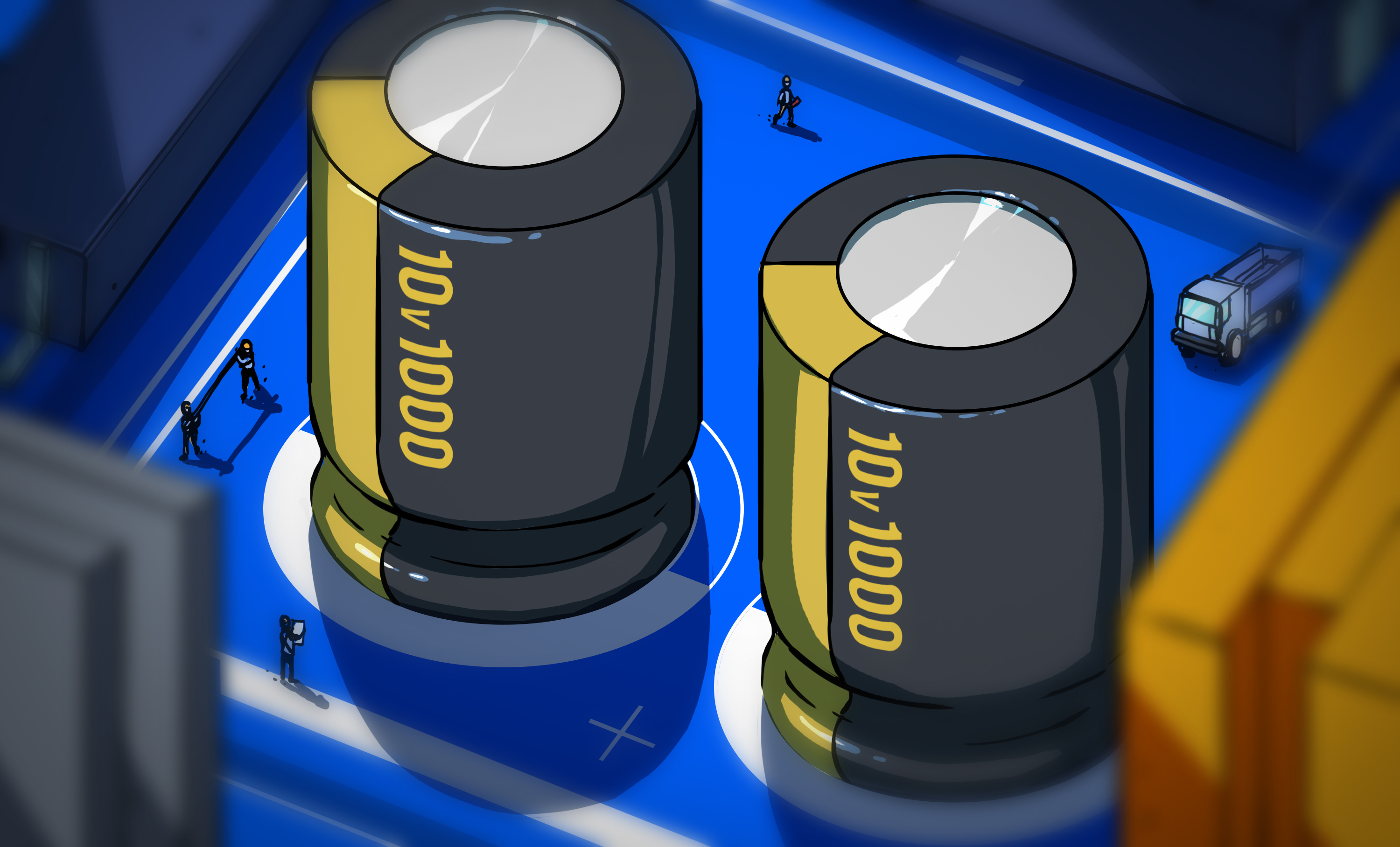
If you regularly create circuitry, you must have used capacitors. This is a standard component of circuits, the same as resistance, which you simply take off the shelf without hesitation. We use capacitors to smooth voltage / current ripples, to match loads, as an energy source for low-power devices, and other applications.
But a capacitor is not just a bubble with two wires and a pair of parameters - operating voltage and capacitance. There is a huge array of technologies and materials with different properties used to create capacitors. And although in most cases almost any capacitor of a suitable capacity will fit for any task, a good understanding of the operation of these devices can help you choose not just something suitable, but the right one. If you have ever had a problem with temperature stability or the task of finding a source of additional noise - you will appreciate the information from this article.
Let's start with a simple
It is better to start simple and describe the basic principles of capacitors before moving on to real devices. An ideal capacitor consists of two conductive plates separated by a dielectric. The charge is collected on the plates, but cannot flow between them - the dielectric has insulating properties. So the capacitor accumulates charge.
Capacitance is measured in farads: a capacitor of one farad produces a voltage of one volt, if it contains a charge of one pendant. Like many other units of the SI system, it is impractical in size, so if you do not take into account supercapacitors, which we will not discuss here, you will most likely meet with micro-, nano- and picofarads. The capacity of any capacitor can be deduced from its size and dielectric properties - if interested, the formula for this can be found on Wikipedia. You don’t need to memorize it, unless you are preparing for the exam - but it contains one useful fact. The capacitance is proportional to the dielectric constant ε rused dielectric, which resulted in the sale of various capacitors using different dielectric materials to achieve large capacitances or improve voltage characteristics.

Spurious inductance and resistance of a real capacitor
With the use of dielectrics in capacitors, there is one problem, along with the fact that a dielectric with the desired characteristics has unpleasant side effects. All capacitors have small parasitic resistance and inductance, which can sometimes affect its operation. Electrical constants vary with temperature and voltage, piezoelectricity or noise. Some capacitors are too expensive; some have failure conditions. And now we come to the main part of the article, in which we will talk about different types of capacitors, and about their properties, useful and harmful. We will not cover all possible technologies, although we will describe most of the usual ones.
Aluminum Electrolytic
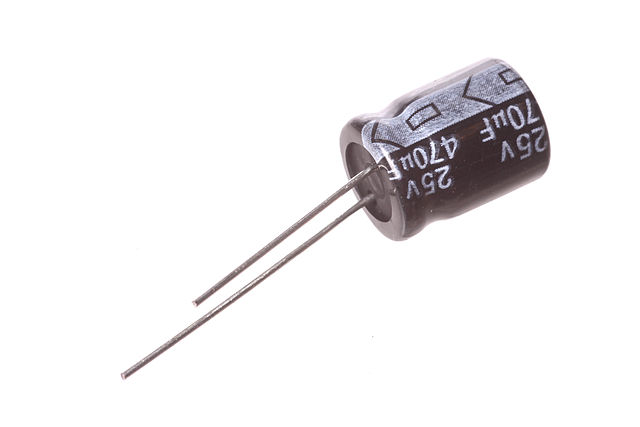
Aluminum electrolytic capacitors use an anode-oxidized layer on an aluminum sheet as one dielectric plate, and an electrolyte from an electrochemical cell as another plate. The presence of an electrochemical cell makes them polar, that is, a DC voltage must be applied in one direction, and the anodized plate must be an anode, or a plus.
In practice, their plates are made in the form of a sandwich of aluminum foil wrapped in a cylinder and located in an aluminum can. Operating voltage depends on the depth of the anodized layer.
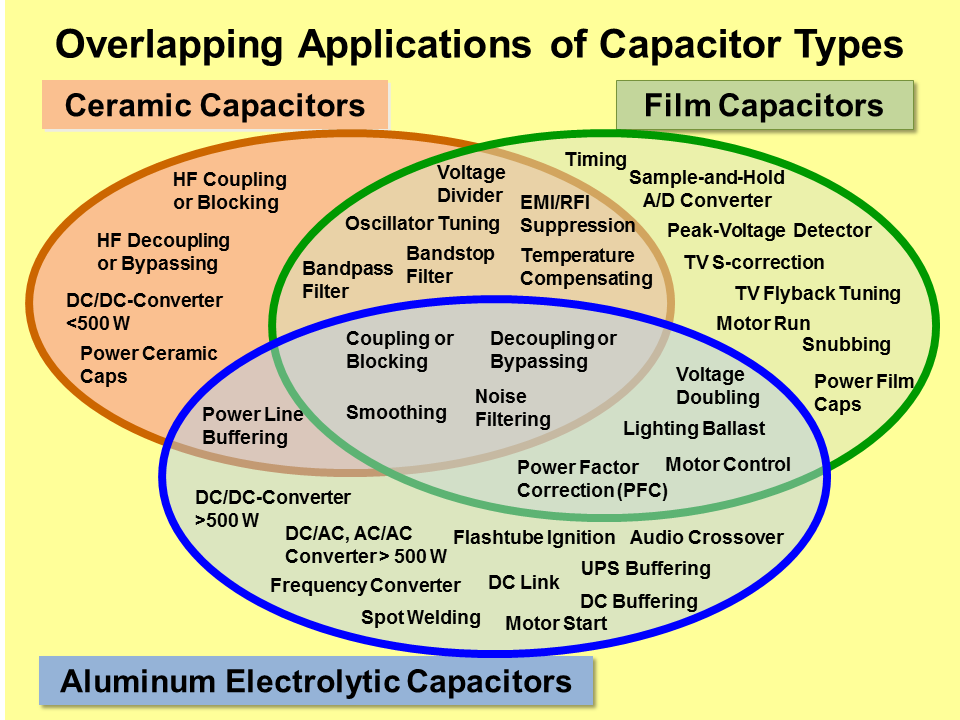
Electrolytic capacitors have the largest capacitance among the common ones, from 0.1 to thousands microfarads. Due to the tight packing of the electrochemical cell, they have a large equivalent series inductance (ESI, or effective inductance), which is why they cannot be used at high frequencies. They are typically used to smooth power and decoupling, as well as binding on audio frequencies.
Tantalum Electrolytic
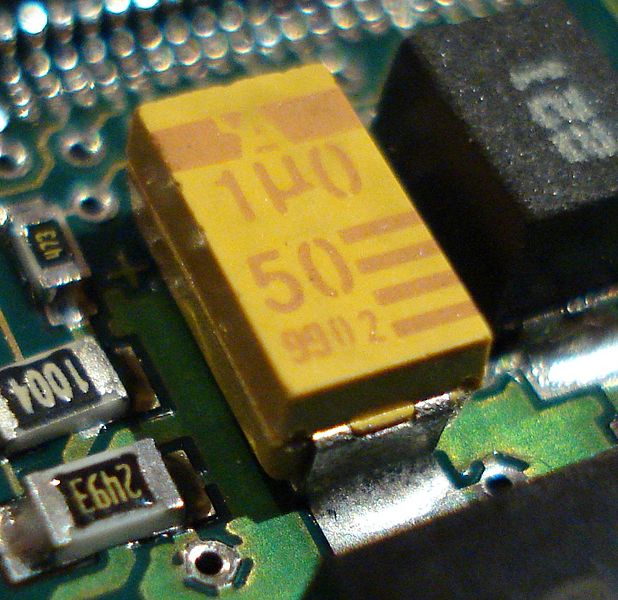
Surface-mounted tantalum capacitor
Tantalum electrolytic capacitors are manufactured as a sintered tantalum anode with a large surface area on which a thick oxide layer is grown, and then a manganese dioxide electrolyte is placed as a cathode. The combination of a large surface area and the dielectric properties of tantalum oxide leads to high capacity in terms of volume. As a result, such capacitors output much less aluminum capacitors of comparable capacity. Like the latter, tantalum capacitors have a polarity, so the direct current should go in exactly one direction.
Their available capacitance varies from 0.1 to several hundred microfarads. They have much less leakage resistance and equivalent series resistance (ESR), which is why they are used in testing, measuring instruments and high-quality audio devices - where these properties are useful.
In the case of tantalum capacitors, it is especially necessary to monitor the failure state, it happens that they light up. Amorphous tantalum oxide is a good dielectric, and in crystalline form it becomes a good conductor. Improper use of a tantalum capacitor - for example, supplying too much inrush current can lead to the transition of the dielectric into another form, which will increase the current passing through it. True, the fire-related reputation came from earlier generations of tantalum capacitors, and improved production methods led to more reliable products.
Polymer films
A whole family of capacitors uses polymer films as dielectrics, and the film is either between twisted or alternating layers of metal foil, or has a metallized layer on the surface. Their operating voltage can reach up to 1000 V, but they do not have high capacitances - this is usually from 100 pF to units of microfarads. Each type of film has its pros and cons, but in general the whole family is characterized by lower capacitance and inductance than electrolytic ones. Therefore, they are used in high-frequency devices and for decoupling in electrically noisy systems, as well as in general-purpose systems.
Polypropylene capacitors are used in circuits requiring good thermal and frequency stability. They are also used in power systems, for suppressing electromagnetic fields, in systems using alternating currents of high voltage.
Polyester capacitors, although they do not have such temperature and frequency characteristics, are cheap and can withstand high temperatures when soldering for surface mounting. In this regard, they are used in circuits intended for use in non-critical applications.
Polyethylene-naphthalate capacitors. They do not have stable temperature and frequency characteristics, but they can withstand much higher temperatures and voltages compared to polyester ones.
Polyethylene sulfide capacitors have the temperature and frequency characteristics of polypropylene capacitors, and in addition withstand high temperatures.
In old equipment, you can stumble on polycarbonate and polystyrene capacitors, but now they are no longer used.
Ceramics
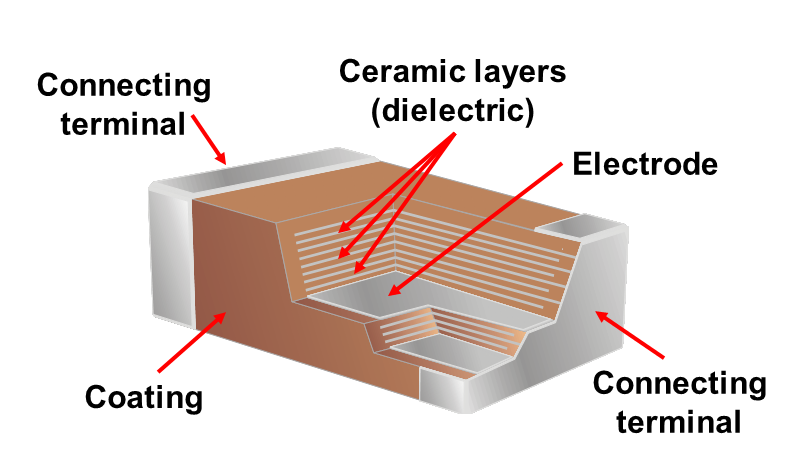
The history of ceramic capacitors is quite long - they have been used from the first decades of the last century to this day. The early capacitors were a single layer of ceramic, metallized on both sides. Later ones are also multilayer, where plates with metallization and ceramics alternate. Depending on the dielectric, their capacitances vary from 1 pF to tens of microfarads, and voltages reach kilovolts. In all industries of electronics where a small capacity is required, one can find both single-layer ceramic disks and multilayer package capacitors of surface mounting.
It is easiest to classify ceramic capacitors by dielectrics, since it is they that give the capacitor all the properties. Dielectrics are classified by three-letter codes, where their operating temperature and stability are encrypted.
C0G is the best stability in capacitance with respect to temperature, frequency and voltage. Used in high-frequency circuits and other high-speed loops.
X7R do not have such good characteristics in temperature and voltage, therefore, they are used in less critical cases. Usually this is untying and various universal applications.
Y5V have a much larger capacity, but their temperature and voltage characteristics are even lower. Also used for untying and in various universal applications.
Since ceramics often have piezoelectric properties, some ceramic capacitors also exhibit a microphone effect. If you worked with high voltages and frequencies in the audio range, for example, in the case of tube amplifiers or electrostatics, you could hear capacitors “singing”. If you used a piezoelectric capacitor to provide frequency stabilization, you might find that its sound is modulated by the vibration of its surroundings.
As we already mentioned, the article does not intend to cover all capacitor technologies. If you look in the electronics catalog, you will find that some of the technologies available are not covered here. Some catalog offers are already outdated, or they have such a narrow niche that you most often will not meet them. We only hoped to dispel some secrets about the popular models of capacitors, and help you in choosing the right components when developing your own devices. If we have warmed up your appetite, you can study our article on inductors.
I ask you to write about inaccuracies and errors that you discovered through personal messages of the site . Thanks.