November 14, 2014 at 13:54
Interview with the creator of the first food 3d printer. Part 1
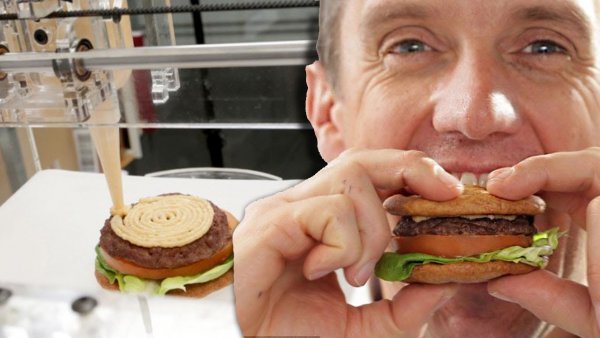
Today, Fabbers interviewed the creator of the world's first food-grade 3d printer, Emilio Sepulveda. Emilio Sepulveda is the co-founder and CEO of Natural Machines, creators of Foodini, the first 3D printer to work with sweet and savory foods. The company has demand in more than 45 countries, including Russia. Since the company was founded in 2012, several patents have been sold covering new systems and technologies, the company is present in the USA and China, and an office in Moscow will open soon.
Mr. Sepulveda loves snowboarding and sailing. He studied at Telecom Engineering and Humanities and has a master's degree in software development and a master's degree in business administration from ESADE.
For convenience, we have added an interview text under
spoiler.
F .: - Hi Emilio, I would like to ask a few questions about your amazing printer. Tell me, how did you get the idea to create a 3D printer that prints with food?
ES: - Basically, this was an answer to the problems that we had. One of the founders had and still has a vegetarian bakery. That is, they make vegetarian cakes without any ingredients of animal origin. And the problem was that the production was far from him and it was necessary to freeze the cakes and send them frozen. Actually, this process is very expensive and the logistics are very expensive, and the ingredients are very cheap, so we can send the production, the ingredients and send the recipe, which is the basic information, therefore, we decided that the best technology that we could use is the one we use (now), and then we decided to do it.
F .: - Emilio, tell us about your team: who is working on creating a 3D printer. And maybe there is even a chef on your team?
ES: - So, we have an interdisciplinary team: there are engineers, programmers and nutrition specialists. And we involve local universities and people from outside, that is, we work with partners in the industry and they help us find new concepts and new ones. recipes.
F .: - How do you see business development in Europe and in Russia?
ES: - Well, it largely depends on the country and region. For example, Mediterranean countries have barriers, many cultural barriers and economic barriers. In Northern Europe they are more inclined towards pleasant products and the country where we see the smallest barrier is Russia, where people tend to introduce new technologies in order to try new things and experiment. It was a bit surprising for us, we expected that this would be in Germany, but in Russia it is more in our case.
F .: - Emilio, tell us in more detail: how does the 3D printer work and what can it create, and the most interesting is what supplies does it use?
ES: - At the heart of the device is 3D printing technology from the inside and another technology that allows us to work with food. So, it works so that you stack food in the form of capsules, or buy pre-filled capsules, then load them into the device up to five different types, select a recipe and simply type. And it's just a kitchen appliance, it's not something that would be created for engineers, for example. This is for normal people, and the range of products that we can print starts from very thin, like sauces, to ones that can have hard chunks, or softly hard ones, like meat with nuts. Something that is actually not the type of food that you expect to see printed.
F .: - Emilio, tell me what difficulties you encountered when printing food. And the most interesting - can you print several layers in height?
ES: - Basically, the most difficult thing to accomplish is when you have something that includes various ingredients in one recipe and, at the same time, voluminous, high.
In this case, you must have a very fine calibration of the ingredients and, of course, you must be patient, because more details and more volume means more time. So, by trying and setting the ingredients for these recipes, you can spend some time on the first print.
F .: - Thank you! Tell me if you prepared tapas with Foodini (this is a Spanish national dish).
ES: - Yes, it depends on the type of tapas you want. For example, if you make ham it does not make sense, you just chop the ham, and that’s it. But if you want crackers or you want potato chips, or you want to make something from a paste, or something like that, maybe it makes sense to use something like a printer.
F .: - And the next question is more for engineers - what difficulties did you encounter when developing a printer?
ES: - Thus, we have the final development of the device, and now we are creating production
so that we are going to start mass production and begin shipping to our customers.
ES: - Basically, this was an answer to the problems that we had. One of the founders had and still has a vegetarian bakery. That is, they make vegetarian cakes without any ingredients of animal origin. And the problem was that the production was far from him and it was necessary to freeze the cakes and send them frozen. Actually, this process is very expensive and the logistics are very expensive, and the ingredients are very cheap, so we can send the production, the ingredients and send the recipe, which is the basic information, therefore, we decided that the best technology that we could use is the one we use (now), and then we decided to do it.
F .: - Emilio, tell us about your team: who is working on creating a 3D printer. And maybe there is even a chef on your team?
ES: - So, we have an interdisciplinary team: there are engineers, programmers and nutrition specialists. And we involve local universities and people from outside, that is, we work with partners in the industry and they help us find new concepts and new ones. recipes.
F .: - How do you see business development in Europe and in Russia?
ES: - Well, it largely depends on the country and region. For example, Mediterranean countries have barriers, many cultural barriers and economic barriers. In Northern Europe they are more inclined towards pleasant products and the country where we see the smallest barrier is Russia, where people tend to introduce new technologies in order to try new things and experiment. It was a bit surprising for us, we expected that this would be in Germany, but in Russia it is more in our case.
F .: - Emilio, tell us in more detail: how does the 3D printer work and what can it create, and the most interesting is what supplies does it use?
ES: - At the heart of the device is 3D printing technology from the inside and another technology that allows us to work with food. So, it works so that you stack food in the form of capsules, or buy pre-filled capsules, then load them into the device up to five different types, select a recipe and simply type. And it's just a kitchen appliance, it's not something that would be created for engineers, for example. This is for normal people, and the range of products that we can print starts from very thin, like sauces, to ones that can have hard chunks, or softly hard ones, like meat with nuts. Something that is actually not the type of food that you expect to see printed.
F .: - Emilio, tell me what difficulties you encountered when printing food. And the most interesting - can you print several layers in height?
ES: - Basically, the most difficult thing to accomplish is when you have something that includes various ingredients in one recipe and, at the same time, voluminous, high.
In this case, you must have a very fine calibration of the ingredients and, of course, you must be patient, because more details and more volume means more time. So, by trying and setting the ingredients for these recipes, you can spend some time on the first print.
F .: - Thank you! Tell me if you prepared tapas with Foodini (this is a Spanish national dish).
ES: - Yes, it depends on the type of tapas you want. For example, if you make ham it does not make sense, you just chop the ham, and that’s it. But if you want crackers or you want potato chips, or you want to make something from a paste, or something like that, maybe it makes sense to use something like a printer.
F .: - And the next question is more for engineers - what difficulties did you encounter when developing a printer?
ES: - Thus, we have the final development of the device, and now we are creating production
so that we are going to start mass production and begin shipping to our customers.
This was the first part of an interview with Natural Machines founder Emilio Sepulveda. Exactly a week later, Emilio will show us the office and even reveal a secret - what Foodini looks like.
Special for 3D printer store