
 October 19, 2014 at 19:02
Nearly Space Disasters, Part 3
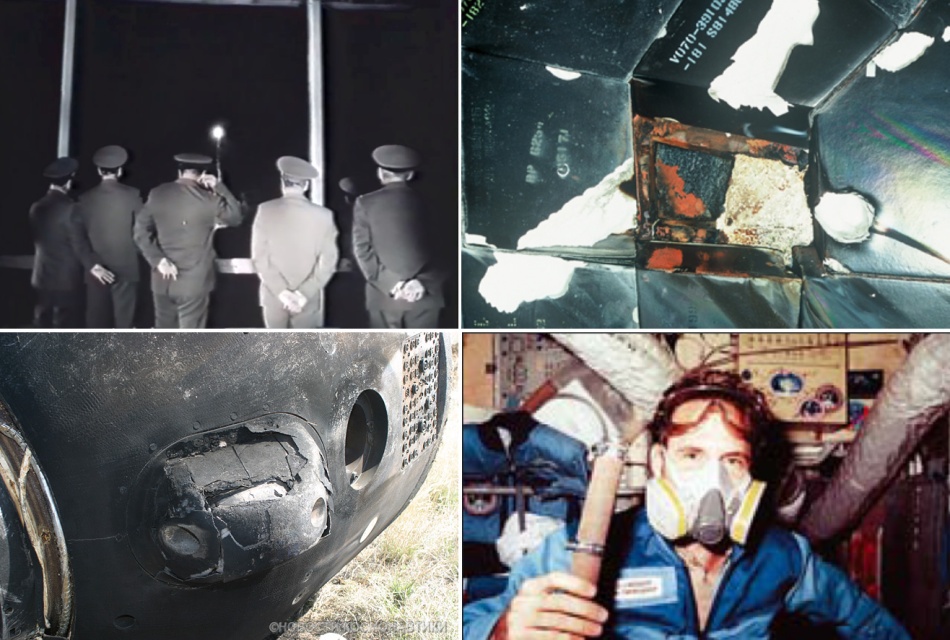
The twenty-year experience of manned space flights has not led to the disappearance of deadly situations. Despite the fact that astronautics has become quite commonplace, the complexity of technology and the hostility of space flight conditions for living organisms have led to the fact that there are still potentially deadly situations. All the more interesting is the story of how and why these disasters did not occur.
STS-1

From the point of view of approaches to testing complex technical systems, the first flight of the Space Shuttle immediately in a manned version was an engineering impudence of a cosmic scale. And the increased risk of such a mission naturally led to potentially catastrophic situations: The
calculation of the shock wave from the launch of solid fuel accelerators turned out to be erroneous . Four times more powerful than expected, the shock wave led to the ultimate load for the structure: the bow mounts of the fuel for orientation engines bent, and the fuselage flap was thrown to an unacceptable angle:

An unacceptable fuselage flap angle meant, firstly, problems with pitch during landing, and secondly, damage or even rupture of the hydraulic system. If astronauts knew about this damage, they would be catapulted during the landing, and the Columbia orbiter would have crashed. But it turned out to be a joke: not knowing about the problem, Young and Kripen made a successful landing, and calculations that promised a break in hydraulics and loss of pitch control during landing also turned out to be erroneous.
The reflection of the sound waves of the engines from the launch pad led to oscillations of the tail stabilizer . If the error in the calculations turned out to be greater, the tail could fall off.
On breeding, Colombia lost 16 heat-shielding tiles. Fortunately, all of them were located on the top surface of the shuttle in places with a low temperature load, and their loss was not dangerous. But on the Columbia, there was no Canadarm with a camera on this flight, and to inspect the lower surface of the shuttle, we had to use a ground military satellite tracking station and the latest optical reconnaissance satellite KH-11 (it’s sad that nothing of the kind was done in the last flight of Columbia ).
Thermal damage to the lower surface during braking in dense layers of the atmosphere . The following were damaged: the locking plate of the front hatch of the external fuel tank fastening (incorrect installation of the adjacent heat-shielding tile) and the right chassis niche (the protruding gap filler between the tiles sent hot air inward).
Despite the generally successful flight, the risk was very serious, and the detected problems required considerable effort to correct. Most strongly changed the water depreciation system on the launch pad, which reduced the shock wave by ten times.
Soyuz T-10-1, aka Soyuz T-10A
September 26, 1983. The Soyuz T-10 ship is getting ready for launch. Cosmonauts Vladimir Titov and Gennady Strekalov should go to the Salyut-7 station. But 1 minute 48 seconds before the start (according to other sources in 48 seconds) a fire started on the launch vehicle. The launch control group quickly understood the situation and made the only right decision - the launch of the emergency rescue system. The propellant SAS engines tore the descent vehicle with the astronauts from the burning rocket and carried it to a safe distance. The flight lasted only 5 minutes 13 seconds, and after 15 minutes the astronauts had already been removed from the descent vehicle by rescuers who approached the landing site by helicopter.
SAS workflow:

Documentary footage of the accident (from 2:40) and SAS test frames (from 3:55) were preserved:
The accident of the Soyuz T-10-1 is the only case today of the “combat” use of the emergency rescue system. SAS stands on all the "Unions", despite its rather large weight, the ability to rescue astronauts in the event of an accident in the first seconds of flight and the launch pad is priceless.
STS-9

The sixth flight of the shuttle Columbia ended successfully on December 8, 1983. The next day, the technicians started maintenance and found with great surprise that the auxiliary power unit (APU) compartment was black from the fire that occurred in it, the valves of two of the three APUs were destroyed by a fuel explosion, and the wiring in the compartment was damaged by fire. Shuttle APU is a small turbine operating on hydrazine and creating the necessary pressure for hydraulics to work, which rotates control surfaces - ailerons and rudders. APU and fuel tanks are located in the aft of the shuttle:

If the APU fire started a few minutes earlier or would have been more active, Colombia would have lost control a few minutes before landing and crashed with the entire crew. The Space Shuttle did not have a special rescue system for landing accidents. Shuttle parachutes appeared only after the Challenger’s death and could be used only when leaving a guided ship. Falling with somersaults, inevitable in case of loss of control, made ordinary parachutes completely useless. The STS-9 crew was very lucky.
STS-51-F

The only shuttle that actually switched to emergency flight mode (the so-called Abort Mode) was the Challenger in the STS-51-F mission on July 29, 1985. In the fourth minute of the flight, the temperature sensor of the central engine turbopump failed. Two minutes later, the second sensor of the same turbopump failed. Automation, relying on incorrect sensor readings, accidentally stopped the central engine. Around the same time, the temperature sensors of the turbo pump of the second engine began to behave inappropriately. MCC managed to navigate the situation and gave the command to prohibit automatic engine shutdown. “Challenger” had the simplest emergency mode - “Abort to Orbit” - emergency exit to a slightly lower orbit. If the MCC did not manage to react, the automation would turn off the second healthy engine (all engines were in order,
Soyuz TM-5

Soviet cosmonauts Valery Polyakov and Vladimir Lyakhov and the first cosmonaut of Afghanistan, Abdul Momand, launched to the Mir station on Soyuz TM-6 on August 29, 1988. Valery Polyakov remained at the station as part of the main expedition, and Lyakhov and Momand, who were part of the short-term visiting expedition, on September 6, undocked from Mir on Soyuz TM-5. The landing procedure was modernized - in order not to waste fuel on braking the unnecessary mass of the household compartment, it was shot not after braking, but before. But with the braking procedure itself, troubles began. Orientation of the ship to braking occurred at the border of day and night, so the infrared vertical sensor worked "uncertainly." The on-board computer (Soyuz TM had a full-fledged digital car) took this as a sensor failure and blocked the braking. After 7 minutes, the orientation was restored, and the computer turned on the engines. But by this time, the flight of the landing point would be 700-800 km and, instead of Kazakhstan, the ship would land in China. Lyakhov quickly orientated himself in the situation and, just 3 seconds later, turned off the engine. After a meeting with the control center, the landing was moved to two turns. A new landing program was handed over from Earth, but probably because of the rush, there was a mistake in it. Instead of the landing program, the computer began to try to make corrections for docking with Mir - this program was written for the flight of the previous crew and is still stored in memory. As a result, the engine turned on at the estimated time, but instead of 230 seconds, it worked only 7. Lyakhov gave the command to turn the engine on manually, but it turned off again after 14 seconds. The second attempt to manually turn on the engine also failed - the engine worked only 33 seconds. In addition, the orientation of the ship was disturbed - it was obviously impossible to try to “redirect” the computer further. The unpleasant situation became deadly - due to the engine turning on / off, the temperature sensors for separating the descent vehicle and the instrument-aggregate compartment turned on, and, worst of all, the timer for the automatic separation of compartments turned on. And without the instrument-aggregate compartment, the lander would have been left without oxygen for breathing (an autonomous supply was only enough for landing) and engines for braking. Given the lack of time to calmly understand what is happening with the MCC and the unknown height of the pericenter (or maybe we are entering the atmosphere?) Lyakhov manually turned off the temperature sensors and blocked the separation of the compartments. The solution turned out to be the only right one - a full braking impulse was needed for landing. MCC analyzed the situation and began to prepare for landing in a day. And here the situation had already begun, not dangerous, but extremely uncomfortable - there was very little space in the descent vehicle, and the toilet flew away with the household compartment. Recalls Vladimir Lyakhov:
“The most difficult was the inconvenience. The suits were not removed so as not to freeze. The chair is molded exactly in shape, it is impossible to turn. The total volume of the SA is only three cubic meters, it is full of returned instruments, equipment, film and photo materials, documents, even fish were. My legs were numb, I really wanted to eat and drink, but did not touch the emergency stock. To the difficulties was added the fact that the sewage system remained in the shot-off household compartment ... I do not absolve myself of guilt that after a repeated refusal I tried to turn on the engine again, since there was an option - to enter the correct setting already during the operation of the engine. I really wanted to go to Earth ... "
Landing on September 7 was automatic. But after this incident, the separation of the compartments of the "Union" is made only after braking. It is better to spend some fuel in vain than to endure such inconvenience.
STS-27

The Atlantis shuttle STS-27 mission was second after resuming flights interrupted by the Challenger crash. It was a military mission during which a spy satellite (presumably the Lacrosse radar reconnaissance satellite) was to be delivered into orbit. On solid fuel boosters were new, lighter, nose fairings. And at 85 seconds of flight, the nose cone of the right TTU began to collapse, and its fragments hit the shuttle's heat shield. What was happening was recorded on ground cameras and did not go unnoticed. After the withdrawal, the crew deployed the Kanadarm manipulator with a camera and began to inspect the bottom surface of the Atlantis. The spectacle was unimportant - the thermal protection tiles seemed to be fired from an anti-aircraft gun (and commander Robert Gibson fought in Vietnam and saw the result of the anti-aircraft guns). But, a strange thing, Houston MCC did not see a problem. The camera image was transmitted over an encrypted communication channel (recall, this is a military mission), encryption greatly reduced image quality, and engineers on Earth decided that damage was just a play of light and shadow. And, for a completely incomprehensible reason, astronauts who verbally described the problem were not believed! Worse, the Houston MCC has not taken any measures to obtain additional information. The STS-27 was not monitored from Earth, did not use spy satellites, the problem was considered insignificant. The landing went fine, but the engineers were in for an unpleasant surprise - during a personal inspection, the damage to the thermal barrier looked even worse. Atlantis received 707 hits, it was necessary to change from 125 to 175 heat protection tiles, and one tile was generally torn off the bottom surface,

The astronauts STS-27 were lucky - this is where the antenna was mounted, and the hull was thicker than usual. But the mismatch of the MCC practically guaranteed that such a problem would turn into a catastrophe. That is exactly what happened with Colombia - we will never know the extent of damage to its wing in 2003, and whether it was possible to save the shuttle and seven crew members.
STS-37

One of the most terrible dangers that threatens a man who went into outer space in a spacesuit occurred in this flight. A small pin in the glove of the spacesuit Jerome Ept moved out of his seat and pierced the fabric of the spacesuit. But it turned out a joke - the hole turned out to be small, the astronaut's skin quickly stuck to it, and the air leak was not even noticed by the automation. Only after returning aboard, Ept noticed a slight abrasion under the knuckle of his right index finger. Easy to get off!
EO-23

EO-23 is the twenty-third main expedition to the Mir station, which lasted from February to August 1997. The permanent members of this expedition were Vasily Tsibliyev and Alexander Lazutkin, also temporarily included: the German astronaut Reinhold Ewald and NASA astronauts Jerry Linanger and Michael Fowl. Many of the incidents fell on this expedition, two of them were so serious that the MCC considered the issue of the emergency return of the crew to Earth, and in one of these incidents the astronauts rescued Mir, contrary to the instructions. The Americans present at the MCC of Moscow even called it “Russian Apollo 13, stretched out for six months.”
February 23 fire. The oxygen regeneration bomb caught fire (they are used in addition to the Electron equipment, which receives oxygen by electrolysis of water). Recalls Alexander Lazutkin:
“In the evening, at 22:30 I flew to burn a sword. I did everything as usual. The checker did not start immediately. I checked that it works. Already about to leave. The guys were sitting at the table in the BB, and I really wanted to see them. Suddenly I hear that against the background of ordinary noises, new sounds have appeared. I look at the THC and see an unusual picture. Dark bag - the filter is covered with red lights. I see how this bag burns out. "He must not burn!" - My first thought. Lights appear more and more often. The crack of a working checker is intensifying ... A small volcano begins to work in front of me. I feel his hot breath. With difficulty I tear myself away from this sight, turn off the TGC fan. The shock begins to let me go. Grab a fire extinguisher. Smoke has already gone to the BB. Together with the howling of an emergency siren, Valera Korzun flew up to me. He grabbed a fire extinguisher from me and demanded more. I flew to the BB.
The crew quickly put on gas masks, armed with fire extinguishers and quickly put out the fire. But there was a risk that the fire would become uncontrollable, and one of the Soyuz ships could be cut off by fire.
Even after the fire, the problems did not end - until the commission investigating the causes of the fire, the crew worked in conditions of potential oxygen shortages, the Electron equipment worked unreliably, and it was necessary to use oxygen cylinders stored for spacewalks. The Commission on Earth successfully burned several checkers, the defect was recognized as a single one, and the regeneration checkers began to be used again.
Collision of "Progress" with "Peace" on June 25. The crew of the EO-23 worked out the fully manual docking mode of the Progress cargo ships - the trucks were brought out to the Mira area by ballistics, and then moored by remote control (the TORU teleoperator control mode) manually by the crew. And both tests failed. For the first time, in March, Progress just flew past the station. The second attempt with another "Progress" in June ended much worse. The trajectory of the truck began to differ from the calculated one (“Progress” did not appear in a certain window, as it should have). Tsibliev braked the ship, realizing the danger of a collision. But due to the fact that it was necessary to turn while holding the Mir in the sight of the sight, the turning pulses practically extinguished the braking ones, and the Progress almost did not lose speed relative to the station. As a result, at 12:09: 51 march Moscow time “Progress” at a speed of ~ 3 m / s crashed into the Spectrum module, damaged its solar panels and, worst of all, broke through the module's casing. Depressurization has begun. According to the instructions, you must evacuate - get into the "Union" and undock. But the “World” cannot be reanimated if left unpressurized. The astronauts rush to the hatch connecting the Spectrum with the Mir and begin to prepare it for closure as quickly as possible - they disconnect the air ducts and cables. Cables that cannot be disconnected are cut. Falling pressure threatens with loss of consciousness and certain death. But Lazutkin and Tsibliev (Michael Fole, according to the instructions, took a place in the "Union") managed. At a pressure of 670 mm. Hg. Art. the hatch was closed and sealed. I had to print cylinders for spacesuits again - to increase the pressure.2 . Subsequent expeditions restored the power supply from the solar panels of the module (a special adapter with cable connectors was delivered) and repeatedly tried to fix the hole, but in vain - the Spectrum module has since flown unsealed.
I recommend watching a good movie about these events:
Now it’s already smaller, but sometimes the question still arises - was it necessary to heat the Mir station? My opinion is that they did it on time. The station exceeded its service life three times (5 years instead of 15), survived a fire, partial depressurization, problems with the thermal regime (the expedition EO-23 was still repairing pipes leaking with poisonous ethylene glycol) and was already dangerous for further operation. And what the opponents of flooding scared us - the loss of access to space - did not happen. The ISS in quantitative terms is still the largest number of Russians (now usually 3 of ours, 2 Americans and Japanese / European / Canadian).
Soyuz TMA-11
On April 19, 2008, Soyuz TMA-11, with a crew of cosmonaut Yuri Malenchenko, astronaut Peggy Witson and the first cosmonaut of South Korea, Lee So Yeon, was in a situation similar to the Soyuz-5 problem. One of the pyro-bolts connecting the instrument-aggregate compartment and the descent vehicle failed, and the SA took the wrong orientation — with the hatch forward. Fortunately, the PAO burned out and fell off after some time, and the thermal protection coped. But the violation of the trajectory led to the fact that the ship switched to the ballistic descent mode and landed 420 km from the estimated landing point. The landing was tougher than usual, Lee So Young was even taken to the hospital upon her return to South Korea (fortunately, they didn’t find anything wrong).
The Cosmonautics News magazine stores a photo gallery of that landing :
Damage to the fairing of the CA pitch engine:

Yuri Malenchenko, the smoked surface of the hatch is visible in the background:

Peggy Witson (in blue):

Lee So Young does not lose optimism even on a stretcher:

EVA-23

ESA astronaut Luke Parmitano was unlucky during his first spacewalk - about 45 minutes after opening the hatch, he felt that water enters the back of the helmet along with oxygen for breathing. Due to surface tension, water flooded the front glass of the helmet, turning it into a "fish eye", and began to envelop its head, flowing into the eyes, ears, nostrils and mouth. Parmitano seriously threatened to drown at an altitude of 450 kilometers above the Earth. The spacewalk had to be interrupted urgently, Luka with the help of his partner Chris Cassidy returned to the airlock almost blindly. Fortunately, the situation did not deteriorate further, and after filling the airlock with air (and this is not a quick operation), Parmitano in a spacesuit was quickly taken out of the airlock, opened his helmet and dried with towels. In general, everything worked out well. As it turned out later, the most terrible danger was the inability to see normally, the risk of drowning was small. But the waters of Luke swallowed.
ESA released a video with footage of the VCD and an explanation of what was happening and how:
Conclusion
So the long story came to an end about those disasters that could have happened, but were prevented. On the one hand, space is hostile to life. On the other hand, mankind is able to conquer hostile elements with the help of technology - people plunge under water and fly in the air. Hostility of the environment means that potentially dangerous situations will necessarily arise, and some, unfortunately, will end in disasters. But the efforts of designers, the labor of workers and engineers, and the high qualifications of astronauts may well make the risks of space flight comparable, for example, with aviation, when flying between cities on an airplane is statistically safer than traveling by car.
List of sources used
In addition to Wikipedia, the encyclopedia “World Manned Cosmonautics: History. Equipment. People "under the editorship of Yu.M. Baturin.
For navigation (tags move a little after moving):