October 15, 2014 at 11:47
Extra-budget tablet progress for the year: comparing Megafon Login 3 and Megafon Login 2
This story began with the second consecutive Chinese e-book. And then I finally realized that the time has come when it is easier to take a budget tablet.
Naturally, the first thing I did was go to AliExpress, hoping to order from there. But then I saw that tablets with a more or less normal screen are the same 3000-4000. Plus a month of delivery, plus the inability to see this screen live and evaluate whether it is more or less realistic. I turned my eyes to the local market and saw it. Megaphone Login 3. 1990 rubles, plus a mandatory package of unlimited Internet for three months for 700 rubles, for a total of 2690.
Given that it used to be used by its predecessor, Megaphone Login 2 (now it has been working as a window on the Internet for mom for almost a year now), I was wondering how the extra-budget tablets have changed over this time. Moreover, the manufacturer is the same - Foxda. Now I can not help but share the information received from communicating with the device.
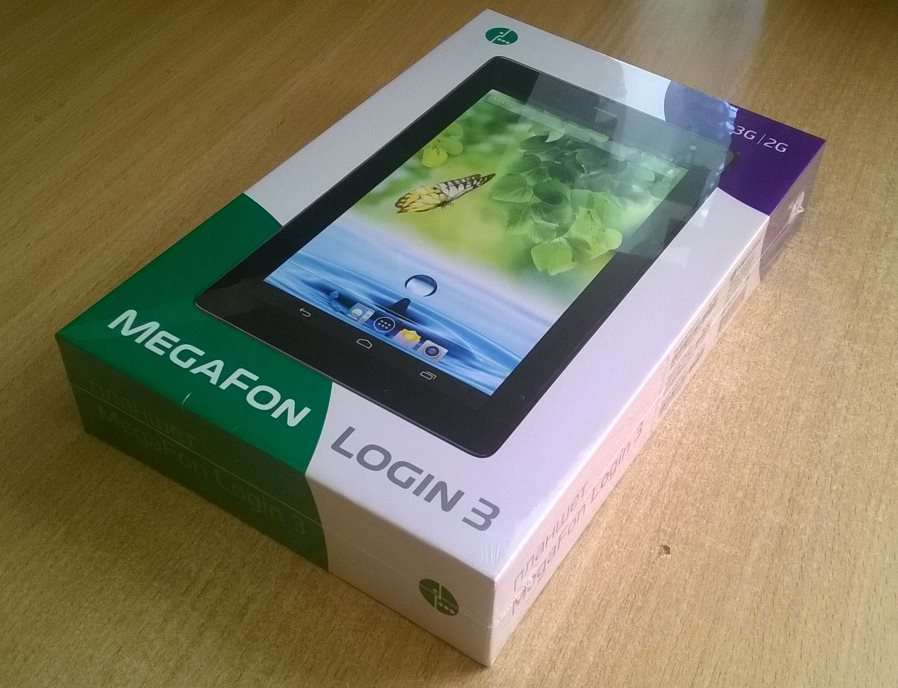
I noticed that for some reason reviews are usually started with packaging. I still don’t understand who it might be interesting to, but apparently these are the traditions and it’s not for me to change them. The printing and box material of the third “Login” is somehow more solid than the second. But the main difference is that now the technical specifications are printed in large print on the package, and not bashfully hidden somewhere in the bowels.

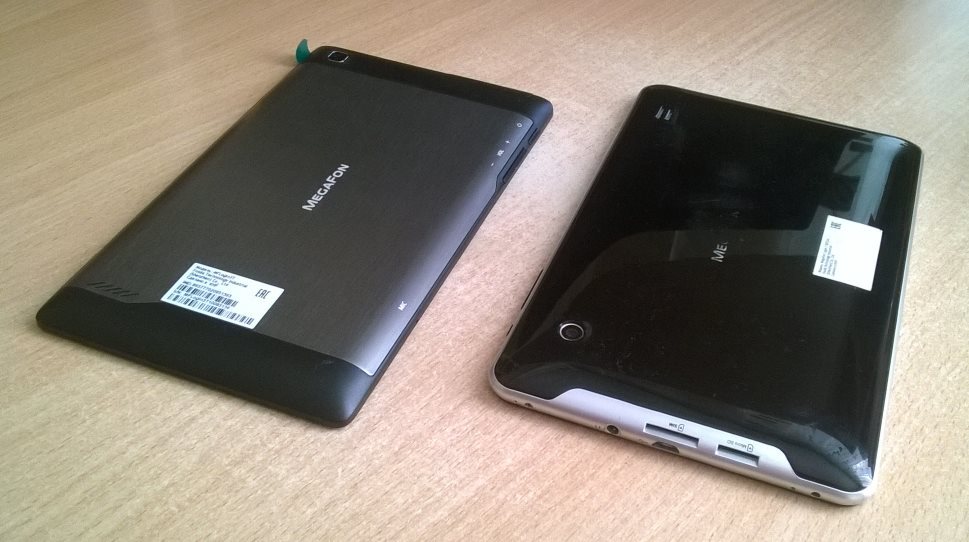
Of the dimensions, only the thickness has changed. Following the general trends, the new tablet has become thinner than the previous one, despite the fact that the battery capacity was increased from 3000 to 3500 mAh. In addition to thickness, visually the tablets differ from the rear: the Login 3 has a metal back cover (for an extra-budget tablet, this is a question of the influence of metal on the price of devices) and a slightly protruding camera module, unlike its predecessor.
The display in size and resolution remained exactly the same: 7``, 1024 * 600. But these are two completely different displays!
To understand, you just need to see what stood on Login 2. There were simply no viewing angles there. He turned a little - everything, the colors became completely different. For a lover of reading, lying to me is very critical. This was one of the two main disadvantages of the device.
On Login 3 a normal, human display can be twisted as you like. IPS, not TN. Of the shortcomings, only the graininess remained, after all, not HD. But this does not stop reading: the eyes are no longer tired.
What I liked - the display is covered with a protective film without inscriptions, which can not be removed. I once scratched the Login 2 tablet, carrying it without a cover in a bag with a metal “zipper”, which is why it’s important. Since there is no protective glass, only the film remains.
What was the second drawback of the previous tablet? RAM size. 512 MB for Android is not serious already. Applications are now such monsters that launched the browser, opened two pages and hello, brakes. Fortunately, Login 3 corrected this shortcoming: now there is gigabyte memory, which, in my opinion, is enough for the tasks assigned to the state employee.
Another notable innovation: the main camera has become 3.2 megapixels, instead of 2 megapixels for Login 2. But still without autofocus. It became more comfortable to shoot any texts, but of course, one should not wait for artistry. The front camera is still 0.3 megapixels, the only thing that has changed is now more logically located: from above, not from below.
The processor has become a little faster, but basically has not changed. Inside is the same dual-core Qualcomm Snapdragon, but not the GHz S4 Play MSM8225, but the 1.2 GHz MSM8210. Visually, the interface became a little smoother, but, as it seemed to me, a larger role was played by the increased amount of RAM and the new OS. The OS is really new - Anrdoid 4.4.4. Login 2 was Anroid 4.1.2.
Wireless modules have not changed much, the same GSM, 3G, Wi-Fi, Bluetooth. The difference is only in 3G speed - before it was limited to 7.2 Mbps, now it has risen to 21.1 Mbps. As I understand it, due to the number of simultaneously used slots.


It makes no sense to describe the shell, the most common one, everything is visible on the screenshots that were taken immediately after opening the box. The kit comes with several pre-installed applications, among which, of course, several branded "Megafon" ones. Of the camera operators, MegaDisk (like Dropbox, but with free traffic), Megafon-Visa (a virtual card tied to a balance — convenient for shopping in the Market), and “Watch +” (online TV) seemed really interesting.
Of the non-operator ones, there are Yandex.Browser (I like the desktop version, but it still doesn’t get damp under Android), Kaspersky Internet Security (okay, let it be for inexperienced ones) and Clean Master (I doubt that it’s really necessary). I just want to write that there are thousands of applications on Android, the more Internet access is already prepaid, so there is no need to clutter up the tablet in advance. But I understand perfectly that this is also one of the ways to lower the price of a device, so I forgive for this segment.


Which of all this can be concluded? On the need for a device of this class, do it yourself based on your personal preferences and requirements. I saw too many different points of view on the previous Login in order to impose something on someone.
But progress is obvious. In addition to the commonly observed top segment, this is very noticeable in the extra-budgetary. Of course, here and there are extremes. The device of the same manufacturer, without changing the price, made a noticeable step forward compared to its predecessor. I wonder if the pace will slow down next year, because there is something to improve. At least screen resolution, for example.