How EdTech Leaders Make Money
Freemium is automatically issued in semantic conjunction with the concepts of “monetization model” and “MOOCs”. Historically, the first EdTech platforms offered educational content for free, earning from the sale of certificates. But in 6 years a lot has changed.

The evolution of monetization approaches
“In many new online markets, companies initially did not have well-developed monetization models and simply worked for rapid expansion, capturing the audience. Investors did not care about whether startups get income. It was important for them to see an aggressive growth plan and a proactive team with a serious background, ”Sergey Oparin, one of the founders of SOLventures , explains this historical fact .
The leaders of MOOCs - Coursera and edX achieved results by capturing huge audiences and gaining popularity. However, the freemium model did not allow them to attract enough funds not only for development, but also for maintaining their status.
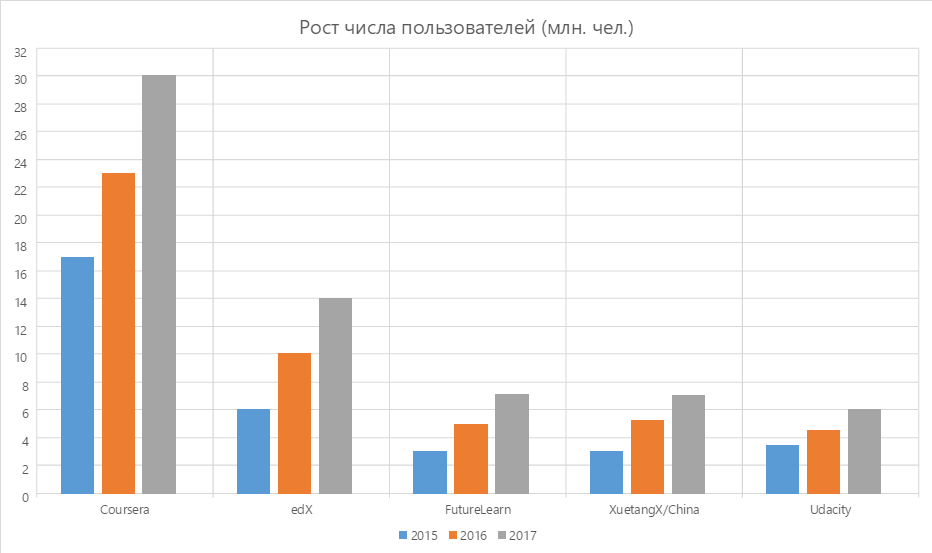
By 2014, many new players appeared on the market, including local ones (for example, the Chinese XuetangX). Competition for the user has grown.
The edX creators were the first to understand this in 2014 and, while retaining free access to short-term course materials, switched to selling paid programs (MicroMasters, Professional Certificate, XSeries). And also began to actively attract donations (crowdfunding) and grants. As a result, edX began to step on the heels of the leader.
Coursera raised $ 210.3 million in investments to support development in 4 rounds, but that was not enough for sustainable development. The platform was not limited to attracting additional financing.
In 2015, Coursera launched a paid product - the first online MBA programs. Thus, both leaders introduced direct sales of the product to end users, supplementing the freemium model, and attracted funding from funds.
They also noticed the interest of corporations and government organizations ripened by 2016. In response to demand, Coursera offered annual subscriptions in the B2B and B2G segments, and edX offered a flexible educational package for the B2B market and a paid additional recruiting service for successful online students.
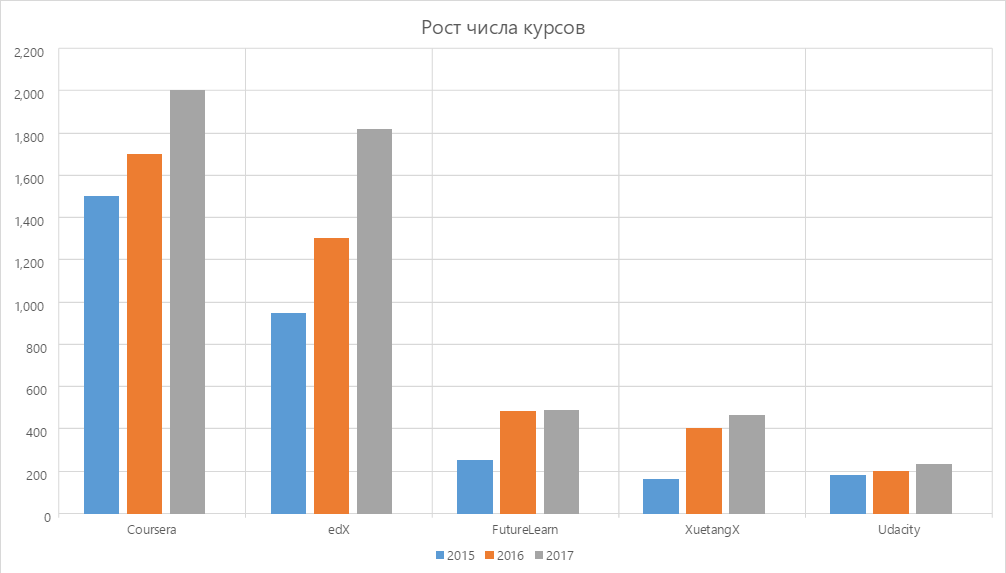
In 2017, FutureLearn, the third on the MOOCs leaderboard, followed suit. FutureLearn, by analogy with its predecessors, added direct sales to freemium: it limited free access to course content and exams, began to actively develop paid FutureLearn programs and launched online MBA.
Among the leaders, only Chinese XuetangX retained pure freemium commitment - today it is at 4 positions among global MOOCs. The platform has some advantages compared to market players, as it is affiliated with the state.
Udacity today takes 5th place in the list of global leaders MOOCs. The platform, like other leaders, while retaining free courses, has introduced Nanodegrees paid programs. In 2016, Nanodegrees were supplemented by paid services. The resource has new employment services for a loyal audience - a freelancing platform for graduates. In partnership with Georgia Tech, Udacity launched a low-cost program - fully online Masters in Computer Science. Today, Udacity uses a hybrid monetization model that combines online and offline learning. Udacity offers paid courses with support, feedback, task verification and subsequent graduation.
Main trends
- The MOOCs market is young and just emerging. The main one is the trend of constant change. The speed of reaction to changes is of great importance.
- New strong local players appear, old global ones lose their positions. For example, in 2016 Udacity was one of the three leaders, and today it occupies the 5th position. Chinese XuetangX has intensified competition in the group of leaders.
- There is an obvious trend of increasing the volume of paid content on MOOCs.
- The MOOCs arsenal has different monetization models: freemium and free trial, direct sales of courses and additional paid services for all market segments, crowdfunding and grants, corporate sponsorship and financial support from the state. We did not mention the advertising model because we did not find it in the arsenal of leaders of MOOCs and we believe that it has many potential negative effects for EdTech projects: distraction from educational content, loss of audience loyalty due to the sale of personal data.
- Leaders are constantly evolving, improving monetization models. Today it is already obvious that the most effective solution is an integrated approach and a combination of several models for attracting financing.
A detailed description of the evolution of the approaches of leaders to monetization is offered to you in cases.
Cases
Coursera
Coursera - the world leader in MOOCs in terms of the number of courses and the number of registered users - started in January 2012. The platform was founded by two professors from Stanford. Today, Coursera partners with more than 150 universities from 29 countries.
On the B2C market, Coursera offers Courses (2000 short-term programs, duration 1-1.5 months), Specializations (180 medium-term programs, duration 4-6 months) and four full online MBAs (1-3 years).
Coursera is active in the B2B and B2G markets, offering companies and government organizations complete products.
How does Coursera make money? Freemium model and paid programs
Freemium Model: Subscription Development
By 2016, new players entered the market, competition for users and investor money has intensified. Coursera had to develop new markets, experiment and develop the conditions for subscribing to Courses and Specializations. Until 2016, users had free access to all materials of the Courses and had to pay for grading and a certificate. In June 2016, Coursera began testing a new course subscription format. The essence of innovation is paid access to all course materials, including video. To date, only a few courses have become fully paid. In October 2016, Courser significantly reduced the cost of subscribing to Specializations (from several thousand dollars a month for subscribing to one Specialization to $ 39-79 per month depending on the Specialization - for access to grading and obtaining a certificate).
As a result of experiments with the conditions for subscribing to Courses and Specializations, there were not only restrictions on access to educational materials and exams (freemium model), but also time limits (free trial model).
In 2016, Coursera began working in B2B and B2G markets, implementing an annual subscription to Courses and Specializations. Coursera works with more than 50 corporate clients, including BCG, BNY Mellon, L'Oreal, Paypal, and Air France KLM. In the B2G market, Coursera collaborates with government agencies in the USA, Pakistan, Egypt, Malaysia, Singapore, and Kazakhstan.
Paid programs
In 2015, Coursera began to develop a new segment - online MBA, opening the first two programs. Today, Coursera offers 4 fully accredited online MBA programs. The cost of training 1 student from 19,000 to 30,000 dollars (University of Illinois) and 20,000 euros (HEC).
Coursera is developing the platform’s traditional subscription monetization model and introducing new paid products. However, for the effective development of self-earned funds is not enough, so Coursera is actively attracting investment.
In total, for 6 years in 4 rounds, Coursera raised $ 210.3 million, of which $ 64 million in 2017. The platform is traditionally supported by GSV Asset Management, New Enterprise Associates (NEA), Kleiner Perkins Caufield Byers (KPCB) and Learn Capital. The new investment partner in 2017 was the Lampert Foundation.
edX
edX is a nonprofit organization founded in 2012 by Harvard and the Massachusetts Institute of Technology. Ranks 2nd among global MOOCs market players and collaborates with 109 partners.
On the B2C market, edX offers Courses (1819 short-term courses in selected disciplines, duration 1-2 months) and Programs (43 MicroMasters, 35 Professional Certificate, 32 XSeries). The training materials of most courses are available for free, payment from 49 to 150 dollars per Certificate.
Since 2014, edX was the first to switch to a paid software implementation model. Some programs are available on credit. MicroMasters ($ 750-1500, duration 10-12 months) are developed mainly with leading universities and allow students to continue their studies at the MBA of the developing university. Professional Certificate developed by leading corporations (Microsoft, Linux, GE and others). Cost from 300 to 800 dollars, duration - 2-8 months. XSeries - developed by renowned, recognized experts in their field, give a deep understanding of the relevant subject areas. Cost from 300 dollars, duration 6-18 months.
edX is active in the B2B market, offering companies a comprehensive product for employee development.
How does edX make money?
According to the official version, edX uses 2 models:
Self Serve Model
edX receive the first $ 50,000 from the sale of the course, or $ 10,000 for each repeated course. A partner - a company or a university - gets 50 percent of all profits that exceed this threshold.
Supported Model
edX charges $ 250,000 for each new course, and also receives $ 50,000 each time the course is extended for a new period. The partner receives 70 percent of the revenue generated from the sale of the course.
Additionally, edX uses several other monetization models.
On the company's website you can find the Donate section - “Donate”. Users are encouraged to make a targeted donation of $ 25 to $ 250. This source is likely to generate little income, but the section is valuable as a tool for getting feedback from students.
Grants are another edX revenue item. For example, in October 2016, the Lumina Foundation gave edX a $ 900,000 grant to develop 30 MicroMasters. A service related to staff training is recruiting employees from among those who have successfully completed profile courses for a partner company. Companies are actively using edX for Business to train and recruit employees.
Futureleearn
FutureLearn ranks 3rd among global MOOCs in terms of registered users and courses. The platform was founded by Open University in 2013. FutureLearn cooperates with 139 partners, including more than 70 European universities.
The platform offers 462 courses for adults (2-6 weeks, cost from 44 to 100 dollars), 4 courses for schoolchildren and 23 FutureLearn Programs (3-14 months, 450-1500 dollars, an analogue of CourseX or XSeries Specializations from edX). Some programs include an assessment of knowledge at the end, and students who successfully complete the assessment receive an Award. Some programs allow students to get university credit, while others offer to continue their studies on accredited Continuing Professional Development (CPD) programs.
Since 2017, FutureLearn has introduced a new pricing model that restricts access to content and exams. Prior to this, fees were charged only for the certificate, and training materials and exams were completely free. In 2017, FutureLearn launched 8 full online graduate degrees. 1 MBA program in partnership with Coventry University and 7 programs in partnership with the Australian Deakin University Cost of a Master's degree of about 20,000 Australian dollars, certificate of completion of the program or diploma costs about 9,000 Australian dollars. For some master's programs, the possibility of free testing for 2-3 weeks is provided.
FutureLearn works only in the B2C market, offering short, medium and long term training programs. FutureLearn Programs and post-graduate fully paid, course materials (short-term programs) are available for free. In 2017, FutureLearn was the last of the leaders to follow the general trend in the development of approaches to monetization: it refused completely free access to content and expanded its line of paid products by introducing online long-term full-time master's programs.
XuetangX / China
XuetangX - the first and largest MOOC platform in China - takes 4th place among global leaders in the number of courses and the number of registered users.
The platform was founded in October 2013 by Tsinghua University under the supervision of the China Ministry of Education Research. Tsinghua Holdings Co, Ltd. invested in MOOC-CN Information Technology (Beijing) Co., Ltd, which operates XuetangX.
XuetangX is one of the fastest growing platforms: over 460 courses. 133 unique courses designed for XuetangX. About 30 courses received under license from edX, the rest - courses from partner universities. In 2017, 63 courses were released. XuetangX partner universities recognize courses hosted on the platform. Among all courses, 42 are considered by universities as programmatic and are recommended to students as elective courses. Universities track the success of students through an individual ID, which the student enters when entering the resource.
XuetangX plans to develop the MicroDegree Program, which integrates university courses, industry courses developed by leading companies, and project work. At the end of the program, students who successfully complete the training receive a certificate and recommendations from well-known companies. XuetangX is active in all markets: B2C, B2B and B2G. All courses and programs on the platform are free.
Udacity
Udacity today takes 5th place in the list of global leaders MOOCs. The resource was founded by Stanford instructors Peter Norwig and Sebastian Thrun. Today, Udacity works with more than 100 partners from 60 countries.
On the platform, training materials for 213 courses are available free of charge (duration 1-3 months), but Udacity has not remained fully committed to the freemium model. Offering Nanodegrees (duration 6-12 months), the project specializes in preparing students for certain specialties - professions of the future.
In 2016, 6 new ones appeared and by the end of the year it became 12 Nanodegrees (the platform closed several programs as a result of the audit), now the platform offers 22 Nanodegrees. Paid services have become an innovation. The resource has new employment services for a loyal audience - a freelancing platform for graduates.
In partnership with Georgia Tech, Udacity launched a low-cost program - fully online Masters in Computer Science ($ 6,600).
Udacity operates in the B2B segment, offering corporate clients 2 virtual trainings, as well as corporate development programs and the ability to attract new employees from among Udacity students.
Udacity is supported by such corporate partners as: IBM Watson, Mercedes Benz, BMW, McLaren, Google, Bosch and others. Udacity recently introduced a hybrid model combining online and offline learning. The platform offers paid courses with accompaniment, feedback, task verification and the subsequent receipt of diplomas. These courses are created with the money of companies interested in highly qualified personnel.
For those who want to pump English!
We invite blog readers to participate in our New Year's campaign: a gift from our partners is attached to any product - subscriptions to WIKIUM, MEGOGO, HTML-academy! Choose for yourself and loved ones New Year's gifts .
Materials
In preparing the article, materials from Corsera, edX, FutureLearn, XuetangX, Udacity sites and blogs were used. As well as Forbes , Class Central , Medium , Edsurge .