December 5, 2017 at 10:30
The story of a system administrator moving to Germany. Part One: Job Search and Visa
Hello.
I decided to publish the story of my move to work in Germany, describing as much as possible all the stages of it - from deciding to start looking for work abroad to actually moving, finding housing and solving numerous issues on the spot. First of all, I was prompted by a very small number of successful job searches in Germany by a sysadmin (and in this area there is a specificity different from programming), and secondly, some non-standardness of my case. Usually they go abroad either alone or with their wife and children, but I left with my sister, which added a lot of nuances to visa issues.
This will be a long story in three parts, where I will try to maximally cover all the rakes that I had to go through.
First, it’s probably worth a little talk about us. In the spring of 2017, I was 28 years old and my sister was 30. We both worked in IT: I was mainly in Linux (web, DevOps), a bit of AWS and incidentally Windows infrastructure, my sister specialized in heavy enterprise solutions from MS, storage and virtualization . By that time, for about half a year, we had been studying German together at the wonderful Deutsch-Klub language school in St. Petersburg, where we lived most of our lives. My sister “fell ill” with Germany a few years ago, and at first I went to learn the language with her for company, but then I discovered German musicals and also got carried away. And once we sat at the panoramic windows of our rented apartment, looked at the sea of St. Petersburg lights below, shared different thoughts ... We both had neither real estate, nor relations, nothing kept us anywhere.

Then we still did not have any clear plans or at least a rough understanding of what difficulties await us. There was only a common goal, to which we agreed to go together, helping each other. Now I am writing these lines from the town of Heusenstamm, in the suburbs of Frankfurt. On one monitor I have this text, on the second the console of one of the working servers is open. My sister sits at the opposite table, bending over a German textbook from the Frankfurt language school. Everything worked out for us; More than two months have passed since we moved to Germany. However, let's get better in order :)

You can get to Germany in different ways. The easiest way for a tourist is to get a Schengen visa and herzlich willkommen! But we wanted to stay in this country to live, so the tourist option fell away immediately. You can find German or Jewish roots in your own home and come on preferential programs for immigrants - it also disappeared: although we had some roots, but it was possible to wait for a decision on this option for years, and without guarantee of success. We did not even consider exotic options, such as a residence permit for freelancers and other businessmen - we need to live on something in a new country, and we are far from being millionaires. Oh yes, you can still marry a German or marry a German. It is not for me to judge those who go to such marriages of convenience, but for us this was absolutely unacceptable. There was only one option - work. There are many in Germany, it’s just looking at what and for whom: EU citizens can work almost without restrictions, and it is very, very difficult for a foreigner from Russia to get a work permit. However, there is an exception to this rule - the Blaue Karte program: in fact, this is a simplified issue of a work visa for highly qualified specialists in certain professions. IT people, doctors, engineers ... The list is long. A specialist who came under this program, after 1 year and 9 months of work in Germany, has the right to obtain an unlimited residence permit (subject to knowledge of the German language at a level no lower than B1), and after 6 years - citizenship (subject to social adaptation etc). in fact, this is a simplified issuance of a work visa for highly qualified specialists of certain professions. IT people, doctors, engineers ... The list is long. A specialist who came under this program, after 1 year and 9 months of work in Germany, has the right to obtain an unlimited residence permit (subject to knowledge of the German language at a level no lower than B1), and after 6 years - citizenship (subject to social adaptation etc). in fact, this is a simplified issuance of a work visa for highly qualified specialists of certain professions. IT people, doctors, engineers ... The list is long. A specialist who came under this program, after 1 year and 9 months of work in Germany, has the right to obtain an unlimited residence permit (subject to knowledge of the German language at a level no lower than B1), and after 6 years - citizenship (subject to social adaptation etc).
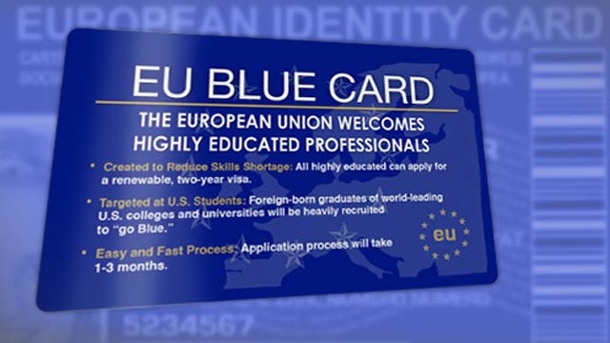
The most interesting thing about this program is that a Blaue Karte visa is issued without fail if three conditions are met:
1. Higher education, which is recognized in Germany ,
2. Work contract with a German company on the profile of your education (there are some concessions: for example, IT people is fine diploma neaytishnoy but technical specialty - physics, maths etc),
3. annual salary, amounting to a tax of at least € 50.800 per year (for a single list of specifically needed specialties, which include IT specialists at least € 39.624 per year). These figures change year by year.
What is good about the mandatory visa issuance procedure? The fact is that most German visas are issued at the discretion . This means that your application will be considered for a rather long time (from a month or longer) in Germany by an official from the Ausländerbehörde - Office for Foreigners, and the decision is made in each case at the discretion of this official, so that a visa can be refused without explanation . Or with the explanation that you ... did not convince the official of the honesty of your intentions, and it will be difficult for you to prove the opposite. But a visa for Blaue Karte, subject to the above conditions, you must issue.
It was in this direction that it was decided to move. My German frankly did not reach a level that allowed me to work, but I had good English, and in many German IT companies it was English that was the language of internal communications - so I estimated my chances as good.
First of all, I wrote a detailed summary in English, which took me about two days. After proofreading this resume by several familiar IT specialists, friendly HR and an English teacher, it was mercilessly shortened and adjusted: three pages left two with the most concise and detailed “squeeze” of key skills and experience. Having registered on monster.de, indeed.com, xing.com, stepstone.de and similar sites for job search, as well as subscribing to job groups for IT people on Facebook, I began to send this resume to vacancies that fit my profile, where either there was no explicit requirement for knowledge of the German language, or it was directly indicated that only English was needed. I always attached a cover letter to my feedback, the template of which was written and checked simultaneously with the resume, and which I changed slightly for each specific vacancy - to emphasize precisely those skills that were required there. In this case, one should carefully read the description of the vacancy - it was often indicated there that the cover letter should reflect the salary expectations and the possible date of joining the job, or asked to send certificates or a copy of the diploma (in German) along with the resume. If no additional information or documents were clearly required, then I limited myself to a cover letter. or asked to send certificates with a resume, or a copy of the diploma (in German). If no additional information or documents were clearly required, then I limited myself to a cover letter. or asked to send certificates with a resume, or a copy of the diploma (in German). If no additional information or documents were clearly required, then I limited myself to a cover letter.
We should also write about salary. In 90% of German IT vacancies, salaries are not indicated, and the applicant will be asked the question of how much he wants to receive - which puts many compatriots in a dead end, like me at that time. How much to ask, so as not to cheapen, but not seem inadequate? I looked at the statistics on salaries in my industry for a particular federal state and the average housing prices in the city where the vacancy was offered, and then correlated this with the tax class that is due to me (it depends on how much you will get on hand). Based on all this, I called the amount. She, of course, among other things, should fit into the above minimums for Blaue Karte.
In short, the job search was in full swing. My sister was doing about the same thing, with the only difference being that her resume was in German - her English was very weak, and she studied German much longer and harder than me, which had a very positive effect on her vocabulary and speaking skills.

I received the first answers after a few days, but it was either automatic beats, or unsubscripts like "your resume has been received, we will contact you if it suits us." The yard was the end of April 2017.
The first real answer came about a week later: Daniel, a recruiter from a recruiting agency, wrote to me and offered to talk by phone. To say that I was worried means to say nothing :) However, everything went well: we understood each other perfectly. Daniel asked me in detail about my experience, said that he had several suitable vacancies, and with my consent sent my resume there with his comments. After a couple of weeks, he called back: I was very interested in one company from Frankfurt that was looking for an DevOps engineer, and I was asked to undergo online testing for professional suitability. Testing consisted of several codigity problems of medium complexity that could be solved in Python or Java, to choose from. I chose Python and managed without any problems, after which I was invited to a telephone interview, which was supposed to take place two weeks later (this was explained by the high workload of the team leader). And a couple of days later a response came from a company from Berlin, where I sent a resume for a job as a system administrator: I was asked to fill out a questionnaire with an assessment of my professional skills, after which I was scheduled for an interview on skype (as much as three weeks later). Already knowing about German leisureliness, I was not particularly surprised.

Here you need to make a digression. From the very beginning of the job search, I was shockingly engaged in English on Skype with a teacher from the USA. For some reason, many buy the magic phrase “native speaker”, completely without thinking that knowing the language and teaching the language are two big differences. I initially looked for (and found) a teacher, and with experience in preparing people for the job interview, and he really helped me - we talked on a variety of topics, corrected the mistakes in my pronunciation and construction of phrases, lost a bunch of possible situations and questions that could be asked at the interview. As homework, first there were tests for fixing grammar and tenses, and then audio and video, which had to be perceived by ear and retold in your own words without errors. I prepared a voluminous text with typical “HR-Style” questions and options for my answers, which we “lost” with the teacher several times. By the time of the first interview, I was already ready for all (well, almost) possible tricks and knew how to answer them.
In mid-May, it was time for the first telephone interview. The team leader from the Frankfurt company’s development department who called me turned out to be Russian, and to some extent my colleague twice (he graduated from a university in St. Petersburg with a degree in RES and VCHU). We communicated with this, however, exclusively in English. After asking me about my experience in development automation, he gave me “homework” (as I later found out from some German programming competition) and a week to implement it. I managed in 5 days, sent a solution, and we had a discussion by e-mail, because our results were slightly different. As a result, Timlid had to agree that he himself solved this problem erroneously, after which I received an invitation to the next stage - a video conference with him and a lady from HR. At a videoconference in mid-June, I was asked the standard “HR-Style” questions (in response to which I gave out my homework without hesitation), told a little about the company, and a couple of days later they sent an invitation to come to the office for a final interview. The company paid me plane tickets to and from Frankfurt, plus hotel accommodation.

An interview on Skype with a company from Berlin was at the end of May. For about an hour I talked with their Senior HR, who was also very IT savvy. After talking on IT and universal topics, HR gave me a test task (to write a medium-sized playbook for ansible taking into account certain conditions). I coped with the task, and after a couple of weeks there was another Skype interview where, in addition to the long-standing HR, there was a team leader and one of the senior admins. For a long time they eagerly figured out why I wrote this playbook in this way and not otherwise, and how I would change it for such or such conditions. They asked a lot about the general principles of infrastructure services - AD, Exchange, Sharepoint, SCCM, plus there were a fairly large number of questions on Linux. These topics were completely familiar to me, so I held myself quite confidently. At the end of June, I was offered to come to Berlin for a final interview. He was scheduled for Monday, and to my surprise, the company suggested that I fly in on Saturday and take a walk around the city for two days. Moreover, tickets and a hotel for the entire stay - also at their expense. Unexpectedly, but nice.
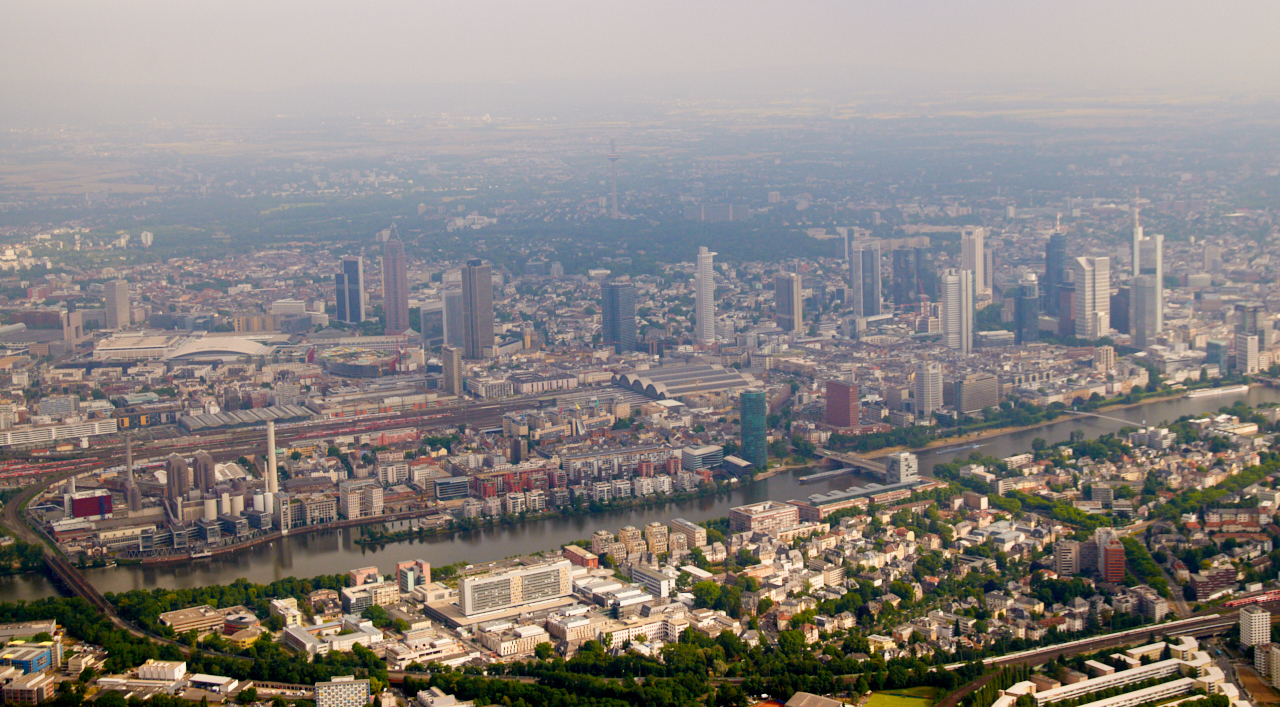
Frankly, I was a little uneasy. I have never been to Germany before, although I knew a lot about this country. And then the plans of emigration through work from something speculative for the first time began to look real. It seemed to me all this is very strange - is there such a lack of qualified IT specialists in Germany that serious companies are ready to solve numerous problems in importing a specialist from abroad? I was skeptical, but there was no time for reflection: the time gap between the two final interviews - in Frankfurt and in Berlin - was only three days. I had a valid Schengen, so, fortunately, I didn’t have to get a visa at a fire pace, but before the trip I had to solve a lot of issues, buy tickets (I was paid for them, but I had to find the suitable flights myself), to motivate your absence at work, to study city maps for habitats, offices, sights ... Plus, I did not stop sending resumes to suitable vacancies, which also took some time. But then, finally, I was sitting on the plane that carried me to Frankfurt. So I saw this city for the first time - from the porthole of an airplane, on an early July morning:
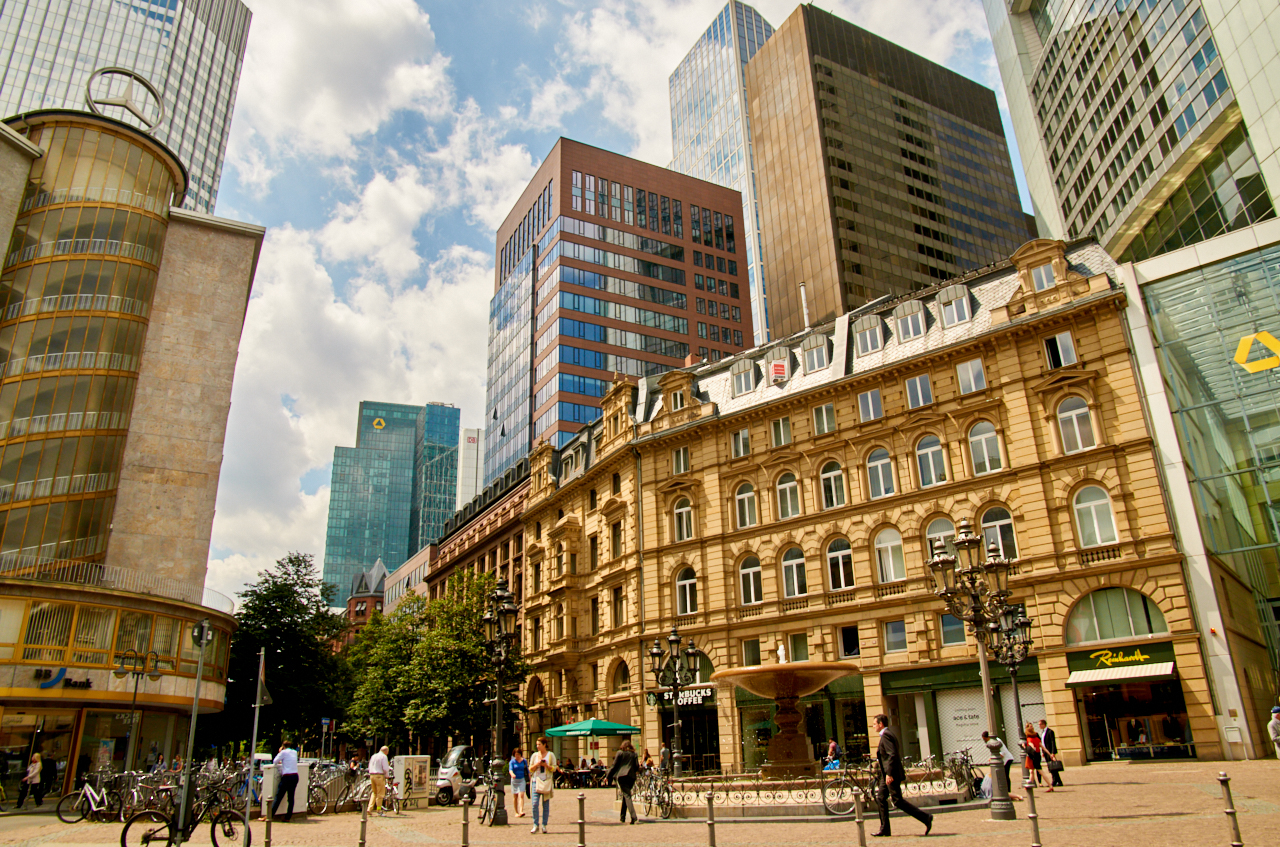
The company from Frankfurt, which invited me through a recruitment agency, was looking for an employee for the position of DevOps Engineer. There was a lot of emphasis on coding in all telephone interviews, and I never tired of repeating that I was not a programmer. They answered me that “this is not a problem” and “will suit us.” I still doubted, but the experience of a face-to-face interview in Germany would obviously not be amiss for me, and who would refuse to fly abroad at someone else’s expense? Arriving on the eve of the interview, I walked all day in Frankfurt. It was the beginning of July, the sun was shining on a cloudless sky, the city was buried in greenery. Gaining courage, I even tried to speak German, and they even understood me. My sister, in order to expand her language practice, wrote me quests on WhatsApp - to go there, ask the local population something, and so on:


The next day, at 8:30 in the morning, I went for an interview. They drove me for a long time in Java and Python, after which they said that I did not fit the position of DevOps due to insufficient programming skills, but they have a vacant admin position. Further, I spoke very positively with the head of the admins team, answered all his questions and made, as it seemed to me, a good impression. The finale was a conversation with HR Manager - a harsh lady under 50 years old, with a military bearing and a suspicious squint. She asked me a bunch of unpleasant questions, which came down to the idea that I wanted to get a residence permit through the company by deception and immediately run across to competitors. In the end, they promised me an answer within a week. I walked a few hours around Frankfurt, ate a bretzel and flew home. A few days later they refused me without explanation.
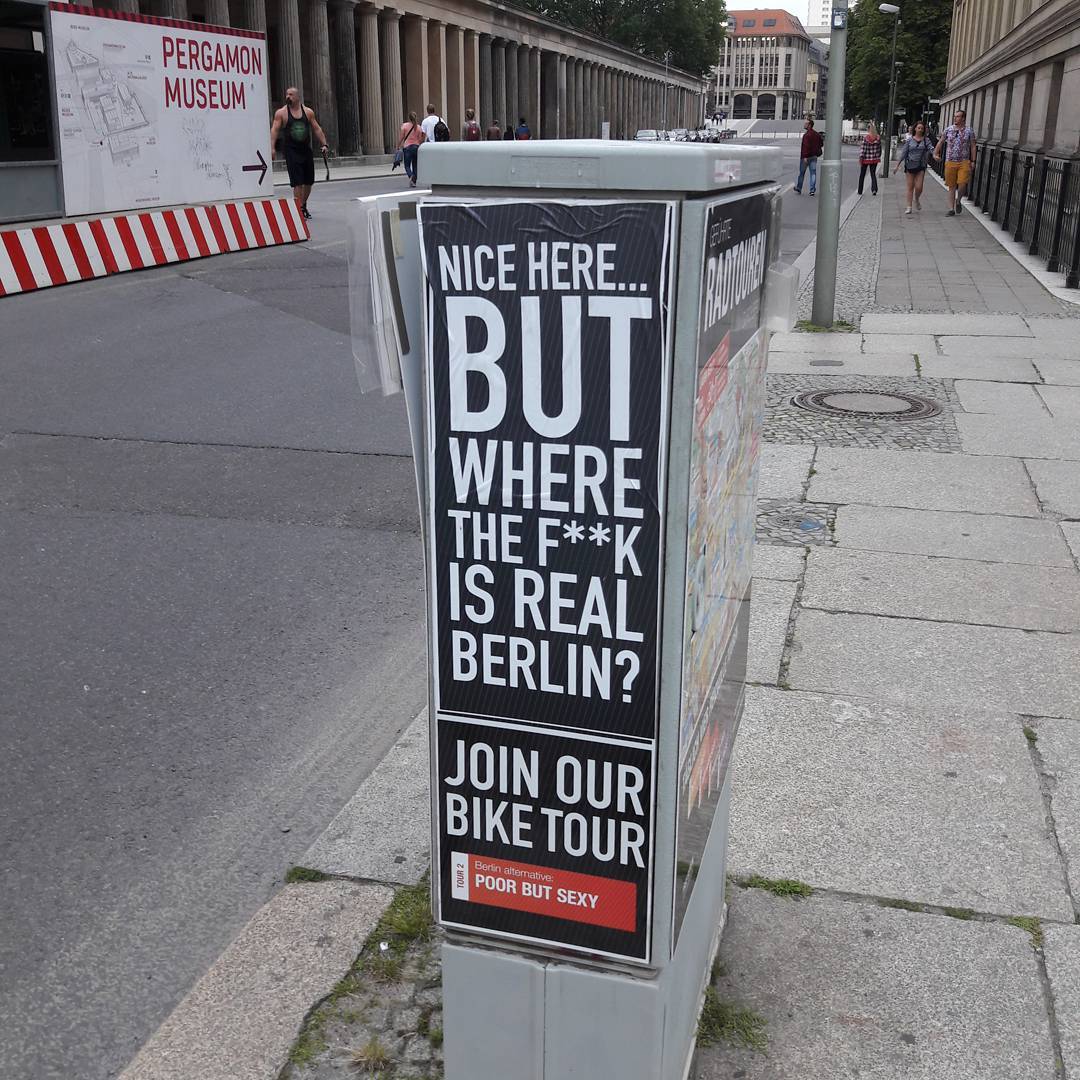
The second company, based in Berlin, was looking for a system administrator, and this was one of the first vacancies where I sent the resume. We discussed all possible issues with them on Skype, and on Saturday morning I flew to Berlin - the company gave me the opportunity to better know the city I was planning to move to, for which I was paid a flight and a hotel (even with breakfast) from Saturday to Tuesday. Having walked around Berlin all weekend, on Monday I spent a full day at the company’s office, passed a couple of interviews with top management and completed a rather extensive test task - entirely on Linux, because I fully demonstrated my Windows skills in previous interviews. The task began with the fact that it was necessary to crack the admin password on the machine, for which I had to execute it :) I managed successfully, We parted on the positive, and promised to give an answer in four days. In the evening after the interview, I climbed onto the Berlin TV tower, wandered around the city at night and flew back to St. Petersburg in the morning.
Four days later, HR companies called me and said that they very much apologize, but still can’t come to a common opinion about me, so they need a few more days to think. Realizing that the thing smells like kerosene, I sat down that evening and wrote a lengthy motivation letter in which I wrote how I liked Berlin, how I appreciate the generosity of the company and how happy I would be to work there, which I sent to all interested people. Either the letter took effect, or the stars converged, but at the beginning of next week they called me and said two magic words: “job offer”.

On the same day they sent me a draft contract. The next day I wrote that the contract suits me, and another week went to the company for its internal coordination, during which I had to urgently shake my former management regarding the recommendations requested by the company at this stage. Moreover, HR, having received a written recommendation, was not too lazy to call and ask in detail what kind of employee I was (and then I heard a lot of interesting things about myself from the former boss, whom they began to call at the height of the rally). Finally, they sent me an official job offer and a contract, I signed it and sent it back. Now they had to sign a contract on their part and send me the original by express mail, after which it would be possible to go to the consulate and apply for a German national visa.
Everything that happened seemed unreal to me - and, as it turned out, not in vain. When I was already made an appointment with the German consulate, I suddenly received a call from the CEO of the Berlin office. He very much apologized and said that they had to withdraw the contract, as the company's investors suddenly spoke out categorically against hiring a person from outside the EU as a system administrator (for security reasons). Then HR wrote to me, who also apologized very much and explained that they had done everything possible to convince investors, but nothing worked. And, since they understood that it was extremely ugly to withdraw a signed contract, I was offered monetary compensation for the inconvenience ... Which, of course, was very nice, but the fact of the collapse of all the plans to move that had already begun to be put into effect could not be fixed.

To say that I was upset is to say nothing. It was difficult not to give up after such a resounding failure, but my sister supported and motivated me in every way. Meanwhile, there were three more responses to my resume: from Cologne, Neustadt and Frankfurt. In the first company (a large system integrator, Linux) I went through all the technical interviews, but was refused because I ... smiled a little, and therefore "will not fit into their corporate culture." The second company, also a system integrator, Windows, wrote that they were very interesting to me, but many times postponed the date of the interview (then they got sick with HR, then a team leader on a business trip,then an alien invasion ), and I eventually spat on them.

Finally, the third company ... To begin with, for some reason their response got into my spam, and I saw it there purely by accident. I was invited to an interview by phone. The head of the department and the senior admin talked to me, who said that they are a small state office that is looking for a specialist for administering WEB infrastructure under Linux, with skills in related fields. I was asked a lot of questions on my experience, the decisions that were applied, their justifications and reasons, on the projects in which I participated, relationships with colleagues. At the same time, they did not ask a single “HR-Style” question in the spirit of “Tell us about your shortcomings,” which I really liked right away. On the same evening, they sent me a test task - quite voluminous, including writing a detailed plan for deploying a fail-safe infrastructure according to given introductory notes. It was given for a week. I managed in two days, trying to paint everything in detail, using all the solutions that I knew (and even those that I had only heard about, having read a bunch of specialized sites for this and consulted with colleagues). After sending the resulting document to a potential employer, I began to wait.

Imagine now my surprise and joy when the next day I received a letter with an offer, the terms of which were even better than I could have expected! So, without a personal acquaintance and a trip to their office, after one telephone conversation, the company decided to take me to work (I learned about the reasons for such promptness later, already on the spot). Of course, I agreed, and the next day they sent me a contract. He got to me not without adventures (hi Russian Post), but this is already particular. It was in mid-August.
The time has come to prepare documents for a national visa. It was necessary to collect everything, translate it into German, fill out questionnaires, lay it out in a certain way ... I even had to go to the consulate again to find out if my diploma should be sent to confirm its conformity with German higher education. It turned out - not necessary, otherwise it would have resulted in an additional 200 euros and 2 weeks of waiting.

Here is the list of documents that I submitted to the consulate:
1. Application for issuing a national visa
2. Statement of responsibility for providing false information
3. Passport with two copies
4. Ordinary passport with two copies
5. Employment contract with two copies
6. Autobiography on German with two copies
7. Diploma with translation into German and two copies (apostille is not needed)
8. Printout from ANABIN on recognition of my specialty as equivalent to German
9. Workbook with translation into German and two copies
10. Certificate from the German language school language courses with two copies
11. "Schengen" medical insurance with two copies
At the German consulate in Germany, I accepted the documents right away, although they cursed because the contract was in English (the company I was working for was international). They promised to make a visa no earlier than a week later, but in fact it was ready in a day - August 23. We planned to leave on September 22nd.
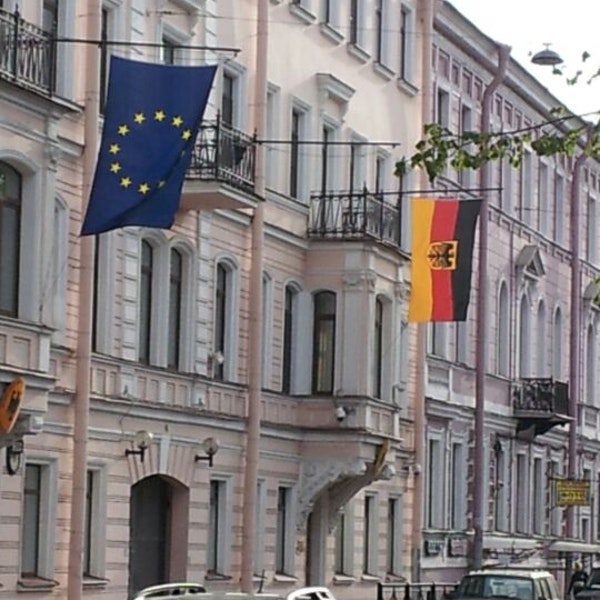
The funny thing is that a couple of days after going to the consulate, the office from Neustadt “woke up”. Mindful of the fact that in Berlin they eventually sent me even with the contract signed, I agreed to talk with them. Since then I actually didn’t care at all, I didn’t particularly bother about what I was saying - I joked, went into lyrical digressions on common topics, poisoned provider bikes, switched from English to German a couple of times in those phrases, where I felt confident ... An hour after the end of the interview, a job offer arrived with an HR note in the spirit of "we are shocked by such a quick decision, but you were so impressed with the department head that he no longer wants to see other candidates."
However, it was all lyrics, and the question before us was quite serious: how to get the opportunity to leave with me for my sister, who by then had not found anything. She is a very good specialist, in some areas she is much better than me, but ... She did not have a specialized diploma, which meant that she would not even accept documents for a visa, since having a higher technical education is a prerequisite for issuing Blaue Karte under an IT contract . Of course, in her resume, the sister did not hide this fact. There is the possibility of obtaining a visa according to the standard (not Blaue Karte) “working” paragraph without a specialized diploma, but this can take months and creates a verythere are many problems for a company that decides to hire a specialist for this paragraph from outside the EU. Therefore, German companies are primarily considering those who are suitable for the conditions of Blaue Karte - there the procedure is not an example faster and easier.
However, at first everything seemed pretty simple: according to German laws, specialists moving to Germany by Blaue Karte have the right to bring close relatives with them, who are issued a “working” residence permit automatically. But when we read this law carefully, it turned out that only spouses and minor children are considered “close relatives” there. Parents, brothers, sisters and children who have reached the age of majority are not included in this category and they do not need a residence permit.
We began to consider other options that give the right to obtain a residence permit for a sister. A visa for job search also required a specialized diploma, so this option was no longer needed. As a result, we came to the conclusion that the sister needs to receive the so-called “language visa” - this makes it possible to live legally in Germany and learn the language for a year. Obtaining such a visa is very difficult, but quite real: it played into our hands that our sister had a Goethe-Institut certificate confirming her German skills at level A2 (although in my opinion, she really knew the language at level B1 then), plus there was an opportunity pay intensive language courses in advance for the entire period of study (fun is not cheap, but without this condition a language visa is not issued). For a year of such courses, and even in the linguistic environment, it is quite possible from the level that the sister had then,

My sister applied for a visa a week after me (it happened because of the overlay with documents on education), and our plan smacked of adventure: since I had to go to work in Frankfurt in October and time was already running out, and considering an application for a language visa - it’s not a quick matter (1-3 months), we decided that my sister would go with me on a valid Schengen visa, which gives me the right to stay in Germany for 3 months. And when they approve the national visa, they fly to St. Petersburg and go to the German consulate for it. That's just a language visa is issued "at the discretion of the official", each case is considered individually and no one guarantees a positive solution. Of course, we had plans for what to do in case of refusal - but, looking ahead, my sister finally got a visa in just three weeks,

Further events rushed straight up. We decided to go by car to transport the cat and as many things as possible. Sister took over b aboutmost of the worries about arranging relocation and finding housing in Germany for the first time, but I had a headache. It was necessary to have everything in time: dismissal from work, termination of the apartment rental agreement, trips to the dentist and other doctors - so as not to get into health problems upon arrival in Germany, diagnostics and car repairs - on the principle of “changing everything that causes suspicion”, because we had to overcome more than two thousand kilometers. Buying an additional roof rack for the car, planning a route, booking a home on the way. Sale of unnecessary things, sorting the right ones into those that we take with us, and those that we leave, transportation of the latter for storage. Transfer all savings in euros and withdraw them from a bank account. Fees, packing things in boxes, trying to shove the unbearable, anger, denial, bargaining, humility,

It was early morning on September 22nd. The last time we left the entrance of the house where we lived for a whole year. In the parking lot there was a car loaded by nowhere, we carried a cat in a carry, not yet suspecting what kind of test awaits him. Our feelings were complex: the past life was over, the new one had not yet begun, there were 2,200 kilometers ahead and three days of travel.
Our road to Germany began. But this should be told in a separate story.
Continuation can be read here .
Sites where I was looking for work:
www.monster.de
www.stepstone.de
www.indeed.com
www.xing.de
www.linkedin.com
Sites where I got information about the nuances of emigrant life in Germany:
toytowngermany.com - English A site with active discussions of many topics that it is important for a newcomer immigrant or someone who is just about to move to Germany to know. The people there are mostly adequate and say things,
tupa-germania.ru is a very interesting site. Many articles on everyday issues and their solutions, an active forum with a lot of useful information,
surfin-birds.ru - also many useful articles, but activity on the forum tends to zero,
foren.germany.ru- I have a difficult impression of this resource. There is enough useful information, but even more flooding, stupid (and even harmful) tips and topics in the spirit of “how to marry a German”, “how to get benefits”, “how to break the law and not get caught” and the like. For an amateur.
ru-geld.de - a description of the German tax classes and how the net salary is calculated (the amount that you get on hand after taxes).
ANABIN website where I checked if my diploma is recognized in Germany: anabin.kmk.org- unfortunately, only in German. If your university is listed in the ANABIN database with an H + rating, and your specialty is there (in the general list of specialties, not necessarily for a specific university), then such a diploma in Germany is recognized as equivalent to German higher education. If the rating of the university is not H +, or your specialty is not on the lists, then most likely you will have to go through the recognition procedure through ZAB (costs about 200 euros and takes 2-3 weeks).
And, of course, the most reliable source of information on visa issues is the website of the German Embassy in Russia: germania.diplo.de .
PS In total, less than six months passed from the decision to leave to go to work in Germany. About 50 resumes were sent during this time, about half of them refused, several were invited to interview by phone / Skype, the rest were not answered at all. 2.5 months have passed from sending a resume to my current company to going to work.
I decided to publish the story of my move to work in Germany, describing as much as possible all the stages of it - from deciding to start looking for work abroad to actually moving, finding housing and solving numerous issues on the spot. First of all, I was prompted by a very small number of successful job searches in Germany by a sysadmin (and in this area there is a specificity different from programming), and secondly, some non-standardness of my case. Usually they go abroad either alone or with their wife and children, but I left with my sister, which added a lot of nuances to visa issues.
This will be a long story in three parts, where I will try to maximally cover all the rakes that I had to go through.
Initial data
First, it’s probably worth a little talk about us. In the spring of 2017, I was 28 years old and my sister was 30. We both worked in IT: I was mainly in Linux (web, DevOps), a bit of AWS and incidentally Windows infrastructure, my sister specialized in heavy enterprise solutions from MS, storage and virtualization . By that time, for about half a year, we had been studying German together at the wonderful Deutsch-Klub language school in St. Petersburg, where we lived most of our lives. My sister “fell ill” with Germany a few years ago, and at first I went to learn the language with her for company, but then I discovered German musicals and also got carried away. And once we sat at the panoramic windows of our rented apartment, looked at the sea of St. Petersburg lights below, shared different thoughts ... We both had neither real estate, nor relations, nothing kept us anywhere.
Then we still did not have any clear plans or at least a rough understanding of what difficulties await us. There was only a common goal, to which we agreed to go together, helping each other. Now I am writing these lines from the town of Heusenstamm, in the suburbs of Frankfurt. On one monitor I have this text, on the second the console of one of the working servers is open. My sister sits at the opposite table, bending over a German textbook from the Frankfurt language school. Everything worked out for us; More than two months have passed since we moved to Germany. However, let's get better in order :)
Germany and how to move here
You can get to Germany in different ways. The easiest way for a tourist is to get a Schengen visa and herzlich willkommen! But we wanted to stay in this country to live, so the tourist option fell away immediately. You can find German or Jewish roots in your own home and come on preferential programs for immigrants - it also disappeared: although we had some roots, but it was possible to wait for a decision on this option for years, and without guarantee of success. We did not even consider exotic options, such as a residence permit for freelancers and other businessmen - we need to live on something in a new country, and we are far from being millionaires. Oh yes, you can still marry a German or marry a German. It is not for me to judge those who go to such marriages of convenience, but for us this was absolutely unacceptable. There was only one option - work. There are many in Germany, it’s just looking at what and for whom: EU citizens can work almost without restrictions, and it is very, very difficult for a foreigner from Russia to get a work permit. However, there is an exception to this rule - the Blaue Karte program: in fact, this is a simplified issue of a work visa for highly qualified specialists in certain professions. IT people, doctors, engineers ... The list is long. A specialist who came under this program, after 1 year and 9 months of work in Germany, has the right to obtain an unlimited residence permit (subject to knowledge of the German language at a level no lower than B1), and after 6 years - citizenship (subject to social adaptation etc). in fact, this is a simplified issuance of a work visa for highly qualified specialists of certain professions. IT people, doctors, engineers ... The list is long. A specialist who came under this program, after 1 year and 9 months of work in Germany, has the right to obtain an unlimited residence permit (subject to knowledge of the German language at a level no lower than B1), and after 6 years - citizenship (subject to social adaptation etc). in fact, this is a simplified issuance of a work visa for highly qualified specialists of certain professions. IT people, doctors, engineers ... The list is long. A specialist who came under this program, after 1 year and 9 months of work in Germany, has the right to obtain an unlimited residence permit (subject to knowledge of the German language at a level no lower than B1), and after 6 years - citizenship (subject to social adaptation etc).
The most interesting thing about this program is that a Blaue Karte visa is issued without fail if three conditions are met:
1. Higher education, which is recognized in Germany ,
2. Work contract with a German company on the profile of your education (there are some concessions: for example, IT people is fine diploma neaytishnoy but technical specialty - physics, maths etc),
3. annual salary, amounting to a tax of at least € 50.800 per year (for a single list of specifically needed specialties, which include IT specialists at least € 39.624 per year). These figures change year by year.
What is good about the mandatory visa issuance procedure? The fact is that most German visas are issued at the discretion . This means that your application will be considered for a rather long time (from a month or longer) in Germany by an official from the Ausländerbehörde - Office for Foreigners, and the decision is made in each case at the discretion of this official, so that a visa can be refused without explanation . Or with the explanation that you ... did not convince the official of the honesty of your intentions, and it will be difficult for you to prove the opposite. But a visa for Blaue Karte, subject to the above conditions, you must issue.
It was in this direction that it was decided to move. My German frankly did not reach a level that allowed me to work, but I had good English, and in many German IT companies it was English that was the language of internal communications - so I estimated my chances as good.
Job Search in Germany
First of all, I wrote a detailed summary in English, which took me about two days. After proofreading this resume by several familiar IT specialists, friendly HR and an English teacher, it was mercilessly shortened and adjusted: three pages left two with the most concise and detailed “squeeze” of key skills and experience. Having registered on monster.de, indeed.com, xing.com, stepstone.de and similar sites for job search, as well as subscribing to job groups for IT people on Facebook, I began to send this resume to vacancies that fit my profile, where either there was no explicit requirement for knowledge of the German language, or it was directly indicated that only English was needed. I always attached a cover letter to my feedback, the template of which was written and checked simultaneously with the resume, and which I changed slightly for each specific vacancy - to emphasize precisely those skills that were required there. In this case, one should carefully read the description of the vacancy - it was often indicated there that the cover letter should reflect the salary expectations and the possible date of joining the job, or asked to send certificates or a copy of the diploma (in German) along with the resume. If no additional information or documents were clearly required, then I limited myself to a cover letter. or asked to send certificates with a resume, or a copy of the diploma (in German). If no additional information or documents were clearly required, then I limited myself to a cover letter. or asked to send certificates with a resume, or a copy of the diploma (in German). If no additional information or documents were clearly required, then I limited myself to a cover letter.
We should also write about salary. In 90% of German IT vacancies, salaries are not indicated, and the applicant will be asked the question of how much he wants to receive - which puts many compatriots in a dead end, like me at that time. How much to ask, so as not to cheapen, but not seem inadequate? I looked at the statistics on salaries in my industry for a particular federal state and the average housing prices in the city where the vacancy was offered, and then correlated this with the tax class that is due to me (it depends on how much you will get on hand). Based on all this, I called the amount. She, of course, among other things, should fit into the above minimums for Blaue Karte.
In short, the job search was in full swing. My sister was doing about the same thing, with the only difference being that her resume was in German - her English was very weak, and she studied German much longer and harder than me, which had a very positive effect on her vocabulary and speaking skills.
I received the first answers after a few days, but it was either automatic beats, or unsubscripts like "your resume has been received, we will contact you if it suits us." The yard was the end of April 2017.
Remote Job Interviews
The first real answer came about a week later: Daniel, a recruiter from a recruiting agency, wrote to me and offered to talk by phone. To say that I was worried means to say nothing :) However, everything went well: we understood each other perfectly. Daniel asked me in detail about my experience, said that he had several suitable vacancies, and with my consent sent my resume there with his comments. After a couple of weeks, he called back: I was very interested in one company from Frankfurt that was looking for an DevOps engineer, and I was asked to undergo online testing for professional suitability. Testing consisted of several codigity problems of medium complexity that could be solved in Python or Java, to choose from. I chose Python and managed without any problems, after which I was invited to a telephone interview, which was supposed to take place two weeks later (this was explained by the high workload of the team leader). And a couple of days later a response came from a company from Berlin, where I sent a resume for a job as a system administrator: I was asked to fill out a questionnaire with an assessment of my professional skills, after which I was scheduled for an interview on skype (as much as three weeks later). Already knowing about German leisureliness, I was not particularly surprised.
Here you need to make a digression. From the very beginning of the job search, I was shockingly engaged in English on Skype with a teacher from the USA. For some reason, many buy the magic phrase “native speaker”, completely without thinking that knowing the language and teaching the language are two big differences. I initially looked for (and found) a teacher, and with experience in preparing people for the job interview, and he really helped me - we talked on a variety of topics, corrected the mistakes in my pronunciation and construction of phrases, lost a bunch of possible situations and questions that could be asked at the interview. As homework, first there were tests for fixing grammar and tenses, and then audio and video, which had to be perceived by ear and retold in your own words without errors. I prepared a voluminous text with typical “HR-Style” questions and options for my answers, which we “lost” with the teacher several times. By the time of the first interview, I was already ready for all (well, almost) possible tricks and knew how to answer them.
In mid-May, it was time for the first telephone interview. The team leader from the Frankfurt company’s development department who called me turned out to be Russian, and to some extent my colleague twice (he graduated from a university in St. Petersburg with a degree in RES and VCHU). We communicated with this, however, exclusively in English. After asking me about my experience in development automation, he gave me “homework” (as I later found out from some German programming competition) and a week to implement it. I managed in 5 days, sent a solution, and we had a discussion by e-mail, because our results were slightly different. As a result, Timlid had to agree that he himself solved this problem erroneously, after which I received an invitation to the next stage - a video conference with him and a lady from HR. At a videoconference in mid-June, I was asked the standard “HR-Style” questions (in response to which I gave out my homework without hesitation), told a little about the company, and a couple of days later they sent an invitation to come to the office for a final interview. The company paid me plane tickets to and from Frankfurt, plus hotel accommodation.
An interview on Skype with a company from Berlin was at the end of May. For about an hour I talked with their Senior HR, who was also very IT savvy. After talking on IT and universal topics, HR gave me a test task (to write a medium-sized playbook for ansible taking into account certain conditions). I coped with the task, and after a couple of weeks there was another Skype interview where, in addition to the long-standing HR, there was a team leader and one of the senior admins. For a long time they eagerly figured out why I wrote this playbook in this way and not otherwise, and how I would change it for such or such conditions. They asked a lot about the general principles of infrastructure services - AD, Exchange, Sharepoint, SCCM, plus there were a fairly large number of questions on Linux. These topics were completely familiar to me, so I held myself quite confidently. At the end of June, I was offered to come to Berlin for a final interview. He was scheduled for Monday, and to my surprise, the company suggested that I fly in on Saturday and take a walk around the city for two days. Moreover, tickets and a hotel for the entire stay - also at their expense. Unexpectedly, but nice.
In-person interview trips and what came of it
Frankly, I was a little uneasy. I have never been to Germany before, although I knew a lot about this country. And then the plans of emigration through work from something speculative for the first time began to look real. It seemed to me all this is very strange - is there such a lack of qualified IT specialists in Germany that serious companies are ready to solve numerous problems in importing a specialist from abroad? I was skeptical, but there was no time for reflection: the time gap between the two final interviews - in Frankfurt and in Berlin - was only three days. I had a valid Schengen, so, fortunately, I didn’t have to get a visa at a fire pace, but before the trip I had to solve a lot of issues, buy tickets (I was paid for them, but I had to find the suitable flights myself), to motivate your absence at work, to study city maps for habitats, offices, sights ... Plus, I did not stop sending resumes to suitable vacancies, which also took some time. But then, finally, I was sitting on the plane that carried me to Frankfurt. So I saw this city for the first time - from the porthole of an airplane, on an early July morning:
The company from Frankfurt, which invited me through a recruitment agency, was looking for an employee for the position of DevOps Engineer. There was a lot of emphasis on coding in all telephone interviews, and I never tired of repeating that I was not a programmer. They answered me that “this is not a problem” and “will suit us.” I still doubted, but the experience of a face-to-face interview in Germany would obviously not be amiss for me, and who would refuse to fly abroad at someone else’s expense? Arriving on the eve of the interview, I walked all day in Frankfurt. It was the beginning of July, the sun was shining on a cloudless sky, the city was buried in greenery. Gaining courage, I even tried to speak German, and they even understood me. My sister, in order to expand her language practice, wrote me quests on WhatsApp - to go there, ask the local population something, and so on:
The next day, at 8:30 in the morning, I went for an interview. They drove me for a long time in Java and Python, after which they said that I did not fit the position of DevOps due to insufficient programming skills, but they have a vacant admin position. Further, I spoke very positively with the head of the admins team, answered all his questions and made, as it seemed to me, a good impression. The finale was a conversation with HR Manager - a harsh lady under 50 years old, with a military bearing and a suspicious squint. She asked me a bunch of unpleasant questions, which came down to the idea that I wanted to get a residence permit through the company by deception and immediately run across to competitors. In the end, they promised me an answer within a week. I walked a few hours around Frankfurt, ate a bretzel and flew home. A few days later they refused me without explanation.
The second company, based in Berlin, was looking for a system administrator, and this was one of the first vacancies where I sent the resume. We discussed all possible issues with them on Skype, and on Saturday morning I flew to Berlin - the company gave me the opportunity to better know the city I was planning to move to, for which I was paid a flight and a hotel (even with breakfast) from Saturday to Tuesday. Having walked around Berlin all weekend, on Monday I spent a full day at the company’s office, passed a couple of interviews with top management and completed a rather extensive test task - entirely on Linux, because I fully demonstrated my Windows skills in previous interviews. The task began with the fact that it was necessary to crack the admin password on the machine, for which I had to execute it :) I managed successfully, We parted on the positive, and promised to give an answer in four days. In the evening after the interview, I climbed onto the Berlin TV tower, wandered around the city at night and flew back to St. Petersburg in the morning.
Four days later, HR companies called me and said that they very much apologize, but still can’t come to a common opinion about me, so they need a few more days to think. Realizing that the thing smells like kerosene, I sat down that evening and wrote a lengthy motivation letter in which I wrote how I liked Berlin, how I appreciate the generosity of the company and how happy I would be to work there, which I sent to all interested people. Either the letter took effect, or the stars converged, but at the beginning of next week they called me and said two magic words: “job offer”.
On the same day they sent me a draft contract. The next day I wrote that the contract suits me, and another week went to the company for its internal coordination, during which I had to urgently shake my former management regarding the recommendations requested by the company at this stage. Moreover, HR, having received a written recommendation, was not too lazy to call and ask in detail what kind of employee I was (and then I heard a lot of interesting things about myself from the former boss, whom they began to call at the height of the rally). Finally, they sent me an official job offer and a contract, I signed it and sent it back. Now they had to sign a contract on their part and send me the original by express mail, after which it would be possible to go to the consulate and apply for a German national visa.
Everything that happened seemed unreal to me - and, as it turned out, not in vain. When I was already made an appointment with the German consulate, I suddenly received a call from the CEO of the Berlin office. He very much apologized and said that they had to withdraw the contract, as the company's investors suddenly spoke out categorically against hiring a person from outside the EU as a system administrator (for security reasons). Then HR wrote to me, who also apologized very much and explained that they had done everything possible to convince investors, but nothing worked. And, since they understood that it was extremely ugly to withdraw a signed contract, I was offered monetary compensation for the inconvenience ... Which, of course, was very nice, but the fact of the collapse of all the plans to move that had already begun to be put into effect could not be fixed.
New Hope
To say that I was upset is to say nothing. It was difficult not to give up after such a resounding failure, but my sister supported and motivated me in every way. Meanwhile, there were three more responses to my resume: from Cologne, Neustadt and Frankfurt. In the first company (a large system integrator, Linux) I went through all the technical interviews, but was refused because I ... smiled a little, and therefore "will not fit into their corporate culture." The second company, also a system integrator, Windows, wrote that they were very interesting to me, but many times postponed the date of the interview (then they got sick with HR, then a team leader on a business trip,
Finally, the third company ... To begin with, for some reason their response got into my spam, and I saw it there purely by accident. I was invited to an interview by phone. The head of the department and the senior admin talked to me, who said that they are a small state office that is looking for a specialist for administering WEB infrastructure under Linux, with skills in related fields. I was asked a lot of questions on my experience, the decisions that were applied, their justifications and reasons, on the projects in which I participated, relationships with colleagues. At the same time, they did not ask a single “HR-Style” question in the spirit of “Tell us about your shortcomings,” which I really liked right away. On the same evening, they sent me a test task - quite voluminous, including writing a detailed plan for deploying a fail-safe infrastructure according to given introductory notes. It was given for a week. I managed in two days, trying to paint everything in detail, using all the solutions that I knew (and even those that I had only heard about, having read a bunch of specialized sites for this and consulted with colleagues). After sending the resulting document to a potential employer, I began to wait.
Imagine now my surprise and joy when the next day I received a letter with an offer, the terms of which were even better than I could have expected! So, without a personal acquaintance and a trip to their office, after one telephone conversation, the company decided to take me to work (I learned about the reasons for such promptness later, already on the spot). Of course, I agreed, and the next day they sent me a contract. He got to me not without adventures (hi Russian Post), but this is already particular. It was in mid-August.
Visa Issues
The time has come to prepare documents for a national visa. It was necessary to collect everything, translate it into German, fill out questionnaires, lay it out in a certain way ... I even had to go to the consulate again to find out if my diploma should be sent to confirm its conformity with German higher education. It turned out - not necessary, otherwise it would have resulted in an additional 200 euros and 2 weeks of waiting.
Here is the list of documents that I submitted to the consulate:
1. Application for issuing a national visa
2. Statement of responsibility for providing false information
3. Passport with two copies
4. Ordinary passport with two copies
5. Employment contract with two copies
6. Autobiography on German with two copies
7. Diploma with translation into German and two copies (apostille is not needed)
8. Printout from ANABIN on recognition of my specialty as equivalent to German
9. Workbook with translation into German and two copies
10. Certificate from the German language school language courses with two copies
11. "Schengen" medical insurance with two copies
At the German consulate in Germany, I accepted the documents right away, although they cursed because the contract was in English (the company I was working for was international). They promised to make a visa no earlier than a week later, but in fact it was ready in a day - August 23. We planned to leave on September 22nd.
The funny thing is that a couple of days after going to the consulate, the office from Neustadt “woke up”. Mindful of the fact that in Berlin they eventually sent me even with the contract signed, I agreed to talk with them. Since then I actually didn’t care at all, I didn’t particularly bother about what I was saying - I joked, went into lyrical digressions on common topics, poisoned provider bikes, switched from English to German a couple of times in those phrases, where I felt confident ... An hour after the end of the interview, a job offer arrived with an HR note in the spirit of "we are shocked by such a quick decision, but you were so impressed with the department head that he no longer wants to see other candidates."
However, it was all lyrics, and the question before us was quite serious: how to get the opportunity to leave with me for my sister, who by then had not found anything. She is a very good specialist, in some areas she is much better than me, but ... She did not have a specialized diploma, which meant that she would not even accept documents for a visa, since having a higher technical education is a prerequisite for issuing Blaue Karte under an IT contract . Of course, in her resume, the sister did not hide this fact. There is the possibility of obtaining a visa according to the standard (not Blaue Karte) “working” paragraph without a specialized diploma, but this can take months and creates a verythere are many problems for a company that decides to hire a specialist for this paragraph from outside the EU. Therefore, German companies are primarily considering those who are suitable for the conditions of Blaue Karte - there the procedure is not an example faster and easier.
However, at first everything seemed pretty simple: according to German laws, specialists moving to Germany by Blaue Karte have the right to bring close relatives with them, who are issued a “working” residence permit automatically. But when we read this law carefully, it turned out that only spouses and minor children are considered “close relatives” there. Parents, brothers, sisters and children who have reached the age of majority are not included in this category and they do not need a residence permit.
We began to consider other options that give the right to obtain a residence permit for a sister. A visa for job search also required a specialized diploma, so this option was no longer needed. As a result, we came to the conclusion that the sister needs to receive the so-called “language visa” - this makes it possible to live legally in Germany and learn the language for a year. Obtaining such a visa is very difficult, but quite real: it played into our hands that our sister had a Goethe-Institut certificate confirming her German skills at level A2 (although in my opinion, she really knew the language at level B1 then), plus there was an opportunity pay intensive language courses in advance for the entire period of study (fun is not cheap, but without this condition a language visa is not issued). For a year of such courses, and even in the linguistic environment, it is quite possible from the level that the sister had then,
My sister applied for a visa a week after me (it happened because of the overlay with documents on education), and our plan smacked of adventure: since I had to go to work in Frankfurt in October and time was already running out, and considering an application for a language visa - it’s not a quick matter (1-3 months), we decided that my sister would go with me on a valid Schengen visa, which gives me the right to stay in Germany for 3 months. And when they approve the national visa, they fly to St. Petersburg and go to the German consulate for it. That's just a language visa is issued "at the discretion of the official", each case is considered individually and no one guarantees a positive solution. Of course, we had plans for what to do in case of refusal - but, looking ahead, my sister finally got a visa in just three weeks,
Preparing for the move
Further events rushed straight up. We decided to go by car to transport the cat and as many things as possible. Sister took over b aboutmost of the worries about arranging relocation and finding housing in Germany for the first time, but I had a headache. It was necessary to have everything in time: dismissal from work, termination of the apartment rental agreement, trips to the dentist and other doctors - so as not to get into health problems upon arrival in Germany, diagnostics and car repairs - on the principle of “changing everything that causes suspicion”, because we had to overcome more than two thousand kilometers. Buying an additional roof rack for the car, planning a route, booking a home on the way. Sale of unnecessary things, sorting the right ones into those that we take with us, and those that we leave, transportation of the latter for storage. Transfer all savings in euros and withdraw them from a bank account. Fees, packing things in boxes, trying to shove the unbearable, anger, denial, bargaining, humility,
It was early morning on September 22nd. The last time we left the entrance of the house where we lived for a whole year. In the parking lot there was a car loaded by nowhere, we carried a cat in a carry, not yet suspecting what kind of test awaits him. Our feelings were complex: the past life was over, the new one had not yet begun, there were 2,200 kilometers ahead and three days of travel.
Our road to Germany began. But this should be told in a separate story.
Continuation can be read here .
useful links
Sites where I was looking for work:
www.monster.de
www.stepstone.de
www.indeed.com
www.xing.de
www.linkedin.com
Sites where I got information about the nuances of emigrant life in Germany:
toytowngermany.com - English A site with active discussions of many topics that it is important for a newcomer immigrant or someone who is just about to move to Germany to know. The people there are mostly adequate and say things,
tupa-germania.ru is a very interesting site. Many articles on everyday issues and their solutions, an active forum with a lot of useful information,
surfin-birds.ru - also many useful articles, but activity on the forum tends to zero,
foren.germany.ru- I have a difficult impression of this resource. There is enough useful information, but even more flooding, stupid (and even harmful) tips and topics in the spirit of “how to marry a German”, “how to get benefits”, “how to break the law and not get caught” and the like. For an amateur.
ru-geld.de - a description of the German tax classes and how the net salary is calculated (the amount that you get on hand after taxes).
ANABIN website where I checked if my diploma is recognized in Germany: anabin.kmk.org- unfortunately, only in German. If your university is listed in the ANABIN database with an H + rating, and your specialty is there (in the general list of specialties, not necessarily for a specific university), then such a diploma in Germany is recognized as equivalent to German higher education. If the rating of the university is not H +, or your specialty is not on the lists, then most likely you will have to go through the recognition procedure through ZAB (costs about 200 euros and takes 2-3 weeks).
And, of course, the most reliable source of information on visa issues is the website of the German Embassy in Russia: germania.diplo.de .
PS In total, less than six months passed from the decision to leave to go to work in Germany. About 50 resumes were sent during this time, about half of them refused, several were invited to interview by phone / Skype, the rest were not answered at all. 2.5 months have passed from sending a resume to my current company to going to work.