November 16, 2016 at 18:58
Overview of decentralized crypto platforms. Part 2: Lisk
 With this post, we continue the cycle of reviews of blockchain platforms ( Part 1: Waves ), which are rarely mentioned and discussed in the Russian media, however, they are widely known in narrow "cryptocurrency" circles and among enthusiasts.
 The second part of the series will focus on the open source blockchain platform Lisk, which by March this year during the preliminary coin sale (ICO) managed to collect 14,009 BTC and more than 80 million XCR for a total of $ 5.9 million.
I decided to learn more about the functionality of this platform of decentralized applications, which gives developers the opportunity to independently participate in the project ecosystem. At the same time, the developers themselves are gradually abandoning the familiar term dapps in favor of the term “blockchain application”.
A bit of history
The Lisk project was created by Max Kordek and Olivier Beddows, former members of Crypti. In their mission, they do not hide their intention to win part of the market from Ethereum and become the leading dapp-blockchain platform for JavaScript developers in the world. The project, by the way, has already managed to become one of the partners of the cloud service for corporate Azure developers from Microsoft.

The official launch of Lisk took place on May 24, 2016, as a result of which the version of Lisk v0.3.0 for public download was deployed. The success of the launch was unequivocal: the platform server could not withstand the load and was unavailable for some time. Already in August of this year, the platform team introduced an easy client to access the main functions: walletLisk Nano for Windows, MacOS and Linux is installed on the computer, and with its help you can manage your own account, as well as make transactions.
The project’s API is based on JavaScript, which means that the Lisk system works on the basis of open source code, as a result of which anyone can take part in the development of the platform. Lisk decentralized applications operate on the basis of sidechains (side chains), which are separated from the main block chain of Lisk. Therefore, users of the platform developing such an application will be able to fully customize it for themselves.
Among the main exchanges where Lisk is traded: Poloniex, Bittrex, BloomBit, YoBit, etc.
What is the main goal of the project? Experts are talking about creating applications for social networks, exchanges, forecast markets and decentralized games. This opinion was also confirmed by Max Kordek, one of the founders of the platform, in his interview. He emphasized that among the main advantages of Lisk, one can note not only the fact that developers can very quickly start a project due to the ease of understanding the platform, but also that it is quite possible to create applications with a large set of functionality (the system does not require tokens Lisk for each operation), including based on the Internet of things. By the way, Lisk coins are needed for transactions only within the main ecosystem of the blockchain, for adding contacts or registering user names. In general, Lisk decentralized applications work on their own as long as they are supported by nodes.
Key features Lisk
- Everything for application developers
Decentralized applications (dapps) have enormous potential: they can be used for drawing up smart contracts, and for integration into various applications. Lisk in this sense may become a kind of standard - as conceived by the founders.
According to Max Kordek, there is as yet no crypto platform that would allow developers to easily implement their own applications on the blockchain or JavaScript blockchain. Lisk can be viewed by analogy with WordPress templates for web designers and bloggers. You can not sacrifice quality, but create, publish, distribute and monetize applications much faster and easier. Moreover, the same functionality can be used not only for games, social networks and the Internet of things, but also for the development or expansion of business segment applications.
- Using sidechains
Lisk offers a simple and understandable solution to the main problem of the blockchain - an overabundance of test or artificial transactions, which slows down the operation of the entire network. The key is in sidechains - add-ons that can be “attached” to independent blockchains and placed with their help voluminous transactions without interfering with the main blockchain. All this allows you to maintain fast speed of the entire network.
- "Modular" cryptocurrency
“The first modular cryptocurrency using sidechain” - that's what the founders call Lisk. “Modularity” tells us that a coin consists of modules that are responsible for the foundation and design. Lisk allows anyone using its building blocks to create their own decentralized applications. Given the use of JavaScript, one of the most popular and universal programming languages, the platform is quite capable of achieving widespread use. Especially when compared with the "competitor" Ethereum, where applications are written in the platform’s own language.
- No sooner said than done
What does a decentralized application look like? The “modularity” and use of sidechains is what Lisk is trying to demonstrate. The official website of the project provides a list of some examples: BlockData (a prototype of a smart home based on Lisk), Criterion , a social network for artists Discovr , as well as a decentralized MarketPlace store .
- Delegate Proof (DPoS)
Far from the last item in the list of platform features is the Lisk consensus model. In general, each cryptocurrency based on a chain of blocks today uses a consensus algorithm to determine who will generate the next block. Bitcoin introduced proof of work (PoW), based on which miners must calculate the solution (hash) of the task. Moreover, the more powerful the miner is, the faster it can find a solution. The miner, who finds the solution first, extracts, and therefore generates a block and a certain number of bitcoins with it. This means that the miner has a financial incentive in order to be the fastest. The NXT platform, in turn, introduced proof of ownership of shares (PoS), eliminating the mining element from the network, thus dramatically reducing energy consumption.
Lisk, however, combines both methods: an energy-efficient proof of ownership (PoS) algorithm and a competitive element of proof of work (PoW). In addition, Lisk adds a community element of selected delegates to the consensus mechanism. According to official documentation , the Lisk network is secured and / or protected by 101 active delegates. The duty of the 101 active delegate is to provide the main chain of Lisk blocks (i.e., the main chain). To provide an incentive to protect the network, network transaction costs are shared evenly among 101 active delegates. In addition, the block of inflationary remuneration (remuneration for the formation) is distributed for each creator of the block.
Formation
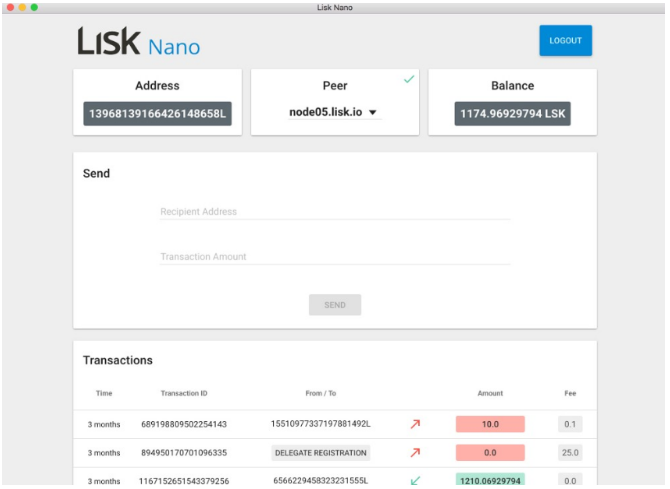
On the Lisk platform, the term “formation” is used, which means generating a block, by analogy with “mining” (mining) on Bitcoin. Everyone can start forming, but only 101 active delegates will actually generate and receive rewards. Having entered the client’s user interface, you can begin to form blocks manually, however, in the event of an emergency client reboot, you will have to start all over again. Developers recommend starting their own site for smooth operation and inserting a passphrase into the config.json file. Thus, when the Lisk client starts, the formation will be automatically enabled for all accounts for which key phrases are specified in the config.json file. In this case, the formation will continue without interruption and after a possible reboot.
At the moment, the only important factor for the formation is the expectation of an Internet connection. Most modern home connections and any cloud hosting provider are more than enough to get started. As for earnings, the total share of regular payments for a transaction depends on the volume of transactions occurring on the network in this round. Compensation fees are paid at a fixed rate for each block.
In November 2016, the platform also announced plans to distribute block rewards among delegates. The delegate's reward for each block formed will be 5 LSK. According to Max Kordek, this became possible due to the fact that the development of the platform protocol has made significant progress and has noticeably stabilized.
Total
In general, the Lisk platform from the point of view of the developer looks very attractive. On the other hand, like other altcoins, Lisk is not immune to volatility. Since this project is very new, only time will tell if it has everything it needs to become truly mainstream among JavaScript blockchain programmers.
Continue to follow the updates on the Web-Payment.ru blog and find out about the most interesting technological projects in the field of payments, fintech and blockchain.