October 14, 2016 at 14:26
The Great Hacker War of 1990
- Transfer

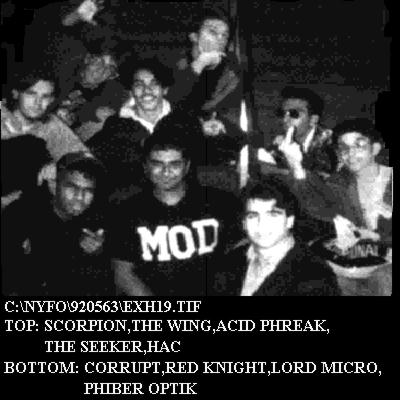
The Great Hacker War refers to the conflict of 1990-1991. between Masters of Deception (MOD) and the group breaking away from the Legion of Doom (LOD) group , from the old hacker guard, as well as other lesser-known hackers. Allegedly, both main groups made attempts to hack each other's resources via the Internet, X.25 and telephone networks.
At the debate at the conference “ The Next HOPE”In 2010, Phiber Optik repeated more than once that the“ cyber-space war of factions ”between LOD and MOD is just gossip, that it was invented by the US prosecutor’s office and the media sensationalists. Moreover, two of the high-ranking members of the LOD confirmed that there was no “Great Hacker War”, and if it did, it was nothing more than a competition, a desire to show their superiority.
However, there was still a conflict between the “new” LOD, led by Erik Bloodaxe, and MOD. Even if there was a “war”, all this is not at all what is commonly believed.
About two leaders already wrote on Habré:
" Erik Bloodaxe (Chris Goggans)
" Phiber Optik (Mark Aben)
What was really
The irony is that none of the LOD members ever tried to take control of various exchanges from MOD, did not clog their chats with inscriptions like “phiber sux”, etc. This was stated by Netw1z in the HOPE talk broadcast. And despite this, Erik Bloodaxe proclaimed a victory in the “war”, a clear victory for MOD on all fronts, even started distributing T-shirts at the HoHoCon conference with the words “Great Hacker War” and “LOD: 1 MOD: 0” . Other LOD members who did not participate in this, such as Marauder and others, consider this simply to be the propaganda of the new LOD by Hoggans.
It is noteworthy that the only one who gained access to the territory of telecommunication companies and the X.25 PSN, recognized as MOD, did this out of a desire to show that he was worthy of the level of MOD participants, and never mentioned his involvement in any war. John Lee and Allen Wilson have stated that The Phrezh Prince of Bellcore is an elite inaccessible, and many hackers who know it share this opinion. Yes, sometimes he can play in the IRC, but he has no equal in skills in many areas.

Late in MOD and LOD
Phrezh Prince of Bellcore (aka sw1tchg0d) was 16 when he allegedly controlled the RBOCs Qwest, Bell Atlantic and ILEC GTE (the last two later turned into Verizon) and all North American telephone companies '99 - '01. A long time after the “war” between sw1tchg0d and Erik Bloodaxe ended, which left an impression on MOD and sw1tchg0d as a scammer. Members of the sw1tchg0d group - H4G1S - and the alleged friends of the MOD group said that sw1tchg0d was the best at breaking Bell's internal systems and networks, also at such a young age, and even at a time when more security mechanisms were involved (identification SecurID, among others). The nickname sw1tchg0d (in life - Jonathan) was previously used by his mentor - the founder of H4G1S Shokwave Rider (sw_r), another cracker of telephone networks. Jonathan assigned this nickname after some time to show respect to Mohammed (sw_r).
After reading a book about MOD, sw1tchg0d began to respect them. And so he allegedly took control of Phiber Optik's access to the Manhattan telephone exchange, pulling out the qcm, qinfo and qdn data, just as a souvenir from memory, and not with the goal of demonstrating neglect. Phiber Optik reported that the one who did this knows his job well.
Erik Bloodaxe was also the target for jokes sw1tchg0d, about which he distributed excerpts from the lawsuit in the hacker environment about his shooting with a shotgun at his wife.
Knowledge
The Masters of Deception group had three specialization members. By general agreement, Phiber Optik possessed a wealth of telecommunications information. W1ng was generally considered a UNIX expert, even before most of the tricks became known, and John Lee (Corrupt) was an excellent system cracker and was very versed in VMS.
Phiber Optik knew about many internal PBXs, about undocumented features of headsets, about SCCS systems, about the possibility of authentication, about obtaining privileged rights and much more that should not be published here so as not to cause criticism. These were powerful things, he shared them with only a few people, in MOD.
At LOD, she was little interested in telecommunications or X.25, and had difficulty penetrating and maintaining control over such systems. They didn’t have an understanding of Datakit, which is necessary for waging a “war” in telecommunication networks. Moreover, there are BBS archives of a number of hackers where Erik Bloodaxe asks ridiculous questions about telecommunication systems. They say this: “Erikb could only access telecommunication systems if he came across the still logged-in COSMOS terminal.”
According to Phiber Optik and C0rrupt, the so-called “war” began because Erik Bloodaxe was begging Phiber Optik for access to the Nynex Packet Switched Network (npsn - available at the time through the Nynex Datakit, which Bloodaxe did not have). The balance of mastery was so much more shifted towards the Masters of Deception that it was almost never called into question anywhere except Erik Bloodaxe and his friends.

Development of events
The "Great Hacker War" lasted only a few days, during which 4 main events can be distinguished.
Event One.
It all began with the closure of the electronic notice board (with invite access) “Fifth Amendment” (“Fifth Amendment”), whose participants were well-known hackers. It was run by members of the recently reformed LOD under the direction of Chris Goggans (Erik Bloodaxe) and Lloyd Blanekeship (The Mentor).
The closure was blamed on John Lee (Corrupt) of MOD. Chris Goggans announced that Lee is distributing the information that is being discussed in the chat. In MOD, they found that Chris Goggans and his friends decided to use the information with the "Fifth Amendment" to organize a company in the field of information security and merged the information with other organizations whose activities were discussed on this bulletin board.
Event two
Several home telephone rallies upset Hoggans and he urged everyone to get personal information from MOD members at a conference call organized between LOD members.
Members of MOD connected to her and overheard how they were being poured with mud, mocking their racial affiliation. It all ended with the fact that MOD members “cut off wires” by making calls to personal numbers of conference participants with jokes and threats.
Event Three
A conversation took place between Chris Goggan and Mark Aben. John Lee secretly for the first was also on the line. Goggans was angry that Aben refused to comply with his numerous demands to provide personal information about MOD members, hacking information allegedly belonging to LOD, etc., and said the following: “MOD is just niggas, Latinos and white trash.”
Event four
Members of MOD began to listen to Chris Goggans's telephone conversations in order to understand his motivation, using a remote headset through the PBX closest to Goggans (DMS-100). And they heard the confirmation of the earlier version: Goggans, Scott Chocin (Doc Holiday) and Jake Kenion Schulman (Malefactor) decided to establish a company in the field of information security called ComSec.
Epilogue
In 1991, Phiber Optik, at the first CFP conference in San Francisco, together with Craig Neudorf, was invited to participate in a telephone conference organized by hacker friends, at which the repentant Schulman regretted that the situation went beyond that Goggans crossed the line by transferring information about other hackers to the authorities to raise the profile of ComSec.
Then they began to suspect Hoggens of surrendering information to the federal authorities about the Australian hacker group The Realm. Other LOD members contacted Aben to find out if Goggans and his informants had involved them in Aben's current lawsuit, and assured him of no involvement in such obscene behavior.
In 1993, at the third CFP conference, also in San Francisco, Phiber / Aben met for the first time live several of his old friends from LOD (with the exception of Goggans), although by this time they had been friends for more than 10 years. They recalled the past a little.
A few years later, Goggans publicly stated that he regrets having dragged Aben into his testimony to law enforcement agencies.
In general, Phiber and Lex Luthor probably all agree on the same thing - there really was no “Great Hacker War”, and that all these speculations on the theme of “warring hacker gangs” were only the result of a zealous attitude of the authorities and irresponsibility of the media.
Read more
Gang War in Cyberspace | WIRED
History of the computer underground: Legion of Doom vs Masters of Deception
Translation: Sergey Danshin
Publishing support is Edison , which is developing an automatic firmware assembly system for networking equipment , as well as translating software into Russian for a multinational industrial corporation .