How to optimize the memorization of foreign words
Before embarking on the development of a mobile application for memorizing vocabulary, we at Skyeng spent a lot of time studying the algorithms of working memory and memorizing words. As a result, the development of Aword took a little longer, but we are more confident in the result - the use of certain algorithms in the display of words helps to replenish the vocabulary more efficiently.
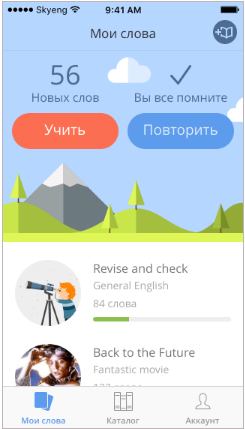 The market has a large number of applications for memorizing foreign words. All of them are united by a common feature - the use of cramming (drilling) as the main learning tool. The more time a student spends repeating words, the higher the chance that he will remember them. For example, it is quite possible to learn a hundred words in an hour. However, without repeating after 6 hours, half of them will be forgotten. After another six hours, no more than 15 words will be remembered. To prevent this from happening, you must regularly repeat the entire set (cramming).
If a student pauses in repeating the list (for a week, for a month, for a vacation, for a working breakdown, ...) - there is a high probability that words will be forgotten and cramming will have to start from the beginning. If he switched from one set of words to the next and did not repeat the first after a while, he will forget him. In order for such memorization to work effectively, it is necessary to draw up a clear learning plan on your own or with the help of a teacher and strictly follow it, otherwise cramming will turn into a meaningless loss of a huge amount of time without an obvious, predictable result.
We thought: is it possible to make an application that will provide not only the “drilling” process, but also the preparation and maintenance of a lesson plan and control over the knowledge gained? How to maximize learning efficiency and save student time?
You will have to start from afar: by talking about the structure of our memory, which can be short-term or long-term.
Cramming vs memorization
 Short-term is well known to students who pass some not-so-needed formal subject. If you study the textbook the night before the exam, there is a high probability that most of the information, albeit in a fragmented form, will remain in your memory long enough to pass the exam or the test. However, in a couple of days it will disappear without a trace (more precisely, studies show that it will not disappear, but will hide so reliably in the depths of consciousness that it will be problematic to extract it from there).
Long-term memory is what makes it easy for us to recall the information we receive after a year or five years. But in order for it to work, regular training is necessary, and the most effective format for these training is not to re-read the textbook, but to check on control questions or to constantly apply the acquired knowledge in practice.
For example, a student learning a new programming language gets this workout in the form of daily coding sessions. Having comprehended the subject of objects in C ++, he will be able to remember it forever if he uses it regularly. Therefore, teachers require object-oriented programming, even trivial tasks, where it would be reasonable to do without it.
Long-term memory is not always required. A chemist does not need to know all the formulas; the lawyer does not need to have in his head the full versions of the criminal, civil and procedural code. Directories can always come to their aid; for them it is more important to understand the principles of work and knowledge of the direction of data search.
But there are areas where long-term memory is needed. The most obvious are medicine and linguistics. The doctor must remember the symptoms of any, even rare, diseases. A person who claims to be fluent in English should know the word serendipity, even if he never comes across it in his life. Of course, the most effective way to develop such a long-term memory is practice. A graduate of a medical university is sent to residency or internship for several years. A professional translator is required to go on an internship among native speakers.
But what if there is no such possibility? And what if the doctor during the residency did not encounter a case of Kawasaki syndrome?
It is necessary to develop long-term memory in some other way. It is not surprising that the main research in this area is carried out by physicians and linguists.
Polish student and German psychologist
Petr Wozniak, the author of the most famous SuperMemo memory algorithm, thought about optimizing this process in the 80s, as a student at the Poznan Polytechnic. One of the tasks that he set for himself was full knowledge of the English language - he was not satisfied with the superficially professional level that his fellow students were quite content with.
Wozniak turned out to be a fairly stubborn guy. He created a database of cards in English and biology containing a question and answer, and engaged in daily training, carefully writing down the results in a diary. At the end of the experiment, he formed three thousand cards in English and more than one and a half thousand in biology.
With the help of simple calculations based on the data obtained, Wozniak found that to memorize a small dictionary of 15 thousand English words, he would need to spend two hours each day on training. The time spent grows in proportion to the number of words: remembering 30 thousand will require four hours of repetitions daily. Not very comfortable.
 Fortunately, a hundred years before Peter Wozniak, German psychologist German Ebbinghaus, also a very stubborn person, was concerned about a similar problem. Ebbinghaus conducted two one-year experiments, during which he remembered meaningless sets of syllables. As a result, several discoveries were made, the most important of which is the Forgetting Curve.
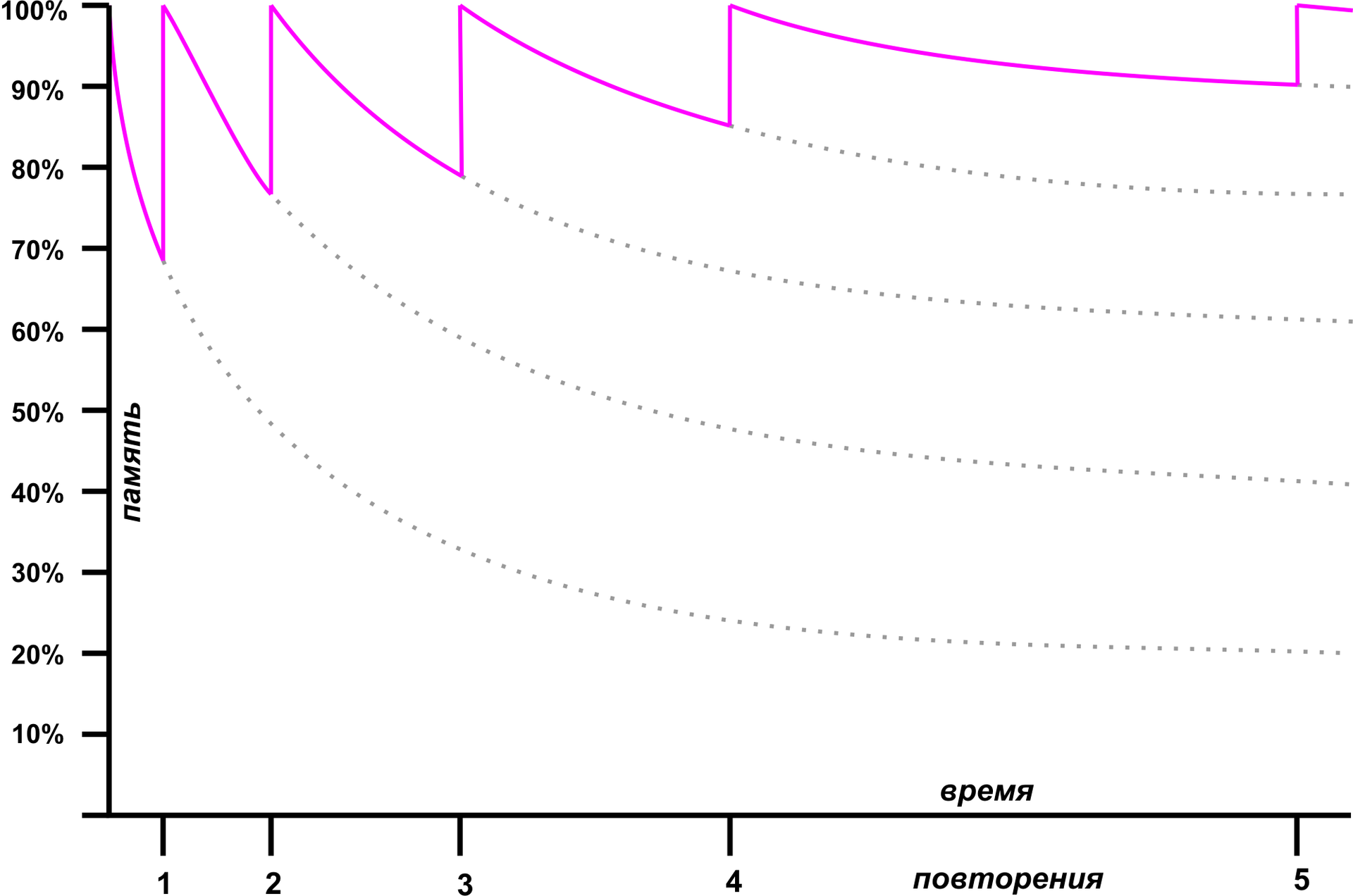
Ebbinghaus experimentally found that the rate of forgetting information decreases after each repetition. After the first memorization of data, forgetting is very fast: after about an hour, about half of the material flies out of the head, after ten hours - 65%; however, about 20% remains one month after the study. However, if you repeat all the material in the first hour, the process of forgetting it will slow down significantly, and a new repetition can be done in a day. Using the Curve of Forgetting, you can arrange the repetitions so that there is a maximum long-term assimilation of the material for a minimum number of workouts.
This method is called Spaced Repitition. In the 30s, an experiment was conducted that showed that such a technique really has a beneficial effect on the learning process. However, she did not find popularity at that time because of her excessive complexity: it was necessary to prepare thousands of cards with questions and answers, correctly shuffle them, repeat them on time ... But then computers appeared.
Let us return to the Polish student Petr Wozniak, who dreamed of learning English, but was not eager to spend four hours a day on training. He decided to algorithmize the interval repetition technique, which ultimately resulted in the SuperMemo program. Of course, everything turned out to be far from simple, and the development of SuperMemo became, in fact, his life's work.
Algorithmization of the interval repetition method is a fairly obvious task. The main problem of this method is the need to accurately calculate the time when the repetition will be most effective - i.e. the very moment when information is forgotten. If you write a program that will not only conduct training, but also promptly remind the user of their need, this theoretically will allow for more effective training.
It has its own characteristics. The forgetfulness curve itself is a universal phenomenon, but different exponents overlap with different people. Someone needs a third repetition in 20 minutes, someone in an hour; the distance between subsequent repetitions changes in a similar way. Therefore, training should be flexible - in their course, the algorithm tries to understand the speed of forgetting a particular student and adapt to it.
An important problem on the path to successful learning is the human factor. In order to effectively remember the maximum amount of information in a minimum period, you need to accurately follow the schedule. In reality, this creates inconvenience, and students decide to postpone for later. As a result, having missed the right moment, they roll back - one step, two, or even to the very beginning of training. This rollback also needs to be correctly calculated in order to minimize overhead costs.
Word License
Our Aword mobile app is based on the concept of “word licenses” - similar to time-limited software licenses. After the first memorization, the “license” is valid for about an hour; if you do not repeat the word, it will be forgotten. If you repeat the words at the end of this hour, a new “license” will appear, for six hours already. The next “license” will be for a day, then for three days, for a week, a month, six months, two years. The most effective moment for repetition is borderline, when the previous “license” expires, and in order to remember the word, you need to make some efforts. All “licenses” for each word are stored on our server in the student’s account, and the task of the mobile application is to remind in time that it is time to update them.
The basic algorithm underlying Aword can be described with this pseudo-code:
functionmakeRepetition( user, word, license ){
var timePassed = (new Date()) - license.startTime;
var answer = showWordCard( word );
user.tuneParameters( license, timePassed, answer.quality );
word.tuneComplexity( license, timePassed, answer.quality );
if(answer.quality > 0) {
 license.next( timePassed );
} else {
 license.rollback( timePassed );
}
}
The core code of this algorithm determines whether an increased “license” per word can be given, or whether it needs to be taught again. tuneParameters and tuneComplexity - conditional links to tuning algorithms; the quality of the answer (answer.quality) is a number from 0 to 1. This number is equal to one if the student quickly, the first time learned the word; his memory works well, the task was too easy for him. In this case, the algorithm will increase the repetition intervals. If the quality of the answer is close less than 0.5 - the answer was given with difficulty, after prompting; the standard repetition interval for this student is too long, more training needs to be done.
The original forgetting curve was built on the basis of synthetic experiment data. Ebbinghaus deliberately used meaningless syllables in order to ultimately get the most pure results.
Modern medical students successfully use the forget curve in its initial form, for example, to memorize data on pharmacology (also, in general, consisting of sets of letters). Here, for example, is a typical instruction for repeating material:
- the first repetition - immediately after reading (verification on control questions);
- second repeat - after 20 minutes;
- the third - in a day;
- the fourth - 48 hours after the third;
- fifth — 72 hours after the fourth.
There are universal algorithms that allow you to use the interval repetition method to effectively store any information. The most famous (and also free) such program is Anki . Of course, it does not take into account the peculiarities associated with the study of foreign languages, but it can be very useful if you need to remember something really important for a long time.
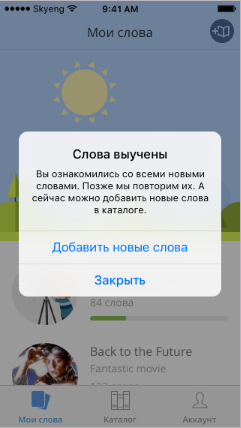 When learning a foreign language, we are not dealing with chaotic sets of letters, but with meaningful words. The degree of meaningfulness and comprehensibility of the word to the student directly affects the speed of memorization. Thus, an engineer will remember the word “gear” much faster than a philosopher. Familiar, easily presented words (“oak”) are remembered more easily than exotic (“fir”). As a result, it is necessary to carefully select groups with approximately the same speed of memorization. The SuperMemo algorithm uses a subjective assessment of the user for such a selection - how difficult it is for him to give a word; This is not a very accurate indicator. Another factor is the student’s existing vocabulary base, which must be assessed to draw up the program. All this should also be algorithmized. However, these are topics for individual articles.
The algorithms used in our mobile application were tested for six months on volunteers from among employees and their friends. This allowed us to select some average parameters (term of “licenses”), which are ultimately used to optimize the process of long-term memorization of words. Now that the application has become available to everyone, we will be able to collect much more analytical data to further fine-tune these parameters. And all this can be seen by downloading the mobile application in the App Store . At the end of October, the application will be available on Google Play, and in November it will be available on the Web.
And if you yourself want to participate in the development of such pieces - we have a lot of interesting vacancies !