September 30, 2016 at 14:39
Corporate Databases - 2016: Hot Ten
- Transfer
 If your organization needs to store and process data, then, regardless of its size, you can not do without a cloud or local DBMS. Today we will talk about the leading representatives of the corporate database market, about those developments that are worth paying attention to in 2016.
 The corporate DBMS market has existed for several decades. We believe, evaluating a particular system, it will be useful, among other things, to take into account its history. But the maturity of the market does not mean that today it is a quiet place. The level of competition here is very high.
Business requirements are constantly growing, approaches to creating IT infrastructures are changing. DBMS developers either manage to give the market what they want, or find themselves on the periphery. And database users, thanks to the choice, only benefit from this state of affairs.
This is not to say that choosing a corporate DBMS is simple, but we are sure that among the leading systems that we will talk about, you can find the one that interests you.
Oracle Database
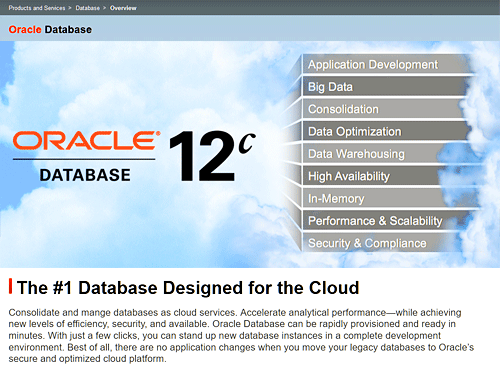
Oracle released its first relational database in 1979. Over the years of the company's presence on the market, the word "Oracle" has become synonymous with the concepts of "corporate DBMS" and "reliable work with data." Oracle, as, by the way, and some other companies whose developments are present in our review, is included in the Fortune 500 list. Oracle's main area of activity is a powerful and rather complex database solution.
The current version of the company's DBMS is called Oracle 12c. The letter c means cloud. This reflects Oracle’s move toward the cloud, which enables organizations to consolidate and manage databases as cloud services. Among the features of the Oracle DBMS are multi-tenant architecture, fast deployment of solutions, and the ability to process data in memory.
Microsoft SQL Server
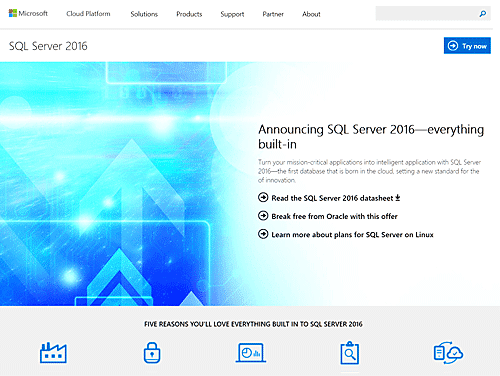
You can say anything about Microsoft, but it is one of the most profitable technology companies in the world. Its desktop operating systems are literally everywhere; however, SQL Server played an important role in Microsoft's success . It is hard to imagine a server running Microsoft OS without SQL Server.
The ease of use of SQL Server, its availability and tight integration with the Windows family of OSs make it an obvious choice for companies using Microsoft products for corporate purposes. Microsoft is talking about the latest release of SQL Server 2016 as a platform for on-premises and cloud databases, as well as for business intelligence systems.
In addition, Microsoft is promoting SQL Server 2016 as a solution that can help organizations build mission-critical online transaction processing (OLTP) applications. Such solutions are characterized by high performance, the ability to process data in memory and to protect data during storage and movement. On the basis of SQL Server 2016, you can create high-volume storage, data analysis systems.
There are various rental options for MS SQL Server . You can purchase a license for one user, you can license the server core, without limiting the number of users.
Can also downloadthe free entry-level release of SQL Server 2016 Express, which is ideal for deploying small databases in production environments and installing it on an inexpensive VPS , this is quite enough to create small server-side applications for data processing that take up to 10 GB of disk space.
IBM DB2

IBM is said to have been nicknamed the “Blue Giant” because of its mainframes from the 50s and 60s, which occupied an entire room and were painted in the appropriate color. The company's efforts to promote the DB2 database management system , its ruthless competition with Oracle, suggest that IBM wants to fill many, many server rooms with the computers on which its database system is installed. There are studies on comparing comparable solutions from IBM and Oracle. For example, here you can take a look at the data from the report prepared by ITG. The report shows significant savings when using DB2 and related IBM technologies.
In April of this year, a fresh version of the DBMS was released - DB2 11.1. It can work on many systems, in particular, on Linux, Unix and Windows, on IBM z Systems mainframes, supports hardware acceleration on Power 8 processors.
SAP ASE

The first release of the Sybase DBMS was released in 1987 under the name SQL Server. He grew up in Adaptive Server Enterprise, the company's most famous and successful product. In 2010, Sybase was absorbed by SAP; as a result, today the database is called SAP Adaptive Server Enterprise (SAP ASE). Although Sybase has become part of another company, its DBMS is still one of the main players in the corporate market. In addition, Sybase is known for directing significant efforts to mobile enterprise solutions, usually buying developers of promising products. Apparently, SAP continues this tradition.
SAP ASE 16, the latest release of the DBMS, supports partition-level locking technology, integration with SAP HANA and SAP Business Suite. The database is notable for its cost-effectiveness, scalability and system audit capabilities, supports dynamic thread assignment, query plan optimization with star connections, and many other features .
PostgreSQL

PostgreSQL , the successor to Postgres, whose development began in 1986, is a free, open-source object-relational database management system. It finds application in very interesting places like online casinos, data center automation systems, domain registries. In addition, it is used in highly loaded tasks Yahoo! and skype. PostgreSQL can be found in so many systems hidden from prying eyes that it may well be called the "Secret Corporate Database."
The current stable release of PostgreSQL is 9.6. It was released on September 29 this year.
PostgreSQL supports many operating systems. Among them are Linux, Windows, FreeBSD, Solaris. PostgreSQL is used as the standard database on Apple's OS, starting with Mac OS X Lion. The capabilities of this DBMS are comparable to those of Oracle and IBM. In particular, it is characterized by full compliance with ACID requirements for transactional reliability, and is capable of supporting high parallel loads.
MariaDB Enterprise
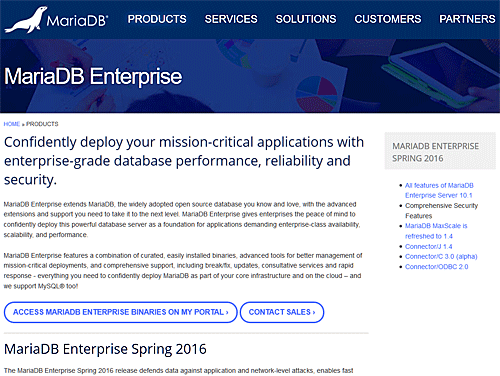
MariaDB Enterprise is a fully open source database management system released under the GPL, LGPL, or BSD licenses. The path of MariaDB began in 2009. This system was a fork of MySQL, which the community of developers worked on under the guidance of the creators of MySQL. They started a new project, worried about Oracle's licensing policy, which acquired MySQL.
MariaDB became popular due to MySQL. In particular, after MariaDB took the place of MySQL in well-known Linux distributions. So, only in 2013, the developers of Red Hat Enterprise Linux abandoned MySQL in favor of MariaDB, the same thing was done in Fedora 19, openSUSE and Slackware Linux switched to MariaDB. In addition, MariaDB began to be used as a server database in the Wikipedia project.
Another major factor that made MariaDB ahead of MySQL was the advanced query optimizer and other speed improvements.
The latest release of MariaDB Enterprise Server is 10.1, also known as MariaDB Enterprise Spring 2016. This release improves data protection from attacks at the application and network level and helps to develop new, high-performance applications.
MySQL
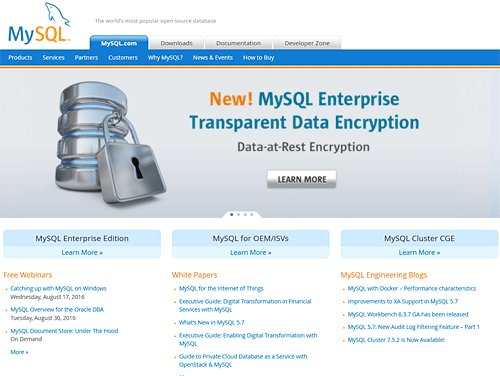
MySQL started as a highly specialized solution for developers, but has grown into one of the key players in the corporate DBMS market. At first, in 2008, it was sold to Sun Microsystems, later, in 2009, it became part of the Oracle empire. For many years, MySQL is much more than a niche solution. Hundreds of thousands of commercial websites operate on MySQL; it serves as a server-side DBMS for a huge number of internal corporate applications.
Today, MySQL remains a very popular option for web solutions, it continues to serve as the central component of the LAMP stack. At the same time, MySQL, due to the takeover of Oracle, is experiencing a weakening of support from users and independent developers.
The decline in popularity of MySQL has accelerated the adaptation of other open source DBMSs and its own forks, like Percona or the aforementioned MariaDB with fully open source code, in which there are no closed modules introduced in new versions of MySQL Enterprise Edition.
The latest release of this DBMS, MySQL Community Server 5.7.15, was released in early August 2016.
Teradata database
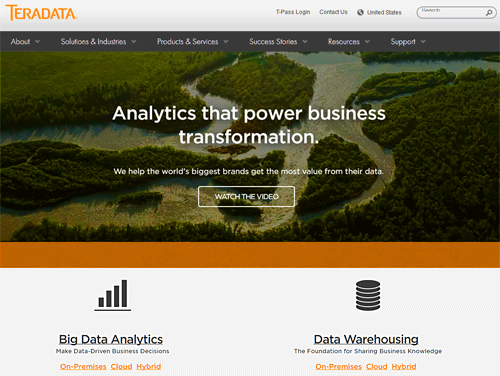
Have you heard about Teradata? If you were creating a large data warehouse, you most likely heard. Teradata has been leading the story since the late 1970s. It was then that she began work on solutions that later became known as “data warehouses.” In 1992, Teradata built the first terabyte database for Wal-Mart. Since then, the word "Teradata" has been constantly mentioned in conversations of experts on corporate storage systems. Teradata Database
features are very large databases. This system is great for supporting recent trends such as big data research, business intelligence, and the Internet of things. Teradata released version 15.10 of its relational database management system in early 2015.
Ibm informix
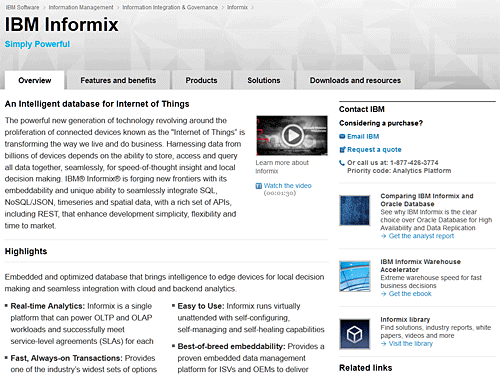
As you can see, there is another IBM development on our list. The company offers a wide range of options for the Informix object-relational database management system . It is promoted as an intelligent database that can be deployed on multiple platforms.
Often associated with educational institutions, Informix entered the corporate world and took first place in customer satisfaction. Users of this DBMS are usually very flattering to express its low cost, the need for a small amount of maintenance and high reliability.
Ingres

Ingres relational database management system is very relevant in the corporate market, in addition, it is one of the old-timers in the database world. Work on it began in the early 1970s.
Ingres has an attractive pricing model, which may mean a reduction in the total cost of ownership of the system. This system boasts advanced capabilities for switching to it from more expensive DBMSs. In addition, it has the high safety features required to comply with HIPAA and Sarbanes-Oxley law.
The latest corporate version of Ingres is 10.2. She came out in 2015, introducing support for geospatial data types, remote GCA clients, UTF-8 transliteration, DBMS authentication and other new features.
In June 2016, Ingres 11 Technical Preview was released for testing.
Amazon simpledb
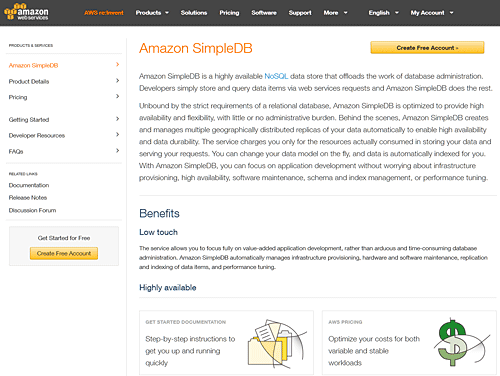
This is the eleventh item on our list. You can consider it a dessert for the main ten dishes.
At first glance, the concepts of "Amazon" and "DBMS" may not seem completely compatible, but in fact this is not so, especially today, in the era of cloud computing. SimpleDB (Simple Database Service) offers organizations a simple, flexible, and inexpensive alternative to traditional DBMSs.
SimpleDB allows users to store data and work with them through requests for web services. It features scalability, high speed, minimum maintenance requirements and integration with other Amazon services. Get started with SimpleDB for free.
Summary
There is no one right solution for all data tasks. There is no ideal corporate DBMS. Each of them has its pros and cons, which, moreover, are very dependent on the specifics of the business.
The best thing that can be done in order to choose the right DBMS is to analyze everything that the market offers, taking into account the characteristics of a particular organization.
We hope that our story about the leading corporate DBMS in 2016 made a feasible contribution to the matter of choosing a system that suits you.
Only registered users can participate in the survey. Please come in.
What database is used in your business?
- 25.5% Oracle 198
- 43.2% Microsoft SQL Server 335
- 3.2% IBM DB2 25
- 2.4% SAP ASE 19
- 41.8% PostgreSQL 324
- 9% MariaDB Enterprise 70
- 35% MySQL 272
- 1.5% Teradata Database 12
- 0.9% IBM Informix 7
- 0.3% Ingres 3
- 0.5% Amazon SimpleDB 4
- 9.1% Other 71