September 14, 2016 at 17:26
AdBlock Plus has made a new round in the history of “acceptable advertising”
One of the world's largest ad blockers, AdBlock Plus, has pleased advertisers with a new initiative. The blocker developers launched the Acceptable Ads Platform ( AAP ), designed to place ads on the Acceptable Ads list of sites. Acceptable ads can be set instead of the usual banners that block Adblock Plus.
The Acceptable Advertising program itself was launched back in 2011. At the same time, Eyeo, the development company of Adblock Plus, admitted that it did not cooperate with partners in the framework of this program for free. To dissatisfied users, the company suggested simply changing the settings of the blocker.
In the settings, the option "Allow unobtrusive ads" is selected by default. The developer admits that the “white list” is held precisely by laziness - most users do not like to get into the settings unnecessarily. In general, the company does not consider it shameful to make money from laziness, illiteracy and inattention of the audience. After all, not all citizens communicate with the computer on "you".
Monetization or venality
For some time, the service bypassed the topic of monetization and did not disclose exactly how much it earns on the “white list”. The only data that the company published was statistics on working with advertisers and online sites. But based on these statistics, it was not possible to estimate Eyeo's revenue under the relevant article.
Now Adblock Plus decided to open this veil as well. However, service representatives noted that unacceptable advertising could not be on the exclusion list, even for money. The blocker is paid only to "large" sites that receive income from showing banners from the "white list".
A large site is considered to be an advertisement on which, after getting into the “white list”, it will be shown more than 10 million times a month. In this case, not all traffic is taken into account, but only ad impressions from the “white list”. Considering that about 5% of the audience usually uses blockers, such a site should have a minimum of 200 million hits.
Large are 10% of sites with which AdBlock Plus collaborates. The sites transfer the percentage of advertising profit to the service.
Due to the fact that Google pays Eyeo GmbH for participating in the eligible advertising program, users see Google AdWords ads in sponsored links next to relevant search results. When users discovered this flagrant fact, they saw it as a “loophole” for Google.
Despite the fact that Eyeo did not particularly hide the presence of paid partners, some users with a heightened sense of justice were offended and accused her of corruption.
The scandal erupted after a series of publications on the German portal Mobile Geeks. Blogger Sasha Pallenberg said that Adblock Plus is deceiving users and skipping some advertising. According to him, the developer also trained on fake accounts and transmitted them to the eCircle system, which is engaged in sending spam via email.
And just then, in July 2013, Eyeo publicly recognized, which makes exceptions for some advertisers. Adblock Plus enters into agreements with online sites and ad networks that wish to participate in an affordable advertising program. But at the same time, advertisers must ensure that advertising meets the criteria. In particular, advertising with animations and sounds in the middle of the text and with page locking is not allowed .
According to the Adblock Plus poll, only 25% of users are opposed to any ad. The rest agree on some types of advertising, as they understand that this is necessary for monetizing sites.
“We will go the other way”
Other major sites decided not to pay the blocker, but act more harshly. In June 2016, one of the largest publishing houses - the German Axel Springer (Business Insider, Bild, Maxim and others) - obtained from Adblock Plus free inclusion in the white list of non-blocking online media advertising. For this, the media holding appealed to a German court.
This will enable Axel Springer to increase its reach by 100 million potential buyers. The victory of Axel Springer could cause a sharp increase in the number of lawsuits against Eyeo from its partners.
Sami with a mustache
And now, 5 years after the appearance of the “Acceptable Advertising” program, AdBlock Plus decided to sell display advertising on its own. The new platform (AAP) combines the functions of SSP and advertising exchange. The system makes the process of adding to the "white list" faster, simpler and more transparent. Eyeo COO Ben Williams calls AAP "a compromise between users and advertisers."
The AdBlock Plus partner is ComboTag, which offers advertising solutions for publishers and agencies. Publishers, for example, can use the ComboTag platform as an advertising server, and agencies as a private exchange.
Also, ads through this program will be sold by Google and AppNexus, notes The Wall Street Journal. However, both of these companies refute this information. However, Google and AppNexus are known to be partners with ComboTag.
AAP will allow publishers and bloggers to place ads on their sites that have passed the “eligibility” test. As a result, the process of getting into the "white list" will be reduced from a few weeks to a couple of seconds.
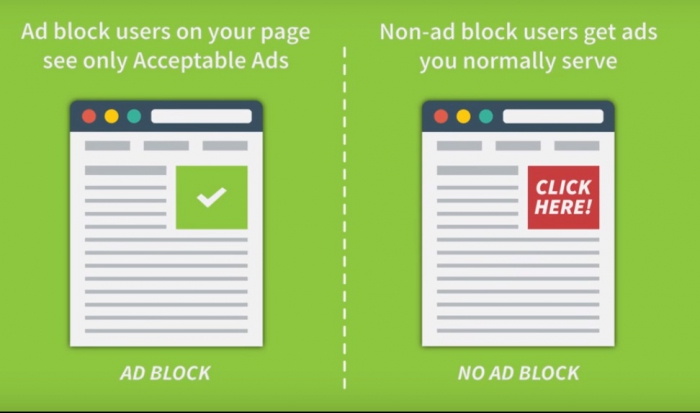
Thanks to the platform, site and blog owners will be able to continue to make money on advertising - selected ads will appear on the site of blocked banners. They will be seen by users who have accepted an acceptable advertising policy. And they did it 90% of the 100 millionth blocker audience.
Sites will receive 80% of ad revenue through the Acceptable Ads Platform. The remaining 20% will be received by the exchange itself and its partners. Adblock Plus will receive 6% of sales.
The company hopes to create a market where they will only work with advertisers who agree to a compromise. At the same time, the company notes that the effect of such cooperation for the advertiser will be minimized, since he will not be able to choose neither the placement of advertising, nor the size, nor will he be able to target them.
Since September 2016, Acceptable Ads Platform will be in beta mode, a full launch is scheduled for late 2016.
“Ad blocking will exist with or without us. We try to prevent a situation in which 100% of advertising will be blocked. We hope that Acceptable Advertising will bring about positive changes [in the market], ” said AdBlock Plus representatives.
In the future, AdBlock Plus promises to launch a feedback mechanism that will be built directly into the ad. With it, the user will be able to tell whether he likes the advertisement or not. Such a feedback will make RTB more “human”, according to the company.
Expert Opinions
We asked representatives of the advertising and media market to answer several questions:
1. What do you think of the Adblock initiative to sell "acceptable" ads on the sites of blocked banners?
2. Would you become a member of such an advertising network?
3. Now in the settings of AdBlock Plus you can turn off the display of even “acceptable” ads. If this situation does not change, will there be any sense in their initiative?
4. How can Google benefit from the AdBlock Plus initiative?
Yuri Sinodov, ROEM:
 1. I think that the essence of AdBlock Plus’s business will now be clear to everyone.
 2. No thanks.
3. If this feature will hit hard on their income - it will be disabled, I suppose.
4. No way, I think. Anyone can take the place of Google if he offers enough money.
Ivar Maksutov, editor-in-chief of Postnauka:
 1. I think that this is hypocrisy. Very similar to the behavior of ecoterrorists.
 2. No. Sooner or later, media will learn how to deal effectively with parasites like Adblock. First of all, they will be defeated by internal monetization of sites: purchases within the system, such as donations or subscriptions, native advertising, etc. When updating a site, for example, we completely abandoned banners by integrating advertising modules into the grid, making them native.
3. This means that they will disable the ability for Adblock users to control the settings for displaying ads - you will only see what the managers of the company consider “acceptable”.
Dmitry Falaleev, Firrma:

To be honest, I am not a specialist in such advertising, so I can answer simply as the owner of the site and as an interested person. I don’t really understand what “acceptable advertising” is.
In general, the attitude is philosophical: it is good that there are attempts to come up with something new, but so far everything that has appeared has not been effective. Sometime they will come up for sure.
Alexey Ametov, publisher of Look At Media:

1. I think these are very strange actions. Or put on your underpants or remove the cross, as they say.
2. I am sure that users will go to places where there will be no advertising.
4. As for Google, they, like Yandex, have a problem in a completely different plane - the point is not AdBlock, but the fact that they lost to mobile.
Sergey Baryshnikov, Bigpicture.ru
 1. A clear, but strange initiative. The term “acceptable” is very vague and what can be absolutely acceptable for one category of users can be completely unacceptable for another category. The guys woke up the desire "to somehow make money." At the same time, they scare away part of the audience loyal to their product, and they will have to conduct a long explanatory conversation with the part.
 2. No, we have long stopped betting on a dying media and have been successfully doing native advertising for several years, redirecting media traffic to it.
3. I think this is an attempt to remove the negative from the part of the audience that will be unhappy - they were given an alternative, but some percentage will not include this check mark.
4. In theory, Google already follows the path of “acceptable” advertising, trying to adapt the target to the user as efficiently as possible, causing his interest. They do this to increase their own effectiveness. Well, maybe they will break through a small percentage of the audience that they could not reach because of AdBlock Plus.
Ilya Dyer, publisher at Meduza
 1. Firstly, I don’t understand what “acceptable advertising” is. I did not understand the issue, but in general it is like a raider seizure of advertising spots and deceit of the audience. Blockers download so that there is no advertising, and not so that it is, but different.
 2. So far I see no reason to use it. On the one hand, as I said, I don’t really like it ethically. Secondly, any media network is not a significant source of revenue, so it is unlikely.
3. You know, it seems to me that the conversation itself about blocking ads is not very interesting. I can not blame people who turn off the banners - they are really annoying, and this is a problem for advertisers and sites. Users vote with blockers. Therefore, all initiatives in the field of banner advertising are, in principle, not very interesting to me.
Danil Khasanshin, CEO of Committee Publishing House
 1. I don’t know what I think about this unequivocally. It looks strange that they are selling something that does not belong to them.
 2. Not sure.
3. I don’t really understand “acceptability” and what they are trying to do now.
4. I did not think and do not think in this vein. These are some games far from our interests, but the “ping pong” with Facebook was quite funny to watch, no more.
Brave Browser and Acceptable Advertising
In the spring, Mozilla co-founder Brendan Eich launched the Brave browser, which blocks third-party ads and places safe ads in its place. Newspaper owners opposed the development of the former head of Mozilla.
17 companies appealed to Brendan Eich with a request to stop illegal activities. Among the signatories to the letter are the owners of the newspapers The Washington Post, The New York Times Co., Dow Jones and others, reports Business Insider. All are members of the Newspapers Association of America (NAA). The companies said they were ready to protect their brands and materials in all legal ways.
Brave is designed for Windows, Max, Linux, iOS, and Android. By default, the browser blocks third-party ads, and instead the user sees secure ads approved by the developer. They load quickly and provide anonymity to the user, because they do not track cookies and pixels.
If the publisher collaborates with Brave, then he receives 55% of the revenue. Another 15% goes to the browser, 15% to the partner who is involved in the placement, and the user can count on 10-15%.
However, media companies do not agree with this scheme. They call Eih's business model absolutely illegal and claim that the project is capitalizing on the $ 5 billion that the industry spends on journalism. Brave was accused of copyright infringement, unfair competition, unauthorized access to publisher sites.
The authors of the letter believe that the plan to replace ads is indistinguishable from the plan to steal content. “Your public statements clearly demonstrate that you intend to take advantage of the content of all publishers on the Internet to sell your own advertising. You have no right to use our names, trademarks and logos to promote and operate your business, ”the appeal says.
The law allows companies to demand up to $ 150 thousand for each "borrowed" work. Using foreign brands to sell ads, Brave misleads consumers and infringes publishers' exclusive rights to their brands.
PSAd blockers are a major concern for the global online advertising industry. According to a joint study by PageFair and Adobe, at the end of 2015, 198 million users in the world had installed blockers. At the same time, the losses of the advertising industry reach $ 22 billion a year.