Voice biometrics in the contact center of the bank. Implementation case

Hello! Last year, we introduced our solution for voice verification of VoiceKey.Agent contact center users in Priorbank (this is one of the largest commercial banks in Belarus, part of the Raiffeisen Austrian group) and now we want to tell you about how we did it and why it all took the bank. On the territory of Russia and the CIS, this is the second introduction of voice biometrics in the bank's credit center, so we have become almost pioneers.
Why a jar of biometrics
We will not once again say that traditional user verification technologies (that is, verification of identity by knowledge: passwords, PIN codes, code words, etc.) are cumbersome and do not give a guaranteed result. It is extremely difficult to make sure whether the very person for whom he claims to be is really on the other end of the wire. The contact center operator can only ask clarifying questions and compare a person’s voice with his gender, age and other features. Obviously enough, this is not enough to protect financial information.
Therefore, banks, insurance companies, pension funds, etc. looking for ways to optimize remote service through the CC. For example, the number of customer calls to contact centers of banks with requests requiring personal identification is growing. So, if in November-December 2007, 46% of calls were recorded in the Priorbank CC with the need to request personal information, then in the same period of 2015 the number of such calls increased to 68% of the total number of all calls, and this is two out of three calls.
Typical questions customers ask by phone
Today, Priorbank's contact center operators process tens of thousands of calls every month, more than half of the requests are requests for information on accounts and operations. Main questions: “why the card doesn’t work”, “what is the loan debt”, “why the operation doesn’t go through” and so on. These issues cannot be resolved without confirming the identity of the client - according to the legislation, information on accounts is provided only to their owners.
Such information was repeatedly tried not by the account holders, but by third parties. That is why the person who called the bank is always asked for passport details, card number, mother’s maiden name and so on. Clarification of these issues takes an average of 30-40 seconds per client.
It turns out that, firstly, the danger of giving information to the wrong person is quite serious, and secondly, the average customer service time is growing, and this is one of the main performance indicators of any CC.
Thus, the bank needs to minimize the time it takes to service one client, increase the level of data protection and do it all so that it is still convenient and easy for the client to get the necessary information from the CC. To solve these problems, we proposed Voicebank Key.Agent to Priorbank.
How VoiceKey.Agent Works
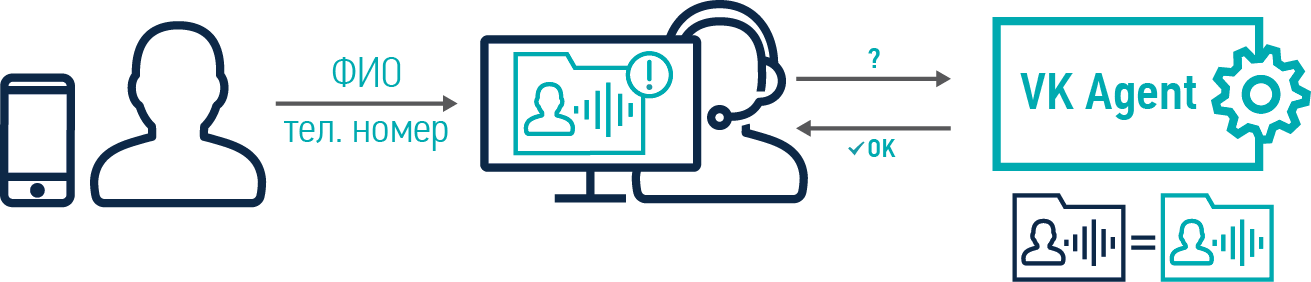
Each call (incoming or outgoing) at the moment of the start of a conversation with the operator starts a user check in the background and collects data about his voice. Then the information goes to the server for processing and is compared directly with the sample voice of the client stored in the system. The test result is displayed in the contact center operator interface. This process is called verification (there is also such a thing as identification, and they need to be distinguished).
The VoiceKey.AGENT architecture has a client-server architecture and provides flexible options for integration with a contact center and CRM.
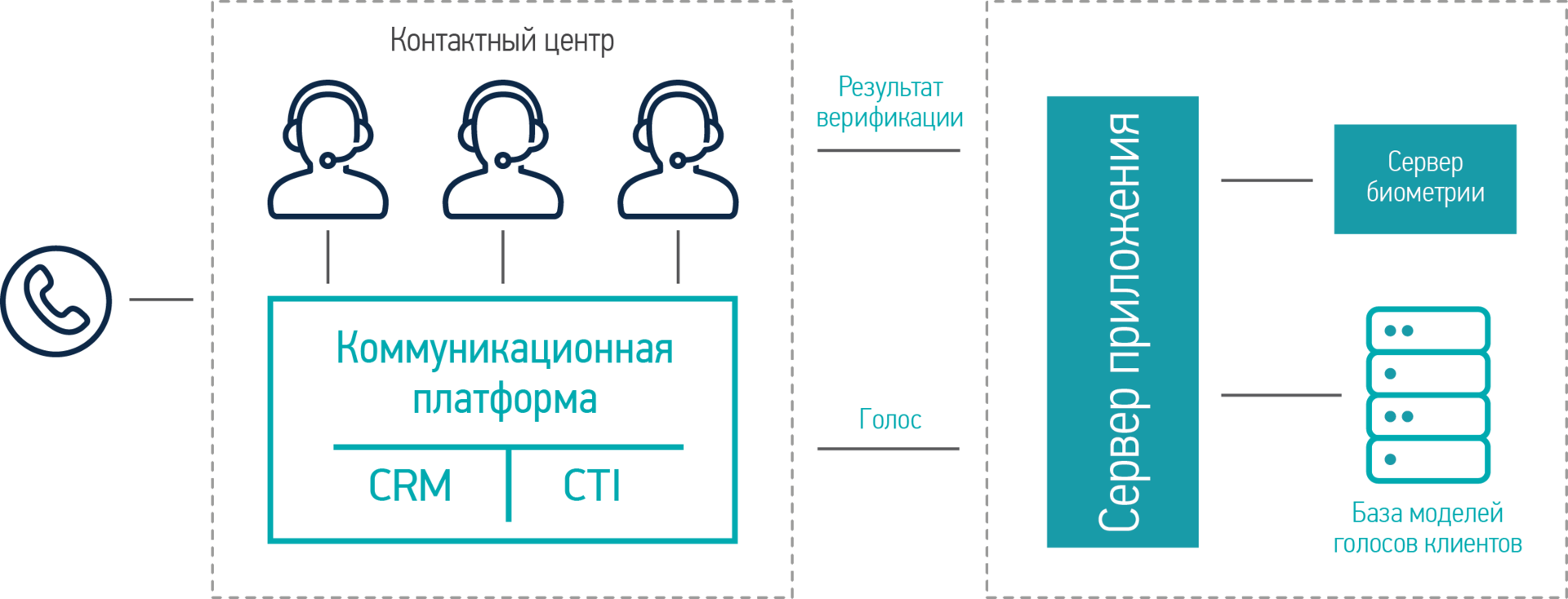
The process is so reliable that it allows you to distinguish, for example, the voices of twins or the call of a parodist. In a few seconds, the system will verify the voice with the standard and inform that the verification failed. The system is language independent, therefore, a bank client can speak any language that is available to him.
But for voice fingerprints (or voice standards) of customers to appear in the database, they must first be recorded.
How was the customer base formed in Priorbank?
Several processes are provided for working with voice standards:
• initial filling of the database with voice standards of customers based on the records of their calls to the contact center. Moreover, when creating the standard, the client must confirm his consent to his (standard) record;
• updating voice standards;
• voice verification of customers.
A database with voice standards of customers was formed in the process of their contacting the bank’s contact center by phone. If during a conversation with the operator, the client could confirm his identity in a standard way (according to passport data, secret words, contract numbers, etc. details), then when a sufficient amount of speech material was dialed, the system created a digital standard based on the unique features of his voice: accent and the speed of speech, pronunciation, etc. Also taken into account and physical features: speech tact, shape and size of the mouth, the structure of the nose. Thus, already at the next call to the CC, the client verification procedure was significantly reduced in time due to background identification by voice.
Voice Reference Registration
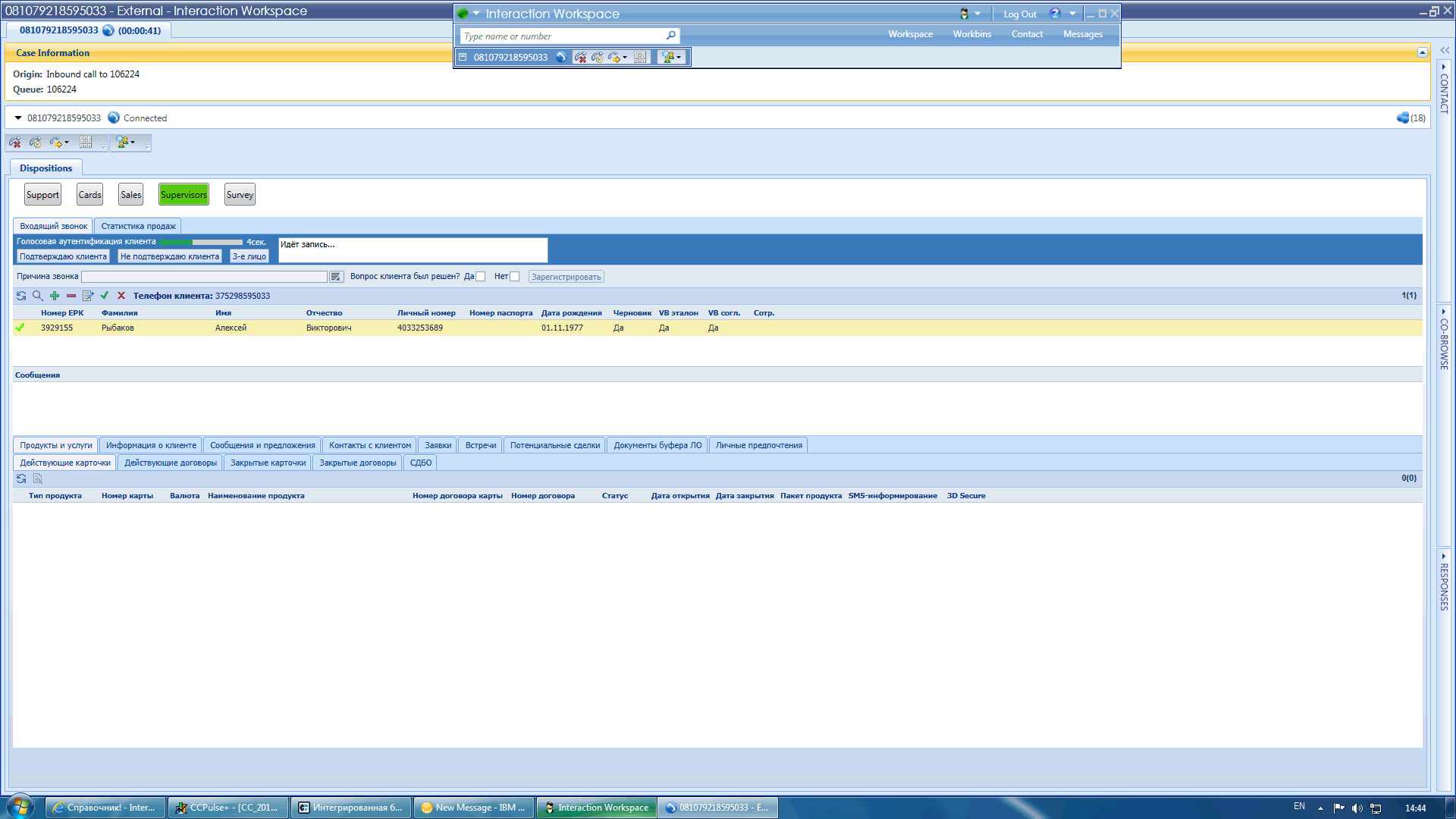
• When making a call, the client is identified by the phone number (if he is calling from a mobile phone whose number is registered with the bank).
• Then he goes through the standard authentication procedure based on knowledge of the name, date of birth, passport and contract number, passphrase. In general, right up to the name of the cat.
• During a conversation, the system accumulates the amount of speech necessary to create a voice standard (usually about 40 seconds of pure speech), and when enough is collected, it informs about the readiness to create a standard. The operator presses the button, and if the information that the client has reported about himself coincides with the data from the bank's systems, the operator saves the voice standard. Otherwise, the save does not occur. The bank receives the consent from the client to create a voice standard in advance, at the stage of signing the service contract by the client.
An example of a client-operator dialogue:

Customer Verification

The client calls and is identified by his mobile phone number. If a voice standard has already been created for him, then the system will begin:
• verification procedure, if not, then look at the history of registering a new standard. The operator asks a few simple questions to the client (asks to introduce himself and indicate the date of birth).
• Within a few seconds of the conversation, when enough of the client’s clear speech is accumulated (7–9 seconds), the system compares his voice with the standard and shows the result to the operator (“own”, “alien”, “not sure”).
• The operator either ends the survey, or continues, because the system is “not sure” that it is its own, or gently refuses the client, because he is “alien”.
Example of successful verification:

If necessary, the operator can manually restart the client’s biometric verification procedure, for example, if a third party interfered with the conversation during the verification process.
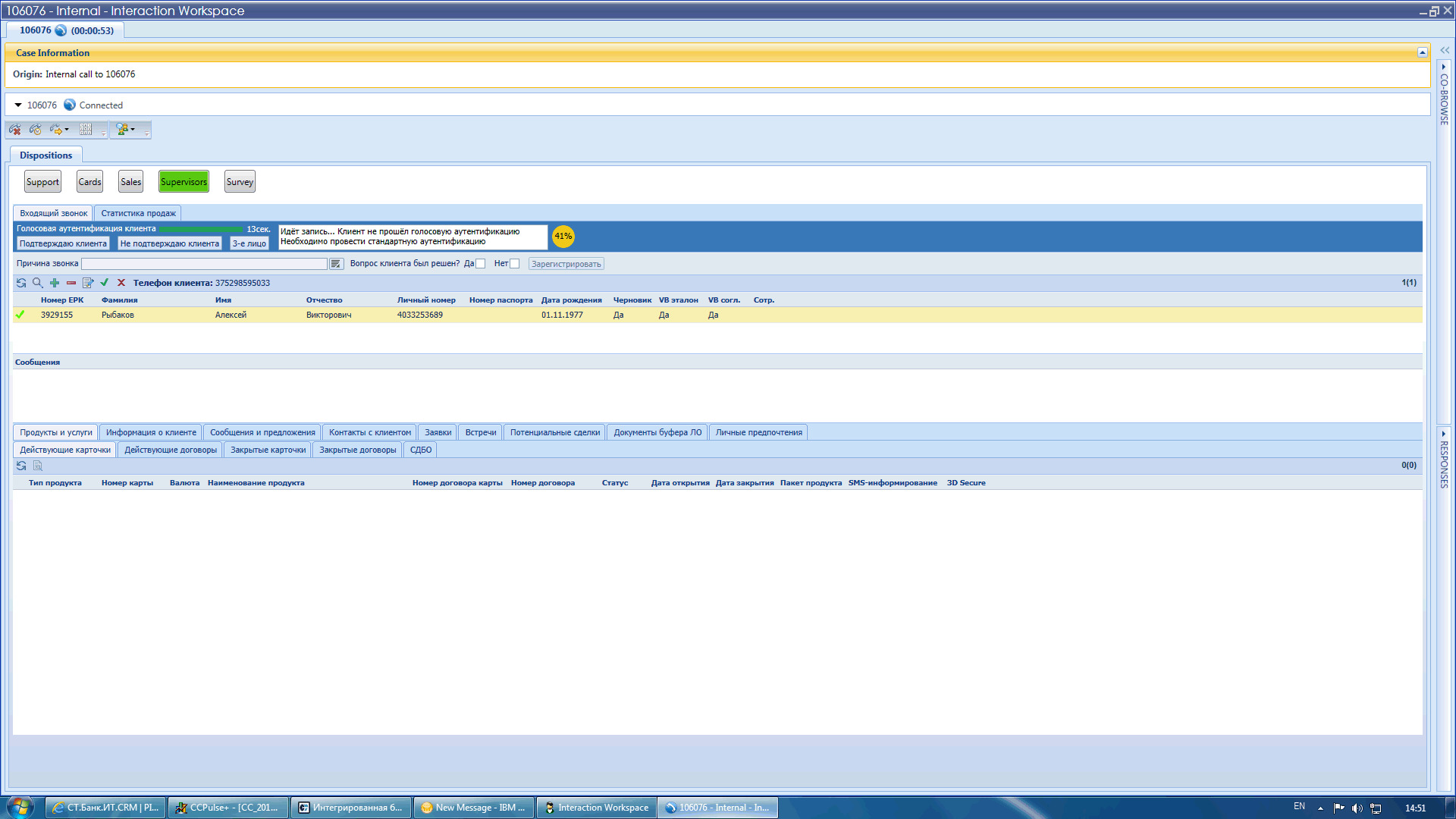
Or transfer the client to his supervisor or security service:

After the verification procedure is completed, the system no longer “listens” to the conversation, and its resources are not used.
Stages and features of implementation
• Development of technical specifications, design and implementation.
• Integration with CRM.
• System calibration.
• Testing / trial operation.
• Submission of work.
To determine the solution, three thresholds are configured in the system (“first”, “second” and “enrichment”). If the comparison result is above the first threshold, then the system considers that the client is “own”, if below the second - the client is “stranger”, if between - this means that the system cannot be sure of its decision.
If, when comparing, the result is higher than the first threshold and above the “enrichment” threshold, then the system automatically updates the voice standard. This allows you to keep standards up to date.
Of course, no biometric system can give out a 100% result, since it is probabilistic. Sometimes, although very rarely, errors occur.
They come in different types.
Types of errors
Errors are of the first and second types or, otherwise, a false pass of the “alien” (False Acceptance Rate, FAR) and errors of false denial to the “own” (False Reject Rate, FRR). These errors are interrelated, and setting up biometric systems requires finding a “compromise” between the levels of these errors in order to satisfy the task as much as possible.
Voice biometrics can be applied in various applications. For example, to verify users when talking with a contact center operator, automatically verify voice by IVR, provide the user access to a mobile application (used in conjunction with other types of biometrics: fingerprint or face), identify fraudsters by voice (antifraud), etc.
Links:
»Learn more about the VoiceKey biometric platform .
»Report on the project at the Belarusian Interfax .