Flash to flash discord: new Hitachi Accelerated Flash modules
Over the past few years, flash technology has become widespread in data centers. However, the high cost, limited reliability and suboptimal performance when performing write operations hinder their implementation. IT departments have to find a trade-off between performance and capacity in order to achieve cost-effective metrics within a limited budget. Another important issue for implementing solutions based on flash technologies is the choice between storage platforms, which are based solely on flash drives, and hybrid architecture.

As the world leader in flash technology (over 350 patents), Hitachi Data Systems introduces the new Hitachi Accelerated Flash (HAF) enterprise-class flash modules for the most demanding workload environments. New HAF capabilities integrated into the Hitachi Storage Virtualization Operating System (SVOS) unified operating system provide higher performance, capacity and lower cost per bit compared to traditional solid-state drives (SSDs) on the market today.
Customers have the opportunity to achieve a high return on investment in flash-based solutions, while lowering operating costs, and the Hitachi Accelerated Flash storage module is the first optimized flash device to provide the level of performance and reliability needed for mission-critical applications. These include, for example, OLTP databases, ERP systems, financial systems, indexing systems, and working with metadata. An improved operating system for corporate platforms has significantly improved the performance of the I / O stack to speed up access to flash drive devices.
The second generation of Flash Module Drive (FMD) DC2 drives, which are an essential part of Hitachi Accelerated Flash solutions, can achieve even greater performance indicators, speed up the company's services, and increase operational efficiency. The advanced technology of the FMD DC2 storage controller increases the performance of flash memory with MLC (Multi-level cell) technology to a level that exceeds the characteristics of the more expensive SLC (Single-level cell) memory.
The patented design of the Hitachi FMD DC2 drive uses a high-speed architecture with parallel processing, which allows, in comparison with standard solid-state drives (SSDs), to perform 5 times more I / O operations per second when writing and 3 times when reading. Another innovative innovation implemented on second-generation FMD DC2 drives is the real-time data compression technology, which can increase the efficiency of disk space utilization by up to 80%.

Structurally, FMD DC2 drives are designed for installation in a disk shelf that supports placement in a standard mounting rack and provides high data storage density - more than 154 TB of effective capacity in a 2U-height disk shelf. They can be used on any Hitachi Virtual Storage Platform G family of disk arrays, ranging from mid-range VSP G200 / 400/600/800 to Hitachi's flagship Hi-End – VSP G1000 storage system. For each of these platforms, you can create both a fully flash-based and a hybrid solution. With support for more data flows, HAF significantly speeds up I / O and data processing. In addition, the response time of the disk subsystem is significantly reduced.

Business Benefits
- Unique performance;
- The minimum cost of a storage unit;
- The highest capacity;
- Improved reliability.
A new expansion for storage systems based on solid-state drives is offered in the form of 2U disk enclosures that are connected to the controllers using the standard SAS protocol, which accommodate up to 12 high-capacity drives based on flash memory modules (FMD). The Hitachi Accelerated Flash solution is much more cost effective than the 1.6 TB enterprise-class small form factor SSD. It provides the following benefits:
1. 3 times higher performance per device when performing random read I / O;
2. 5 times higher performance per device when performing random I / O write operations;
3. reduction in the cost of information storage units to 70%;
4. 60-fold increase in formatting speed;
5. reducing peak load response time up to 60%;
6. Superior data integrity performance.
Main technical characteristics of the FMD modules FMD
combines flash memory chips and a specialized Hitachi controller used to control chip operations and implement advanced functionality that provides intelligent storage and management of information on a flash drive.
The second generation Flash Module Drive (FMD) DC2 DC has the following components:
- A controller based on a 4-core ASIC processor;
- 20nm flash drive MLC NAND;
- DDR3 8 GB;
- SAS 12Gb / s interface;
- Available to order in versions with a capacity of 1.6, 3.2, 6.4 TB.

Summary table of types FMD and their main characteristics.

The FMD
controller Hitachi’s built-in multi-core flash drive controller provides many unique features designed specifically for highly loaded enterprise-class systems with increased demands on the reliability of information storage.
It includes a specially developed ASIC, consisting of a quad-core processor with more than 60 million transistors (which is twice as much as the previous generation), two coprocessors (for calculating compression and parity) and direct memory access (DMA). The new ASIC for FMD DC2 has eight times more channels and 16 times more NAND flash chips than regular 2.5-inch solid state drives.

Using data from more than two billion system-hours of work in the most demanding corporate environments for production analysis, Hitachi engineers improved the algorithms of the new ASIC, as a result of which they increased its efficiency, functionality and speed, which provides unprecedented data processing capabilities for the FMD DC2 module, avoiding many pitfalls and bottlenecks that other manufacturers face.
Key features of the new ASIC:
1. 4 x nuclear, 1GHz, 32-bit processor.
2. 8 x PCIe 2.0 with a parallel I / O control unit on a chip.
3. 32 x channels to flash memory with a patented control unit on a chip.
4. Built-in DDR-3 interface.
5. Support 128 NAND chips.

Hitachi's briefly-named “highly intelligent concurrency” is the main performance strategy for Hitachi’s new ASIC flash controller. A large number of channels in combination with new control algorithms help to distribute data streams for parallel execution of several tasks, allocating only a certain part of the data in a separate channel for processing by various services without changing the speed of movement in other streams.
Key Features
Inline Compression
One of the most important innovations implemented in the second generation FMD DC2 drives is the real-time data compression technology. The Inline Compression mechanism using the VLSI (very large-scale integration) architecture allows lossless data compression based on the LZ77 algorithm. It should be noted that data compression operations are carried out at the level of the FMD DC2 processor integrated into the drive. This allows you to increase the speed of compression operations up to 10 times compared to traditional software implementations offered by other companies on the market.
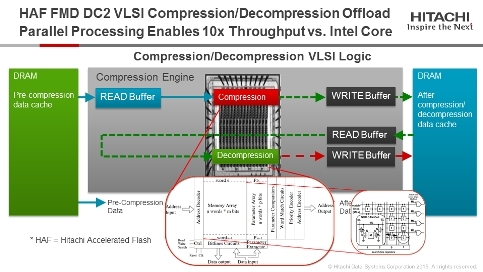
FMD DC2 ISIC Inline Compression Offload Engine

FMD DC2 ASIC Inline - Lossless Compression Operation
Reducing the load on the ASIC flash controller during data compression provides the following advantages:
1. Resources are released for performing key storage operations, such as I / O operations, data integrity protection, snapshots, various types of replication;
2. Provides better system efficiency and scalability in terms of per unit of energy expended;
3. Provides a stably short response time even when processing a large I / O block.
Workload Priority Access The
technology of providing priority access to the application (Workload Priority Access), built into the controller of the FMD drive, together with the SVOS operating system, can guarantee the critical resource with critical resources in the form of dedicated flash chips.

Smarter Garbage Collection
The function of "garbage collection" allows you to reduce the waiting time for input / output from background tasks and improves the response time due to multi-channel and more NAND flash chips, redistributing the queue to other NAND targets if necessary.

VMware vSphere End-to-End Quality of Service
Support for Virtual Storage Platform arrays VMware vSphere Virtual Volumes VVOL technology along with the use of the Workload Priority Access feature allows you to create unique configurations of VMware virtual environments that focus on application features, while providing the necessary level of service from a virtual machine to a specific flash resource

Error-correcting Code
The improved data integrity function corrects up to 59 single-bit errors in every 2 KB of data, providing higher integrity indicators than enterprise-class disk drives - SAS 10K, SAS 15K. Each memory unit has its own indicators of wear, i.e. durability. To account for these differences in characteristics, the flash controller performs an analysis of the memory blocks. Due to the continuous scanning and diagnostics of each unit, it is possible to effectively determine the optimal time for its decommissioning, which ensures compliance with the requirements for ensuring the integrity of corporate data. The adaptive data update function dynamically replaces pages with new ones in accordance with the applied error correction algorithm. In addition, this feature reduces overhead,

Figure 20. FMD DC2 Block Write Avoidance error correction
The zero block write warning feature speeds up write operations and improves performance. Thanks to this algorithm, data streams consisting of only zeros or ones are compressed in real time by up to 94%. At the same time, built-in encoding mechanisms process data blocks of 128 KB in size. The incoming data is replaced by a pointer and the corresponding checksum. This function, without increasing the response time, allows you to effectively use the capacity of flash memory, freeing it up to allocate new pages, which improves the average performance of the recording process, and to ensure the operation of background tasks such as garbage collection and cell wear leveling functions flash memory. It also reduces the time to put the array into operation,
Conclusion
Hitachi Data Systems' long-term development plan for flash memory technology covers many applications - servers, storage systems and hardware and software systems designed to speed up computing, caching systems and high-performance storage media. Compared to alternative or narrowly targeted products based on flash memory technology, new solutions should provide a higher return on investment and lower operating costs.
As the world leader in flash technology (over 350 patents), Hitachi Data Systems introduces the new Hitachi Accelerated Flash (HAF) enterprise-class flash modules for the most demanding workload environments. New HAF capabilities integrated into the Hitachi Storage Virtualization Operating System (SVOS) unified operating system provide higher performance, capacity and lower cost per bit compared to traditional solid-state drives (SSDs) on the market today.
Customers have the opportunity to achieve a high return on investment in flash-based solutions, while lowering operating costs, and the Hitachi Accelerated Flash storage module is the first optimized flash device to provide the level of performance and reliability needed for mission-critical applications. These include, for example, OLTP databases, ERP systems, financial systems, indexing systems, and working with metadata. An improved operating system for corporate platforms has significantly improved the performance of the I / O stack to speed up access to flash drive devices.
The second generation of Flash Module Drive (FMD) DC2 drives, which are an essential part of Hitachi Accelerated Flash solutions, can achieve even greater performance indicators, speed up the company's services, and increase operational efficiency. The advanced technology of the FMD DC2 storage controller increases the performance of flash memory with MLC (Multi-level cell) technology to a level that exceeds the characteristics of the more expensive SLC (Single-level cell) memory.
The patented design of the Hitachi FMD DC2 drive uses a high-speed architecture with parallel processing, which allows, in comparison with standard solid-state drives (SSDs), to perform 5 times more I / O operations per second when writing and 3 times when reading. Another innovative innovation implemented on second-generation FMD DC2 drives is the real-time data compression technology, which can increase the efficiency of disk space utilization by up to 80%.
Structurally, FMD DC2 drives are designed for installation in a disk shelf that supports placement in a standard mounting rack and provides high data storage density - more than 154 TB of effective capacity in a 2U-height disk shelf. They can be used on any Hitachi Virtual Storage Platform G family of disk arrays, ranging from mid-range VSP G200 / 400/600/800 to Hitachi's flagship Hi-End – VSP G1000 storage system. For each of these platforms, you can create both a fully flash-based and a hybrid solution. With support for more data flows, HAF significantly speeds up I / O and data processing. In addition, the response time of the disk subsystem is significantly reduced.
Business Benefits
- Unique performance;
- The minimum cost of a storage unit;
- The highest capacity;
- Improved reliability.
A new expansion for storage systems based on solid-state drives is offered in the form of 2U disk enclosures that are connected to the controllers using the standard SAS protocol, which accommodate up to 12 high-capacity drives based on flash memory modules (FMD). The Hitachi Accelerated Flash solution is much more cost effective than the 1.6 TB enterprise-class small form factor SSD. It provides the following benefits:
1. 3 times higher performance per device when performing random read I / O;
2. 5 times higher performance per device when performing random I / O write operations;
3. reduction in the cost of information storage units to 70%;
4. 60-fold increase in formatting speed;
5. reducing peak load response time up to 60%;
6. Superior data integrity performance.
Main technical characteristics of the FMD modules FMD
combines flash memory chips and a specialized Hitachi controller used to control chip operations and implement advanced functionality that provides intelligent storage and management of information on a flash drive.
The second generation Flash Module Drive (FMD) DC2 DC has the following components:
- A controller based on a 4-core ASIC processor;
- 20nm flash drive MLC NAND;
- DDR3 8 GB;
- SAS 12Gb / s interface;
- Available to order in versions with a capacity of 1.6, 3.2, 6.4 TB.
Summary table of types FMD and their main characteristics.
The FMD
controller Hitachi’s built-in multi-core flash drive controller provides many unique features designed specifically for highly loaded enterprise-class systems with increased demands on the reliability of information storage.
It includes a specially developed ASIC, consisting of a quad-core processor with more than 60 million transistors (which is twice as much as the previous generation), two coprocessors (for calculating compression and parity) and direct memory access (DMA). The new ASIC for FMD DC2 has eight times more channels and 16 times more NAND flash chips than regular 2.5-inch solid state drives.
Using data from more than two billion system-hours of work in the most demanding corporate environments for production analysis, Hitachi engineers improved the algorithms of the new ASIC, as a result of which they increased its efficiency, functionality and speed, which provides unprecedented data processing capabilities for the FMD DC2 module, avoiding many pitfalls and bottlenecks that other manufacturers face.
Key features of the new ASIC:
1. 4 x nuclear, 1GHz, 32-bit processor.
2. 8 x PCIe 2.0 with a parallel I / O control unit on a chip.
3. 32 x channels to flash memory with a patented control unit on a chip.
4. Built-in DDR-3 interface.
5. Support 128 NAND chips.
Hitachi's briefly-named “highly intelligent concurrency” is the main performance strategy for Hitachi’s new ASIC flash controller. A large number of channels in combination with new control algorithms help to distribute data streams for parallel execution of several tasks, allocating only a certain part of the data in a separate channel for processing by various services without changing the speed of movement in other streams.
Key Features
Inline Compression
One of the most important innovations implemented in the second generation FMD DC2 drives is the real-time data compression technology. The Inline Compression mechanism using the VLSI (very large-scale integration) architecture allows lossless data compression based on the LZ77 algorithm. It should be noted that data compression operations are carried out at the level of the FMD DC2 processor integrated into the drive. This allows you to increase the speed of compression operations up to 10 times compared to traditional software implementations offered by other companies on the market.
FMD DC2 ISIC Inline Compression Offload Engine
FMD DC2 ASIC Inline - Lossless Compression Operation
Reducing the load on the ASIC flash controller during data compression provides the following advantages:
1. Resources are released for performing key storage operations, such as I / O operations, data integrity protection, snapshots, various types of replication;
2. Provides better system efficiency and scalability in terms of per unit of energy expended;
3. Provides a stably short response time even when processing a large I / O block.
Workload Priority Access The
technology of providing priority access to the application (Workload Priority Access), built into the controller of the FMD drive, together with the SVOS operating system, can guarantee the critical resource with critical resources in the form of dedicated flash chips.
Smarter Garbage Collection
The function of "garbage collection" allows you to reduce the waiting time for input / output from background tasks and improves the response time due to multi-channel and more NAND flash chips, redistributing the queue to other NAND targets if necessary.
VMware vSphere End-to-End Quality of Service
Support for Virtual Storage Platform arrays VMware vSphere Virtual Volumes VVOL technology along with the use of the Workload Priority Access feature allows you to create unique configurations of VMware virtual environments that focus on application features, while providing the necessary level of service from a virtual machine to a specific flash resource
Error-correcting Code
The improved data integrity function corrects up to 59 single-bit errors in every 2 KB of data, providing higher integrity indicators than enterprise-class disk drives - SAS 10K, SAS 15K. Each memory unit has its own indicators of wear, i.e. durability. To account for these differences in characteristics, the flash controller performs an analysis of the memory blocks. Due to the continuous scanning and diagnostics of each unit, it is possible to effectively determine the optimal time for its decommissioning, which ensures compliance with the requirements for ensuring the integrity of corporate data. The adaptive data update function dynamically replaces pages with new ones in accordance with the applied error correction algorithm. In addition, this feature reduces overhead,
Figure 20. FMD DC2 Block Write Avoidance error correction
The zero block write warning feature speeds up write operations and improves performance. Thanks to this algorithm, data streams consisting of only zeros or ones are compressed in real time by up to 94%. At the same time, built-in encoding mechanisms process data blocks of 128 KB in size. The incoming data is replaced by a pointer and the corresponding checksum. This function, without increasing the response time, allows you to effectively use the capacity of flash memory, freeing it up to allocate new pages, which improves the average performance of the recording process, and to ensure the operation of background tasks such as garbage collection and cell wear leveling functions flash memory. It also reduces the time to put the array into operation,
Conclusion
Hitachi Data Systems' long-term development plan for flash memory technology covers many applications - servers, storage systems and hardware and software systems designed to speed up computing, caching systems and high-performance storage media. Compared to alternative or narrowly targeted products based on flash memory technology, new solutions should provide a higher return on investment and lower operating costs.