February 16, 2016 at 15:04
Not everything can be bought: game developer Ubisoft is trying to avoid a violent takeover by Vivendi
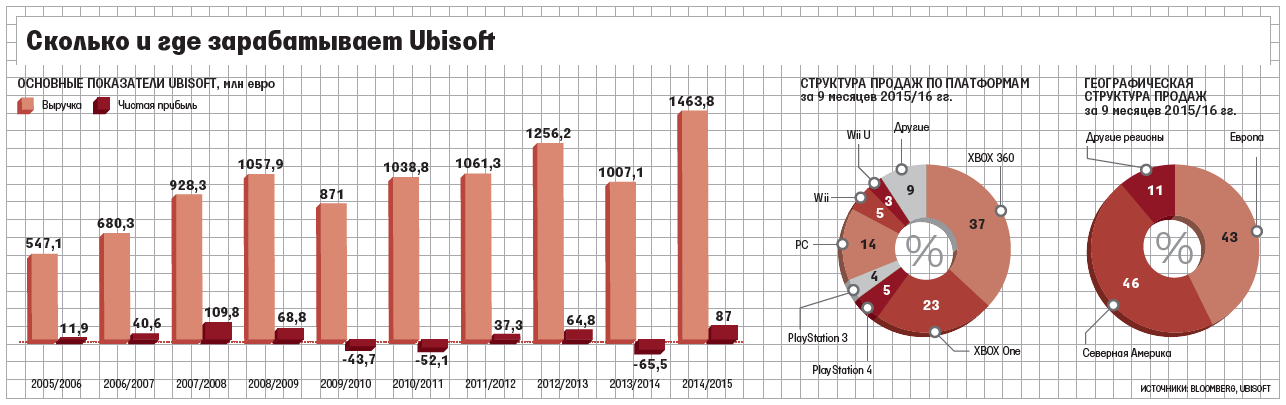
Sources: Bloomberg and Ubisoft. In a few years,
Ubisoft has evolved from a small family-owned company in France into a global player in the gaming market. Ubisoft employs 10,000 people. The company has opened studios in almost 20 countries.
Recently, however, the head of Ubisoft, Yves Guillot, got a call from French industrialist, billionaire and chairman of the Vivendi media group, Vincent Bollore. “He said we need to talk about potential synergies,” recalls Guillaume.
Two hours after the conversation, Guillaume found out that Vivendi bought 6.6% of Ubisoft. This was not a proposal to discuss potential partnership opportunities, but a demonstration of Vivendi’s intention to absorb Ubisoft - whether it wants to or not.
Now Guillaume fears that Vivendi will take over Ubisoft in parts, sequentially redeeming shares from shareholders. To date, Vivendi has already acquired a 15% stake in the company, reports the Financial Times.
Vivendi's culture is alien to Ubisoft's business and will put an end to creativity, Guillau is sure. Jim Ryan, President of Sony Computer Entertainment Europe, describes Guillaume as a fair, but tough person who is hard to deal with. But 90% of Ubisoft's revenue comes from overseas markets. And this is the best evidence of the success of Guillaume.
Ubisoft is the third largest producer of computer games in the world. Among the cult ones are Assassin's Creed, Prince of Persia, Rainbow Six, Ghost Recon, Splinter Cell and others. Ubisoft develops games for personal computers, and for mobile devices, and for game consoles. In 2011, the company created the Ubisoft Motion Pictures film studio to release films on games.
Vivendi is the largest French media group. She owns the world-famous music holding Universal Music Group, large stakes in France’s second-largest mobile operator SFR, mobile operator Maroc Telecom, as well as Canal + cable TV network.
The company’s value is not comparable: the capitalization of Ubisoft is 2.2 billion euros, and Vivendi is 24.1 billion euros.
The company recently became Telecom Italia 's largest shareholder , buying up 20% of its shares. Her acquisitions include 26.7% at Gameloft , also a prominent player in the global video game industry affiliated with Ubisoft.
On September 2, the French media conglomerate Vivendi increased its stake in the Dailymotion video hosting owned by telecommunications Orange to 90%, having bought 10% in the parent company.
According to Les Echos sources, Vivendi acquired a 10% stake in Orange for a little over 27 million euros. Last June, the French conglomerate bought an 80% stake in a telecommunications company for 217 million euros. Now Vivendi owns 90% of Orange and indirectly 90% of its subsidiary Dailymotion.
The difference between games and cinema is getting smaller, Guillaume admits: "The video game industry can create mythical worlds, and Hollywood can create stories."
Vivendi has around 2 billion euros in cash available to the company from the sale of assets in the past two years. She has experience in the gaming industry - Vivendi owns a majority stake in Activision Blizzard, a California-based video game company .
Vivendi CEO Vincent Bollore has a reputation as a cunning and ruthless businessman who knows how to create equity. But Guillaume plans to replay Bollore and maintain the independence of the family company.
The Guillot Brothers created Ubisoft in 1986. Starting with sales of games from other manufacturers, Ubisoft grew rapidly: within a few years, it entered the markets of Great Britain, Germany and even the USA. Later, the company began its own production of games - the first of them was called Zombie.
Between 2011 and 2015, the company's shares grew 4 times. Rapid growth stopped after Vivendi became interested in the company's business. Guimo recently announced that he is breaking the tradition of the annual release of the new Assassin's Creed game series and, after the disappointing results of the last series, intends to review the franchise.
Guimo does not want to do anything with Vivendi: “If we want to make films for the international market, we will negotiate with Fox, Warner or Sony Pictures. They are specialists in this industry. And we will not speak with Canal +. ”
“Vivendi has a completely different way of doing business that you will never see in the UK, USA or even Asian countries,” Guillaume explains. - If you want to acquire a company, you will first negotiate with it and then buy it. You do not just come and take away its entire system. ”
“Many companies practice a“ big boss ”style of management that requires blind execution of orders, but we work in the creative industry, and creativity is based on what allows people to take risks so that they can achieve outstanding results,” he says. “If a group begins to manage our company that does not understand the industry, but simply wants to control the business, this will quickly kill creativity.”
In the coming days, Guillaume is going to present a medium-term development plan to shareholders. Shareholders will discuss it collectively. Neither Guillaume nor Bollore will be able to directly influence the decision on the further development of the company (including a possible sale).
However, it is clear that the trust of major shareholders in Guillaume, as the founder of the company and a long-standing partner, will play a role.
“In the video game industry, those companies that are able to make decisions quickly are successful, and usually those who are part of large groups are not capable,” summarizes Guillaume.
According to Newzoo , the value of the video game market will grow from $ 91.5 billion in 2015 to $ 107 billion in 2017. The average American will spend 28.3 minutes a day on computer games in 2018 compared to 23.2 minutes in 2013.