August 25, 2015 at 23:46
Cloud technology from Macedonia or managing a B2B online project remotely. Part 2, business incubator in Skopje
To raise the morale of the readers of Megamind and their own fighting spirit, in conditions of an ending summer, I continue the story of sunny Macedonia, the summer season in which ends only at the end of October. By the way, the choice of Macedonia as a country for long-term residence and remote work was also determined by a good climate - not as hot as in Southeast Asia and not so dank as in Western Europe with all the attributes of a European country and the availability of major European IT events . The Balkan climate is completely superimposed on the fragile physiology of the Moscow office samurai - there are no critical winter temperatures and there is no sweltering heat all year. In city parks, you can meet birch trees and exotic yuccas that are dear to your heart or even sit under a palm tree with a laptop, if it is important for someone to work under a palm tree.
At the Skopje airport, the Wizzair low-cost airline was tightly obsessed with which, if you follow the stocks, you can fly to London or Milan and back for a symbolic 89 euros. Initially, when the move was planned, I assumed that working remotely on our AltegroCloud project , a European business segment could form and I would need to periodically move around Europe in search of new, undeveloped competitors, market segments for conducting numerous and effective negotiations and presentations somewhere on Lazurny Shore or in the City of London. As further practice has shown, attempts to promote SaaS IP-PBX in the Balkans are, to put it mildly, not an easy task, but more on that in the next publication. Today I would like to talk about the economic side and the format of residence of an IT entrepreneur in Macedonia.
It’s clear that if you live in another country and at the same time work, and not just travel, mastering the monthly income from renting a kopeck piece in the Preobrazhenskaya Square metro area, you will have to work and have to work almost like in Russia, maximally coinciding with your schedule Moscow colleagues, clients and partners, i.e. 8-10 hours a day. This means that you will need a workplace, smart Internet and relative peace around, because the hard mental work of the head of the SaaS-project does not endure the hustle and bustle around. Before leaving, having no previous experience of working remotely, I naively assumed that I would “organize” working hours and space in the same apartment in which I would live with my family “one at a time”, I will calm my two-year-old son with a harsh cry and make my wife not pierce pots with a piercing gaze at the moment when I hold the next, reporting-elective, Skype conference with my colleagues. With such approaches, the budget for organizing a workplace completely coincided with the budget for renting an apartment.
You can rent an apartment in Skopje (which is the most expensive city in the country) for relatively little money, even in today's difficult times: for a “kopeck piece” of 60 square meters, in a quiet area, among pine trees and low-rise buildings, they will ask for 200 euros without utilities payments. As a bonus, you will get roosters crowing in the mornings, a complete absence of traffic jams, friendly and relaxed Slavic neighbors, and a reasonably acceptable 5 megabit cable Internet channel (optics are laid mainly in the central and business part of Skopje). The Macedonian “dvushka” is a full-fledged Moscow “treshka” both in terms of area and number of rooms (Macedonians consider only bedrooms to be rooms). The communal apartment is also relatively inexpensive and approximately the same for all areas of the city - for 60 square meters you will have to pay 60-80 euros in the summer and 120-150 euros in the winter (the cost of heating is added, the heating season is November-March). In the city center, closer to shopping centers and parties (and parties in Skopje never stop) a similar kopeck piece can be removed for 300-350 euros per month with the same utility bills. Five minutes on foot and you are on the central Skopje square with the world famous Stone Bridge.
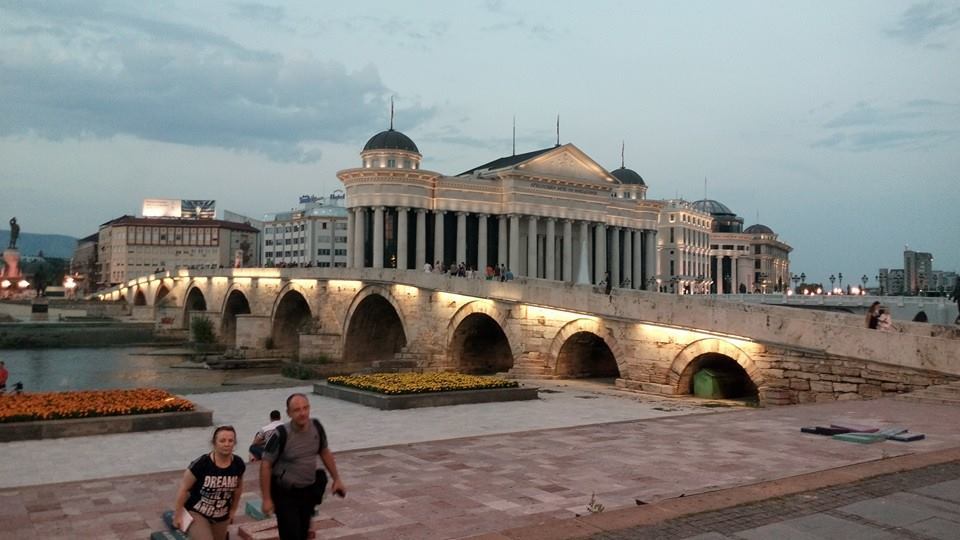
The Internet is accessible almost everywhere and is offered by default. Cable Internet 5-10 Mbps together with 100 cable TV channels - about 15-20 euros per month, if you want space speeds up to 50 Mbps and optics to the apartment - you have to pay 30-40 euros per month and it’s not a fact that such connection is available in your home. You can also use mobile Internet, it runs quite fast here and is relatively inexpensive - 5 euros for 5 GB of traffic, followed by a speed limit until the end of the month. Through my cable Internet from the TeleKabel provider, Skype and video and applications critical to delays work without bugs. In total, there will be about 5-6 providers in Skopje, penetration, as I said, is almost 100%.
In a word, I started working in a rented apartment via the Internet with a huge terrace and a gorgeous view of the mountains. This is how my workplace looked at first (the pictures, by the way, were taken at the end of October, the weather makes it possible to work outdoors).
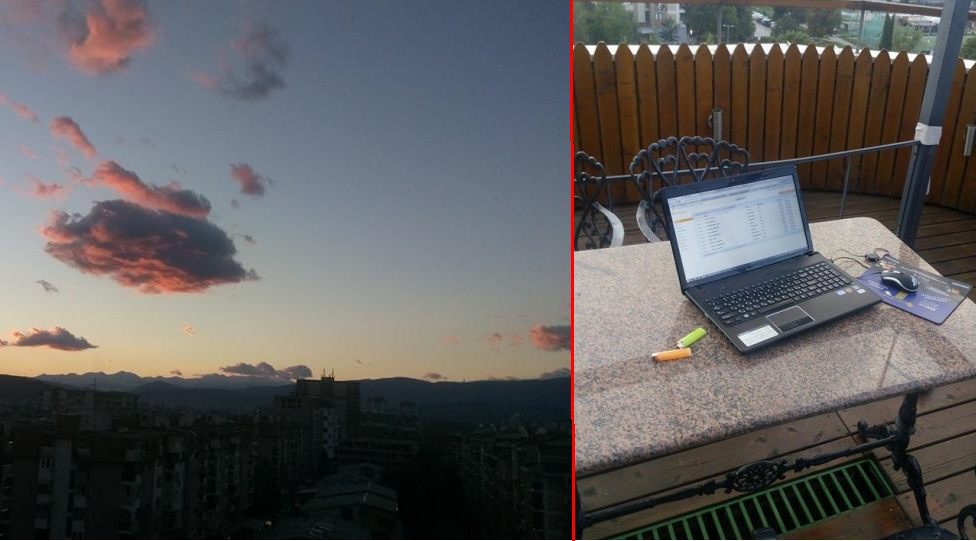
At first, working at home really became more efficient and faster - the Balkan air and a relaxed atmosphere pretty much added positive and desire to work, I began to think that the home-based project management format was a life hack, which I, as one of my favorites, as a real highlander, opened for themselves as the innermost secret of being, inaccessible to the office majority, suffering from vegetative-vascular dystonia. Everything really looked extremely attractive: the cost of food and travel to exotic places fell significantly. A family of three in Macedonia can live quite calmly with not very big money - 300-400 euros for all are enough for food, trips to the sea are a lot of nonsense: to the Greek Thessaloniki and the sea, respectively, a little more than 200 km or 2 hours by car.
Everything would be good, but something is bad. Over time, understanding came: working at home is convenient and saves time, but there turned out to be more minuses than pluses - the two-year-old son refused to understand that dad was talking in Skype conference with serious uncles, and not with Leva-Gruzovichk and that crying-screaming -You can’t throw toys, and a wife who decided that since her husband is now working from home, then this husband can start to “load” with household chores and that the family is “much more important than any work”. After working in a home-based format for about six months, I realized that I urgently needed to get out of the house. Fell into the office and work there, otherwise the efficiency will soon collapse to zero, since a normal telephone conversation or email reply began to turn into a role-playing game with running around with a laptop and a mobile phone in the corners of the apartment, albeit quite large.
Commercial real estate in Skopje, as they say, heaps. Even such business centers are being built.
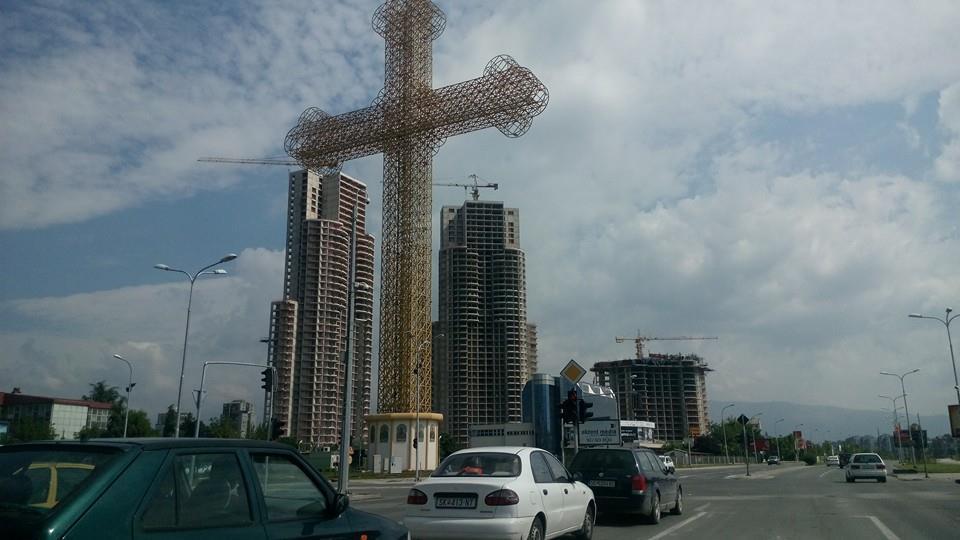
Finding a room in Macedonia is a simple and relatively inexpensive task: business activity in Skopje is very different from business activity in San Francisco and there are office space everywhere, and asking for no more than 150 square meters for an office -200 Euro per month, even in a class A business center. But I wanted something special, with the appropriate environment, atmosphere and environment, and for the office neighbors to admire my competencies and offer multi-million dollar contracts. One of my friends, having learned that I was looking for a room for an IT company office, advised me to contact the Macedonian business incubator YES , in fact, the only IT business incubator in the country.
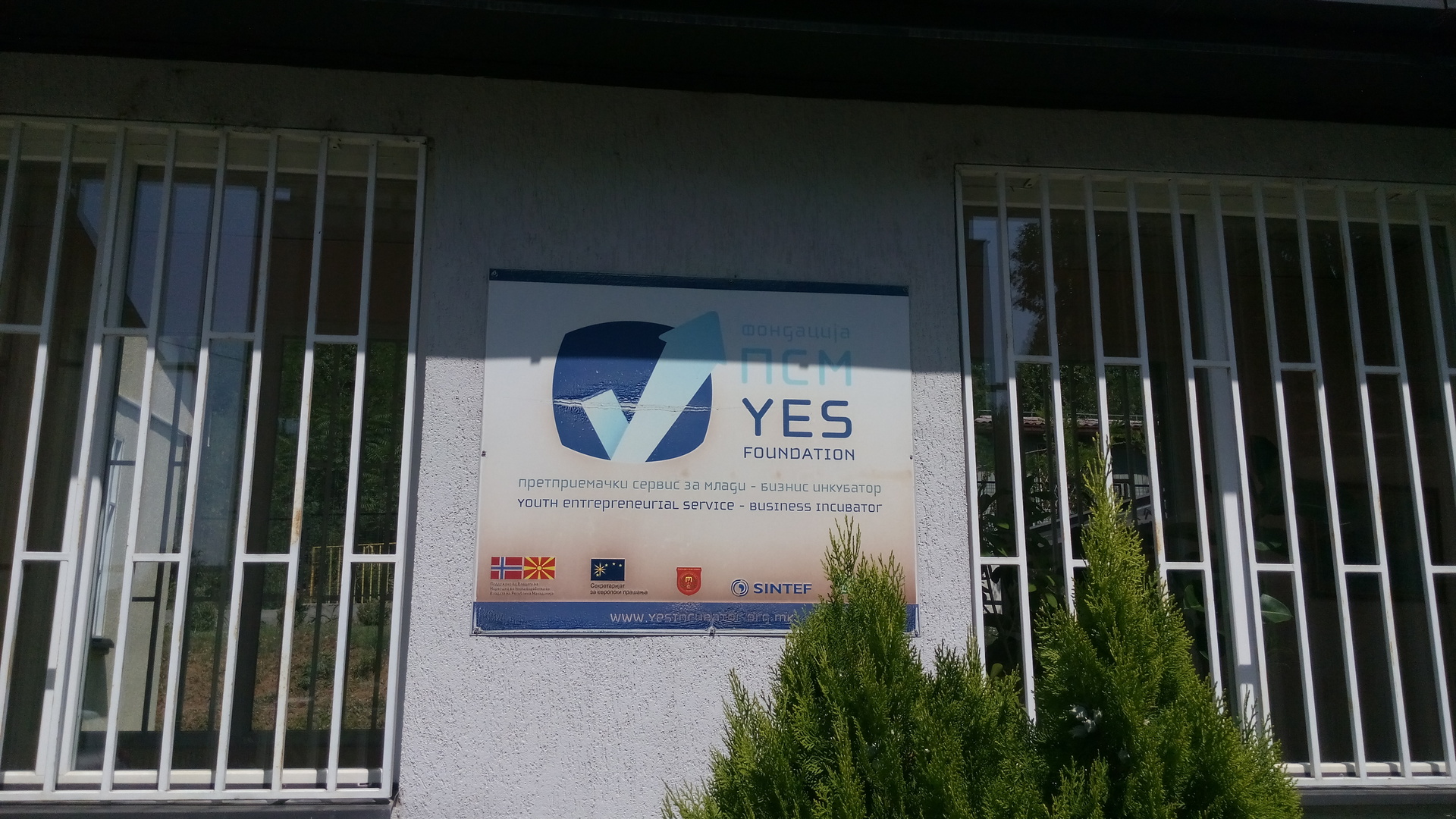
The YES incubator exists on funds allocated by the EU for business development in Eastern Europe and is well funded. YES does not offer completely free cheese, but the conditions of residency are more than loyal, and the requirements for potential residents are not "star-like" at all. After a couple of meetings with officials and filling in the required applications in English, I began to wait for the commission’s decision, with almost no doubt about the positive result: the Russian, seasoned, turned gray in the telecom field, the project manager wished to become part of the IT community of a small Balkan country. And, indeed, a week after submitting the application I was accepted. True, it was not at all because they saw in me the savior of the telecom industry throughout Eastern Europe, but because one of the residents was just “tempted” to move sawing a startup in Scandinavia and the office was vacated.
Actually, the incubation conditions themselves: the program is designed for a year, as part of the acceleration, they provide an office room with a substantial discount for rent, free parties, events, meetings with mentors and officials from the Ministry of Communications, help and support in all endeavors at the government level, as well as free coffee , office supplies, breakfasts in the student cafeteria, meeting rooms and conference rooms.
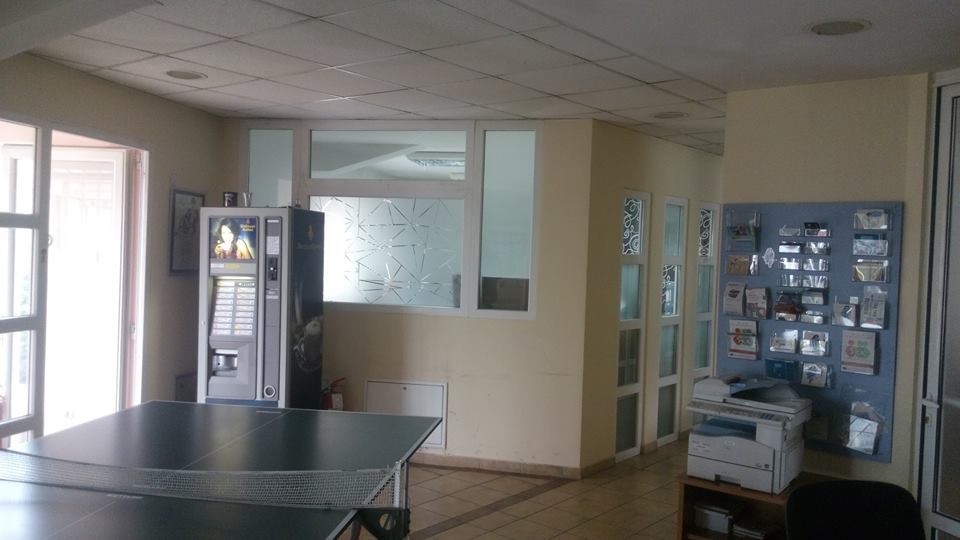
For a fully furnished office with an area of 10 square meters I have to pay 80 euros per month with all included utility bills and a 50 Mbps optical Internet channel. The office building itself is located on the territory of the University of St. Cyril and Methodius, around the mountains, parks, churches and friendly Macedonians.
Incubator outside

inside
motivating promo

my 10 square meters

Resident colleagues are young and not very Macedonian companies, trying their hand at the field of IT entrepreneurship. The specificity of the country is such that it is impossible to build a high-margin business, focusing only on the domestic market: the market is small, specific and very difficult with investments. Therefore, the guys are trying to work on European markets, and many do it very well. So far, no mega-breakthrough business ideas have been found, but in general, all businesses are in trend. The Macedonians are practical people and are primarily concerned about making a profit, there are practically no startups living on venture money in our incubator.
Colleague Gligor has been engaged in 3D modeling for several years and is successfully developing his project in the markets of Switzerland and the UK. He leaves work very late - a lot of work. Gligor and I often discuss methods and technologies for consuming strong alcoholic drinks in Russia.

Colleagues Nikola and Igor are almost not interested in statistics on the consumption of spirits in the Russian Federation, but often spend time in the courtyard, actively discussing the difficult fate of an IT entrepreneur in the Balkans. The guys are promoting their site builder on the European market, and judging by the fact that they are at work even on weekends, the rushing business

In the incubator, meetings and IT parties are often held, invitations to European events are regularly sent out, participation in which is paid from YES funds. I have been actively “residing” in the incubator for half a year soon and am completely satisfied with the current format of my work, there is simply no desire to look for other options, I found the perfect office.
Summing up the financial result of the remote “Macedonian format”, I will cite some average economic statistics of life in Skopje:
- rental of a comfortable apartment, 60-70 square meters - 250-350 euros per month with utility bills;
- full-fledged nutrition for a family of three “I do not deny myself anything” - 300-400 euros;
- Cafes and restaurants for two - 10-25 euros for a full meal;
- one-way public transport - 0.5 euro;
- Internet channel for home - 15-20 euros;
- Cellular communication per month with the 3G / 4G package “so that it is enough for Facebook and Skype” - 10-15 euros per month;
- office rental 10 sq. M. meters, with all payments and costs (my case) - 80 euros per month;
- a business lunch in a nearby cafe - 2-3 euros
- periodic and sometimes spontaneous trips to the sea to Greece for a weekend for a family, taking into account the two-night apartment and the cost of gasoline - 100 euros;
- A round-trip air ticket to Berlin or Milan or elsewhere to Europe - 90-100 euros;
- air ticket to Moscow and back per person - 250-300 euros;
It is clear that living in a European country near the points of attraction of world venture capital and not trying to get closer to these very points is almost impossible. Over a year of my life in Macedonia, I honestly collected statistics on the IT industry, went to exhibitions, analyzed the prospects for the development of our project in Eastern European markets, met with whom I needed and formed a certain vision of the IT market in the Balkans, which I am naturally ready to share in the next publication.
To be continued…
At the Skopje airport, the Wizzair low-cost airline was tightly obsessed with which, if you follow the stocks, you can fly to London or Milan and back for a symbolic 89 euros. Initially, when the move was planned, I assumed that working remotely on our AltegroCloud project , a European business segment could form and I would need to periodically move around Europe in search of new, undeveloped competitors, market segments for conducting numerous and effective negotiations and presentations somewhere on Lazurny Shore or in the City of London. As further practice has shown, attempts to promote SaaS IP-PBX in the Balkans are, to put it mildly, not an easy task, but more on that in the next publication. Today I would like to talk about the economic side and the format of residence of an IT entrepreneur in Macedonia.
It’s clear that if you live in another country and at the same time work, and not just travel, mastering the monthly income from renting a kopeck piece in the Preobrazhenskaya Square metro area, you will have to work and have to work almost like in Russia, maximally coinciding with your schedule Moscow colleagues, clients and partners, i.e. 8-10 hours a day. This means that you will need a workplace, smart Internet and relative peace around, because the hard mental work of the head of the SaaS-project does not endure the hustle and bustle around. Before leaving, having no previous experience of working remotely, I naively assumed that I would “organize” working hours and space in the same apartment in which I would live with my family “one at a time”, I will calm my two-year-old son with a harsh cry and make my wife not pierce pots with a piercing gaze at the moment when I hold the next, reporting-elective, Skype conference with my colleagues. With such approaches, the budget for organizing a workplace completely coincided with the budget for renting an apartment.
You can rent an apartment in Skopje (which is the most expensive city in the country) for relatively little money, even in today's difficult times: for a “kopeck piece” of 60 square meters, in a quiet area, among pine trees and low-rise buildings, they will ask for 200 euros without utilities payments. As a bonus, you will get roosters crowing in the mornings, a complete absence of traffic jams, friendly and relaxed Slavic neighbors, and a reasonably acceptable 5 megabit cable Internet channel (optics are laid mainly in the central and business part of Skopje). The Macedonian “dvushka” is a full-fledged Moscow “treshka” both in terms of area and number of rooms (Macedonians consider only bedrooms to be rooms). The communal apartment is also relatively inexpensive and approximately the same for all areas of the city - for 60 square meters you will have to pay 60-80 euros in the summer and 120-150 euros in the winter (the cost of heating is added, the heating season is November-March). In the city center, closer to shopping centers and parties (and parties in Skopje never stop) a similar kopeck piece can be removed for 300-350 euros per month with the same utility bills. Five minutes on foot and you are on the central Skopje square with the world famous Stone Bridge.
The Internet is accessible almost everywhere and is offered by default. Cable Internet 5-10 Mbps together with 100 cable TV channels - about 15-20 euros per month, if you want space speeds up to 50 Mbps and optics to the apartment - you have to pay 30-40 euros per month and it’s not a fact that such connection is available in your home. You can also use mobile Internet, it runs quite fast here and is relatively inexpensive - 5 euros for 5 GB of traffic, followed by a speed limit until the end of the month. Through my cable Internet from the TeleKabel provider, Skype and video and applications critical to delays work without bugs. In total, there will be about 5-6 providers in Skopje, penetration, as I said, is almost 100%.
In a word, I started working in a rented apartment via the Internet with a huge terrace and a gorgeous view of the mountains. This is how my workplace looked at first (the pictures, by the way, were taken at the end of October, the weather makes it possible to work outdoors).
At first, working at home really became more efficient and faster - the Balkan air and a relaxed atmosphere pretty much added positive and desire to work, I began to think that the home-based project management format was a life hack, which I, as one of my favorites, as a real highlander, opened for themselves as the innermost secret of being, inaccessible to the office majority, suffering from vegetative-vascular dystonia. Everything really looked extremely attractive: the cost of food and travel to exotic places fell significantly. A family of three in Macedonia can live quite calmly with not very big money - 300-400 euros for all are enough for food, trips to the sea are a lot of nonsense: to the Greek Thessaloniki and the sea, respectively, a little more than 200 km or 2 hours by car.
Everything would be good, but something is bad. Over time, understanding came: working at home is convenient and saves time, but there turned out to be more minuses than pluses - the two-year-old son refused to understand that dad was talking in Skype conference with serious uncles, and not with Leva-Gruzovichk and that crying-screaming -You can’t throw toys, and a wife who decided that since her husband is now working from home, then this husband can start to “load” with household chores and that the family is “much more important than any work”. After working in a home-based format for about six months, I realized that I urgently needed to get out of the house. Fell into the office and work there, otherwise the efficiency will soon collapse to zero, since a normal telephone conversation or email reply began to turn into a role-playing game with running around with a laptop and a mobile phone in the corners of the apartment, albeit quite large.
Commercial real estate in Skopje, as they say, heaps. Even such business centers are being built.
Finding a room in Macedonia is a simple and relatively inexpensive task: business activity in Skopje is very different from business activity in San Francisco and there are office space everywhere, and asking for no more than 150 square meters for an office -200 Euro per month, even in a class A business center. But I wanted something special, with the appropriate environment, atmosphere and environment, and for the office neighbors to admire my competencies and offer multi-million dollar contracts. One of my friends, having learned that I was looking for a room for an IT company office, advised me to contact the Macedonian business incubator YES , in fact, the only IT business incubator in the country.
The YES incubator exists on funds allocated by the EU for business development in Eastern Europe and is well funded. YES does not offer completely free cheese, but the conditions of residency are more than loyal, and the requirements for potential residents are not "star-like" at all. After a couple of meetings with officials and filling in the required applications in English, I began to wait for the commission’s decision, with almost no doubt about the positive result: the Russian, seasoned, turned gray in the telecom field, the project manager wished to become part of the IT community of a small Balkan country. And, indeed, a week after submitting the application I was accepted. True, it was not at all because they saw in me the savior of the telecom industry throughout Eastern Europe, but because one of the residents was just “tempted” to move sawing a startup in Scandinavia and the office was vacated.
Actually, the incubation conditions themselves: the program is designed for a year, as part of the acceleration, they provide an office room with a substantial discount for rent, free parties, events, meetings with mentors and officials from the Ministry of Communications, help and support in all endeavors at the government level, as well as free coffee , office supplies, breakfasts in the student cafeteria, meeting rooms and conference rooms.
For a fully furnished office with an area of 10 square meters I have to pay 80 euros per month with all included utility bills and a 50 Mbps optical Internet channel. The office building itself is located on the territory of the University of St. Cyril and Methodius, around the mountains, parks, churches and friendly Macedonians.
Incubator outside
inside
motivating promo
my 10 square meters
Resident colleagues are young and not very Macedonian companies, trying their hand at the field of IT entrepreneurship. The specificity of the country is such that it is impossible to build a high-margin business, focusing only on the domestic market: the market is small, specific and very difficult with investments. Therefore, the guys are trying to work on European markets, and many do it very well. So far, no mega-breakthrough business ideas have been found, but in general, all businesses are in trend. The Macedonians are practical people and are primarily concerned about making a profit, there are practically no startups living on venture money in our incubator.
Colleague Gligor has been engaged in 3D modeling for several years and is successfully developing his project in the markets of Switzerland and the UK. He leaves work very late - a lot of work. Gligor and I often discuss methods and technologies for consuming strong alcoholic drinks in Russia.
Colleagues Nikola and Igor are almost not interested in statistics on the consumption of spirits in the Russian Federation, but often spend time in the courtyard, actively discussing the difficult fate of an IT entrepreneur in the Balkans. The guys are promoting their site builder on the European market, and judging by the fact that they are at work even on weekends, the rushing business
In the incubator, meetings and IT parties are often held, invitations to European events are regularly sent out, participation in which is paid from YES funds. I have been actively “residing” in the incubator for half a year soon and am completely satisfied with the current format of my work, there is simply no desire to look for other options, I found the perfect office.
Summing up the financial result of the remote “Macedonian format”, I will cite some average economic statistics of life in Skopje:
- rental of a comfortable apartment, 60-70 square meters - 250-350 euros per month with utility bills;
- full-fledged nutrition for a family of three “I do not deny myself anything” - 300-400 euros;
- Cafes and restaurants for two - 10-25 euros for a full meal;
- one-way public transport - 0.5 euro;
- Internet channel for home - 15-20 euros;
- Cellular communication per month with the 3G / 4G package “so that it is enough for Facebook and Skype” - 10-15 euros per month;
- office rental 10 sq. M. meters, with all payments and costs (my case) - 80 euros per month;
- a business lunch in a nearby cafe - 2-3 euros
- periodic and sometimes spontaneous trips to the sea to Greece for a weekend for a family, taking into account the two-night apartment and the cost of gasoline - 100 euros;
- A round-trip air ticket to Berlin or Milan or elsewhere to Europe - 90-100 euros;
- air ticket to Moscow and back per person - 250-300 euros;
It is clear that living in a European country near the points of attraction of world venture capital and not trying to get closer to these very points is almost impossible. Over a year of my life in Macedonia, I honestly collected statistics on the IT industry, went to exhibitions, analyzed the prospects for the development of our project in Eastern European markets, met with whom I needed and formed a certain vision of the IT market in the Balkans, which I am naturally ready to share in the next publication.
To be continued…