March 23, 2016 at 13:29
How to Become a Gartner Leader
Gartner once again decides which players in the IT market deserve the title of best. What matters in rating? How to get ahead of other market giants?
How Gartner creates a report
Founded by Gideon Gartner in 1979, the company is engaged in consulting and research exclusively in the IT field. “Magic quadrants” reflecting the position of players in the market are very popular. Two linear scales are indicated in the ranking - completeness of vision and ability to execute. Based on these criteria, vendors are divided into four groups. It turns out that companies have little to declare their merits, for example, by writing on the website about a wonderful new product. It is also necessary to prove their worth in the market, to demonstrate real completed projects. Product strategy, innovative approaches, targeting literacy also play a role.
Belonging to the group of “leaders”, according to Gartner, indicates that the company is highly profitable, demonstrates profit growth, is present in most large markets and offers advanced functional capabilities, following the fundamental principles and new market trends. The audience of Gartner is counted by millions of high-tech professionals, among whom there are hundreds of potential customers who are carefully listening to the agency. IT directors, executive directors, advisors, and other key decision makers are used to relying on research reports. Gartner ratings are a cherished goal for market players who want to receive international recognition of their achievements and attract new customers.
A preliminary study by Gartner analysts begins 6-8 months before the publication of the final version. Thorough customer feedback on the results of completed projects is one of the main sources of information for forming quadrants. Everything matters: whether the implemented system has been effectively put into operation, whether the necessary functions have been finalized and advanced technologies have been applied.
Companies implementing BSS / OSS systems take on great responsibility, because customizable processes directly affect the operator’s profit. The speed of filing new applications for Internet connection, the accuracy of the location of cable infrastructure, the availability of an engineer to go to the subscriber - one mistake in the system code - and the customer receives a million loss. Moreover, a completely new functionality appears in the implementation process, which the operator “forgot to mention right away.” And not to provide it right on time - damage to the image of the company.
The role of technology and innovation in the ranking
Today, operators are increasingly striving to go beyond simple communications. Modern technological capabilities make it possible to make smart not only cars and houses, but also entire cities, opening up new sources of income for operators. To implement these tasks, operators are increasingly deploying solutions based on cloud technologies and SDN / NFV. Investments in development, new strategic directions and in-depth expertise of the company are necessary so that the customer chooses you.
There are several ways to advance in the market. The first way is to make long-term investments in the development of new technologies and increase the competencies of employees. The second is an affiliate scheme where a synergistic effect is used. Another is the takeover of another company in order to use its project expertise. And it is better to combine all three options.
In our case, it mattered in the Gartner rating that Netcracker organized training centers around the world, expanded the staff of developers, and developed eight engineering areas, providing a solid base for implementing innovative solutions in the project. The company has created all the conditions for the development of professional qualities of employees: a corporate career development center, internal trainings on personal development and competence development, language courses. Our experts exchange experience, working directly on the spot at the client. The USA, Australia, the Principality of Andorra, New Zealand, Canada, Japan, Switzerland, Uruguay - far from a complete list of countries where we implemented solutions. In 2008, Netcracker merged with the Japanese corporation NEC and combined all the assets to develop software for the telecommunications industry and provide professional business services. And in 2012, through the acquisition of Convergys, we strengthened our position in the market for client and revenue management software.
The presence of full-fledged SDN / NFV solutions, built-in analytics and support for innovative technologies, such as M2M / IoT, VoLTE, played an important role in moving the company to the most advanced positions in the Gartner rating. Providing the opportunity to work together with new types of partners, supporting a variety of business models and forms of interaction are key factors that give undeniable advantages over competitors.
Satisfied customer is the key to success
“The client decides everything” - all managers and businessmen are still arguing about this phrase. Is it important to consider all customer needs? In the market of telecom operators and providers, this is of key importance. How quickly they arrive and connect to the Internet, what speed it will have, how convenient it will be to change the tariff in your account - one mistake - the client will immediately go to another provider. That is why operators need intelligent systems to manage all of the service delivery processes. The highest requirements are imposed on such systems; software companies wishing to become leaders in this market must be able to not only satisfy, but also exceed the expectations of operators.
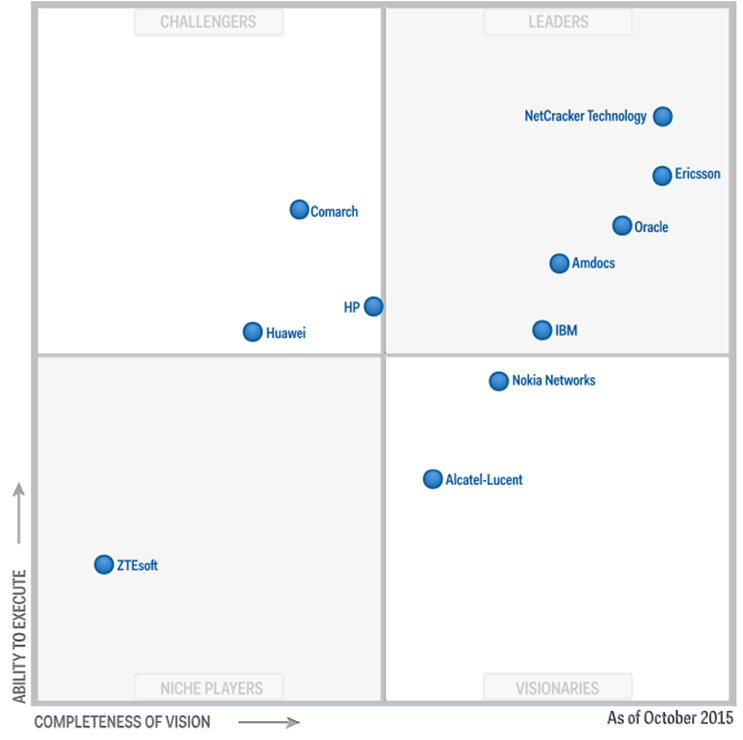
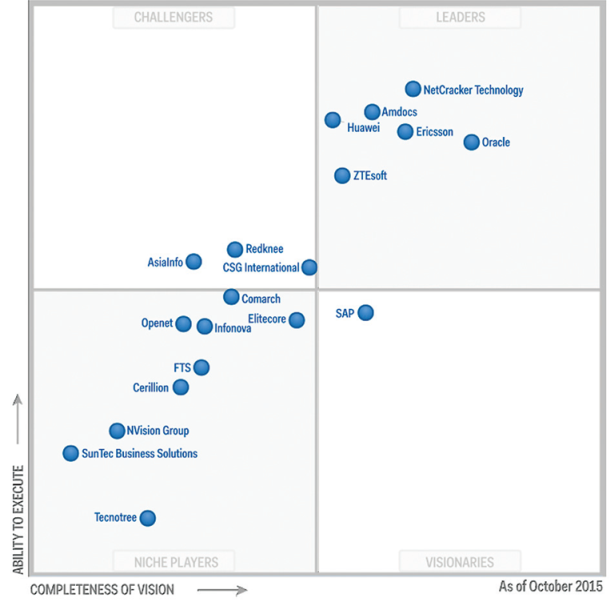
One of the strengths of Netcracker is that we carry out the comprehensive implementation of all our projects: from the development of the necessary functionality to commissioning, testing, consulting and technical support at all stages of working with the system. That is why we received extremely positive feedback from our customers, which is why in 2015 we became leaders in the ranking of two magic quadrants:
- “Operation Support Systems”, which include integrated solutions for accounting of resources, management of orders and catalogs, systems for the provision and activation of services to subscribers, and quality of service;
- “Integrated revenue and customer relationship management systems”, covering billing systems, payment and billing management, self-service and customer support systems, as well as analytics.
The full version of the reports can be found at the links above.