
 October 12, 2015 at 13:20
How a flood in Thailand in 2011 helped Amazon Web Services rethink its work and create a “cloud case”

There are quite a lot of clouds in Thailand, and this is not a figurative expression - it really rains here often, especially during the monsoon season. The most active nature manifested itself in 2011, when a massive flood occurred in Thailand, caused by incessant rain for a long time. In Thailand, as you know, there are many factories for the production of hard drives and other types of drives - and these factories, in the majority, were flooded in 2011. Then the prices for hard drives increased, the supply chains of hard drives to those who need them were violated.
Amazon’s cloud-based subsection was more affected by the elements than many other companies. So, Amazon Web Services data centers were left without the necessary equipment for some time, which led to some problems with AWS. Jerry Hunter, AWS Infrastructure Vice President, spoke about all this at a recent re: Invent event.

He also added that the flood in Thailand was a wake-up call. He and some other senior company managers arrived in Thailand in 2011 to solve supply problems. But they realized that there was nothing to be done, after they saw the problem factories - an example can be seen in the announcement photo. The company had to rethink the entire network of equipment supplies for its data centers. Amazon S3 cloud storage is one of the largest consumers of network equipment.
During the crisis of 2011, S3 stored about 750 billion objects (now this number significantly exceeds a trillion). Other cloud service providers also faced similar problems. Cloud service providers were also strongly affected by rising hard drive prices, asit took two whole years for prices to drop to the pre-crisis level.
Now, according to Hunter, Amazon controls almost the entire supply chain of network equipment.
Snowball: Big Data in the bag
At the same event, Amazon Web Services presented an interesting solution for high-speed data transfer, which can be considered, among other things, as a tool that solves the problem of client communication with AWS if the communication channel does not function normally for any reason. Snowball is a portable data warehouse with an available volume from 50 to 100 TB. This solution can be useful to the AWS client even if the communication channel is working normally, but slowly. According to AWS experts, if a client with a communication channel of 100 Mbps needs to transfer 100 TB of data to AWS DC, then the transfer will take 100 days. And the “cloud suitcase” allows you to transfer all this data much faster - it will take as long as the car or plane travels from the client to the AWS data center.
Here you can recall a saying like “Never underestimate the throughput of a truck filled with archive cassettes traveling on the highway.”
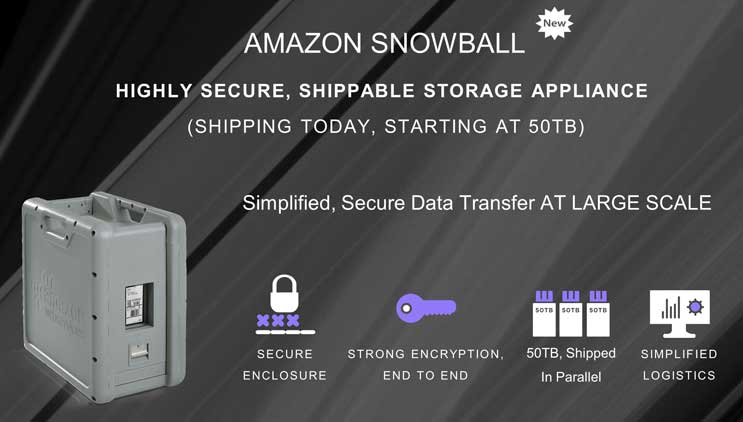
AWS delivers Snowball directly to the client, which connects the device to the local network using software tools to encrypt data stored on portable storage. Then, Snowball is sent to AWS and uploaded to the client server.
One of the first customers of this type of service was the BuzzFeed resource, which delivers news and videos to more than 200 million unique visitors per month. Now the company has about 250 TB of archival data, which is too much to store on regular disks, while transferring such a volume of data even over a high-speed channel will take too much time. And so, the transfer of archived data from BuzzFeed to the AWS data center took less than a week.