June 22, 2015 at 12:53
How DIY robots will change education by 2035
In the last post , we looked at the history of designers. Now let's take a look at the future. On Monday , a round table on robotics in the Russian education system was held at the Robostation . It was about all the ideas and plans for the Russian education system until 2035, representatives of technical universities gathered and talked about their plans for the future, do not consider offtopic, because it will be DIY kits and DIY robotics.
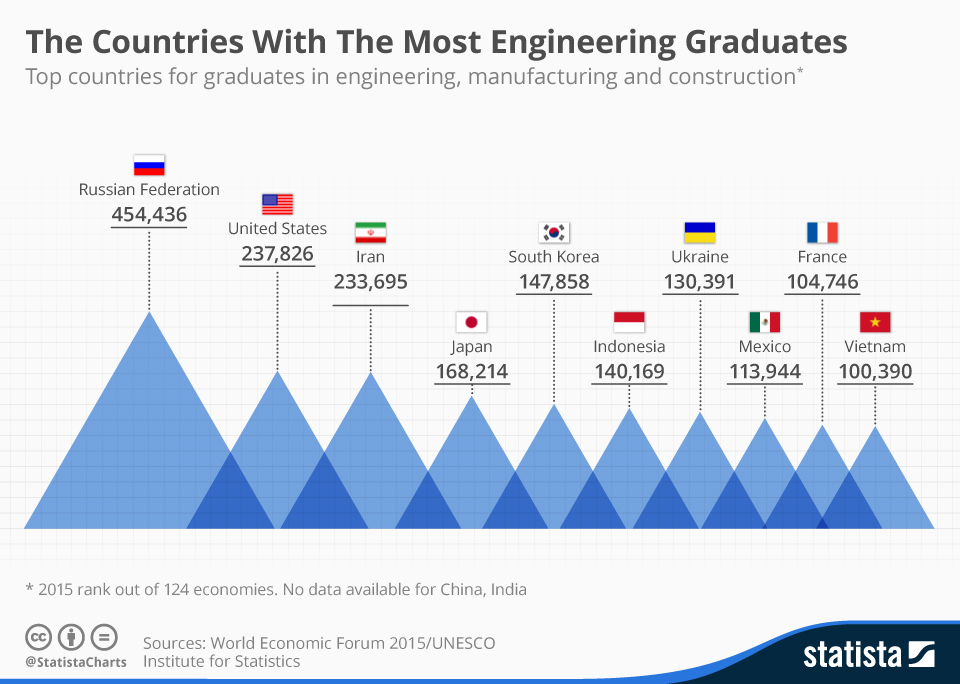
Russia graduates engineers more than anyone. At the same time, there are 18 million schoolchildren in Russia, 12 million of them go to circles and sections, and only 9,000 people are engaged in modeling (air, auto, hydro and robot). Only nine thousand!This is clearly not enough, moreover, such electives are not integrated into the educational process, but often contradict it. The result is something like this:

What is the Ministry of Education going to do? Approximately the following: Surprisingly, the plans assigned a prominent place for DIY robotics. ASI plans until 2020 to build four large children's technology parks dedicated to robotics (as before the pioneer palaces) and, in general, make this direction a mainstream. This is a pilot who is expected to work from the fall somewhere, from September, as soon as the vote in the State Duma passes. 4 regions: Khanty-Mansiysk Territory, Kaliningrad, Moscow Region and Ulyanovsk. Depending on the results of this large-scale experiment, the format of our entire education system after 2015 will be determined.
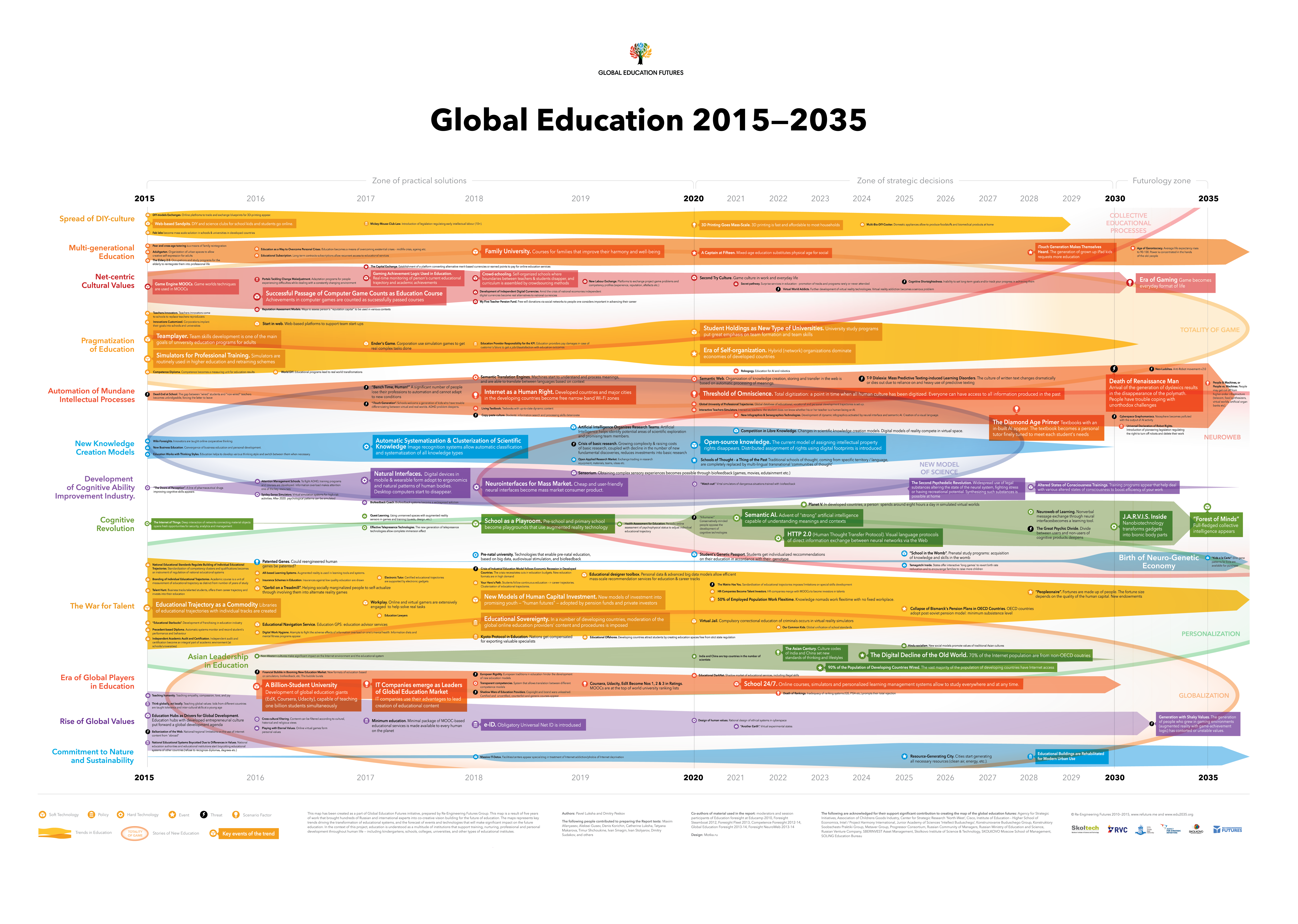
Olga Kairova gave a small educational program:
All this is simply perpendicular and often hostile to the classical school system. Why this happens is easy to answer, but for this you will have to make an excursion into history. The secondary education system is one of the oldest social systems. It was created by the Jesuits and practically has not undergone any changes since the publication of the "School Charter of the Society of Christ", and this, for a minute, is 1599!
Jesuits created everything to the smallest detail- came up with classes, lessons of 45 minutes, textbooks, ruled notebooks, grades, essays, expositions, quizzes, seminars and lectures and brought out the technology of “schooling” itself: endless repetition of abstract logical techniques and strict adherence to the rules. The teacher, like the students, was deprived of any kind of independence in work, each of his steps was regulated by the school charter. The goal of such a school is not so much to educate a person as to accustom him to monotonous mental work and make a unified element of the system suppressing creativity.

Doesn’t resemble anything?
This system almost did not undergo changes, except that in 1905, the Venetian teacher Roberto Nevelis decided to give additional homework instead of flogging negligent students. Why did the Jesuit system turn out to be so good that it has been working without much change for five (!) Hundreds of years? And it works well, efficiently.
The meaning of the school is not in study, but in schooling. Knowledge and technical thinking are not so important. It is important to interrupt the hormonal explosion during puberty and to train the brain to work in an enhanced mode. So that the tormenting teachers are not confused, it is advisable to tie schooling to any one discipline. In the gymnasiums of the 19th century, they went in cycles in dead languages, in schools of the mid-20th century - in mathematics. The more abstract and meaningless the better - this is like drill in the army. For example, in a Swiss panzergrinadera, a rookie runs around the stadium with a log on his shoulder, exactly until he stops asking himself why he is doing this. This is the idea of the school brought to the limit.
But this is the floor of the picture, because the schools were not on their own. They trained uniform personnel for Jesuit universities (and this is what all European universities are). As a result, everything was standardized and everyone understood each other perfectly, from such students and teachers it is already possible to build “production chains” at the university. And the Jesuit University is ... a medieval computer. A library is a hard drive, a processor sits in the directorate, and output systems sit in the audience. The essence of this “computer” is simple copying of information, in the form of copying by hand into a notebook, and copying of lectures which are often not even in print. For every manuscript, money falls into the pocket of a university, literally from the air - it is not surprising that the system has been working for so many years.
It is not difficult to see that all this machinery is designed for a society with a fatal deficit of information, a so-called hypoinformation society. And it is not at all designed for a modern hyper-information society.
Historically, the university and school were institutions where a certain amount of knowledge was transferred to a person. People were engaged under the supervision of specialists who facilitated the process of assimilation and processing of information. However, in modern society, these functions are no longer significant. Who needs university libraries or archives, if 99% of the information can be obtained via the Internet, and a hundred times more efficiently. Students also do not need housing and benefits. Why live inside a huge retro computer when a real computer fits in your pocket for a long time?

This is how education of the future was presented in 1900.
Therefore, the seminar was devoted to the question of how to integrate robotics education into this system without profaning it.
Andrey Ponomarev , expert at the Center for the Development of Youth Entrepreneurship at the University of Mechanical Engineering:
Yes, now even a seller in a store requires a diploma of higher education, but this does not mean the value of the diploma, but rather the opposite. In today's hyper-information society, the problem of obtaining knowledge is not a problem - everything is available in two clicks. But the students do not know what kind of knowledge they need.
Andrey Ponomarev , expert at the Center for the Development of Youth Entrepreneurship at the University of Mechanical Engineering:
The 21st century puts situations on its head - the Internet provides access to all the knowledge of mankind, which is why children often know more than their school teacher and are eager to put their knowledge into practice. Robotic education serves this purpose - these are electives that are built in contrast to the classical lessons with grades. What is its purpose? It turns out to put the question in the student’s head in such a way that he asked himself the question “Why,” so the initiative passes from the teacher to the student.

1933 year.
Nargiz Isaeva , expert:
This approach aims to change the core element of learning. Instead of copying and imitation, classes are built on creative tasks. Let the student use the Internet, look for material, process it. We do not have grades, diplomas and homework, instead of competing with other students for grades, everything is presented in a playful way.
Diana Strelets , Bation Robotics Center:
In addition, there is another important difference - if a classical diploma is issued to a student, then here you need to get a diploma. That is, you can’t just sit out a course of lectures, you need to collect or do something. It seems a trifle, but it turns the whole educational process.
Konstantin Ermishin , graduate student and teacher of robotics at MSTU. Bauman, Department of Robotics RK-10:
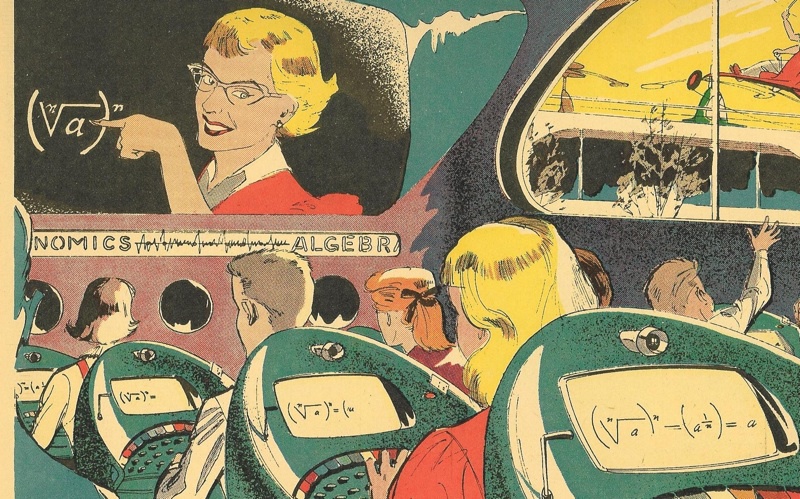
1958
It is this object-oriented approach that conflicts with the ideas of online education. But if you look closely, then the contradiction may be of help.
Mustafin Sergey , teacher of robotics:
Of course, it's great when everyone from home can get an education on their own. But he will not forget that education must be unified and standardized; otherwise, simply graduates of schools will not understand each other. Self-education has become more real than ever, but this leads to inevitable profanity when a student himself can “skip something unnecessary”, for example, learn physics, and miss chemistry - such a person cannot become a first-class engineer. That is why attention to reforms of the Ministry of Education is so important - now online courses and robotics centers have climbed like mushrooms after the rain, each has its own program and knowledge, which is also not integrated with the school curriculum. But the Ministry of Education and Science doesn’t just standardize all this economy - first you need to figure out and understand which system is effective.
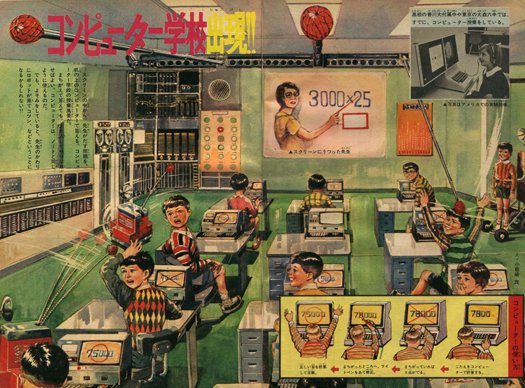
1970, the Japanese and in the future do not see an alternative to battered.
That is why the whole DIY community places high hopes on the ASI project with children's technology parks. In short, they will not be a turnkey solution, but a platform for various franchises. All DIY educational programs will be tested on them during the year and they will develop federal standards that will already go into the series. For example, financing for these centers will be built according to the scheme: 1 ruble from the federal center + 2 rulers from the federal district + 1 ruble from the business. Moreover, this is not the business that will teach children on the site, but the business that is interested in obtaining specific young specialists from the incubator, and it will finance the franchises, circles and programs that he needs.
Such a scheme may seem like improvisation, but you need to see the whole picture. Such a move with the palaces of pioneers is very rational to fall on the general vector of the development of education. I will not go into details, just one example - after the launch of the satellite in 1957, the United States became very scared and created three organizations, DARPA, NASA and NDEA. If the first two are familiar to all, then the third did not fall under the spotlights of advertising, and it is just the most important of them. National defense education actIn 1958, he copied the education system of the USSR - now school-university-factory became one structure and the production of rocket engines from school already noted capable students, led them to the right university and already assigned the graduate to future production upon admission. Only thanks to this reform, the Americans could, if not catch us in space, then reduce the backlog.
It is not difficult to see that now our education system wants to take another huge step in this direction - business will pay for the training systems it needs, the federal center will ensure standardization and monitor quality, and local authorities will do everything as necessary for their region - based on the conditions and needs.
Sounds great, but will it work? In a sense, the Robostation is a demonstration model of this system and shows the effectiveness of the idea.
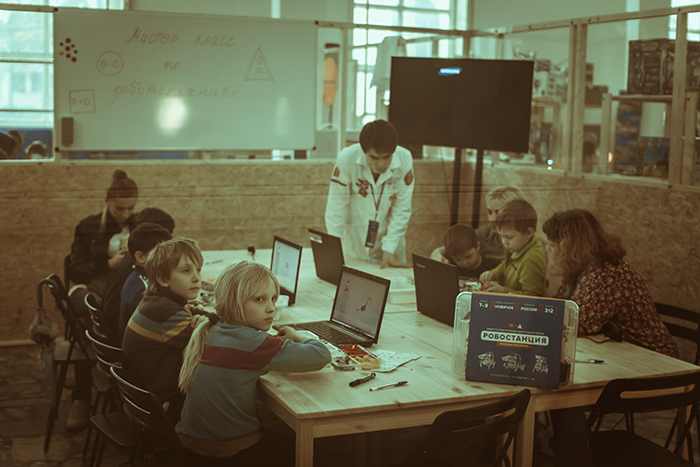
2015, the education of how it turned out really.
Igor Nikitin , founder of the Robostation:
So we invest. The guys opened the Robostation , the experts held a seminar, and I wrote this post - maybe he will encourage you to collect your robot or enroll in Roboshkola .

Russia graduates engineers more than anyone. At the same time, there are 18 million schoolchildren in Russia, 12 million of them go to circles and sections, and only 9,000 people are engaged in modeling (air, auto, hydro and robot). Only nine thousand!This is clearly not enough, moreover, such electives are not integrated into the educational process, but often contradict it. The result is something like this:
What is the Ministry of Education going to do? Approximately the following: Surprisingly, the plans assigned a prominent place for DIY robotics. ASI plans until 2020 to build four large children's technology parks dedicated to robotics (as before the pioneer palaces) and, in general, make this direction a mainstream. This is a pilot who is expected to work from the fall somewhere, from September, as soon as the vote in the State Duma passes. 4 regions: Khanty-Mansiysk Territory, Kaliningrad, Moscow Region and Ulyanovsk. Depending on the results of this large-scale experiment, the format of our entire education system after 2015 will be determined.
Olga Kairova gave a small educational program:
The first trend and the most important trend is the spread of “do you it your self” culture. Now 3D printing technology has arisen and, accordingly, everything that was previously done centrally will now gradually go away, now everything can be done in the garage.
The second is intergenerational, that is, different generations can study together and a format such as family universities will emerge. And, accordingly, education at work, it already exists, but it will be aggravated. Then, due to the fact that the Internet is spreading in us, the IT culture, it leaves its mark on the values that are now emerging in our society. And from IT there are many new technological formats. For example, online courses, they are already. Here on the edu2035 website You can look directly at the technology within each trend.
The third is the pragmatization of education. That is, teachers who broadcast and share knowledge will leave, and education will be tailored to the specific goals of the individual. And in this regard, simulators will appear there that allow you to achieve specific goals. If you want group work, say skill education, it will be distributed and it will be possible to compose your own educational profile from it. There will be automation of basic intellectual processes, now you can google anything on the Internet already. This is the automation of the search component, let’s say, in humans. This will be aggravated with the development of artificial intelligence, and even to the extent that the external environment itself begins to tell a person how to act in different situations.
Fourth, new models for creating knowledge. Nowadays, the wiki format and crowdsourcing are very widespread, now anyone can create knowledge. And big date technologies will allow them to be collected and analyzed, and researched. In general, new research will accumulate from open sources. There is an industry for the development of human cognitive abilities. That is, if earlier they were nootropics that were taken to improve memory, now this is achieved by hardware. And there will be techniques for working with the brain. And such simulators for the development of cognitive abilities. And in principle, in the absolute, it will go into the era of neuronet when the Internet is over and people begin to communicate from brain to brain. So, accordingly, a cognitive revolution is emerging on this trend.
The next trend is the struggle for talent. This is about individual educational trajectories, about the fact that a person will build his life on the basis of his abilities. Here, here, who watched the Gattak movie, all genetic experiments and alignments, let’s say, the pre-established inclinations in children, will also get here. And it turns out that genetics will allow you to initially form the prerequisites, and that neurotechnology will train the child in the right direction, depending on his goal. Or the goals of his parents. Over time, if now we are more likely to have such a variety of educational formats, and then here, by about 2017, a certain order will be formed and those who offer the most successful solutions will be singled out and global players will appear in online education.
From here we have formed about such an educational landscape in 3 horizons. In the short horizon, 3-5 years, there will be many educational formats online, a change will occur, that is, grades will leave and a system of recognition of achievements and passports of competence will appear, models for investing in talent will appear. In a longer horizon, we will have global online universities that will teach people billions. Mentor networks will appear, learning solutions without classical universities will appear, gamification will permeate everywhere. And things like neural interfaces and biometrics will allow you to collect objective feedback about your learning process. And in a very long horizon, everything will be built on the game, and artificial intelligence will prompt a person a decision on his life path. In the end, new types of pedagogy will appear,
And in the short horizon, teachers who simply carry knowledge will leave, standard tests will leave and be replaced by intellectual and educational trajectories. Accordingly, grades for semesters will go away. Diplomas, academic journals, and author's textbooks will go long. In very long, in principle, classical types of schools and universities will go away (by 2035).
All this is simply perpendicular and often hostile to the classical school system. Why this happens is easy to answer, but for this you will have to make an excursion into history. The secondary education system is one of the oldest social systems. It was created by the Jesuits and practically has not undergone any changes since the publication of the "School Charter of the Society of Christ", and this, for a minute, is 1599!
Jesuits created everything to the smallest detail- came up with classes, lessons of 45 minutes, textbooks, ruled notebooks, grades, essays, expositions, quizzes, seminars and lectures and brought out the technology of “schooling” itself: endless repetition of abstract logical techniques and strict adherence to the rules. The teacher, like the students, was deprived of any kind of independence in work, each of his steps was regulated by the school charter. The goal of such a school is not so much to educate a person as to accustom him to monotonous mental work and make a unified element of the system suppressing creativity.
Doesn’t resemble anything?
This system almost did not undergo changes, except that in 1905, the Venetian teacher Roberto Nevelis decided to give additional homework instead of flogging negligent students. Why did the Jesuit system turn out to be so good that it has been working without much change for five (!) Hundreds of years? And it works well, efficiently.
The meaning of the school is not in study, but in schooling. Knowledge and technical thinking are not so important. It is important to interrupt the hormonal explosion during puberty and to train the brain to work in an enhanced mode. So that the tormenting teachers are not confused, it is advisable to tie schooling to any one discipline. In the gymnasiums of the 19th century, they went in cycles in dead languages, in schools of the mid-20th century - in mathematics. The more abstract and meaningless the better - this is like drill in the army. For example, in a Swiss panzergrinadera, a rookie runs around the stadium with a log on his shoulder, exactly until he stops asking himself why he is doing this. This is the idea of the school brought to the limit.
But this is the floor of the picture, because the schools were not on their own. They trained uniform personnel for Jesuit universities (and this is what all European universities are). As a result, everything was standardized and everyone understood each other perfectly, from such students and teachers it is already possible to build “production chains” at the university. And the Jesuit University is ... a medieval computer. A library is a hard drive, a processor sits in the directorate, and output systems sit in the audience. The essence of this “computer” is simple copying of information, in the form of copying by hand into a notebook, and copying of lectures which are often not even in print. For every manuscript, money falls into the pocket of a university, literally from the air - it is not surprising that the system has been working for so many years.
It is not difficult to see that all this machinery is designed for a society with a fatal deficit of information, a so-called hypoinformation society. And it is not at all designed for a modern hyper-information society.
Historically, the university and school were institutions where a certain amount of knowledge was transferred to a person. People were engaged under the supervision of specialists who facilitated the process of assimilation and processing of information. However, in modern society, these functions are no longer significant. Who needs university libraries or archives, if 99% of the information can be obtained via the Internet, and a hundred times more efficiently. Students also do not need housing and benefits. Why live inside a huge retro computer when a real computer fits in your pocket for a long time?
This is how education of the future was presented in 1900.
Therefore, the seminar was devoted to the question of how to integrate robotics education into this system without profaning it.
Andrey Ponomarev , expert at the Center for the Development of Youth Entrepreneurship at the University of Mechanical Engineering:
Having plunged into a practice-oriented education in the fall, we discovered such an interesting thing. It was understood that students, having united in groups of 3-5 people each, would begin work with projects, with pieces of iron. And it turned out that they have nowhere to get a job at a technical university with glands. All laboratories are somewhere under the departments, somehow covered, somehow closed. And now the last 1.5-2 years, students began to annoy closed classrooms, laboratories. That is, when they cannot come, sit down and make noise in the reading room. They even got a project called “Anti-library”, which was successfully replaced by coworking for them. But, nevertheless, they all the same cannot knock, make noise, hum, drill. This turned out to be not a ready-made technical education.
This year we are completely immersed, and we now have the opportunity to free a whole platform for this practice-oriented education, they will work with the glands anyway. It was there (in the diagram above) that it was beautifully written that he would leave, but I’ll so rudely say the teacher. The teacher will not leave, and will not leave soon. And we will see how ours is, it’s been written there for 20 years, just today’s students will have their children, they will bring them to you and say: “Work out, I don’t want him to work through the Internet.” Because it’s impossible for a child of 5-10 years old to choose a course on the Internet himself. This will have to be done by parents. Parents have limited time, either you earn money, or you orient the child somewhere on the Internet.
But when I was offered to buy a robot designer for a child from about 25 thousand rubles, in collaboration with neighboring dads, we decided that the garage and the old “penny” for 20 thousand rubles would fill up all their technical knowledge, assemble and disassemble. And it will be cheaper than robotic under the supervision of an adult, under the supervision of control. That thing that they are even more interested in than a robot. Because they do not represent how the crank mechanism works.
Here is this work with pieces of iron, they are more attracted to dirt than to go somewhere in the circle for 1.5-2 hours. Or here's another example. When you come, they give you, well, we have our children, if dad comes with one child they slip him, 3-5 more, and they disassemble the VCR. They disassemble it under the comments of an instructor who runs, serves several tables. Children can’t imagine what a video recorder is, they don’t know how a computer works, a laptop is a mystery to them, and up to 15 it’s just fantastic.
What am I driving this to? Here a colleague correctly said that we are now striving to unite several universities, students of different universities in teams. We hardly do this inside the university, we practically kick these teams. Designers understand that this team needs a designer, where girls make a self-moving suitcase, a robot engineer understands that robotics are needed there, but at the same time we combine them with practically kicks. The result, that’s whom we forcibly drove and forced this business to form, the result, oddly enough, in the estimates impresses them the most and they remain to work with teams with some changes. The rating will not go anywhere, the rating will still remain. 5 points it will be or 100 points, as it is now customary for us to differentiate according to a 100-point system. They all the same for every point, they come and say: “Here I have 75 points, but for him, he worked with me on the team, he has 77 points.” These 2 points against 100, these 2% mean nothing. And so, by chance, somewhere he put an extra tick on him, somewhere he went to an extra event, but they are fighting for him.
But the worst is not even that. That's when it was written that diplomas would leave. Carry out an experiment, go to any employer and say that you are without a diploma. And he just won’t understand you. Just do not understand. You come to the clinic - they require a card from you. We come to the employer to arrange for students to practice, he says: “Excellent, everything, good. Let’s practice it, and in a year he’ll come to me, and I’ll send him ... this is an engineer, to courses in order to learn how to operate CNC machines. We bought a lot of machines. ” We tell him: “Here is a technical school. Here they do it, cook it for your machine "-" No, I don’t need a technical school. I need with higher education. "
Today, stores are recruiting sellers with higher education, not lower. And here we are trying to give them some ... They know very well, people who want to be sellers, they know very well what is required of them. Crust. Crust. And that's all, nothing else is needed. There are these ...
Yes, now even a seller in a store requires a diploma of higher education, but this does not mean the value of the diploma, but rather the opposite. In today's hyper-information society, the problem of obtaining knowledge is not a problem - everything is available in two clicks. But the students do not know what kind of knowledge they need.
Andrey Ponomarev , expert at the Center for the Development of Youth Entrepreneurship at the University of Mechanical Engineering:
When we offer the children a 3D printer at their complete disposal and ask what they want to print, do you know that they all answered one and all? Anything! Only after lengthy interrogations can one pull out a phone case from them. But then we say a simple thing: why print a cover for $ 10 that will hide the phone’s body, the design of which has been spent millions? Only then does the child begin to think and we already tell him what and how to print, after which they can already come up with something. This is a very big progress for just a 45 minute lesson - here is more abstract thinking and systematization and solving creative problems.
The 21st century puts situations on its head - the Internet provides access to all the knowledge of mankind, which is why children often know more than their school teacher and are eager to put their knowledge into practice. Robotic education serves this purpose - these are electives that are built in contrast to the classical lessons with grades. What is its purpose? It turns out to put the question in the student’s head in such a way that he asked himself the question “Why,” so the initiative passes from the teacher to the student.
1933 year.
Nargiz Isaeva , expert:
In my opinion, the most important thing is to answer the question “Why?”. It is also necessary for teachers to answer this question, and so that the children understand why they need it? Why do they come to the robotics laboratory, why is this needed? What is wonderful is that you said that the role of the teacher, it is still changing in this system. This is no longer the person who stands behind the department and puts in any knowledge that no one understands why these children need them. And children can never take advantage of this. There is an abundance of knowledge, knowledge has depreciated, knowledge can be obtained not only from the teacher. They are teeming with the Internet, and the further, the more. And only when the child answers his question why he needs it, only then, and if there is an adult who will orient him and say: “You know, you’ve conceived such an interesting thing, let me show you where you can find knowledge, where you can get the knowledge with which you will realize your idea. " That's exactly the way the role of the teacher is changing.
This approach aims to change the core element of learning. Instead of copying and imitation, classes are built on creative tasks. Let the student use the Internet, look for material, process it. We do not have grades, diplomas and homework, instead of competing with other students for grades, everything is presented in a playful way.
Diana Strelets , Bation Robotics Center:
Olga said in her report that in the near future, academic journals will disappear and the classical education system will be replaced by some other. We are also moving away from the regular journal of academic performance and from the classical grading system. We each child has his own profile in online, and for the academic year he develops a rating for himself, as in the game. He passes the tests in the lesson, he participates in the educational process, performs some tasks. And for successfully passing the tests, for participating in the educational process, he receives a certain amount of points. He goes through some levels, receives some titles, some funny titles, which, in general, inspire, motivate. Get some points, points. Then these points can change to some material buns, some devices he can take home for himself. Well, generally this further motivates the child, besides the end in itself, that he comes to study robotics. Well, this aspect of the competition is added, the aspect of the game.
In addition, there is another important difference - if a classical diploma is issued to a student, then here you need to get a diploma. That is, you can’t just sit out a course of lectures, you need to collect or do something. It seems a trifle, but it turns the whole educational process.
Konstantin Ermishin , graduate student and teacher of robotics at MSTU. Bauman, Department of Robotics RK-10:
I would like to share our experience, the experience of MSTU. Bauman for working with students, well, probably from 8 to 11 grade. We have a partner organization, Detsky Krai, this is a physical and mathematical forum in Yakutia, where for probably the last 3 years we have been conducting weekly and 2-week visiting workshops 2 times a year according to a specially designed for them the program. In short, this is an educational process that is as close as possible to what a university teacher does with an applicant when he enters MSTU. Bauman, under the program "Step into the future." The Step into the Future program is a competition of technical projects. Already today, a colleague from MAMI mentioned technical Olympiads, which are gradually equated in status with Olympiads in physics, mathematics, and which subsequently give additional points to the USE, or some bonuses when entering a university. The Step into the Future program is about the same. Those. This is a competition of technical projects, this is a project. A project that is as close as possible to a graduation project of a university graduate, but carried out by students on a primitive basis. Those. these are all stages of designing from setting the definition of the problem and setting the problem, developing a conceptual design up to the implementation of the prototype, but on an accessible element base. These are designers, this is arduino electronics, anything printed on a 3D printer, etc. Here, in principle, for the past, well, 2 years I have been taking part in this, before me a couple of years my colleagues were engaged in this matter. We are implementing such a program with students, including which of them will subsequently come to our faculty of robotics. The Step into the Future program is about the same. Those. This is a competition of technical projects, this is a project. A project that is as close as possible to a graduation project of a university graduate, but carried out by students on a primitive basis. Those. these are all stages of designing from setting the definition of the problem and setting the problem, developing a conceptual design up to the implementation of the prototype, but on an accessible element base. These are designers, this is arduino electronics, anything printed on a 3D printer, etc. Here, in principle, for the past, well, 2 years I have been taking part in this, before me a couple of years my colleagues were engaged in this matter. We are implementing such a program with students, including which of them will subsequently come to our faculty of robotics. The Step into the Future program is about the same. Those. This is a competition of technical projects, this is a project. A project that is as close as possible to a graduation project of a university graduate, but carried out by students on a primitive basis. Those. these are all stages of designing from setting the definition of the problem and setting the problem, developing a conceptual design up to the implementation of the prototype, but on an accessible element base. These are designers, this is arduino electronics, anything printed on a 3D printer, etc. Here, in principle, for the past, well, 2 years I have been taking part in this, before me a couple of years my colleagues were engaged in this matter. We are implementing such a program with students, including which of them will subsequently come to our faculty of robotics. A project that is as close as possible to a graduation project of a university graduate, but carried out by students on a primitive basis. Those. these are all stages of designing from setting the definition of the problem and setting the problem, developing a conceptual design up to the implementation of the prototype, but on an accessible element base. These are designers, this is arduino electronics, anything printed on a 3D printer, etc. Here, in principle, for the past, well, 2 years I have been taking part in this, before me a couple of years my colleagues were engaged in this matter. We are implementing such a program with students, including which of them will subsequently come to our faculty of robotics. A project that is as close as possible to a graduation project of a university graduate, but carried out by students on a primitive basis. Those. these are all stages of designing from setting the definition of the problem and setting the problem, developing a conceptual design up to the implementation of the prototype, but on an accessible element base. These are designers, this is arduino electronics, anything printed on a 3D printer, etc. Here, in principle, for the past, well, 2 years I have been taking part in this, before me a couple of years my colleagues were engaged in this matter. We are implementing such a program with students, including which of them will subsequently come to our faculty of robotics. these are all stages of designing from setting the definition of the problem and setting the problem, developing a conceptual design up to the implementation of the prototype, but on an accessible element base. These are designers, this is arduino electronics, anything printed on a 3D printer, etc. Here, in principle, for the past, well, 2 years I have been taking part in this, before me a couple of years my colleagues were engaged in this matter. We are implementing such a program with students, including which of them will subsequently come to our faculty of robotics. these are all stages of designing from setting the definition of the problem and setting the problem, developing a conceptual design up to the implementation of the prototype, but on an accessible element base. These are designers, this is arduino electronics, anything printed on a 3D printer, etc. Here, in principle, for the past, well, 2 years I have been taking part in this, before me a couple of years my colleagues were engaged in this matter. We are implementing such a program with students, including which of them will subsequently come to our faculty of robotics.
1958
It is this object-oriented approach that conflicts with the ideas of online education. But if you look closely, then the contradiction may be of help.
Mustafin Sergey , teacher of robotics:
I would like to say a couple of reasons against online education in robotics. In general, in principle, all engineering specialties, they are somehow craft, i.e. the result of an engineer’s activity is the introduction of his developments in any industrial process, technological, industrial, etc. And the main component in the process of introducing any results of engineering activity is the commissioning process, which requires some experience, competence from specialists, work with physical equipment, with iron equipment. Those. it is impossible at the stage of any remote design, remote design to take into account all the nuances associated with the development of a project, and of the subsequent nuances of its implementation and operation. There is such an old Soviet saying, that electrical engineering is the science of contacts, i.e. it is impossible to study electronics, the design process of all disciplines related to remote instrumentation. Remotely there can be lecture material taught, remotely there can be some courses. But without the physical participation of a student, a student in the design process, in the process of soldering, commissioning, commissioning of this device, equipment, it is impossible to achieve any results.
On the other hand, everyone knows that in the world of robotics there are quite a lot of expensive professional equipment. And often it is not available to individual developers, students, even often, departments in universities. So, including in our department of robotics, a number of projects require equipment for successful implementation, such as, for example, one laser scanning rangefinder costs about half a million rubles. And to develop an autonomous robot, it is necessary. In this regard, we have established the process of remote work of students with a robot model, it is both a virtual robot model and a semi-full-scale robot model, when a physical robot is in the training laboratory, it is one, it is available for all students, it is equipped with the necessary amount of equipment, Remote access for students to the robot. They respectively
Of course, it's great when everyone from home can get an education on their own. But he will not forget that education must be unified and standardized; otherwise, simply graduates of schools will not understand each other. Self-education has become more real than ever, but this leads to inevitable profanity when a student himself can “skip something unnecessary”, for example, learn physics, and miss chemistry - such a person cannot become a first-class engineer. That is why attention to reforms of the Ministry of Education is so important - now online courses and robotics centers have climbed like mushrooms after the rain, each has its own program and knowledge, which is also not integrated with the school curriculum. But the Ministry of Education and Science doesn’t just standardize all this economy - first you need to figure out and understand which system is effective.
1970, the Japanese and in the future do not see an alternative to battered.
That is why the whole DIY community places high hopes on the ASI project with children's technology parks. In short, they will not be a turnkey solution, but a platform for various franchises. All DIY educational programs will be tested on them during the year and they will develop federal standards that will already go into the series. For example, financing for these centers will be built according to the scheme: 1 ruble from the federal center + 2 rulers from the federal district + 1 ruble from the business. Moreover, this is not the business that will teach children on the site, but the business that is interested in obtaining specific young specialists from the incubator, and it will finance the franchises, circles and programs that he needs.
Such a scheme may seem like improvisation, but you need to see the whole picture. Such a move with the palaces of pioneers is very rational to fall on the general vector of the development of education. I will not go into details, just one example - after the launch of the satellite in 1957, the United States became very scared and created three organizations, DARPA, NASA and NDEA. If the first two are familiar to all, then the third did not fall under the spotlights of advertising, and it is just the most important of them. National defense education actIn 1958, he copied the education system of the USSR - now school-university-factory became one structure and the production of rocket engines from school already noted capable students, led them to the right university and already assigned the graduate to future production upon admission. Only thanks to this reform, the Americans could, if not catch us in space, then reduce the backlog.
It is not difficult to see that now our education system wants to take another huge step in this direction - business will pay for the training systems it needs, the federal center will ensure standardization and monitor quality, and local authorities will do everything as necessary for their region - based on the conditions and needs.
Sounds great, but will it work? In a sense, the Robostation is a demonstration model of this system and shows the effectiveness of the idea.
2015, the education of how it turned out really.
Igor Nikitin , founder of the Robostation:
As you know, robotics is a very important and simply incredibly science-intensive industry. This is a great direction, and it is almost impossible to do something here alone. Only by joining collective efforts can any serious results be achieved. And our exhibitions, our events, this school would never have happened if the partners who conduct educational seminars, in addition to our teachers. If the partners, including those providing educational designers and other materials here, the Department of the Science of Entrepreneurship Industry, the CSC or personally vice-mayor Natalya Sergunina, would not give us the opportunity to rent, use equipment on which here, including Last week, the first Ecological Robots project was already created. 4 projects showed robots that can move independently, build a route, make decisions and measure the environmental situation. It was an absolutely school project that the students themselves did. In fact, children, as they grow up, I only read about books in robots. That is, imagine how much smarter they are now and informing us! And what other educational project can give them all this? Only robotic designers!
Therefore, we have a big goal to move the educational system so that as many robotics lessons as possible appear in our schools, as many robotics Olympiads as possible, as many events related to educational robotics as possible. And they were always in sight, by ear. And as many guys as possible, young engineers became robotics. This is the mission of our company, a non-profit mission - the revival of the engineering elite. And to do this, to achieve this great task and goal can only be done together, when everyone's contribution is important.
So we invest. The guys opened the Robostation , the experts held a seminar, and I wrote this post - maybe he will encourage you to collect your robot or enroll in Roboshkola .