Recovery PC "Mikrosha"
In my last article on assembly-mounted PC Specialist Express , I mentioned that I also have a Mikrosh PC (a clone of the famous Radio-86RK), which is waiting in the wings. So this time has come. Today I plan to launch it.

What interesting can be said about this machine? Mikrosha, this is one of the first household Soviet PCs. Its production was established at the Lianozovsky Electromechanical Plant. It was produced since 1987 (I was only 4 years old then, and before the first PC-01 Spectrum appeared at home, another 2 years remained.
His brain was the well-known K580VM80 processor, operating at a frequency of 1.78 MHz.
The computer had as much as 32 kilobytes of RAM. Of the software in it, there was only a Monitor, occupying 2 kilobytes, located in the K573RF2 ROM, and allowing you to perform primitive but sufficient for work actions, such as viewing memory, reading characters from the keyboard, writing to memory cells, and reading and writing to tape , which was the main place to store programs for Mikrosha.
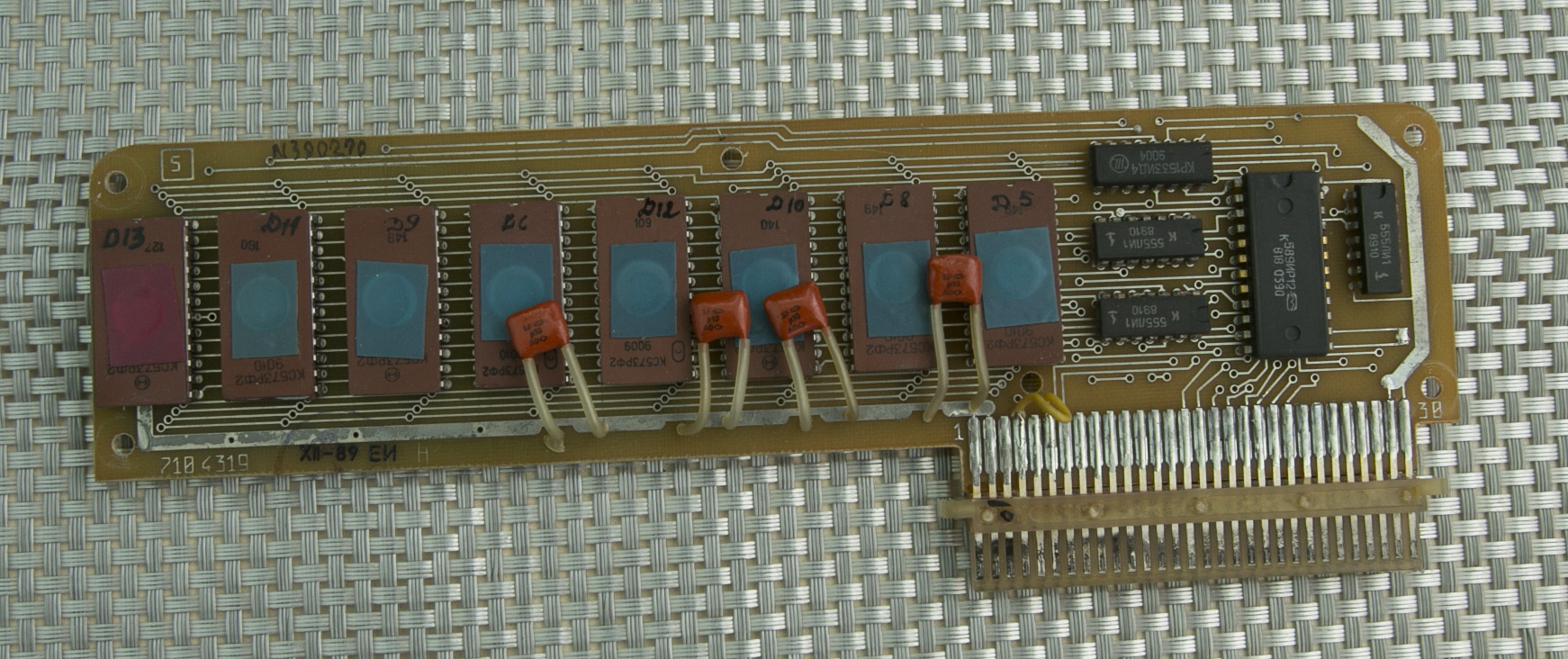
In addition to the magnetic tape, the user could purchase an external ROM of 16 kilobytes (assembled on 8 K573RF2 microcircuits), containing 4 programs - the BASIC language interpreter, Text Editor, Assembler and Assembler loader. This external ROM was supplied in the form of a cartridge, and was inserted into the upper part of the computer case. To boot from the ROM, it was enough to enter the G8000 Monitor command and press the VK key.
Another feature of the computer, as well as the difference from Radio-86RK, was the presence of a built-in timer K580VI53, which was mainly used to generate sound.
In addition, Mikrosh differs from Radio-86RK in that its devices have different addresses, and the character generator is made on the K537RF2 ROM and has twice as much volume, which made it possible to place the Cyrillic alphabet and some pseudographic symbols in it. The format of input / output to magnetic tape has also changed. Well, thanks to these changes, the source code of the Monitor has changed. In this regard, not all programs for Radio 86RK could be launched on the Mikrosh without alterations.
For Mikrosha herself, no less programs were written. Among the system programs can be noted the assembler, disassembler, text editor, graphics program, music editor, RAM monitor and others. Many game programs have also been written, listing which there is not enough time and place.
In general, the machine for the second half of the 80s, it turned out quite decent. However, it cost about 500 rubles.
I got Mikrosh with tail number 006837, assembled in October 1988, performed by 1A, apparently one of the first options, since it contains a large number of corrections in the circuit (more on this later).
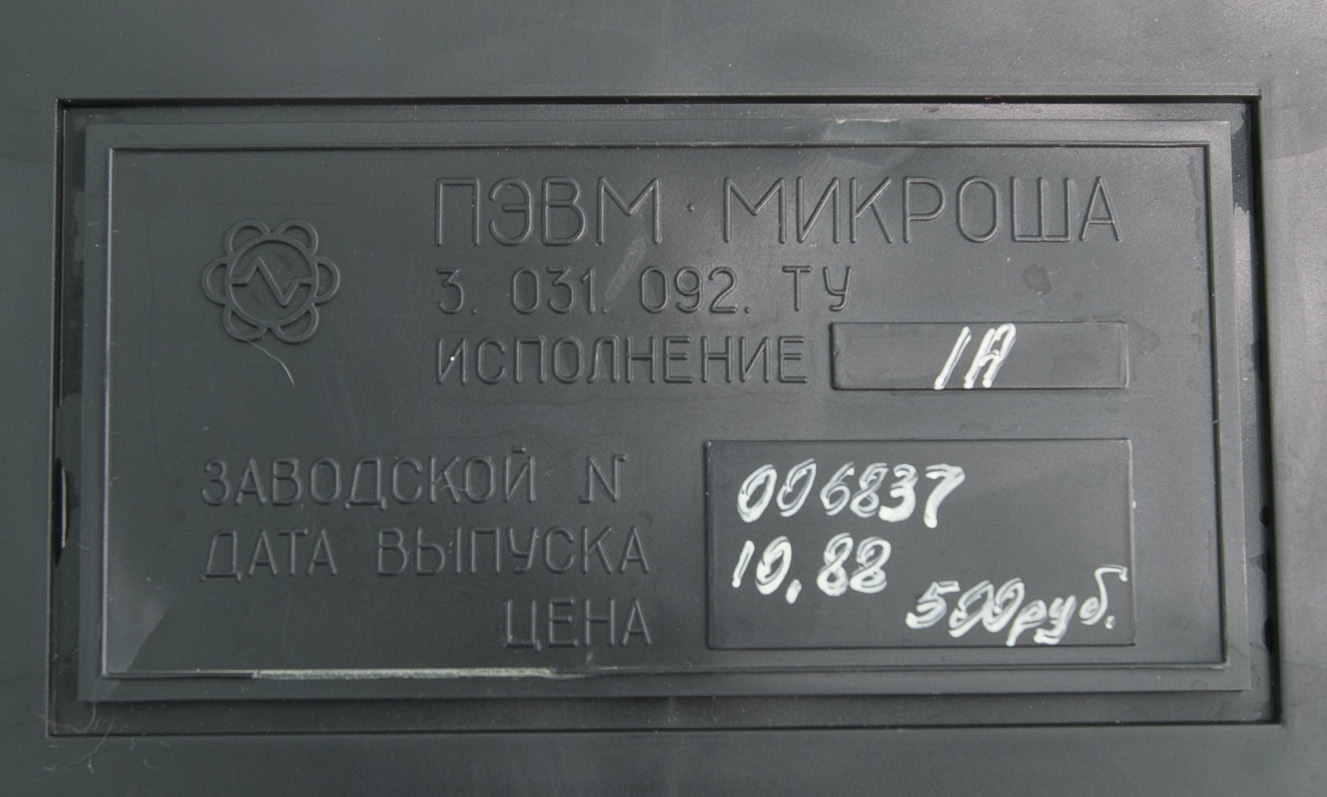
Kulchev Igor gave it to me, for which many thanks to him. Igor at one time actively used it, but now the computer was lying idle in the pantry. The owner treated him carefully, so the capacitors in him were not bitten out, and the whole board was generally in good condition. An external ROM with tail number 000786, collected in February 1991, a lot of documentation, and about a dozen cassettes with programs and games in machine codes, and in BASIC came with a computer. Mikrosh came to me in 2012. Then I turned it on, it did not work, and since then it was already on my shelf, although at times my hands itched to carry out resuscitation work.
So patient. Having seen his own, and from this a little grimy Mikrosh.
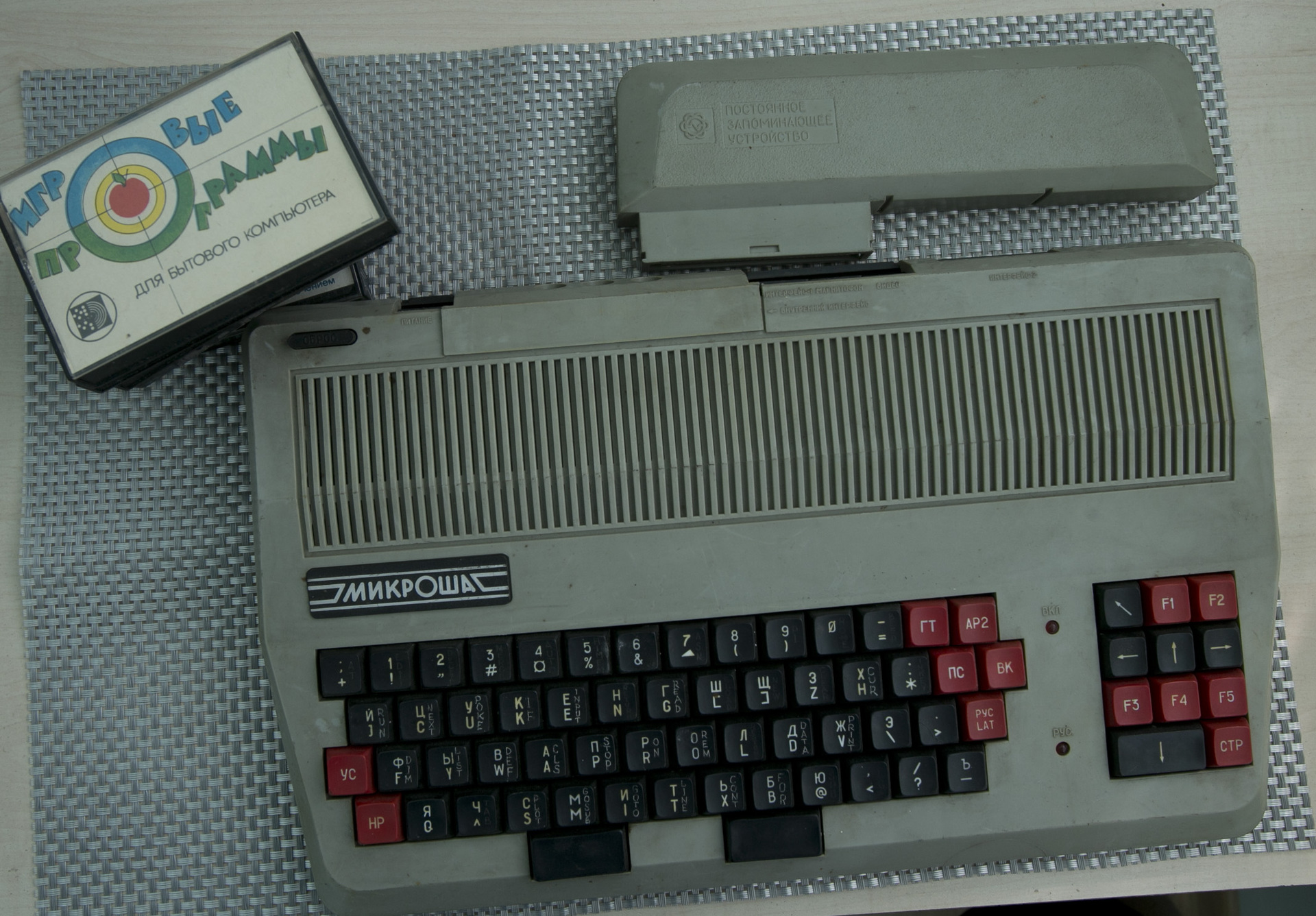
The owner was probably a Basic Analyst, and the keys left prompts with the teams.
It’s more pleasant to work with clean and tidy iron, so the first thing I did was to launder it, clean all the connectors and keys. The plastic was washed with the simplest sponge with fairies, then it was dried on the balcony under the spring Sun.

While the case is dry, I took up iron. Power supply, transformer, without any features, issuing honest + 5V, + 12V and -6V. Apparently, the age affected, and some of the capacitors dried up, so the oscilloscope showed a little noise at the outputs, but since there were additional smoothing capacitors on the board, I thought it was not fatal.
The power supply is washed and checked.

Next, I inspect the board. The hinged K155LA3 catches the eye, somehow cunningly connected to the image forming circuits, apparently for inversion, until I turn it off.

In the middle part of the board are several hand-soldered conductors filled with glue. Apparently there was a factory marriage on the board and had to get out on the spot. Moreover, it seems that the board was shirked with something sharp, a high-quality and deep cut was obtained, which is visible even to the left of the BB55, but there were no damage to the conductors. Otherwise, everything is as it should be - oxidized places on the board, dry, from time to time, soldering. 30 minutes of working with a soldering iron, and the upper part of the board in a suitable form.
We pass to the bottom. Things are good here, too, but a lot of wires are hung among the cut contacts, apparently this is a feature of the 1A assembly. Most likely, the board was put into production without waiting for tests, and it was brought later, at the debugging stage, by the forces of factory craftsmen, under the original Russian abuse, since corrections were required in abundance.
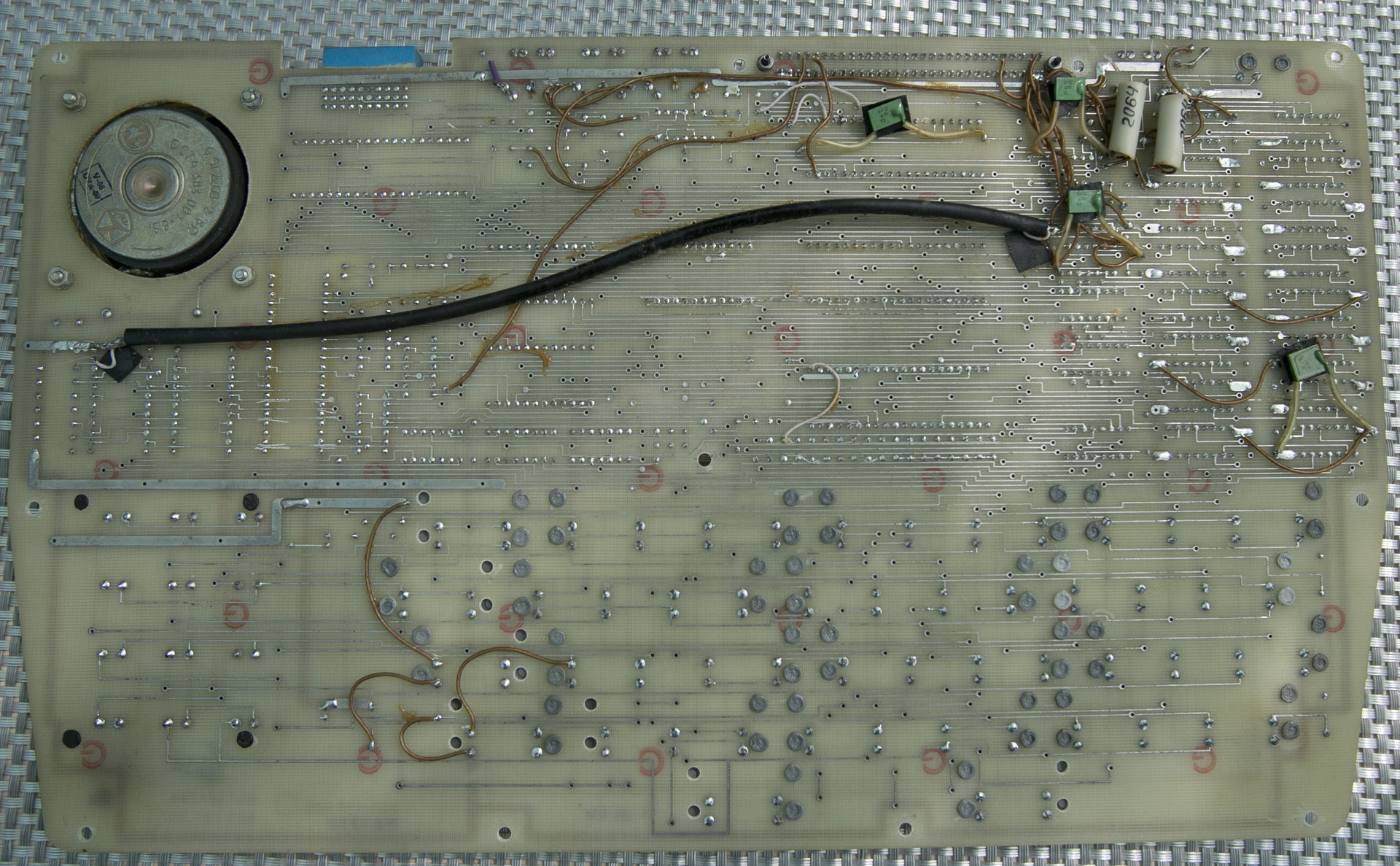
Here I had to solder mainly the keyboard buttons, where the legs simply lagged behind the solder from old age. Half an hour working with a soldering iron, and the computer is ready for the first start.
An exciting moment. Clicking the power switch toggle on and off. Smoke did not blow, traffic jams in the apartment did not rise, it’s already good. We turn it on, there is no image, but the On light is on.
I went through the power supply circuits, all the voltages are normal, although instead of -5V there goes -6.3V.
The most logical way to start debugging is from the master oscillator. In Mikrosh, it is assembled on a K580GF24 chip. At the output of F1, there were pulses with a frequency of about 20 kHz, there was nothing on F2, which is clearly not the norm. Since only a quartz resonator is needed for its operation, and it is unlikely to have died, I bite out the microcircuit, solder off the legs, clean the metallized holes with a toothpick and solder a new K580GF24. The phase generator is working.
I checked the presence of frame and line pulses on the K580VG75 with an oscilloscope, they are there, which means that most likely the processor, ROM, RAM and small-chip microcircuits are working, and there should be some kind of image.
The image really was, and really “some kind”.

He went through the video signal generation scheme, decided to throw out the strange K155LA3, then after spending another 30 minutes on the ringing and soldering of the conductors, he managed to get a joyful exclamation from the speaker and the necessary greeting. The corpse of Mikrosh came to life.
However, he was still in a fever. Shortly after the reset (5-10 seconds), garbage appeared on the screen and the computer did not respond to external influences. The soldering of the conductors yielded nothing more, so I returned to the power supply, with its garbage at the exit. I did not have the original capacitors, so I dropped out 3 capacitors per 1000 microfarads and one at 470 microfarads from the old Gigabyte motherboard. Two of them were soldered on the RAM power bus, one near the ROM of the character generator and the imaging unit, and the fourth near the I / O port. Just in case, I soldered to the new two electrolytes remaining on the circuit board at 10 microfarads.

After that, the computer worked as it should. After a 15-minute run, he did not go into reboot. So food was really to blame.
It was not possible to start from an external ROM right away. But after cleansing the contacts (I borrowed nail polish remover from my wife, and then sherkanul to a shine with a pile of GOI paste).
ROM started immediately. View before cleaning the
ROM in work
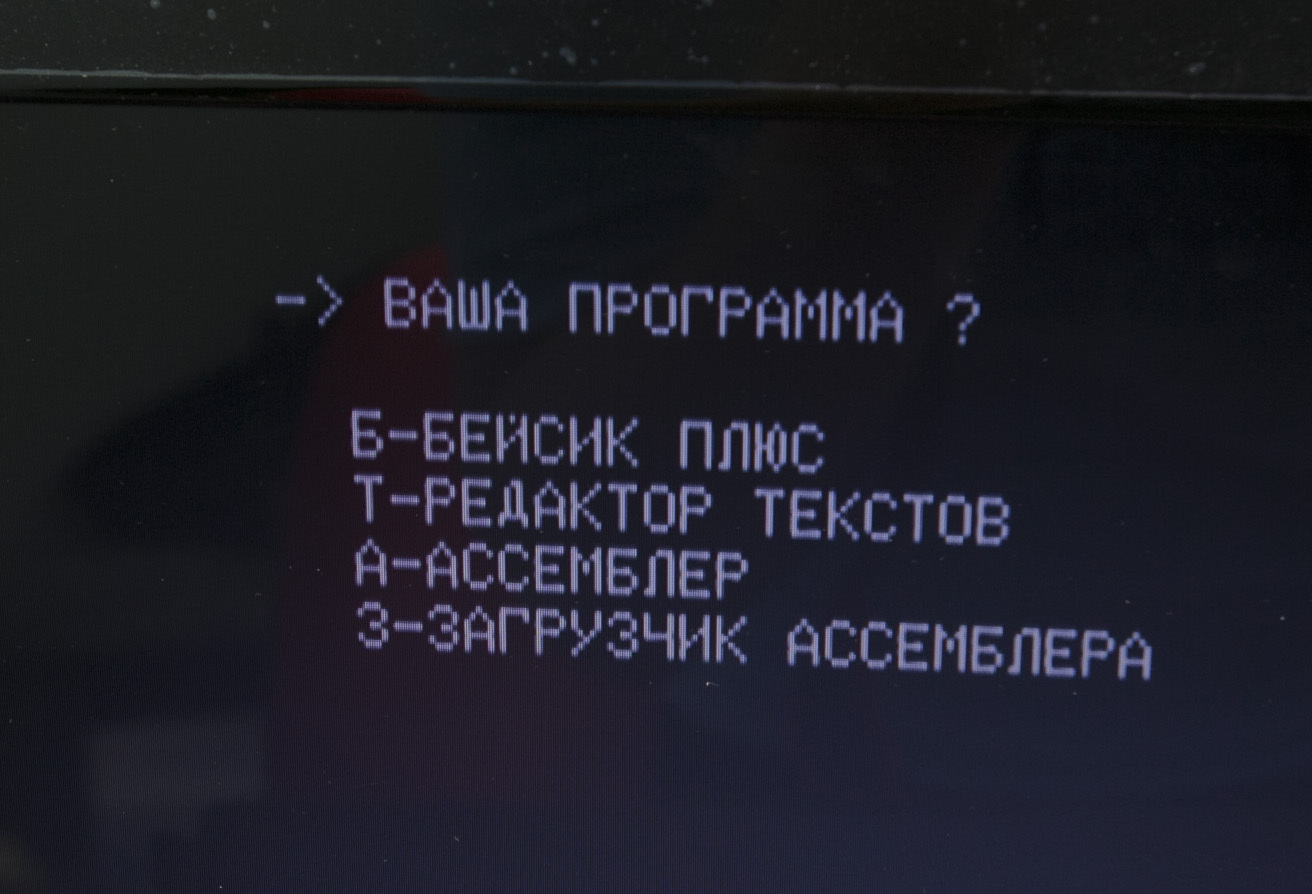
Having pampered with the built-in BASIC (ala 10 PRINT “HELLO MICROSHA”), I soldered the tape recorder in a hurry. And with the help of the utility WRKWIN32.EXE and a laptop, Tetris was loaded into it.
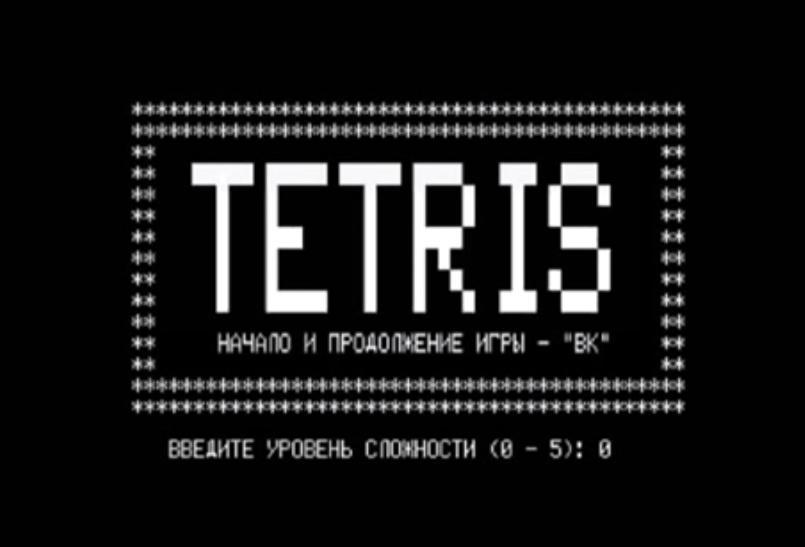
Having played a little, he assembled it in his native case, screwed the screws and put it on the upper, museum shelf, to his relatives from the last century: ZX-Spectrum, PK-01 Lviv, Specialist Express and Vector-06Ц.
The appearance of the computer:
There are still cassettes with programs, but I do not have a tape recorder. Maybe later I will digitize and lay out for general use.
What applications can these computers come up with? Probably in the near future, when I finish collecting Orion-128 and Apple-1, I will arrange a chess tournament between them.
Keep, protect, and restore old computers, there is something magical about it. Good luck!
What interesting can be said about this machine? Mikrosha, this is one of the first household Soviet PCs. Its production was established at the Lianozovsky Electromechanical Plant. It was produced since 1987 (I was only 4 years old then, and before the first PC-01 Spectrum appeared at home, another 2 years remained.
His brain was the well-known K580VM80 processor, operating at a frequency of 1.78 MHz.
The computer had as much as 32 kilobytes of RAM. Of the software in it, there was only a Monitor, occupying 2 kilobytes, located in the K573RF2 ROM, and allowing you to perform primitive but sufficient for work actions, such as viewing memory, reading characters from the keyboard, writing to memory cells, and reading and writing to tape , which was the main place to store programs for Mikrosha.
In addition to the magnetic tape, the user could purchase an external ROM of 16 kilobytes (assembled on 8 K573RF2 microcircuits), containing 4 programs - the BASIC language interpreter, Text Editor, Assembler and Assembler loader. This external ROM was supplied in the form of a cartridge, and was inserted into the upper part of the computer case. To boot from the ROM, it was enough to enter the G8000 Monitor command and press the VK key.
Another feature of the computer, as well as the difference from Radio-86RK, was the presence of a built-in timer K580VI53, which was mainly used to generate sound.
In addition, Mikrosh differs from Radio-86RK in that its devices have different addresses, and the character generator is made on the K537RF2 ROM and has twice as much volume, which made it possible to place the Cyrillic alphabet and some pseudographic symbols in it. The format of input / output to magnetic tape has also changed. Well, thanks to these changes, the source code of the Monitor has changed. In this regard, not all programs for Radio 86RK could be launched on the Mikrosh without alterations.
For Mikrosha herself, no less programs were written. Among the system programs can be noted the assembler, disassembler, text editor, graphics program, music editor, RAM monitor and others. Many game programs have also been written, listing which there is not enough time and place.
In general, the machine for the second half of the 80s, it turned out quite decent. However, it cost about 500 rubles.
I got Mikrosh with tail number 006837, assembled in October 1988, performed by 1A, apparently one of the first options, since it contains a large number of corrections in the circuit (more on this later).
Kulchev Igor gave it to me, for which many thanks to him. Igor at one time actively used it, but now the computer was lying idle in the pantry. The owner treated him carefully, so the capacitors in him were not bitten out, and the whole board was generally in good condition. An external ROM with tail number 000786, collected in February 1991, a lot of documentation, and about a dozen cassettes with programs and games in machine codes, and in BASIC came with a computer. Mikrosh came to me in 2012. Then I turned it on, it did not work, and since then it was already on my shelf, although at times my hands itched to carry out resuscitation work.
So patient. Having seen his own, and from this a little grimy Mikrosh.
The owner was probably a Basic Analyst, and the keys left prompts with the teams.
It’s more pleasant to work with clean and tidy iron, so the first thing I did was to launder it, clean all the connectors and keys. The plastic was washed with the simplest sponge with fairies, then it was dried on the balcony under the spring Sun.
While the case is dry, I took up iron. Power supply, transformer, without any features, issuing honest + 5V, + 12V and -6V. Apparently, the age affected, and some of the capacitors dried up, so the oscilloscope showed a little noise at the outputs, but since there were additional smoothing capacitors on the board, I thought it was not fatal.
The power supply is washed and checked.
Next, I inspect the board. The hinged K155LA3 catches the eye, somehow cunningly connected to the image forming circuits, apparently for inversion, until I turn it off.
In the middle part of the board are several hand-soldered conductors filled with glue. Apparently there was a factory marriage on the board and had to get out on the spot. Moreover, it seems that the board was shirked with something sharp, a high-quality and deep cut was obtained, which is visible even to the left of the BB55, but there were no damage to the conductors. Otherwise, everything is as it should be - oxidized places on the board, dry, from time to time, soldering. 30 minutes of working with a soldering iron, and the upper part of the board in a suitable form.
We pass to the bottom. Things are good here, too, but a lot of wires are hung among the cut contacts, apparently this is a feature of the 1A assembly. Most likely, the board was put into production without waiting for tests, and it was brought later, at the debugging stage, by the forces of factory craftsmen, under the original Russian abuse, since corrections were required in abundance.
Here I had to solder mainly the keyboard buttons, where the legs simply lagged behind the solder from old age. Half an hour working with a soldering iron, and the computer is ready for the first start.
An exciting moment. Clicking the power switch toggle on and off. Smoke did not blow, traffic jams in the apartment did not rise, it’s already good. We turn it on, there is no image, but the On light is on.
I went through the power supply circuits, all the voltages are normal, although instead of -5V there goes -6.3V.
The most logical way to start debugging is from the master oscillator. In Mikrosh, it is assembled on a K580GF24 chip. At the output of F1, there were pulses with a frequency of about 20 kHz, there was nothing on F2, which is clearly not the norm. Since only a quartz resonator is needed for its operation, and it is unlikely to have died, I bite out the microcircuit, solder off the legs, clean the metallized holes with a toothpick and solder a new K580GF24. The phase generator is working.
I checked the presence of frame and line pulses on the K580VG75 with an oscilloscope, they are there, which means that most likely the processor, ROM, RAM and small-chip microcircuits are working, and there should be some kind of image.
The image really was, and really “some kind”.
He went through the video signal generation scheme, decided to throw out the strange K155LA3, then after spending another 30 minutes on the ringing and soldering of the conductors, he managed to get a joyful exclamation from the speaker and the necessary greeting. The corpse of Mikrosh came to life.
However, he was still in a fever. Shortly after the reset (5-10 seconds), garbage appeared on the screen and the computer did not respond to external influences. The soldering of the conductors yielded nothing more, so I returned to the power supply, with its garbage at the exit. I did not have the original capacitors, so I dropped out 3 capacitors per 1000 microfarads and one at 470 microfarads from the old Gigabyte motherboard. Two of them were soldered on the RAM power bus, one near the ROM of the character generator and the imaging unit, and the fourth near the I / O port. Just in case, I soldered to the new two electrolytes remaining on the circuit board at 10 microfarads.
After that, the computer worked as it should. After a 15-minute run, he did not go into reboot. So food was really to blame.
It was not possible to start from an external ROM right away. But after cleansing the contacts (I borrowed nail polish remover from my wife, and then sherkanul to a shine with a pile of GOI paste).
ROM started immediately. View before cleaning the
ROM in work
Having pampered with the built-in BASIC (ala 10 PRINT “HELLO MICROSHA”), I soldered the tape recorder in a hurry. And with the help of the utility WRKWIN32.EXE and a laptop, Tetris was loaded into it.
Having played a little, he assembled it in his native case, screwed the screws and put it on the upper, museum shelf, to his relatives from the last century: ZX-Spectrum, PK-01 Lviv, Specialist Express and Vector-06Ц.
The appearance of the computer:
There are still cassettes with programs, but I do not have a tape recorder. Maybe later I will digitize and lay out for general use.
What applications can these computers come up with? Probably in the near future, when I finish collecting Orion-128 and Apple-1, I will arrange a chess tournament between them.
Keep, protect, and restore old computers, there is something magical about it. Good luck!