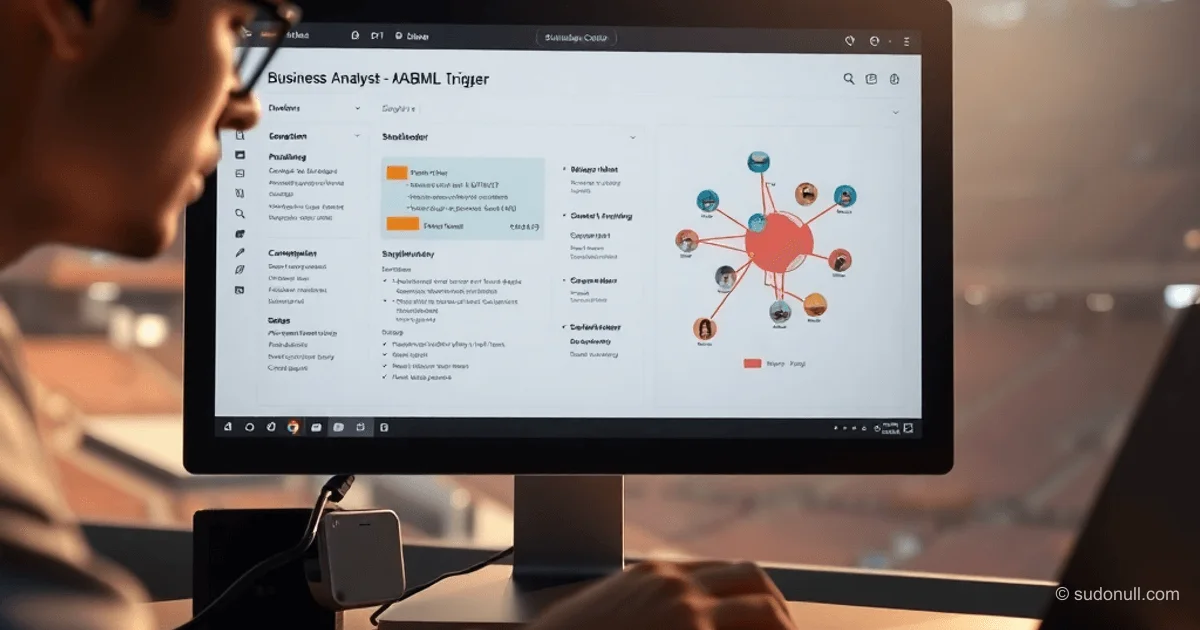
# AInalitik: Integrating Claude Code with BABOK for Professional Business Analysis
The AInalitik platform transforms Claude Code into a specialized business analyst that strictly adheres to the BABOK v3 methodology. This open-source solution automates routine tasks, leaving the analysis and decision-making to humans, and is suitable for both seasoned professionals and newcomers.
How BABOK v3 Becomes an Executable Methodology
Traditionally, the BABOK v3 guide is a 500-page body of knowledge that demands deep study. AInalitik turns it into a set of executable processes through three technological layers. Instead of poring over documentation, analysts get real-time step-by-step guidance.
The key innovation is the integration of Claude Code—an AI agent that can not only answer questions but also take actions: reading files, running tools, and generating structured artifacts. However, Claude alone isn't enough: without a clear framework, it remains an unstructured conversationalist. The platform solves this through:
- Skills (21 modules): each handles a specific BABOK task (e.g., planning stakeholder engagement or requirements traceability). Skills include built-in expertise: how to perform the task, what to watch for, and which artifacts to create.
- MCP tools (22 servers, 111 tools): they perform analytical operations—building traceability matrices, analyzing transcripts, assessing risks.
- Contextual management: the system automatically loads skills and tools based on the current task.
Example of a skill in action (YAML header with triggers):
triggers:
  - "podgotovitsya to interview with"
  - "nuzhno provesti interview"
  - "sostavit plan interview"
action: generate_interview_plan
When a user writes: "I need to prepare for an interview with the CFO," the system recognizes the trigger and activates the generate_interview_plan skill, which launches the appropriate MCP tools.
Target Audience: From BAs to Startup Founders
The platform serves several groups facing business analysis challenges:
- Experienced business analysts: get automation for routine work (structuring transcripts, building traceability matrices), freeing up time for analysis and decision-making.
- Beginner BAs: follow the methodology without mistakes—the system suggests steps, explains requirements validation, and generates artifacts.
- Product and project managers: take on the BA role without deep methodology knowledge, using the platform as a "smart assistant."
- Startup founders: gather requirements on a tight budget, avoiding rework through a structured approach.
Important: the platform doesn't replace the analyst but enhances their skills. As the author notes, the "BABOK rails" ensure you reach the goal, but humans still steer the process.
Architecture: Avoiding LLM Hallucinations
The main challenge with LLMs is the limited context window and the risk of hallucinations. AInalitik addresses this through two-stage component loading:
- Skills: at the start of a session, only headers (triggers) are loaded. Full loading happens when a trigger fires.
- MCP tools: loaded fully, but their size is controlled. To prevent context overflow, a data prioritization strategy is used.
Workflow structure:
- The user describes the task in natural language.
- Claude Code analyzes the request and matches it to skill triggers.
- The relevant skill activates and calls MCP tools.
- Tools process data from the
inputs/folder (supports .txt, .md, .pdf, .docx). - Results are saved to
governance_plans/reports/in Markdown format.
Critically, users don't need to know the internal details. As the documentation states: "Just talk to AInalitik in plain human language."
Zone of Responsibility: Where Humans Are Irreplaceable
Despite the automation, three aspects remain the business analyst's domain:
- Context building: providing source data (transcripts, documents) to the
inputs/folder. - Decision-making: the system offers recommendations, but the final call is human (prioritizing requirements, approving solutions).
- Phase management: overseeing project stage sequences, especially transitions between BABOK sections.
As the author emphasizes, the platform "doesn't make decisions instead of a live business analyst." This is key to maintaining analysis quality.
Key Takeaways
- Reduced cognitive load: the platform logs all decisions and requirements, preventing "knowledge leaks" during analyst handovers.
- Faster onboarding: new BAs ramp up on a project in hours, not weeks, via direct system interaction.
- Strict BABOK alignment: covers 4 of 7 guide sections (planning, elicitation, requirements management, strategy analysis), with others in development.
- Open-source model: the project is released under AGPL v3 license, allowing customization for specific needs.
- Limitation: the current implementation requires manual context window management to prevent hallucinations.
— Editorial Team










No comments yet.