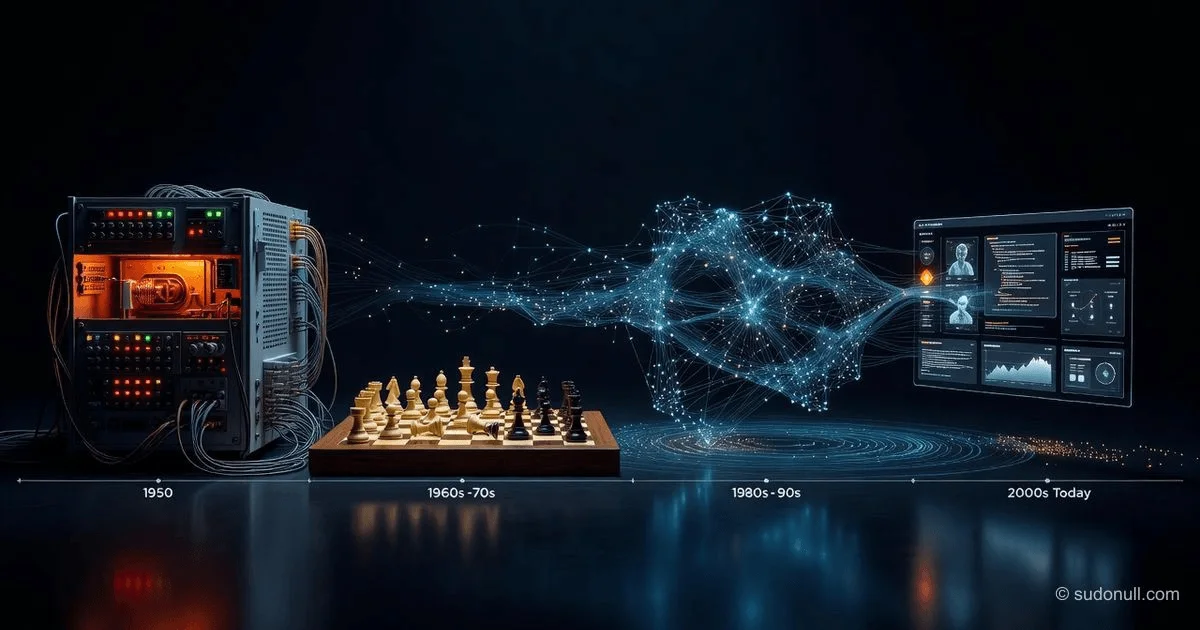
The Complete History of AI: From Turing to Today
The journey of artificial intelligence is a testament to human ambition—a decades-long pursuit to replicate our own intelligence in machines. To truly understand where AI is headed, it is essential to grasp the complete and often cyclical history of artificial intelligence development, from the theoretical musings of a British mathematician to the generative AI revolution that is reshaping the world today.
What You'll Learn
The history of artificial intelligence development is not a straight line, but a series of booms and busts driven by the fundamental tension between "symbolic" logic and "statistical" learning. From the Turing Test in 1950 to the transformer architecture powering today's generative AI, progress has been defined by the convergence of better algorithms, vast datasets, and, critically, the immense computing power that made deep learning viable.
The Philosophical Seed and the Birth of a Discipline
The conceptual foundation for AI was laid long before the first computer could run a program. In 1950, Alan Turing published his seminal paper, "Computing Machinery and Intelligence," proposing a test to determine if a machine could exhibit intelligent behavior indistinguishable from a human . This question shifted the focus from how a machine thinks to whether it can simulate thought convincingly, setting the stage for a new scientific discipline.
The Dartmouth Conference: 1956
The field of AI was officially born at the Dartmouth Conference in the summer of 1956, organized by John McCarthy, who also coined the term "artificial intelligence" . This meeting of brilliant minds, including Marvin Minsky and Claude Shannon, was fueled by immense optimism; they believed a machine with human-level intelligence was within reach . This era saw the creation of the first AI programming language, LISP, and the Perceptron, an early neural network that sparked excitement about machine learning .
Classical AI: Intelligence as Logic and Rules
The first major wave of AI research is now known as "symbolic AI" or "classical AI." The core idea was that intelligence could be replicated by programming explicit rules and logical symbols. If a human reasons using facts and rules, the logic went, a machine could do the same by manipulating these symbols.
Expert Systems and the AI Winters
This approach led to the development of "expert systems" in the 1970s and 80s—programs designed to mimic the decision-making of a human expert . However, this methodology, while elegant for structured problems, proved brittle when faced with the messy, ambiguous nature of the real world. Hand-coding every rule was a monumental task. When the technology failed to live up to its grand promises, it led to the "AI winters"—periods of drastically reduced funding and interest in the 1970s and again in the late 1980s . This was a crucial lesson in the history of artificial intelligence development: brute-force logic was insufficient for true "intelligence."
The Statistical Turn: The Rise of Machine Learning
In the 1990s, a more humble approach began to gain traction. Instead of programming rules, researchers focused on building systems that could learn rules from data. This was the dawn of machine learning (ML). By feeding algorithms vast quantities of data and allowing them to identify patterns, researchers could solve problems like fraud detection and spam filtering that had stymied symbolic systems .
The year 1997 became a landmark for this approach when IBM's Deep Blue defeated world chess champion Garry Kasparov . Deep Blue's success, however, was a tour de force of brute-force search and hand-tuned evaluation functions, a hybrid of classical and learning approaches. But it was a powerful demonstration of what machines could achieve in a defined, logical domain.
The Deep Learning Revolution
Despite the success of shallow machine learning, neural networks had remained in the background. The concept of a "Perceptron" was developed in 1958, and even the foundational method for training multi-layer networks, backpropagation, was introduced in 1969 by Bryson and Ho . However, the computing power and data necessary to make deep networks effective simply didn't exist.
This changed dramatically in the 2000s. Researchers like Geoffrey Hinton, who published pivotal work on training multilayer neural networks in 2006, spearheaded a revival . The breakthrough moment came in 2012 with AlexNet, a deep convolutional neural network that crushed the ImageNet computer vision competition . By leveraging Graphics Processing Units (GPUs)—originally designed for gaming—AlexNet demonstrated that deep learning could achieve unprecedented accuracy in image recognition .
This convergence of algorithms, vast datasets (like ImageNet), and powerful GPUs catalyzed the modern AI boom. In 2011, IBM's Watson defeated Jeopardy! champions, and Apple introduced Siri, bringing AI into millions of homes . Just a few years later, DeepMind's AlphaGo defeated the world champion in the complex game of Go, a feat once thought decades away .
The Generative Era: The Transformer is All You Need
The next monumental leap came not from a new hardware breakthrough, but from a novel architecture: the Transformer. In 2017, the paper Attention Is All You Need introduced an architecture that could process entire sequences of data simultaneously, unlike previous models that processed text one word at a time .
This architecture formed the backbone of the Generative Pre-trained Transformers (GPT) from OpenAI. While GPT-1 (2018) and GPT-2 (2019) showed promise, it was GPT-3 in 2020, with its 175 billion parameters, that stunned the world with its ability to write, code, and translate . OpenAI's release of ChatGPT in late 2022 finally democratized this technology, providing an intuitive interface for millions to interact with a powerful large language model .
This marked the "Generative AI" revolution. The field is now rapidly moving into "Agentic AI," where systems use large language models as a reasoning engine to plan, use tools, and execute complex tasks autonomously . The history of artificial intelligence development has come full circle; the goal-seeking behavior of classical AI is being married to the learning power of modern deep learning. While the path has been a cycle of immense progress and chastening setbacks, the trajectory is clear: artificial intelligence is no longer a question of "if," but "what's next."
Frequently Asked Questions
How did Alan Turing contribute to the development of artificial intelligence? Alan Turing is considered the father of theoretical computer science and AI. His 1950 paper introduced the "Turing Test" as a way to determine if a machine could exhibit intelligent behavior, fundamentally shifting the conversation from how machines think to whether they can simulate it, which laid the groundwork for the entire field .
What are "AI winters," and why did they happen? "AI winters" were periods in the 1970s and late 1980s when funding and interest in AI research drastically declined. They were caused by the failure of early "symbolic AI" systems to live up to their grand promises, leading to widespread disappointment among investors and governments .
What was the "deep learning revolution," and when did it happen? The deep learning revolution started around 2012 with the development of AlexNet, a deep neural network that won the ImageNet competition . This proved that powerful neural networks could be trained effectively, and it was made possible by the convergence of massive datasets, sophisticated algorithms, and powerful GPUs .
What is the main difference between symbolic AI and machine learning? Symbolic AI is based on programming explicit rules and logic for machines to follow, while machine learning is based on training algorithms on data to find patterns and rules for themselves. Machine learning has proven far more effective and flexible in dealing with real-world ambiguity .
What is the "Transformer" architecture, and why is it important? Introduced in 2017, the Transformer is a neural network architecture that uses an "attention mechanism" to process data, like text, all at once. It is the foundational technology behind modern Large Language Models like GPT and BERT, making them significantly more powerful and scalable than previous models .
— Editorial Team










No comments yet.