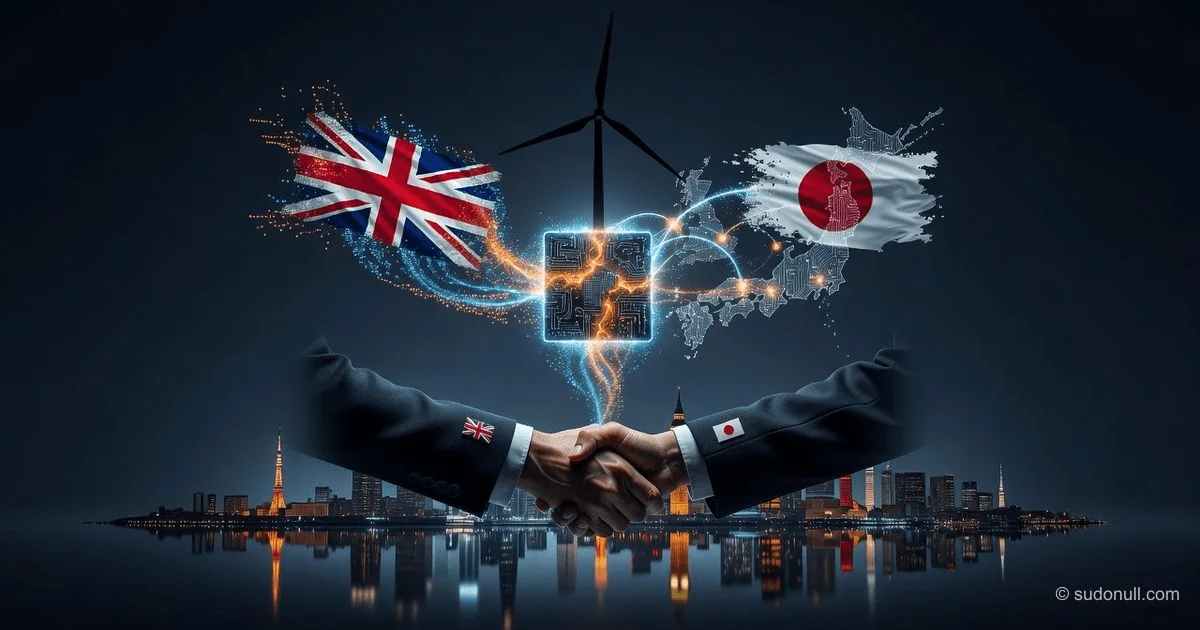
UK and Japan Announce $24 Billion Technology Partnership
The countries launch joint projects in AI, semiconductors, and quantum computing, and invest in 5.9 GW of offshore wind power.
Analysis: The $24 Billion Japan-UK Alliance — The Real Bet in the Game for the Future of Technology
Friends, while everyone is closely watching the tariff negotiations and the G7 shuttle in France, a deal was struck in London and Tokyo that will quietly but fundamentally change the map of the global tech industry. I am, of course, referring to the agreement between Prime Minister Keir Starmer and Prime Minister Sanae Takaichi, formally valued at £18 billion ($24 billion). But if you think this is just "another infrastructure contract," you are deeply mistaken. This is the first public act in 2026 of forming a bipolar techno-sovereignty of the Western alliance without direct US involvement.
Let's break down what lies behind the dry numbers and how this move will impact supply chains in China and South Korea.
[The Essence]: What Is Really Happening
Officially: Japan invests $9 billion in UK infrastructure and finance, and another $9 billion in offshore wind energy (5.9 GW). Another track is the partnership on AI, semiconductors, and quantum.
What is really happening: The United Kingdom and Japan have just legally formalized a mechanism for exchanging "whale bone" for "silicon." England, left without access to the full pool of European defense and quantum developments after Brexit, receives Japanese funding to scale its prototypes. Japan, whose demographic tsunami is destroying domestic demand, gains a testing ground for AI and defense drones on the European theater and access to Rolls-Royce's nuclear energy laboratories.
An attentive analyst will notice a key detail: Rapidus (Japan's national chip champion) signed a formal agreement with the UK Semiconductor Centre. What does this mean? Britain no longer wants to be just a place for chip design from Arm. It has legalized manufacturing on its soil for the Japanese, bypassing US patent risks. This is the first step toward creating a "no man's land" in lithography — outside the scope of the CHIPS Act, but with its own currency corridor (pound/yen).
Timeline and Context
The agreement was signed on June 14, 2026, a day before the opening of the G7 summit in France. This is no coincidence. Starmer and Takaichi met on Downing Street to arrive in Évian-les-Bains with a ready-made bloc, not empty promises.
Below is the actual roadmap of key assets that are coming under the management of this alliance:
| Deal Component | Japanese Investor / Partner | British Asset / Technology | Implementation Timeline (Forecast) |
|---|---|---|---|
| Quantum Computing | Mitsui & Co. (financing) | ORCA Computing (PC supply) | Contract signed, delivery 2026-2027 |
| Advanced Nuclear Energy | JAEA (Japan Atomic Energy Agency) | Rolls-Royce SMR / UK Atomic Energy Authority | Joint development until 2028 |
| Semiconductors (2 nm) | Rapidus (technology) | UK Semiconductor Centre (manufacturing site) | Capacity assessment by end of 2026 |
| Offshore Wind Energy | Consortium (via Offshore Wind Compact) | Ossian, Green Volt, Erebus projects (5.9 GW) | Construction completion by 2030 |
| Neuroscience | Eisai (manufacturing) | New R&D center in Hertfordshire | £48 million plant launch in 2026-2027 |
| Defense Drones / AI | Japan Venture Capital Fund | Defence Capability Council (access to tenders) | Council launch in Q3 2026 |
Note the table: Britain gives away the "fattest" pieces — energy (Rolls-Royce) and land for factories. Japan gives only money and access to lithographic equipment (via Rapidus), but not its materials science secrets. This is a calculated barter trade without full disclosure.
Who Wins and Who Loses
Winners:
- Offshore engineers in Scotland and Northern England: Creating 5.9 GW of capacity is not just a "green agenda." The consortium got the green light to build floating platforms for the Celtic Sea. In the short term, cable and steel manufacturers benefit.
- Rolls-Royce: The company secured a Japanese sponsor for its small modular reactors (SMRs). While French EDF and American Westinghouse are bogged down in regulation, RR receives nuclear data from JAEA and Japanese investment in the civil fleet.
- Seed-A startups: Through the "Frontier Tech Partnership," British laboratories will get a direct channel to Japanese corporate venture funds, bypassing London intermediaries.
Losers:
- South Korean Samsung and Hyundai: Japanese capital ($9 billion in long-term money) went into British wind energy. This is direct money that Korea had hoped to get for its projects in the North Sea.
- China's State Grid Corporation (SEC): Beijing had been trying for 5 years to buy stakes in the British distribution network. The deal with Hitachi Energy, creating 500 new jobs in Glasgow, closes this loophole forever.
- Brussels (EU): The London-Tokyo alliance (G7 without Paris and Berlin) proves that the "Lisbon Strategy" for European technological sovereignty has failed. Britain, through Japan, gains access to advanced chips faster than Germany through its consortia.
What the Media Isn't Saying
Here is the main insight, colleagues. Everyone writes about "AI and semiconductors," but no one mentions GCAP (Global Combat Air Programme). This item is hidden at the end of press release No. 10: "...confirmation of commitments to the next-generation Tempest fighter."
This is a trigger deal for defense. Britain, Italy, and Japan are building a sixth-generation fighter. Yesterday it was an engineering project. Today, with the signing of the "Defence Capability and Industrial Council," it is an industrial conveyor belt. This means:
- Japan will lift the embargo on exporting components for strike UAVs through British territory.
- Rolls-Royce will start supplying power plants for Japanese destroyers (adapting SMR for the fleet).
- Britain will receive Japanese AESA radar technology for its ground-based air defense systems.
In effect, $24 billion is the price of a "technological NATO" in Asia without joining the bloc.
Forecast: Next 30 Days and 90 Days
Next 30 Days (July 2026): Expect a series of small M&A deals. Japanese trading houses (Mitsubishi Corp, Itochu) will start buying second-tier British AI startups specializing in computer vision for autonomous ships. Check sizes range from $50 to $200 million. The GBP/JPY exchange rate will strengthen on news of capital inflow; Japanese exporters will start hedging through London.
90 Days (September 2026): A tender will be officially announced for the construction of the UK's first pilot plant for 2 nm chip production. Currently, Rapidus is only "discussing pathways" with the UK Semiconductor Centre. But I bet that in 3 months we will see a site selection (most likely in South Wales, where there is free energy from wind turbines). This will hit Intel Foundry shares (which tried to sell the British its old capacity) — their price will drop by 7-10%.
Your move: If you work in deep-tech in Europe, now is the best time to apply for joint UK-Japan grants. If you are an investor, look at currency arbitrage and grid construction contracts (Hitachi Energy is already creating 500+ high-skilled jobs, meaning their subcontractors in Glasgow will get orders).
The alliance has just created an "offshore tech hub" that exists outside the jurisdiction of the EU and the US. And it's here to stay.
— Editorial Team










No comments yet.