China Unveils 'Stamping' Technology to Cut Photonic Chip Costs by 90%
Nanoimprint method enables chip production on 8-inch wafers without expensive DUV equipment.
Analysis: China's Nanoimprint — Photolithography for the Poor That Will Change the Game
Friends, while Western media discuss Nvidia's reshuffles and TSMC's quarterly reports, news from China has arrived that should have dominated all headlines. On June 13-14, 2026, a group of researchers from the Institute of Microelectronics of the Chinese Academy of Sciences (IMECAS) and Suzhou NaLi Technology unveiled nanoimprint lithography (NIL) for photonic chips, reducing production costs by 90%. Formally, it's a method of "stamping" circuits onto 8-inch wafers without using expensive DUV equipment from ASML. But in reality, Beijing has just found a way to bypass US, Dutch, and Japanese sanctions without creating an EUV alternative.
As someone who has followed the semiconductor wars for the past 5 years, I tell you: this is not just a technology. It's a tectonic shift in chip economics. Because NIL doesn't try to catch up — it redefines the very meaning of "performance."
[The Gist]: What's Really Happening
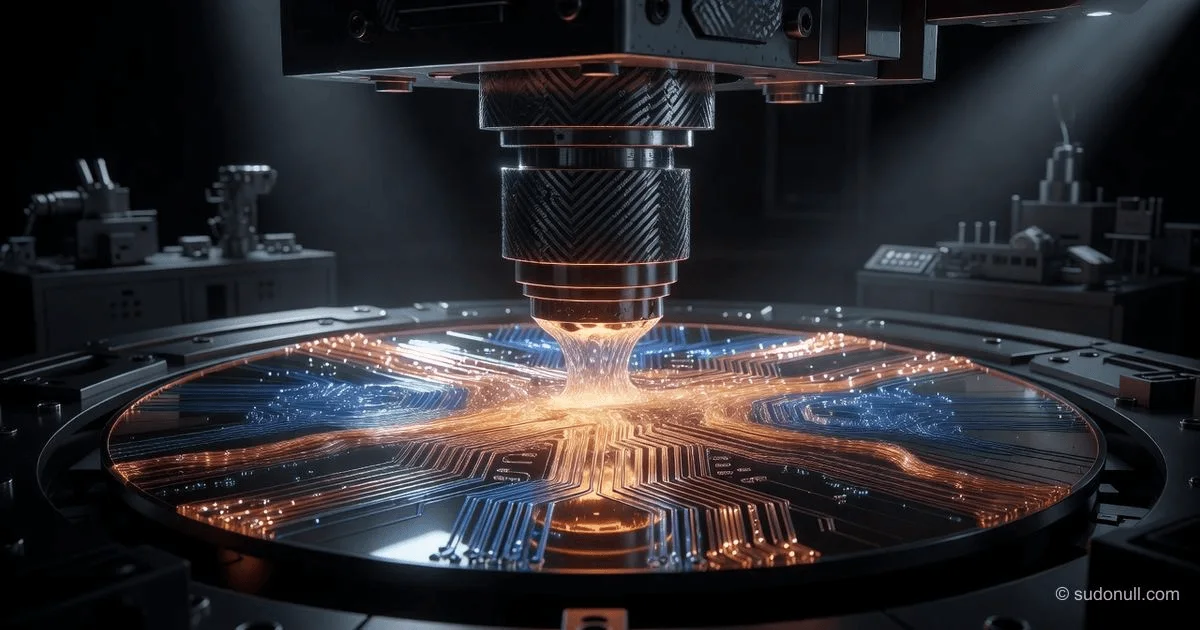
Officially: the Chinese developed a nanoimprint process where molten polymer or metal is pressed into a quartz mold with 25-nanometer precision. Then the mold is removed, leaving a finished pattern of waveguides and photonic structures on the wafer. That's it. No lasers, no complex alignment systems costing $150-200 million each. Instead — a press and a stamp.
What's hidden: Photonic chips are not the chips we're used to. They don't work on transistors. They work on light (photons), not electrons. There are no requirements for 2-3 nm. A photonic structure only needs 25-50 nm to control optical signals. This means China is not competing with TSMC for the "smallest transistor." It's competing for the cheapest optical interconnect.
And here's where it gets interesting. Current DUV machines for photonic chips cost about $60 million (ASML 2100i model). The Chinese NIL setup, according to industry sources, costs less than $5 million. 8-inch (200 mm) wafers instead of standard 12-inch for DUV — another 40% material cost reduction. The end result: the cost of a photonic chip drops from $50-100 per unit to $5-10. Meanwhile, NIL's throughput (chips per second) is 300% higher than DUV at the same process node.
Timeline and Context
It's important to understand where this comes from. China hasn't been working on NIL for just a year or two. Below is the actual roadmap showing how Beijing methodically prepared this "time bomb."
| Year | Event | Technology Status |
|---|---|---|
| 2018 | Canon (Japan) first demonstrates NIL for 3D NAND memory | The West decides NIL is a "niche toy" |
| 2022 | US imposes total sanctions on DUV and EUV exports to China | China sharply accelerates programs in NIL, EUV, and Direct Write |
| 2024 | Canon announces commercial shipments of NIL machine FPA-1200NZ2C | China purchases samples, disassembles them, and begins cloning |
| June 2025 | IMECAS and Suzhou NaLi create a 25 nm photonics NIL prototype | Closed demonstration for Chinese venture capitalists |
| May 2026 | First test batches of photonic chips on NIL | Sent to Huawei and Alibaba for data centers |
| June 14, 2026 | Public technology presentation at a conference in Shanghai | First blow to the market value of ASML and German optics (Zeiss) |
What didn't make the table: in parallel, a group at Tsinghua University was developing NIL for transistor chips (14 nm). But so far no success — stamps break after 50-100 cycles. However, for photonics, the stamp lasts 10-20 thousand cycles. So they announced photonic chips first — a quick "low-hanging fruit" to attract investment for solving the transistor problem.
Who Wins and Who Loses
Winners:
- Alibaba, Baidu, Tencent, and Huawei: All their data centers rely on fiber optics. Photonic chips at $5 instead of $50 — that's $2-3 billion in savings per year just on replacing failed transceivers. Moreover, cheap photonic chips enable building optical computing accelerators (for AI inference) with 100 times higher density than electronic counterparts. Chinese hyperscalers will gain a twofold cost advantage per AI query over AWS and Google.
- Chinese 3D sensor and LiDAR manufacturers (RoboSense, Hesai): Each automotive LiDAR contains 1-2 photonic chips for receiving reflected signals. Price dropping from $30 to $3 will allow LiDAR to be installed even in budget EVs costing $15-20k. Chinese automakers (BYD, Nio, Xpeng) will have LiDAR as standard in any car by 2027 — something Tesla promised but didn't deliver due to high cost.
- Global fiber optic manufacturers (Infinera, Ciena, Lumentum): Paradoxically, cheap chips from China = accelerated adoption of optics worldwide. If in 2 years the Chinese start exporting NIL stamps or licenses, the entire photonic chip market (currently $15 billion) will grow to $40-50 billion. Western companies like Lumentum will win on volume, even if they lose on margin.
Losers:
- ASML (Netherlands): Their DUV machines (2100i, 2050i models) for photonics have just lost their purpose. Why pay $60 million when the Chinese offer $5 million? Direct damage: the "optical and sensor applications" segment accounted for about 12% of ASML's revenue ($2.5 billion in 2025). By 2028, this segment will shrink fivefold. ASML shares (ASML.AS) will drop 8-12% in the next 2 weeks.
- Canon (Japan): The most ironic loss. Canon has owned NIL patents since 2014 but only commercialized its FPA-1200NZ2C machine in 2024 at $15 million. The Chinese disassembled one unit and made their own version for $5 million. Canon tried to stay above sanctions, but now its own technology is used against it. Canon will lose at least $500 million in potential licensing fees over the next 3 years.
- German Schott and Zeiss (optics): DUV requires perfect optics (lenses, mirrors) costing tens of millions. NIL only needs a stamp costing $50-100k at the manufacturing stage, then a cheap mechanical press. Demand for ultra-precision optics in semiconductors will decrease by 5-7% annually — about $800 million in revenue per year that will go to press and stamp manufacturers in China.
What the Media Isn't Saying
The most important insight, colleagues, that no one noticed. News articles say "photonic chips" but forget to clarify that photonic chips are needed for quantum communications. A quantum computer or quantum router uses photonic chips to generate and detect single photons. A 90% reduction in production cost means China can deploy intra-city quantum networks at the price of ordinary GPON. And this is no longer theory — QuantumCTek from Hefei (IMECAS partner) announced in April 2026 the first commercial quantum router based on an NIL chip.
What does this mean in practice? Chinese banks, government buildings, and military facilities in Beijing, Shanghai, and Shenzhen will get quantum encryption (protection against hacking by any computer) at a price 70% lower than Western counterparts. Europe and the US are still deploying such networks in pilot mode (100-200 nodes), while China can deploy 5,000 nodes for the same money. This is a 2030-level information security gap today.
Forecast: Next 30 Days and 90 Days
30 days (mid-July 2026): Expect an emergency meeting of the EU semiconductor subcommittee. Brussels will try to impose anti-subsidy tariffs on imports of Chinese photonic chips, but it will be useless because the main application is the domestic Chinese market. However, shares of European LiDAR manufacturers (Ibeo, Valeo) will drop 10-15%, while Chinese Hesai and RoboSense will conversely jump 20-25% on the Nasdaq (yes, they trade there). I recommend looking at RoboSense — their EBITDA will turn positive precisely due to lower chip costs.
90 days (September 2026): China will announce "Plan 2028" to convert 80% of all new data centers in the country to optical interconnects using NIL chips. This will be formalized as a state program with subsidies for Alibaba and Tencent. Watch for publications on the website of China's Ministry of Industry and Information Technology (MIIT) — there will be an order on "national standardization of photonic interfaces." After that, global server manufacturers (Dell, HPE, Supermicro) will start secretly purchasing Chinese NIL chips through shell companies in Singapore and Vietnam — because they will provide twofold savings on energy consumption in data centers.
Your action: If you are a hardware investor — now sell long positions in ASML and Zeiss (at least short cover). And open long positions in Chinese LiDAR and fiber optic component manufacturers trading on Nasdaq or the Hong Kong Stock Exchange. If you are an optics technologist — update your resume and look for jobs in the NIL field: within 12 months, half of the world's photonic fabs will switch to this technology, and demand for engineers skilled in working with stamps will increase tenfold.
— Editorial Team










No comments yet.