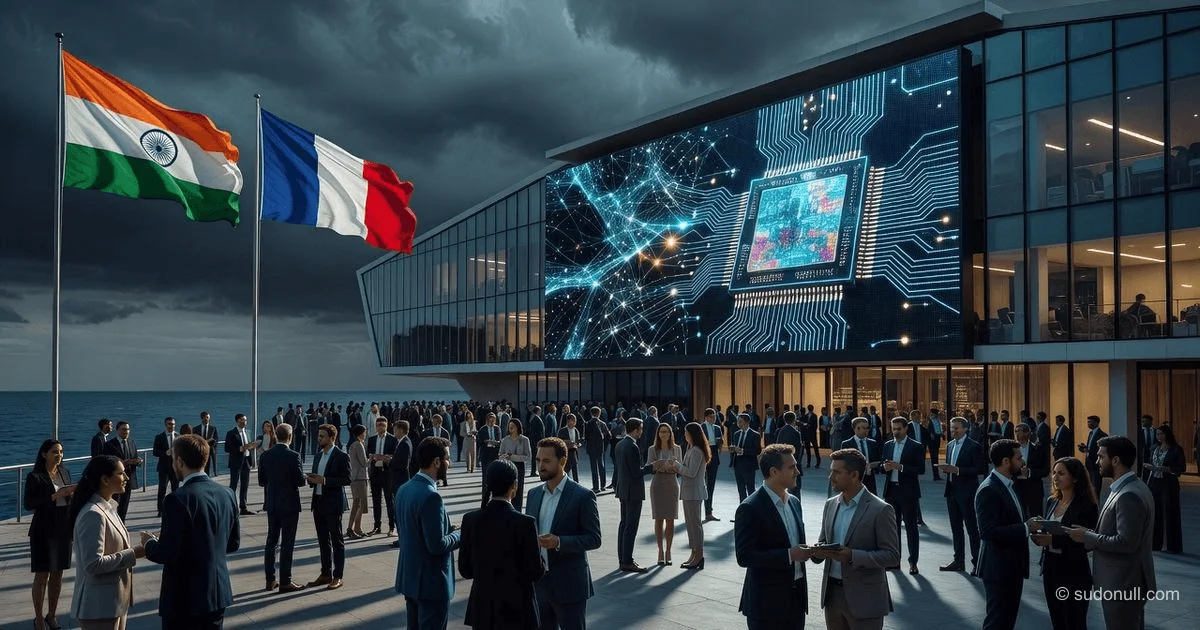
India Brings 120 Startups to European Market at Summit in France
At the 'India Innovates 2026' event in Nice, Indian companies will showcase their developments in AI, quantum computing, biotech, and space to 500 international investors.
Analysis: 'Bharat Innovates 2026' — India's Bet on Technological Hegemony in Europe
Friends, today is June 14, 2026, and while G7 cameras in France are focused on leaders' negotiations, something far more important for the future of the global tech landscape is happening in Nice. Indian Prime Minister Narendra Modi and French President Emmanuel Macron have just opened the 'Bharat Innovates 2026' summit. Formally, it's 120 Indian deep-tech startups in front of 500 international investors. Informally, we are witnessing the birth of a new technological alliance that will break China's monopoly on equipment manufacturing and offer Europeans an alternative to American and Taiwanese semiconductor dominance.
As an analyst, I see here not a 'startup conference' but a forcing of Europe toward cheap, yet high-tech sovereignty. India has not come for grants — it has come to sell patents and take over production.
[The Essence]: What is Really Happening
Officially: A three-day showcase of Indian innovations has kicked off in Nice as part of the 'India-France Year of Innovation'. India has brought select startups from a pool of 3,000 candidates — in AI, quantum, semiconductors, space, biotech, and green energy. 15 leading academic institutions are participating, including IIT Delhi, IIT Bombay, and IIT Madras, presenting over 50 research projects.
What is hidden: This is the first time in history that a 'third world' country exports exactly deep-tech (not outsourcing or call centers) to Europe. A key detail the media misses: among the 120 startups, at least 9 are from the space industry, having already signed strategic agreements with Italians at Space Meetings Veneto in May 2026. So this is not a one-off event — it's links in a chain: first Italy (space and components), now France (AI, biotech, and quantum), next will be Germany with its automation.
Notice the strange wording in official releases: 'India Innovates' and 'Bharat Innovates' are used interchangeably. This is not a typo. It's a marker of an internal struggle within the Indian delegation between two approaches: 'English' (US-oriented) and 'Hindi' (Asia-oriented). The victory of 'Bharat' in the name indicates that the bet is on the Asian-European axis, bypassing Washington.
Timeline and Context
The event did not arise out of nowhere. It is the culmination of a series of deals that began in February 2026. Below is the real timeline showing how India methodically captures the European tech space:
| Date | Event | Significance for the Alliance |
|---|---|---|
| February 2026 | Macron's visit to India, launch of 'Year of Innovation' | Political umbrella for all subsequent deals |
| February 2026 | Signing of 21 agreements, including an AI center at AIIMS and a JV on HAMMER missiles | Military-technical basis (BEL-Safran missiles = technology transfer) |
| May 2026 | 9 Indian space startups sign contracts with Italy | First 'tractor' — space as a pilot market |
| June 12-13, 2026 | Modi arrives in Nice, infrastructure preparation | Finalization of the list of 120 participants |
| June 14-16, 2026 | Bharat Innovates 2026 in Nice | Point of no return: India becomes Europe's tech donor |
| June 16-18, 2026 | G7 in Évian and VivaTech in Paris | Legitimization of status through big politics |
The main takeaway from the table: India used the G7 as a smokescreen. While the world watched tariff talks and the Middle East, Modi and Macron on the Mediterranean coast signed an invisible 'roadmap for replacing Chinese production'. Chinese sanctions against Europe (rare earths, EV components) no longer work when India has its 1.5 million engineers per year.
Who Wins and Who Loses
Winners:
- French defense conglomerates (Safran, Thales, Dassault): They gain access to Indian missile and satellite know-how. The BEL-Safran joint venture for HAMMER missile production in India is not about India; it's about reducing component costs for European defense by 2-3 times.
- European venture capital funds (Partech, Index Ventures, Accel Europe): They no longer need to fly to Bangalore or Delhi. 500 investors came to Nice, and they can pick a startup from the top 120 without leaving their seats. This reduces their due diligence cost by 40-60%.
- Skyroot Aerospace and other Indian space-tech companies: They are already launching Vikram-1 (India's first private rocket). At the Nice summit, they will find European satellite operators willing to pay $10-15 million less per launch than SpaceX.
Losers:
- Chinese component manufacturers (Huawei, DJI, BYD): The European backup airfield is closing for them. Now, when Brussels imposes new duties on Chinese chips or batteries, Europeans have a ready alternative — Indian startups with licenses for Western IP. This will reduce China's share of the European microelectronics market from the current 35% to 20% by 2028.
- Israeli deep-tech startups (second tier): India offers the same technologies (quantum, defense, biotech) but at half the price. An Indian engineer costs $15-25k per year, an Israeli one $80-120k. VC funds will begin to pivot to India as a 'cheap Israel'.
- Polish and Czech outsourcing: 120 startups with direct state support mean 120 potential factories or R&D centers. The Czech Republic has for years attracted Indian IT specialists with visas, but now Indians will build their labs directly in France (via EDF partnerships), bypassing Prague and Warsaw.
What the Media Leaves Out
The most non-obvious insight, colleagues, lies in the crypto-clause of the 'India-France 2026' agreement on digital and metaverse technologies. Summit materials mention the 'Indo-French Centre for Digital Sciences and Technology' and AI data exchange. But there is a second layer — testing the digital rupee (e₹) and digital euro for cross-border payments through Indian startup infrastructure.
Silence. But I'll tell you: one of the 120 startups is a fintech platform based on UPI (Unified Payments Interface), which India is pushing in Africa and Asia. Their goal in Nice is to negotiate with Banque de France a pilot project for converting e₹ to digital euro without SWIFT. If this happens — it's the death of the dollar as a settlement unit for tech deals between Asia and Europe. That's why the US did not invite India to the Japan-UK alliance ($24 billion), which I wrote about earlier — they fear losing control over settlements.
Second: no one talks about the division of labor among Indian universities. IIT Bombay brings quantum computing projects. IIT Madras — semiconductors. IIT Delhi — biotech. This is not just 'show and tell'. Behind each IIT stands a specific French partner: Thales (quantum), STMicroelectronics (chips), Sanofi (biotech). This is a targeted replacement of American and Taiwanese supply chains with a European-Indian duopoly.
Forecast: Next 30 Days and 90 Days
30 days (mid-July 2026): Expect a series of 'quiet' acqui-hires. Large European corporations (Siemens, Schneider, Airbus) will start buying Indian startups from the list of 120 not as independent companies but as R&D departments. Check size: from €20 to €100 million. Indian founders will receive French passports under the accelerated 'French Tech Visa' program — this condition is already in the memorandum (non-public part). By the end of July, at least 5 startups from Nice will announce the relocation of their headquarters to Paris or Sophia Antipolis.
90 days (September 2026): A specific list of 10-15 Indian startups will be released that receive contracts for pilot projects with European state-owned corporations (EDF, RTE, SNCF). This involves AI optimization of power grids, quantum encryption for railways, and biosensors for veterinary control. These are the first 'holes' in the European regulatory field through which Indian technologies will enter the EU public procurement system. Watch for publications in Tender Electronic Daily (TED) — lots with the wording 'Indian origin technology provider allowed' will appear.
Your action: If you are a European venture investor — urgently contact Indian funds (Blume Ventures, Accel India) for co-investments. Until September 2026, the valuation of Indian deep-tech startups in Europe will be 30-50% lower than after the announcement of the first pilot contracts. The window of opportunity is exactly one quarter.
— Editorial Team









No comments yet.