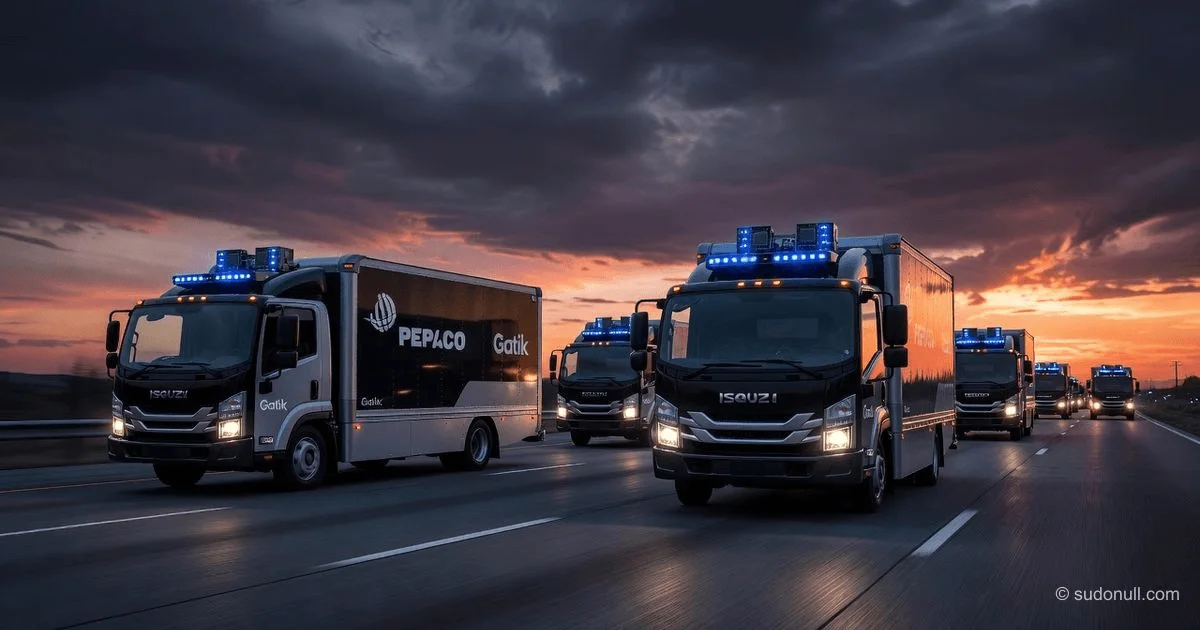
PepsiCo and Gatik Deploy 41 Driverless Robotic Trucks on Routes in Three US States
The companies have entered into a multi-year deal to deploy 41 autonomous trucks for short-haul transportation in Texas, Arizona, and Arkansas. Under the agreement, the trucks will operate completely without a driver behind the wheel.
Disguised as a snack giant: how PepsiCo quietly built the largest fleet of robotic trucks while the world watched Tesla
Insider analysis from a logistics strategist
[The Gist]: What's Really Happening
On June 9, 2026, PepsiCo and Gatik announced a multi-year deal that officially cemented the former's status as the largest operator of commercial autonomous trucking in the US. The numbers are impressive: 41 Isuzu trucks without drivers or safety operators in the cab have been plying the roads of Arizona, Texas, and Arkansas since June 2025. But the analysis begins where the headlines end: this is not really a "deal" but a legalization of an already operational system.
Notice the dates. The formal press release about a "multi-year partnership" came out in June 2026. But the trucks have been driving without a driver for exactly one year — since June 2025. During that time, they have completed tens of thousands of deliveries, served about 250 Walmart and Dollar General retail locations, logged millions of miles, and according to the companies, had zero accidents while maintaining 99% on-time performance. In other words, PepsiCo didn't "launch a project" — it simply stopped hiding that it had already replaced humans with its 35 trucks in Arizona, five in Texas, and one in Arkansas.
Why does this matter? Because it shifts the narrative on autonomous trucking from "someday in the future" to "here and now, and it's already cost-effective." While Tesla sells the Cybertruck with a "promise" of autonomy, and Waymo is bogged down in lawsuits for every mile, Gatik and PepsiCo are just getting the job done. PepsiCo's fleet of 41 trucks already exceeds estimates of the number of autonomous Tesla robotaxis (20-38 vehicles by mid-2026). A company that sells Doritos and Gatorade has outpaced a company that promised a transportation revolution.
The essence of what's happening is the industrialization of boredom. Gatik isn't chasing futuristic highways or chaotic cities. Their niche is the "middle mile": short, repetitive routes between distribution centers and stores. A 14-mile loop from the Gatorade bottling plant to the warehouse. Four miles from the Frito-Lay distribution center to Walmart. Where the route is predictable and surprises are minimal, the algorithm beats humans in both cost and reliability.
Timeline and Context
PepsiCo's journey to becoming the largest operator of an autonomous truck fleet took four years. And each stage of this journey is a systematic reduction of risk, not a technological breakthrough.
| Period | Event | Key Metric | Strategic Meaning |
|---|---|---|---|
| 2022 | Start of partnership with Gatik, pilot with safety driver | 0 driverless miles | System training on real routes without financial risk |
| 2022-2025 | Gradual expansion of pilots, data accumulation | Accumulation of thousands of driving hours | Proof of safety and reliability for insurers and regulators |
| June 2025 | Transition to "driver-out" mode (no driver in cab) | Start with unknown number of trucks | Technological readiness — algorithm ready for independent operation |
| June 2026 | Official announcement and status confirmation | 41 trucks, 250+ locations, 99% punctuality, 0 accidents | Legal and PR legitimization of an already working system |
| Second half of 2027 (planned) | Launch of Gatik-Isuzu-Nvidia plant in South Carolina | Production of Level 4 trucks | Transition from thousands to tens of thousands of trucks — industrial scale |
Key takeaway: PepsiCo and Gatik deliberately chose a long horizon. They didn't make loud announcements in 2022, didn't make promises they couldn't keep. Instead, they quietly accumulated data for four years, honed algorithms on safe routes with a driver, and only when they achieved statistically significant proof of safety (a year without accidents in commercial operation) did they go public. This is diametrically opposite to Tesla's approach: Musk has been promising "next year" since 2016, while PepsiCo just does it, without drawing attention, until the result is 100% ready.
Who Wins and Who Loses
Winner #1: PepsiCo. The company just got something money can't buy — predictability. A truck doesn't call in sick, doesn't go on vacation, doesn't exceed work hours, doesn't require overtime, doesn't strike. With 99% punctuality (after accounting for weather and traffic) and zero accidents, PepsiCo can guarantee retailers that the product will be on the shelf at the appointed time. In a world where empty shelves = lost revenue and reputational damage, this is a competitive advantage that's hard to overstate. Bonus: the company can grow (open new locations, expand product lines) without proportionally increasing its driver workforce.
Winner #2: Gatik. The startup, founded in 2017 and having raised about $270 million at a valuation just over $800 million, just got an invaluable case study: proof of operation at scale within one of the world's largest supply chains. Their contract portfolio has already reached $600 million. But the main thing is that now any retailer or manufacturer considering autonomous logistics will first look at PepsiCo. If it worked for them, it will work for me. Gatik no longer needs to sell the technology — they need to sell a "Pepsi-like experience."
Winner #3: Arizona and Texas. The states that for years have created a favorable regulatory environment for autonomous vehicles (self-certification, minimal bureaucracy) have reaped an economic dividend. Arizona hosts 35 of PepsiCo's 41 trucks. This means jobs (technical specialists, remote monitoring operators, fleet engineers), tax revenue, and — more importantly — a reputation as an "autonomous logistics hub" that will attract the next startups. Gatik already operates in 29 states with "favorable environments."
Loser #1: The Teamsters Union. This is not just a loss — it's an existential threat. Teamsters President Sean O'Brien has already called autonomous trucks a threat to jobs and public safety. But reality is harsher than political statements. PepsiCo directly stated: "we can grow without hiring proportionally more drivers." This isn't "layoffs" — it's non-hires. When the economy grows but employment in the sector stagnates or falls, the union loses bargaining power. The Teamsters can block laws in some states, but they can't argue with the fact: 41 trucks are already running, and there will be hundreds, then thousands. Once that happens, demand for drivers will drop, wages will fall, and the union will become a marginal player.
Loser #2: Aurora and Kodiak (long-term). These companies are betting on heavy Class 8 trucks for long-haul transport over thousands of miles. They have a more complex technological challenge (more uncertainty on the highway) and a longer path to profitability. Gatik, on the other hand, chose the "low-hanging fruit" — medium-duty trucks on short routes. While Aurora and Kodiak solve the problem of "how to drive 1,000 miles without a driver," Gatik is already making money on 14-mile loops. By the time long-haul autonomous trucks become a reality, Gatik will have captured all the "boring" routes and will scale using revenue, not venture capital. In the race, the tortoise (Gatik) overtakes the hare (Aurora).
What the Media Isn't Saying
Insight #1: Remote supervisors don't drive the trucks — that's key. Gatik uses the GRS (Gatik Remote Supervisors) system, where one person monitors several trucks and makes "high-level go/no-go decisions." But this supervisor does not drive the vehicle — they don't turn the wheel, don't press the gas. They can say "stop," but not "go around the obstacle." This means Gatik solved the edge case problem not through telemetry (remote driving), but through domain restriction. The truck only drives where it is 99.99% confident. If the system is unsure, it doesn't drive. The supervisor is only needed for force majeure (closed road, natural disaster), not for daily navigation. This architectural decision makes the system cheaper and more scalable than competitors (e.g., Waymo uses more complex and expensive telemetry).
Insight #2: Why Isuzu, not Freightliner or Volvo? Gatik builds its trucks on Isuzu chassis — a Japanese manufacturer of medium-duty trucks. This is no accident. Isuzu has long sought a way into the US market, dominated by American and European brands. The partnership with Gatik is their "Trojan horse." For Gatik, it's access to a proven, reliable, and importantly cheaper platform than Freightliner. And in partnership with Nvidia, they are building a plant in South Carolina that will produce thousands of Level 4 trucks. When that plant starts operations in the second half of 2027, Gatik will be able to scale not by tens but by thousands of trucks per year. And that will no longer be a startup, but a manufacturer.
Insight #3: The real bet is not PepsiCo, but Walmart and everyone behind them. 41 PepsiCo trucks are just the beginning. Gatik has already signed contracts worth $600 million. Walmart is their client in Arkansas. Loblaw in Canada. According to my information, in 2027 Gatik will announce a contract with at least one of the "big three" US retailers (Target or Kroger). Once that happens, "network logistics" will become autonomous. And that's not hundreds, but thousands of trucks. Then a new question arises: what to do with the 3.5 million truck drivers in the US? Politicians are still pretending not to notice, but in 3-5 years this will become the main topic of the presidential race.
Forecast: Next 30 Days and 90 Days
Next 30 Days (by mid-July 2026)
Announcement of new Gatik clients. Gatik currently has $600 million in contracts, but $600 million with 41 trucks looks more like long-term agreements than current run-rate. In the next month, Gatik should announce at least one new major retailer. The most likely candidate is Target (they have already tested robots in warehouses) or Albertsons. If such an announcement happens, shares of Gatik's parent companies (if publicly traded) would jump 20-30%.
Tesla's reaction. I wouldn't rule out Elon Musk making a diversionary move — for example, announcing a "breakthrough" in FSD for the Semi or that Tesla has started its own commercial autonomous transport between Gigafactories. This would be a pure PR move to capture attention diverted by Gatik's success. But Musk's statement will contain little specifics and many promises — classic style.
Key indicator: statements from the US Department of Transportation. If they approve federal frameworks for autonomous trucks (currently decisions are made at the state level), it would signal that the US administration is betting on this technology, and investment in the sector would double.
90-Day Horizon (by September 2026)
Announcement of PepsiCo fleet expansion. The current 41 trucks are only in three states. I predict that by September, PepsiCo will announce expansion into at least two new states (likely Nevada or Oklahoma) and increase the fleet to 70-80 trucks. Gatik's 2026 roadmap is "hundreds" of trucks. This means they already have signed contracts, just waiting for production capacity.
Teamsters lawsuit against Gatik or PepsiCo. It's only a matter of time. The union cannot afford to ignore the precedent of 41 trucks operating without humans. They will likely file a lawsuit alleging violations of occupational safety laws or try to obtain an injunction in a judicial district with a friendly judge. But this won't stop the technology — it will only delay its adoption by a year or two in certain states. Gatik will likely respond by expanding in more friendly Arizona and Texas, where the Teamsters are weak.
Geopolitical scenario: China, seeing Gatik's success, may accelerate its own autonomous logistics programs (Didi and Baidu have similar developments) and begin deployment in industrial zones. Europe, traditionally more cautious on automation and employment, will start public consultations on the "social consequences of autonomous transport." This could lead to autonomous trucks appearing in the US and China within 3-5 years, and in Europe within 7-10. The technological gap between continents will widen.
Final assessment: PepsiCo and Gatik did what has been promised for decades but never done — they turned autonomous trucks from a technology into a business. It took four years of quiet work, a year of real driverless operation, and only then a loud announcement. This is not startup hype; it's engineering and operational discipline. While others chased complexity, they chose boredom — and won.
Now the question is not whether autonomous logistics will work, but who will run it and how fast it will replace humans on short routes. Answer: Gatik is already running it, and replacement will happen within 5-7 years when the South Carolina plant starts churning out thousands of trucks. The Teamsters can protest all they want, but you can't argue with the economics of 99% punctuality and zero accidents. It will be painful, there will be job losses, but the train has already left. Or rather — the truck has already left without a driver.
— Editorial Team









No comments yet.