November 6, 2014 at 13:00
Practical holacracy. Cut circles and prepare roles
In the middle of summer, we first heard the word "holacracy." For a couple of days, they ousted themselves from misspelling (holoKratia) and learned to distinguish this model of business organization from the form of government that died in a Bose with the consonant name "ochlocracy." Then the fun began: we decided to try holacracy in action. The moment was right, lacking only information. I had to study the poorly described experience of my Western colleagues, call for help from the mentors of Amsterdam and dive into the abyss of search engines. Six months later, a new concept began to take root, and we have experience that is not ashamed to share.
In a previous article, we wrote about what holacracy is and why you do not need it . Today we will dilute the sweet theory with bitter practice and see how it works in the Button. We will not ignore the experience of Zappos, Medium, David Allen Company and argue in the comments about the situation on GitHub. Are you with us :)
Let's just say: The button was ready for holacracy long before it learned about holacocracy. From the very beginning of our fascinating journey, we tried to build a self-organizing company where everyone makes decisions, asks questions and sees the whole picture. From the first days, we used agile , formed values , cultivated an entrepreneurial approach to the work of each employee. The more people we hired, the harder it became to plant and maintain this culture.

In the Button, each boss is his own
Holacocracy itself does not solve the problems described. It only helps to structure the approach and makes it possible to scale it with the growth of the company. The main ingredients of holacracy: intelligent and proactive employees, the flexibility of the company and the will of the founder / director / owner of the business. If all of this is available, let's look at the recipe.
Additives and spices
A business, like any person, may be intolerant to certain products. The Constitution of Holacocracy dictates strict implementation rules, described in a dry legal language. The best idea is to throw out all the harmful elements or use their closest analogues. For example, replacing Mozzarella with goat cheese and abandoning pepper :)
The introduction of holacracy in the Button began messy: we did not read the Constitution, replacing the academic approach by studying someone else's experience. Probably, ifsomeone would bother to download and read the thirty-page PDF, we would not have any holacracy now. And we would hardly see useful concepts behind a veil of obscure English words.
If you do not follow strict guidelines, you need to start with simple things:
If you didn’t find any familiar words on this list, urgently read our first article about theoretical holacocracy . If everything is ok, let's get down to business.
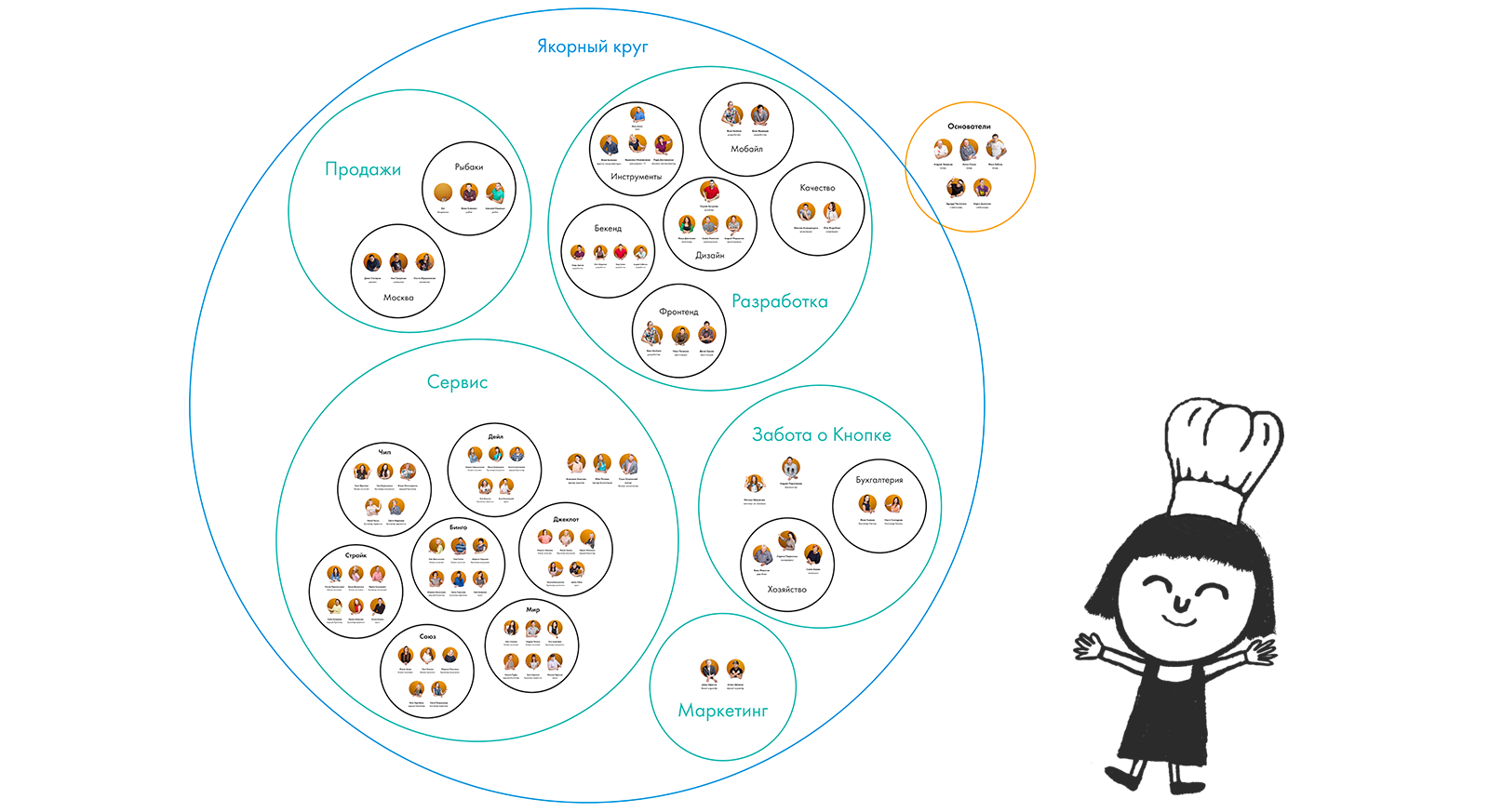
The button can be conditionally divided into several circles: leaders and stakeholders, development (the entire backend, frontend, designers and usabilityists here), marketing, sales and connections, caring for employees and, finally, service. Service is the most important and largest “department”, in which all accountants, lawyers,business assistants and other people directly involved in the service of Buttons work . We decided to start with him.
At first, the idea to divide a large circle of service into subcircles according to professional criteria seemed obvious to us. So the circles turned out more massive and homogeneous:

A few weeks later, we realized that this approach has nothing to do with reality. In reality, button guys work in teams that are not organized on a professional basis. Each team has a half lawyer, acouple of accountants and two assistants. The main work is done precisely in service teams, and when accountants or lawyers get together, they simply share their experience and help each other solve complex professional issues. In general, we redrawn everything, getting this picture:

The formation of the holarchy is the most important stage that determines all further work. The main principle by which circles should be organized is their purpose. We have no problem making the coolest lawyers or accountants in the opinion of lawyers and accountants themselves. We want to achieve amazing customer service. The guys who work together every day, share the same problems and aspirations, serve the same customers, must work in the same circle. It turns out that these circles formed by themselves long before holacracy, and we ignored this fact in attempts to come up withsomething new. Do not repeat this mistake and you will save a lot of time.
Expectations from the circles also formed by themselves, under the strong influence of accumulated experience. Each team has the highest mission - to serve entrepreneurs well, which is easily decomposed for tactical purposes: optimize taxes, deliver reports on time, prepare beautiful documents, solve routine tasks, and so on. It’s easy to measure each of these tactical goals:% of the reports submitted on time, the number of documents checked, the number of tasks solved (everything is logged by our internal tools), and the profitability of the team. It’s more difficult to come up with metrics for a higher goal, but it’s also realistic - we use the NPS rating and other methods to measure customer happiness.

To make progress and metrics transparent, teams created offline dashboards:
To finish circles once and for all, let's see what a button holarchy might look like when fully implemented: And what it looks like now: We still haven't figured out if it’s worth implementing holacracy at the level company, but the service team is not exactly limited. Holacracy is also needed in order to facilitate the interaction between teams performing indirectly related tasks. Now we have a common “anchor” circle of the organization, in which the circle of service is divided, divided into service teams, a circle ofthe founding leaders is seen a little at a distance . In fact, all the delights of holacratic communications are available only to those people who are in these circles.


While we are guided by theMVP approach and are fully focused on the service. As soon as the holacracy in the Button begins to grow and multiply, a topic for a new article will appear :)
The next item in the recipe - assigning roles and assigning metrics and expectations to them - took a lot of time and effort from us. However, it is pointless to spend a lot of time and effort describing this process, because the roles in your company are hardly similar to ours. A brief look at key points. The Great Wall of Expectations and Metrics There are 6 roles in each Button service team : lead accountant, primary accountant, payrollaccountant , accountant consultant , lawyer and business assistant . We formed these roles long before holacracy, based on customer needs. Each employee can take several roles in one circle (for example, an accounting consultant

For each of the roles, you need to form expectations and metrics. It took several weeks of work of trainers, leaders and guys from service teams. At the output, we received a detailed description for each role. The difference between such a description and a typical job description is that elements that have nothing to do with the real tasks of the employee are excluded from it. Expectations and metrics are formed from the totality of the goals of the company, the ideas of the person occupying the role, as well as all the people who work side by side or interact with this role. The job description, as a rule, is formed on the basis of the opinion of management, which can differ greatly from what the employee actually does.
We used only flipcharts, stickers and paintings to visualize the holarchy and fix expectations, buthumanity , HolacracyOne, came up with a special tool for this whole bacchanalia. It is called Glassfrog , it costs from $ 500, allows you to draw circles, list roles, metrics, expectations, and even publish your own holarchy on the Internet. We are waiting for the developers to add likes and comments :)

But here is theOrthodox authentic holarchy in Glassfrog performed by the development company .
The circles are chopped, the roles brought to a boil. You can serve a dish. However, consuming cooked with bare hands is pure barbarism. Need tools. In the standard organizational structure, such tools are managers who control the entire process and lower the will of their superiors from top to bottom, taking care to direct the result in the opposite direction. In the terminal stage - a beautiful report. Holacocracy orders to abandon the term "manager", but does not cancel the transfer of information in both directions. Rather, it makes the process more translucent and mutually beneficial.
To do this, in each circle, you need to add two more roles:lead-link and rep-link . The first brings expectations and information from the outer circle (assigned by the outer circle), the second collects problems and frictions of the inner one and brings them out (selected by voting inside the circle). One and the same person cannot occupy both roles within the same circle. Thus, in each circle 2 leaders appear: one according to the top link of the holarchy, the other from the people.
Choosing alead link is a responsible matter. Obviously, they should be a person who is equally trusted in the outer and inner circles. He should be organized, calm and reasonable, a little better than others to understand the goals of the business and have steel intentions. As a rule, such people can be seen right away, but holacracy will not give you an answer to the question of how to grow them. It can give impetus to their development, but you have to choose from what is.
Withrep-links everything is a little simpler: they are chosen by the team by open voting. The choice may be wrong, but it can be changed through impeachment. We did not immediately recognize the importance of rep links , and this is one of the most important tools in the whole model. Holacracy is needed so that every employee can influence (ideally positively) the life of the company. To do this, he must be able to convey any question or problem to any stage of the holarchy. For this, rep-links are needed - they accumulate information from the inner circle and remove dirty linen from the hut through special processes described in the constitution or in our previous article .

This is howlead-links and rep-links look in push-button holacracy.
Ourlead-links are already doing their part quite well: they inspire ideas, settle conflicts within the circle, look at things broadly and try to figure things out. With rep links slightly worse: we realized their significance late and did not yet have time to formulate the correct expectations.
Listed in these thirteen thousand characters is enough to set the table once. However, the goal of holacocracy is to teach everyone to cook independently. For six months, we met a bunch of problems, most of which are associated with misunderstandings. Here you should be guided by the golden rule of holacracy: do what you must, identify problems, quickly solve them yourself or take them out if you can’t cope, repeat all this necessary number of times. Let’s talk about the main problems, fears and challenges that we encountered in the implementation of holacracy.
Lose the free flow of information - The worst nightmare of any Button employee. From time immemorial, any person in the company (even the most recent marketer) could come up to the CEO, ask any uncomfortable question and even get an answer to it. Holacocracy restricts this opportunity a bit, offering to solve important issues through the management process and rallies. However, if you do not follow the dogma, the rules can and must be broken. But it’s wise to violate, so that when you have 2,000 employees and 2,000,000 questions, the poor CEO will not die from an excess of verbal activity. If the flow of information has dried up, the problem is most likely in the wrong choice oflead-links and rep-links or bad processes.
Not every employee can organize themselves. To everyone’s sadness, this is so. Many people are good at their job, but theystill need a man who will lead them into a brighter future. Usually this role is played by the manager, but at the same time he can give the employee direct instructions, in every way affect his life and moral condition. In a holacratic company, the lead link can inspire, carry the banner and adjust expectations for the role, but it can not adversely affect what the employee knows how to do better than himself. In addition, no one canceled the collaboration and other activities designed to do the job as efficiently as possible.
The fight against the megalomania inherent in every person is another task. Power-hungry man, who was misunderstood as alead link , can weave intrigues and use his position. Holacracy gives mechanisms of influence on such characters, but does not exclude their appearance. The situation with rep-links is even worse: people choose them, expressing the deepest reverence and virtually raising their status. Our bitter experience taught us to correctly formulate expectations from the rep-link and convey them to the performer of this role, but before that we had to part with a couple of great people.
Facilitator and Secretary rolesnecessary for the integrative decision-making process, we have not stood out. However, the management process itself with all tactical and strategic rallies, as prescribed by the Constitution, did not take root. We continue to use daily scrams, live two-week iterations, and reform retrospectives and presentations a bit. In other words, we are trying to solve this problem by adapting the agile inside holacracy. The processes described in the Constitution look entertaining, but require a lot of time and effort to implement.
Enthusiasm for structural issues prevents the elimination of “stress points” - we noticed this problem when we suddenly found ourselves plunged into reforming the organizational structure. Instead, more attention should be paid tolead link roles and rep-links so that the magic machine of holacratic communications works properly. Without this, it is impossible to create a constant flow of information necessary for identifying and eliminating problems (voltage points). Meanwhile, it is this process that will drive the entire company into a bright, holacratic future.
Contradictory and distorted information is the destiny of most articles on holacracy. Media loves sensational headlines in the spirit of “No more managers!” and "Flat structure defeats the bureaucracy." This forms a misconception about the fundamental principles of holacracy and prevents its implementation.
Holacracy does not care about company customers - This is a typical example of misconception generated by loud headlines and misinterpretation. Holacracy is a way to improve the company’s inside, but it doesn’t interfere with building the feedback collection process and studying customers. You canstill use aggile or any other approach that allows you to make a great product for your audience.
Holacracy is too harsh for a flexible company. Constitution 4.0 - hellish hell and bureaucracy on steroids. Its full implementation inmore or less a large company at best will not do any good, but at worst it will break everything. By the way, Holacracy is a registered trademark distributed under the No Derivatives Creative Common License. It can be used for non-commercial purposes, but can not be changed and expanded. Therefore, we do not practice holacocracy, we simply use its principles. Let's call it the Knopocracy.
Now holacracy is at an early stage (although it appeared back in 2007). It is introduced by early followers and young experimenters,because why finding answers to many questions is very difficult. We were helped by professional priests from the distant Amsterdam holacracies - Diderik Janse and Fiona Hayes (Diederik Janse, Fiona Hayes), volunteered to answer our tricky questions by phone. I think they won’t refuse you either, but be careful: you will be invited to visit for a long and expensive master class on holacration :)
Holacracy owes its popularity to Zappos . These guys adopted the constitution last year, and some principles apply even longer. Now the company has more than 1,500 employees, the implementation process is due to end in December. By that time, Zappos will have about 400 laps. Among others, there is a separate circle that is responsible for holacracy itself. In such a large organization, a complete reform seems like an incredible undertaking, but knowing Tony Neck, we can safely say that everything will work out. Last fall, Button visited Zappos at theirLas Vegas office . We saw with our own eyes that even with such a staff, you can maintain the flexibility of a mountain doe startup.

Moreover, against the background of Tony’s new venture, this no longer seems like a crazy idea: the founder of Zappos seriously wants to implement holacratic principles of governance at the level of the centralLas Vegas area . He has already invested a breakthrough in resources to make downtown more comfortable for his employees, and does not intend to stop.
Another example of the triumph of holacracy - David Allen Company - the company of the very uncle who once invented the GTD. The main time managers and priests of productivity introduced holacracy back in 2011. Now the company employs about 50 people. It is argued that holacracy helps them transfer the principles of personal productivity described in the GTD to the level of teams and the whole company. A sort of Getting Teams Done for those who have perfectly mastered the skill of self-organization.
One of the founders of Twitter, now owningthe Medium blogging platform , also decided to keep up with the trend and joined the holacrates movement last year. The guys from the creative studio Undercurrent with a staff of 28 for some the reason, too, found it necessary, although for small companies it hurts rather than helps to open new horizons.
There are a bunch of similar patterns that are often mistaken for holacocracy. For example, the models Valve, 37Signals and the long-suffering GitHub, who allegedly lost an excellent engineerdue to the introduction of holacracy. A careful study of interviews and journalistic investigations gives the impression that the reason was pretty commonplace things. In the end, inter-gender conflicts and malicious wives of the founders are in any control model, whether it is flat or hierarchical.
None of the organizations described in the previous paragraph (and even GitHub) apply classical holacracy - they borrow key principles and develop their own model. We go the same way, try not to rely on dogma and add our own authoring sauces to the dish prepared by Brian Robertson . Even the most titled theorist does not know for sure what is best for your business, but skepticism should not interfere with experiments. We wish you to come up with your own holacocracy, without dogma or excesses.
At leisure, you can read:
And at the same time other button articles about service and project management:
In a previous article, we wrote about what holacracy is and why you do not need it . Today we will dilute the sweet theory with bitter practice and see how it works in the Button. We will not ignore the experience of Zappos, Medium, David Allen Company and argue in the comments about the situation on GitHub. Are you with us :)
Essential Ingredients
Let's just say: The button was ready for holacracy long before it learned about holacocracy. From the very beginning of our fascinating journey, we tried to build a self-organizing company where everyone makes decisions, asks questions and sees the whole picture. From the first days, we used agile , formed values , cultivated an entrepreneurial approach to the work of each employee. The more people we hired, the harder it became to plant and maintain this culture.
In the Button, each boss is his own
Holacocracy itself does not solve the problems described. It only helps to structure the approach and makes it possible to scale it with the growth of the company. The main ingredients of holacracy: intelligent and proactive employees, the flexibility of the company and the will of the founder / director / owner of the business. If all of this is available, let's look at the recipe.
Additives and spices to your taste
A business, like any person, may be intolerant to certain products. The Constitution of Holacocracy dictates strict implementation rules, described in a dry legal language. The best idea is to throw out all the harmful elements or use their closest analogues. For example, replacing Mozzarella with goat cheese and abandoning pepper :)
The introduction of holacracy in the Button began messy: we did not read the Constitution, replacing the academic approach by studying someone else's experience. Probably, if
If you do not follow strict guidelines, you need to start with simple things:
- form a hierarchy of circles (more precisely, a holarchy)
- form expectations and assign metrics to each circle
- identify the roles required within each of the circles
- form expectations and assign metrics for each role
- fill the roles with the right people
- assign
lead links andrep links - teach people to navigate unfamiliar terms
If you didn’t find any familiar words on this list, urgently read our first article about theoretical holacocracy . If everything is ok, let's get down to business.
Holarchy in its own juice
The button can be conditionally divided into several circles: leaders and stakeholders, development (the entire backend, frontend, designers and usabilityists here), marketing, sales and connections, caring for employees and, finally, service. Service is the most important and largest “department”, in which all accountants, lawyers,
At first, the idea to divide a large circle of service into subcircles according to professional criteria seemed obvious to us. So the circles turned out more massive and homogeneous:

A few weeks later, we realized that this approach has nothing to do with reality. In reality, button guys work in teams that are not organized on a professional basis. Each team has a half lawyer, a

The formation of the holarchy is the most important stage that determines all further work. The main principle by which circles should be organized is their purpose. We have no problem making the coolest lawyers or accountants in the opinion of lawyers and accountants themselves. We want to achieve amazing customer service. The guys who work together every day, share the same problems and aspirations, serve the same customers, must work in the same circle. It turns out that these circles formed by themselves long before holacracy, and we ignored this fact in attempts to come up with
Note to the hostess: circles are formed by themselves in the process of work. No need to fence a new structure, just gently circle the existing teams and divide them into subcircles, if necessary.
Expectations from the circles also formed by themselves, under the strong influence of accumulated experience. Each team has the highest mission - to serve entrepreneurs well, which is easily decomposed for tactical purposes: optimize taxes, deliver reports on time, prepare beautiful documents, solve routine tasks, and so on. It’s easy to measure each of these tactical goals:% of the reports submitted on time, the number of documents checked, the number of tasks solved (everything is logged by our internal tools), and the profitability of the team. It’s more difficult to come up with metrics for a higher goal, but it’s also realistic - we use the NPS rating and other methods to measure customer happiness.
Transparency is one of the main principles of holacracy, so it should be given close attention. Any person in the company should have access to any information, even if it does not directly concern him. Otherwise, people will lose their sense of reality and cease to understand the situation of the business.
To make progress and metrics transparent, teams created offline dashboards:
To finish circles once and for all, let's see what a button holarchy might look like when fully implemented: And what it looks like now: We still haven't figured out if it’s worth implementing holacracy at the level company, but the service team is not exactly limited. Holacracy is also needed in order to facilitate the interaction between teams performing indirectly related tasks. Now we have a common “anchor” circle of the organization, in which the circle of service is divided, divided into service teams, a circle of


The circle of leaders stands apart only to create the right attitude to the role of managers in the company. In fact, it is the pinnacle of the holarchy, but is deprived of the power to directly influence the subdistricts and work of specific people. However, leaders canstill change the company's strategy, adjusting the expectations and metrics of the anchor circle, and also influence the outlines of the internal circles throughlead links andrep-links (more about them later).
While we are guided by the
Thoroughly Roasted Roles
The next item in the recipe - assigning roles and assigning metrics and expectations to them - took a lot of time and effort from us. However, it is pointless to spend a lot of time and effort describing this process, because the roles in your company are hardly similar to ours. A brief look at key points. The Great Wall of Expectations and Metrics There are 6 roles in each Button service team : lead accountant, primary accountant, payroll

In a typical development team, roles could look like this: team lead, backend developer, front-end developer, tester, mobile developer. At the same time, for example, our mobile application developer Vasya also acts as a front-end developer and a couple of related roles. It's Complicated :)
For each of the roles, you need to form expectations and metrics. It took several weeks of work of trainers, leaders and guys from service teams. At the output, we received a detailed description for each role. The difference between such a description and a typical job description is that elements that have nothing to do with the real tasks of the employee are excluded from it. Expectations and metrics are formed from the totality of the goals of the company, the ideas of the person occupying the role, as well as all the people who work side by side or interact with this role. The job description, as a rule, is formed on the basis of the opinion of management, which can differ greatly from what the employee actually does.
In drawing up expectations, one should be guided by the ideal unattainable idea of the result that you want to get at the output. It will be difficult to meet such expectations, but it will always be clear what to strive for.
We used only flipcharts, stickers and paintings to visualize the holarchy and fix expectations, but
But here is the
Company management cutlery
The circles are chopped, the roles brought to a boil. You can serve a dish. However, consuming cooked with bare hands is pure barbarism. Need tools. In the standard organizational structure, such tools are managers who control the entire process and lower the will of their superiors from top to bottom, taking care to direct the result in the opposite direction. In the terminal stage - a beautiful report. Holacocracy orders to abandon the term "manager", but does not cancel the transfer of information in both directions. Rather, it makes the process more translucent and mutually beneficial.
To do this, in each circle, you need to add two more roles:
Lead-link andrep-link are not separate independent roles. They are filled with people who have other roles within the circle. In our case, one of the accountants, lawyers andbusiness assistants becomeslead links andrep-links .
Choosing a
With
This is how
Our
The only practical advice we can give is to be careful.The lead link should be a leader, not a manager.The rep link should be the voice of reason, not a union leader. In no case should one choose the loudest, most daring and power-hungry for these roles. As a rule, good leaders come from calm, confident people who are ready to inspire by their own example. Representatives, on the other hand, are those who value logic above empathy.
Learning to cook by trial and error
Listed in these thirteen thousand characters is enough to set the table once. However, the goal of holacocracy is to teach everyone to cook independently. For six months, we met a bunch of problems, most of which are associated with misunderstandings. Here you should be guided by the golden rule of holacracy: do what you must, identify problems, quickly solve them yourself or take them out if you can’t cope, repeat all this necessary number of times. Let’s talk about the main problems, fears and challenges that we encountered in the implementation of holacracy.
Lose the free flow of information - The worst nightmare of any Button employee. From time immemorial, any person in the company (even the most recent marketer) could come up to the CEO, ask any uncomfortable question and even get an answer to it. Holacocracy restricts this opportunity a bit, offering to solve important issues through the management process and rallies. However, if you do not follow the dogma, the rules can and must be broken. But it’s wise to violate, so that when you have 2,000 employees and 2,000,000 questions, the poor CEO will not die from an excess of verbal activity. If the flow of information has dried up, the problem is most likely in the wrong choice of
Not every employee can organize themselves. To everyone’s sadness, this is so. Many people are good at their job, but they
The fight against the megalomania inherent in every person is another task. Power-hungry man, who was misunderstood as a
Facilitator and Secretary rolesnecessary for the integrative decision-making process, we have not stood out. However, the management process itself with all tactical and strategic rallies, as prescribed by the Constitution, did not take root. We continue to use daily scrams, live two-week iterations, and reform retrospectives and presentations a bit. In other words, we are trying to solve this problem by adapting the agile inside holacracy. The processes described in the Constitution look entertaining, but require a lot of time and effort to implement.
Enthusiasm for structural issues prevents the elimination of “stress points” - we noticed this problem when we suddenly found ourselves plunged into reforming the organizational structure. Instead, more attention should be paid to
Contradictory and distorted information is the destiny of most articles on holacracy. Media loves sensational headlines in the spirit of “No more managers!” and "Flat structure defeats the bureaucracy." This forms a misconception about the fundamental principles of holacracy and prevents its implementation.
Holacracy does not care about company customers - This is a typical example of misconception generated by loud headlines and misinterpretation. Holacracy is a way to improve the company’s inside, but it doesn’t interfere with building the feedback collection process and studying customers. You can
Holacracy is too harsh for a flexible company. Constitution 4.0 - hellish hell and bureaucracy on steroids. Its full implementation in
Now holacracy is at an early stage (although it appeared back in 2007). It is introduced by early followers and young experimenters,
Are there other dishes on the menu?
Holacracy owes its popularity to Zappos . These guys adopted the constitution last year, and some principles apply even longer. Now the company has more than 1,500 employees, the implementation process is due to end in December. By that time, Zappos will have about 400 laps. Among others, there is a separate circle that is responsible for holacracy itself. In such a large organization, a complete reform seems like an incredible undertaking, but knowing Tony Neck, we can safely say that everything will work out. Last fall, Button visited Zappos at their
Moreover, against the background of Tony’s new venture, this no longer seems like a crazy idea: the founder of Zappos seriously wants to implement holacratic principles of governance at the level of the central
Another example of the triumph of holacracy - David Allen Company - the company of the very uncle who once invented the GTD. The main time managers and priests of productivity introduced holacracy back in 2011. Now the company employs about 50 people. It is argued that holacracy helps them transfer the principles of personal productivity described in the GTD to the level of teams and the whole company. A sort of Getting Teams Done for those who have perfectly mastered the skill of self-organization.
One of the founders of Twitter, now owning
There are a bunch of similar patterns that are often mistaken for holacocracy. For example, the models Valve, 37Signals and the long-suffering GitHub, who allegedly lost an excellent engineer
None of the organizations described in the previous paragraph (and even GitHub) apply classical holacracy - they borrow key principles and develop their own model. We go the same way, try not to rely on dogma and add our own authoring sauces to the dish prepared by Brian Robertson . Even the most titled theorist does not know for sure what is best for your business, but skepticism should not interfere with experiments. We wish you to come up with your own holacocracy, without dogma or excesses.
At leisure, you can read:
- HolacracyOne Medium Blog
- section " How it works " on their website
- or even watch a one-hour webinar from the creator of holacracy
And at the same time other button articles about service and project management: