April 27, 2014 at 20:04
The invisible difficulties of rocket technology: Part 5. Launch facilities
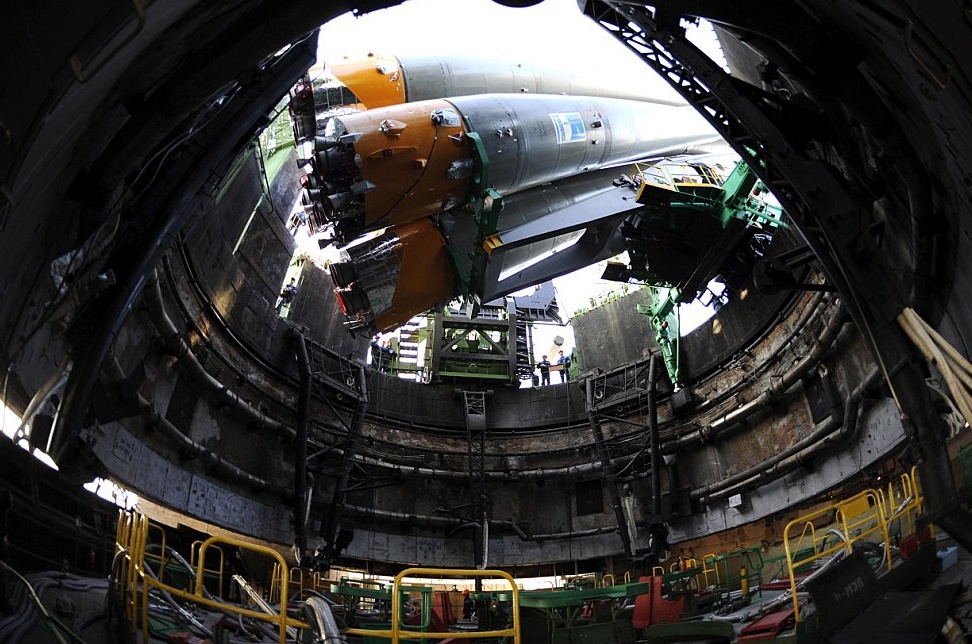
Launching facilities are a separate interesting aspect of space technology. In fact, the rocket must be assembled, taken to the launch pad, checked again, refueled, landed the crew (if the launch is manned) and launched. And each of the tasks challenges engineering ingenuity, materials science, competency and many other disciplines.
Introduction
In order to make it clear what is at stake, it is necessary to explain the terms used and to tell in general how the launch of the launch vehicle occurs.
First of all, the launch vehicle and payload are delivered to the spaceport. The launch vehicle is almost always delivered disassembled, because it is easier to transport. Then the rocket and the payload are assembled in one piece and checked in a special building, which has different names for different rockets in different countries: MIC (installation and testing complex), technical position, technical complex, VAB (Vertical Assembly Building, vertical assembly building ), assembly building, etc. Then the launch vehicle, usually assembled together with the payload, is transported to a special platform from which the launch takes place. This site also has many names - launch complex, launch pad, launch pad, etc. A rocket placed vertically is a very tall thing, so usually there is a so-called
When rockets were small
The smaller the rocket, the easier the launch complex and less difficulties with it. At the dawn of rocket science, the entire launch complex consisted of a flat concrete platform, rocket support on small legs and a simple service tower:
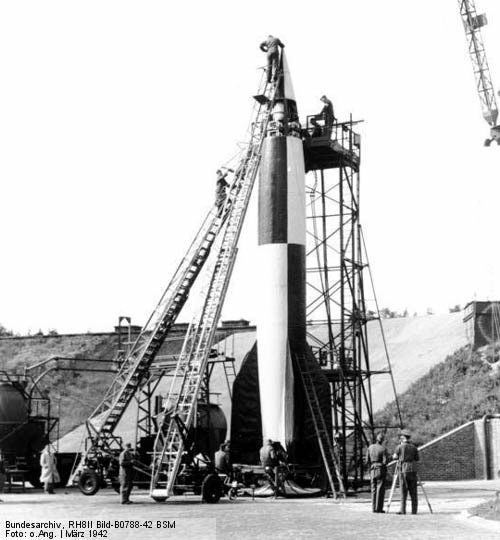
V-2 and ladders.
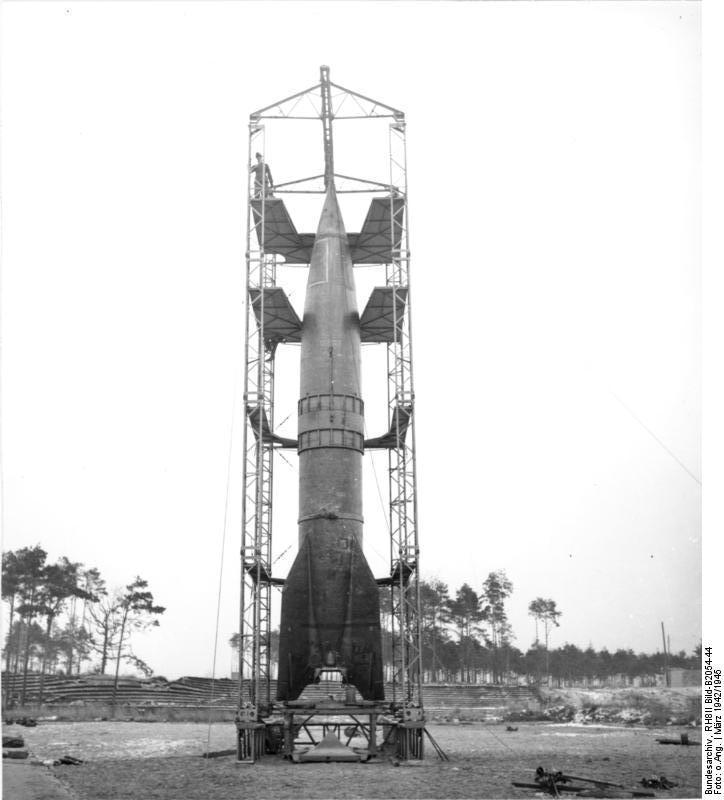
A more advanced version of the service tower. The cone at the bottom is installed for uniform emission of gases to the sides.
Even on manned launches with small missile launch complexes, there were no particular difficulties:
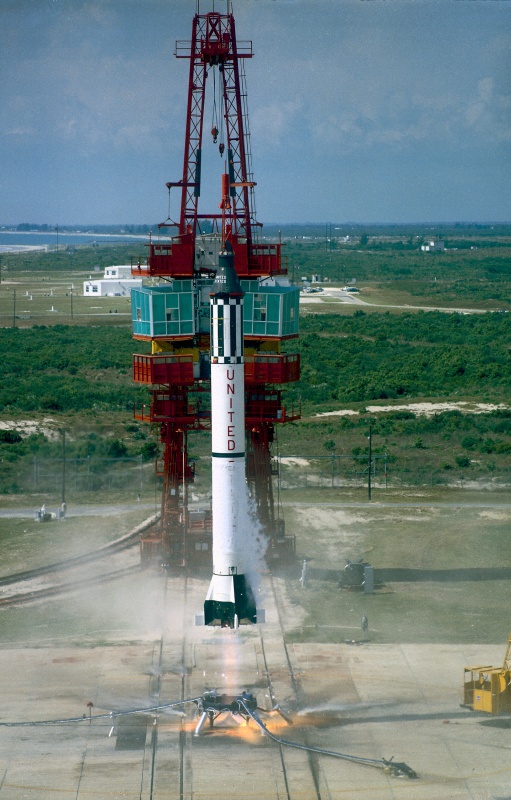
1961, the first manned mission of the Mercury program - Mercury-Redstone 3. The tower moves on rails, the technology is similar to a construction crane. Under the starting support, the same cone is visible for uniform dispersion of gases.
In principle, for small missiles this approach is still alive today. A small starting mass means a relatively small engine power and the absence of problems with exhaust gases, a relatively short exposure to high temperature, which reduces the requirements for materials.
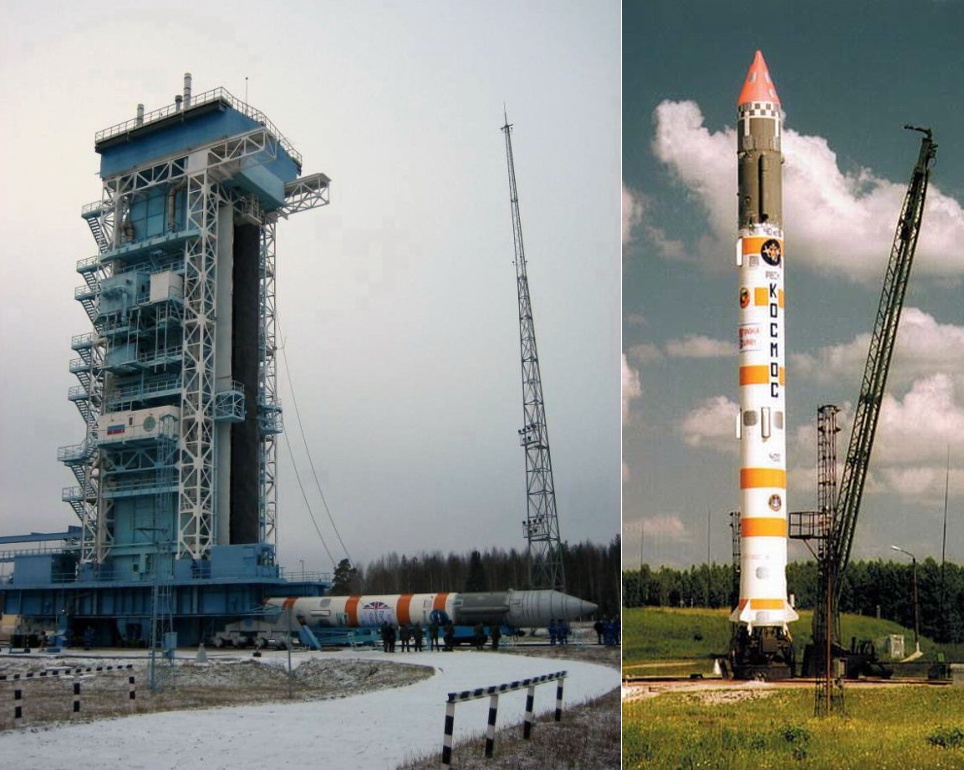
LV Cosmos-3M, most recently decommissioned. The service tower is visible on the left, and a simple launch pad on the right.
In the West, it’s about the same thing - a small rocket can be launched at the start with an industrial crane:

Taurus on the left, Minotaur V. on the right.
And launch from a higher, but still simple launching structure:
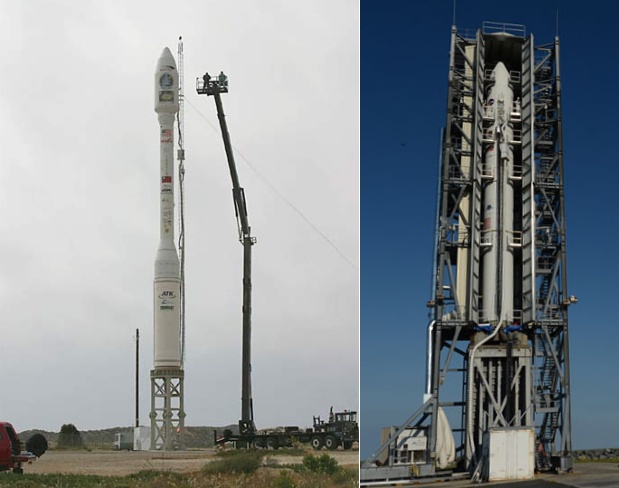
Taurus on the left, Minotaur V. on the right.
How a tulip blossomed
Probably the most unusual launch complex is the R-7 missile family. Firstly, this is the only complex in which the rocket does not stand on the table, but is suspended in the middle. Secondly, in earlier versions, the start table rotates entirely before launch. And thirdly, instead of the service tower, two “half towers” were made, which, moreover, depart from the rocket by turning in a vertical plane. Why were such decisions made?
The decision on the first point is very well described by B.E. Chertoka. For R-7 family missiles, the first and second stages are packaged. And this package was very poorly installed on the launch pad - a serious reinforcement of the tail section was required, which is overweight, and the wind resistance increased. There were even ideas to build a wall around the start. The sketch of the transport device that transported the rocket and placed it on four launching tables, one for each side block, did not inspire anyone either. And then a very beautiful engineering idea arose. In flight, the forces of the side blocks are transmitted to the central block through their upper parts. So why not hang the rocket at the start for the same power nodes? In this case, the rocket at the start experiences the same loads as in flight, and no special measures are needed to strengthen the structure.
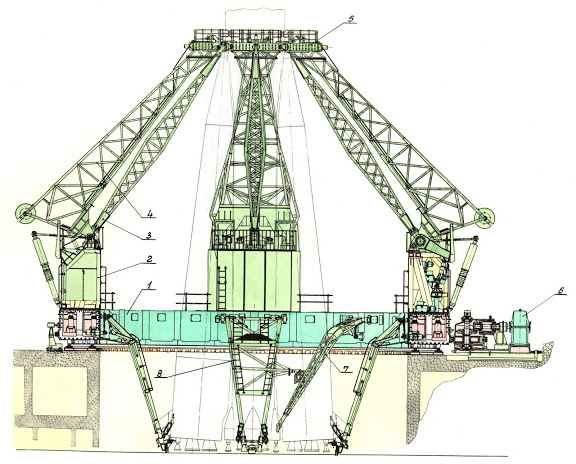
Scheme of the launch pad. At the very bottom there is also a retractable table for personnel access, not shown here.
Point two proceeded from the task of facilitating the work of the control system. At that time, deploying a rocket with a launch pad before launch was easier than setting up a turn after launch for an analog control system. Now, in the age of computers, this is an anachronism. At Baikonur, tables can rotate, and this is used as a legacy, and at new launch complexes (Kuru, Vostochny), tables are already without rotary devices.
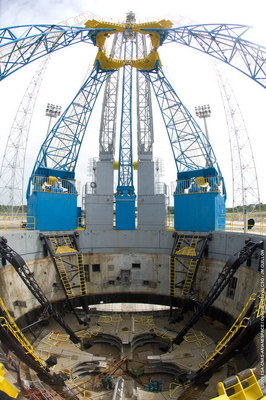
Photo of the launch site in Kourou.
The third point is due to the constant upgrades of the R-7 family missiles. At first there was a simple single-level site:
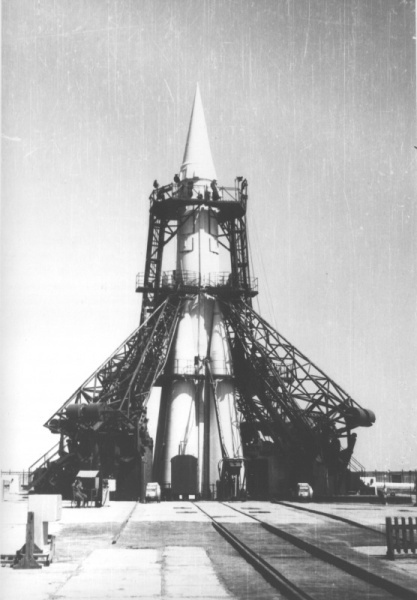
When R-7 became the “East”, a mobile service tower was added to the single-level site:
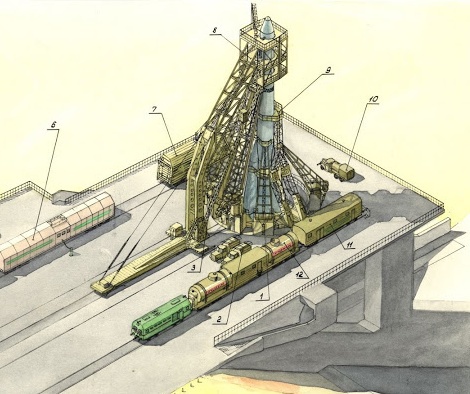
For “Sunrises” and “Lightning” we added levels:
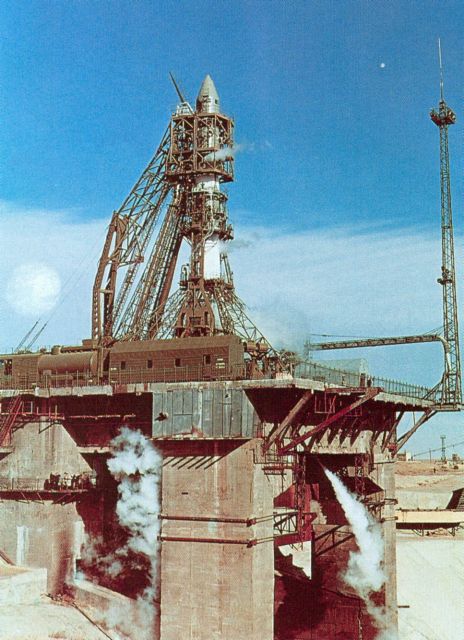
The result is slightly predictable :)

This is Plesetsk, there are 9 levels, on Baikonur 8.
Great photo, very beautiful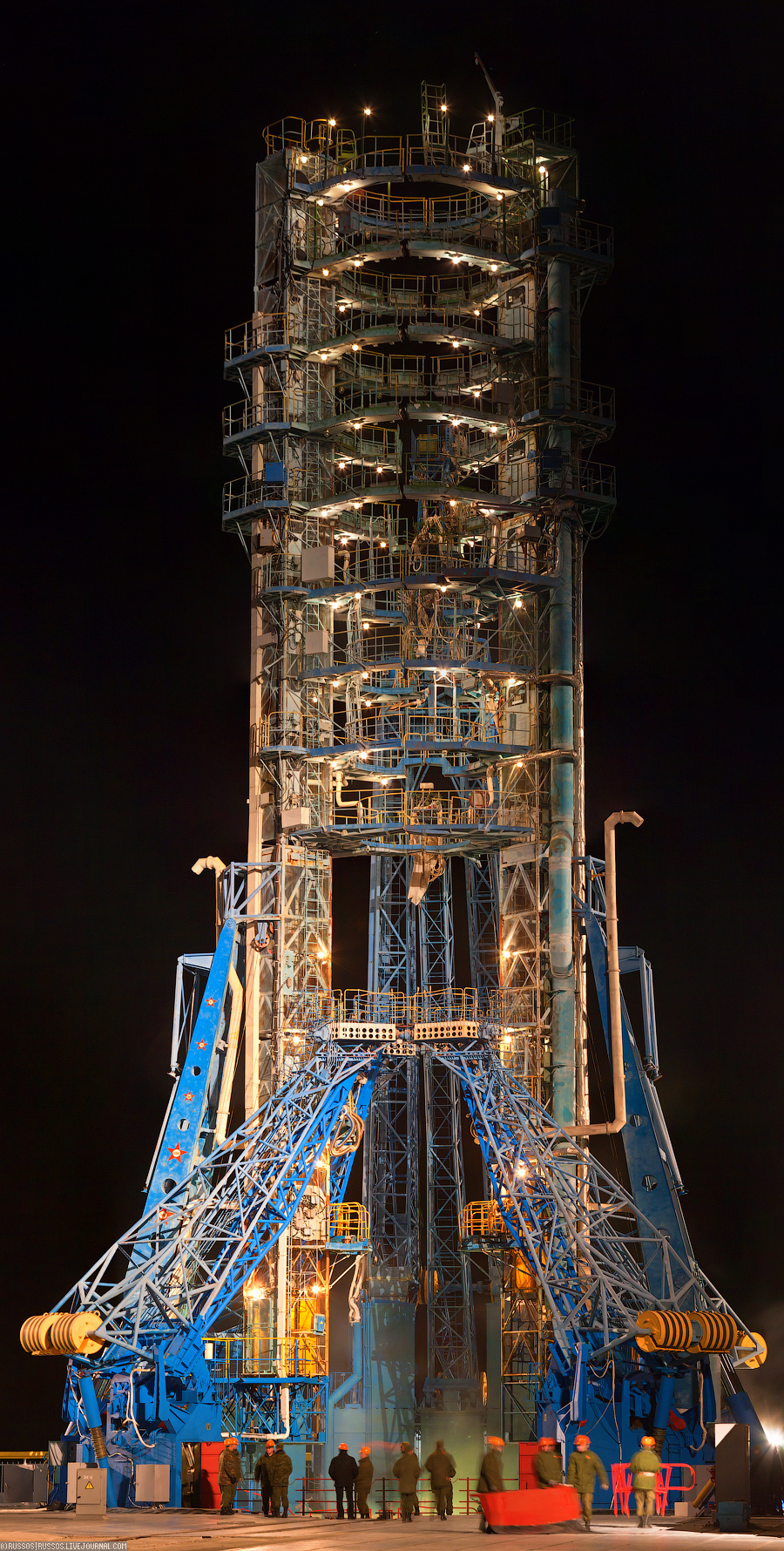
Despite the beautiful view, the structure is not very comfortable. The sites are open, blown away by all the winds, and work in cold or hot weather is an invisible heroism of starting calculations. Therefore, when they began to build the start of the “unions” in Kura, they designed the usual mobile tower (there was one more factor, we will talk about it a bit later):

A good result of the operation of the new tower led to the same situation on Vostochny.
Guns go to battle backwards
A separate interesting dilemma is the transportation of the rocket to the launch line. And, of course, there are many possible solutions, with their pros and cons. Firstly, the missile assembly can not be taken anywhere at all - assemble immediately at the start, check and launch. Secondly, the rocket can be assembled horizontally, taken to the start, set it upright, and launched. Thirdly, the rocket can be assembled vertically, and taken to the launch immediately in a vertical position. And you can mix these options.
The first option is implemented mainly for small missiles (because it's simple):

Taurus again. Left, covered in blue, the first step.
Also, Indians experimented with this option, all of a sudden. The PSLV missile was assembled immediately on the launch pad .
Advantages:
- No need to carry the rocket to the start.
Disadvantages:
- It is necessary to take away the assembly and testing complex from the start.
It is clear that with the growth of the size of the rocket, the MIC becomes harder to carry than a rocket.
The second option is a Soviet / Russian school, as well as SpaceX. "Unions", "Protons", "Cosmos", "N-1", "Energies", "Zeniths" and "Falcons" go to the start in a horizontal position. The conveyor is also an installer, and verticalizes the rocket.
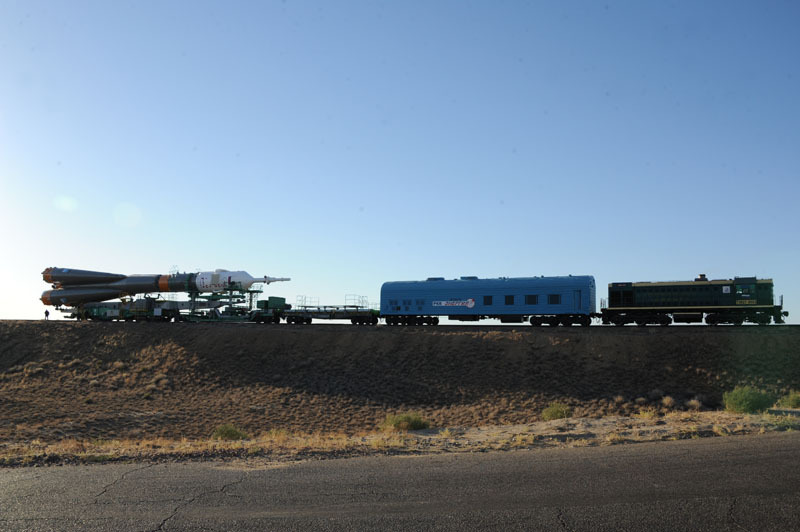
Advantages:
- Long MICs are easier to build than tall ones.
- Carrying in a horizontal position is easier.
Disadvantages:
- Rockets and payloads require additional flexural strength.
The third option is the US school. Then they were joined by India, China, Europe.
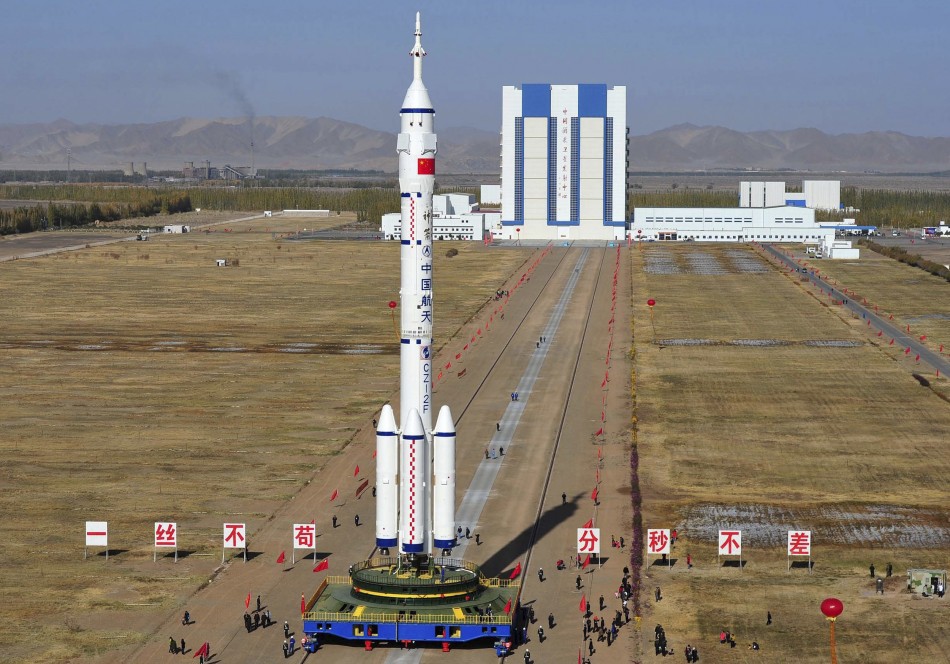
The Great Campaign, manned variant, China.
Advantages:
- The rocket and the payload are affected by force only in the up-down direction.
- No installer or verticalization required.
Disadvantages:
- Need a high MIC.
- Somewhat more complicated transportation.
The fourth option is the Kourou spaceport. The fact is that European satellites are often simply not designed for transportation in a horizontal position. To save weight, they lack bending strength. But what if the Soyuz is designed for horizontal transportation? We decided to make a hybrid method - the first three steps go as usual, horizontally, and the payload with the booster block are set already at the start. This is the second reason for creating a mobile service tower.

Advantages:
- Combines the convenience of horizontal transportation and vertical assembly.
Disadvantages:
- Requires a clean room, mini-MIC in the service tower.
Tower Dilemma
The next question is - do you really need a service tower? Let us carry out all the checks in the MIC, and launch operations should be done automatically. In this case, there is no one and no need to walk around the service tower, and it will not need to be built at all. The idea is attractive, but, as it turned out, it also has its drawbacks. It was the first to be sold in the USSR for the Zenit rocket. The installation, refueling, preparation for start-up and start-up was completely automated and did not require anything from a person except for working with his head and pressing buttons. The start was simple and minimalistic:
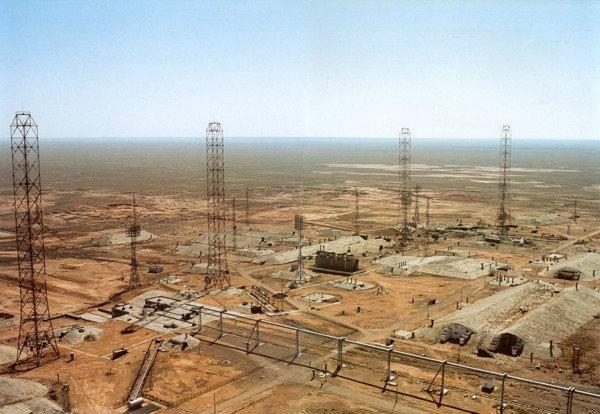
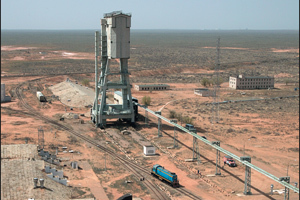
Everything would be fine, but such a start, firstly, is unsuitable for manned launches. For the same "Zenith", which they decided to make manned, it was necessary to build a "birdhouse" service tower:
The second drawback is that nothing can be fixed at the start. If there is a minor failure, which, if there was a tower, could be fixed in half an hour, the rocket has to be removed from the start and taken back to the MIC. SpaceX also lacks a tower, and those who follow Falcon launches must have noticed that launches are regularly rescheduled to a later date. Of course, malfunctions are different, and not everything can be fixed on the spot, but the presence of a tower makes it possible to correct small failures quickly.
Tower Dilemma 2
Another question, again related to the tower, is the question of its mobility. How much is it necessary and justified to spend money so that the tower can move away from the start? They are guided by engineering feasibility. A fixed tower must withstand a rocket explosion at launch. The mobile one should have motors, wheels and rails, as well as a system for stretching and collecting communications and pipelines. What is simpler, cheaper and more familiar is what they do. There are no national schools; in each project, engineers do what they consider more convenient. For example, they made a mobile tower for Proton:
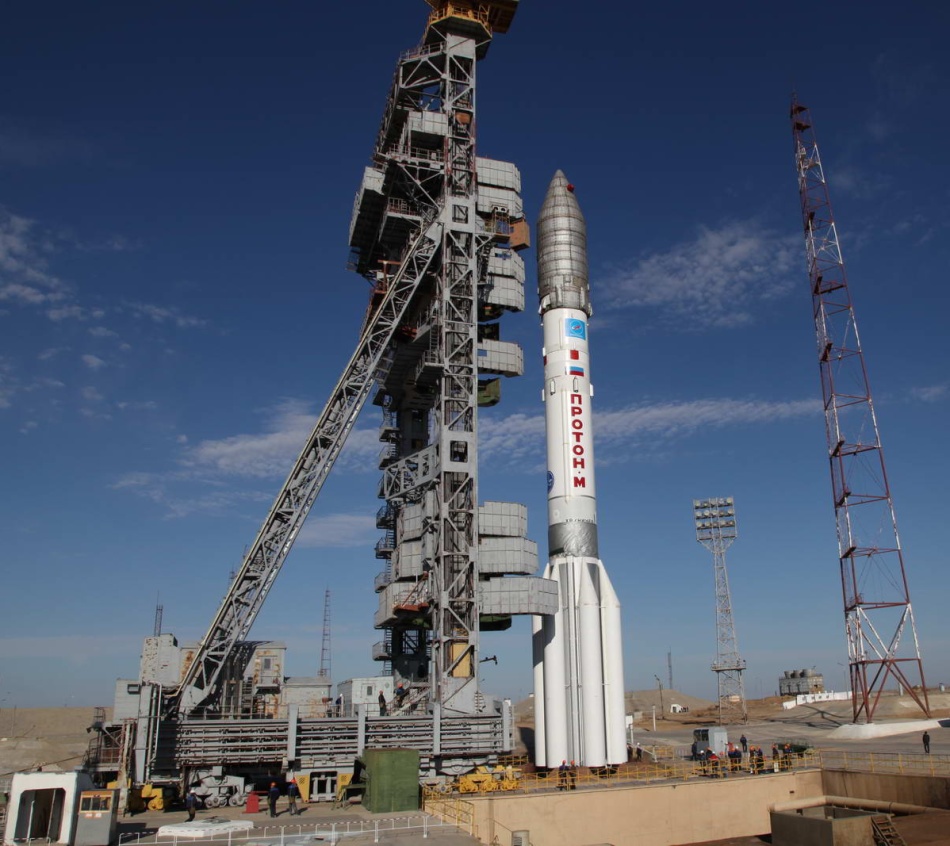
Panorama of the launch complex, view from the very top of the service tower.
And for Angara, it’s already stationary:
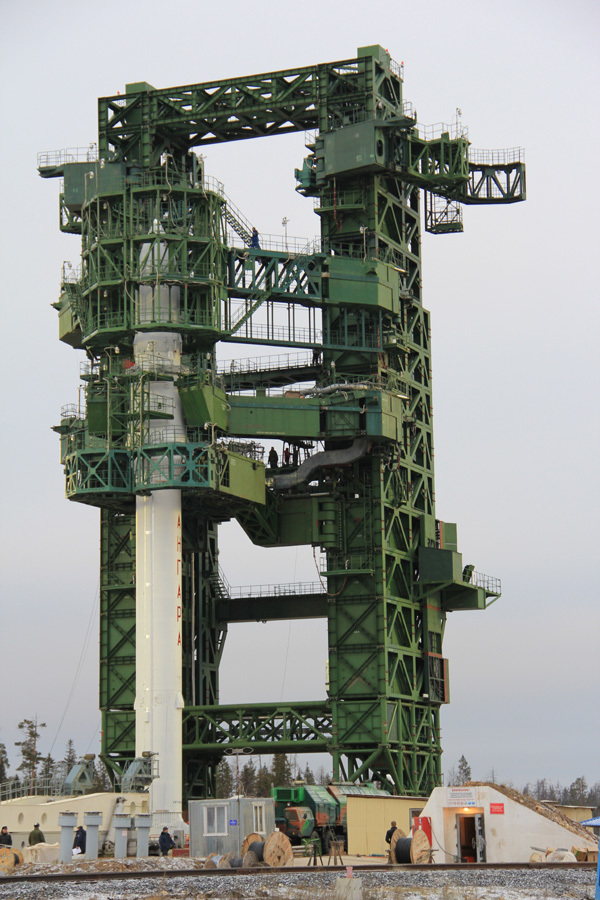
Gulliver's Throne
One cannot ignore launch complexes for superheavy missiles. The size and complexity of these systems, as well as the selected technical solutions are simply amazing.
The Americans acted in the tradition of their school - vertical assembly and transportation. A key element was the transporter tractor, which carried the rocket along with part of the launch pad and service tower. This is less known, but there was still the second half of the tower, which was driven by the same tractor:
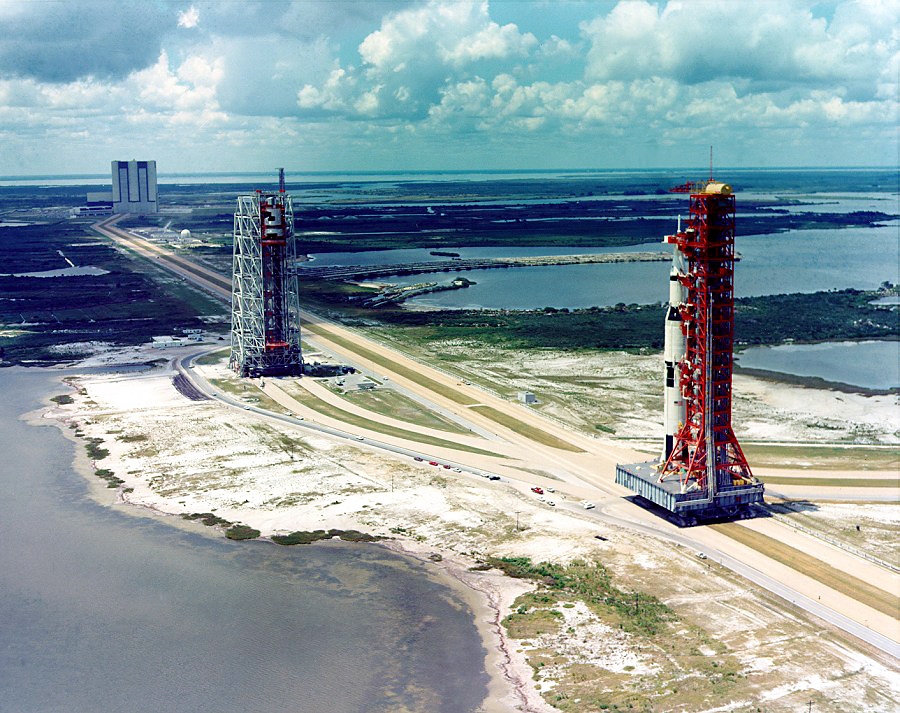
Saturn-V with the top of the launch pad and one service tower going to the start. The second tower is waiting in line at the “dead end” of roads for the tractor. In the distance, a vertical assembly building is visible.
A small engineering curiosity. The Apollo missions to the Skylab station and the Soyuz Apollo mission used the same LC39 launch complex, but a smaller rocket - Saturn-IB. In order for the rocket to stand opposite the same masts on a much larger launching structure, a “highchair” was made - a truss that raised the rocket to the height of Saturn V: The
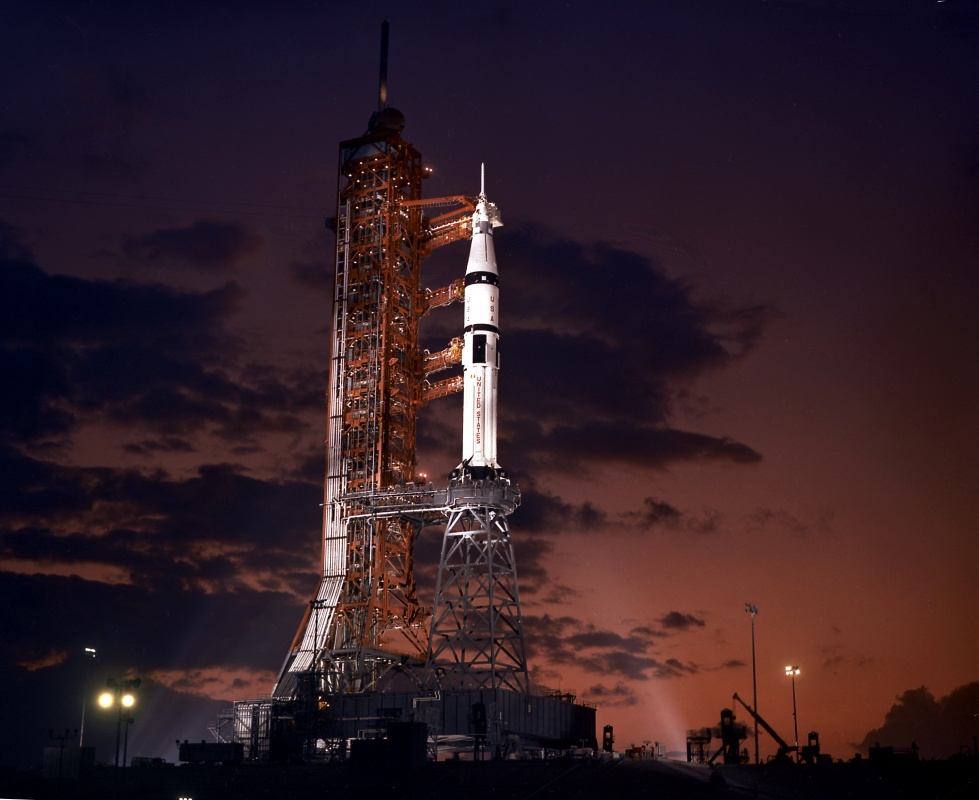
Soviet N-1 rocket was also made in native traditions, it was transported in a horizontal position on a giant installer by two locomotives along parallel rails. Unless the service tower was somewhat unusual - quite small.

With the beginning of the development of reusable ships, the starting complexes were waiting for the same fate - they were converted to reusable ships on both sides of the ocean.
In the USA, a very elegant service tower with a rotary element
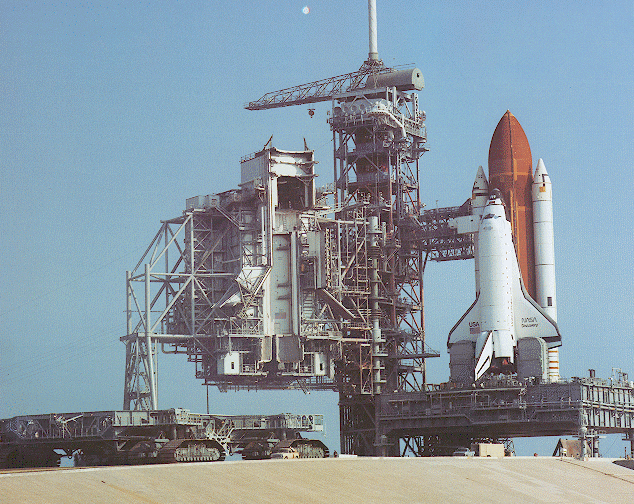
was made : In the USSR, a complex of two towers was made nearby:
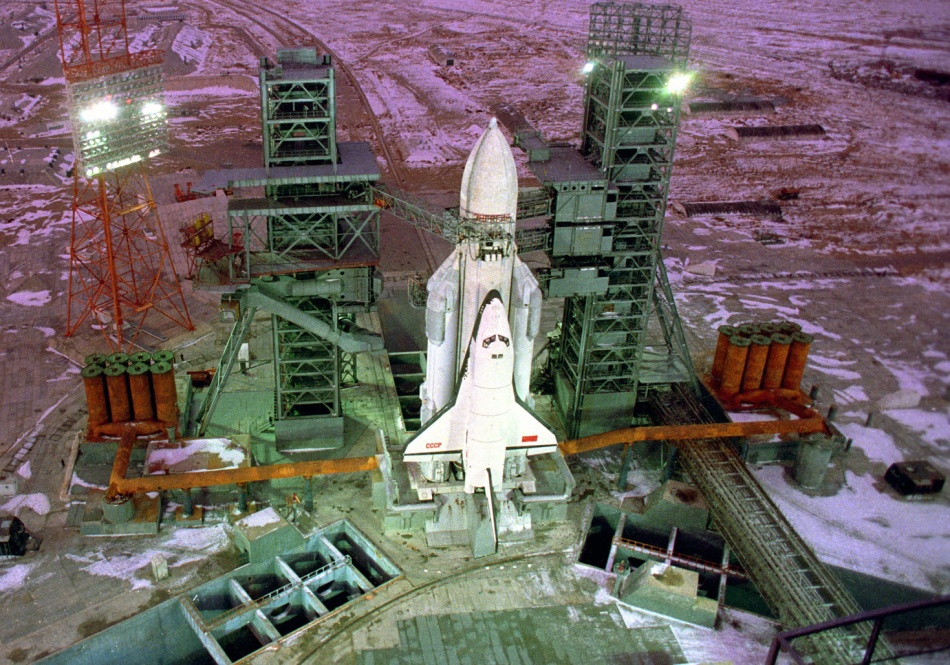
Large pipes on the left tower - a landing and emergency evacuation system for the crew. Photo from the site Buran.ru, copyright had to be cut off when cropping.
Gas ducts
If you carefully looked at the surface under the launch pad in the photographs, you probably noticed tunnels, openings, indentations. These are gas ducts, they are needed to divert the gases emitted by the rocket. For powerful engines of heavy rockets, a simple cone under the bottom is no longer enough. Their design may be different, in the USA they used a bulk launch pad with water-irrigated gas ducts at ground level more often. Water softens the shock wave and reduces the temperature load on the walls. Our gas ducts are usually dry and located below ground level. The April launch of Falcon showed that in the case of using irrigated underground gas ducts, it is worth monitoring the level of liquid in them - the rocket launched through a fountain of dirt, it is good that this did not cause problems.
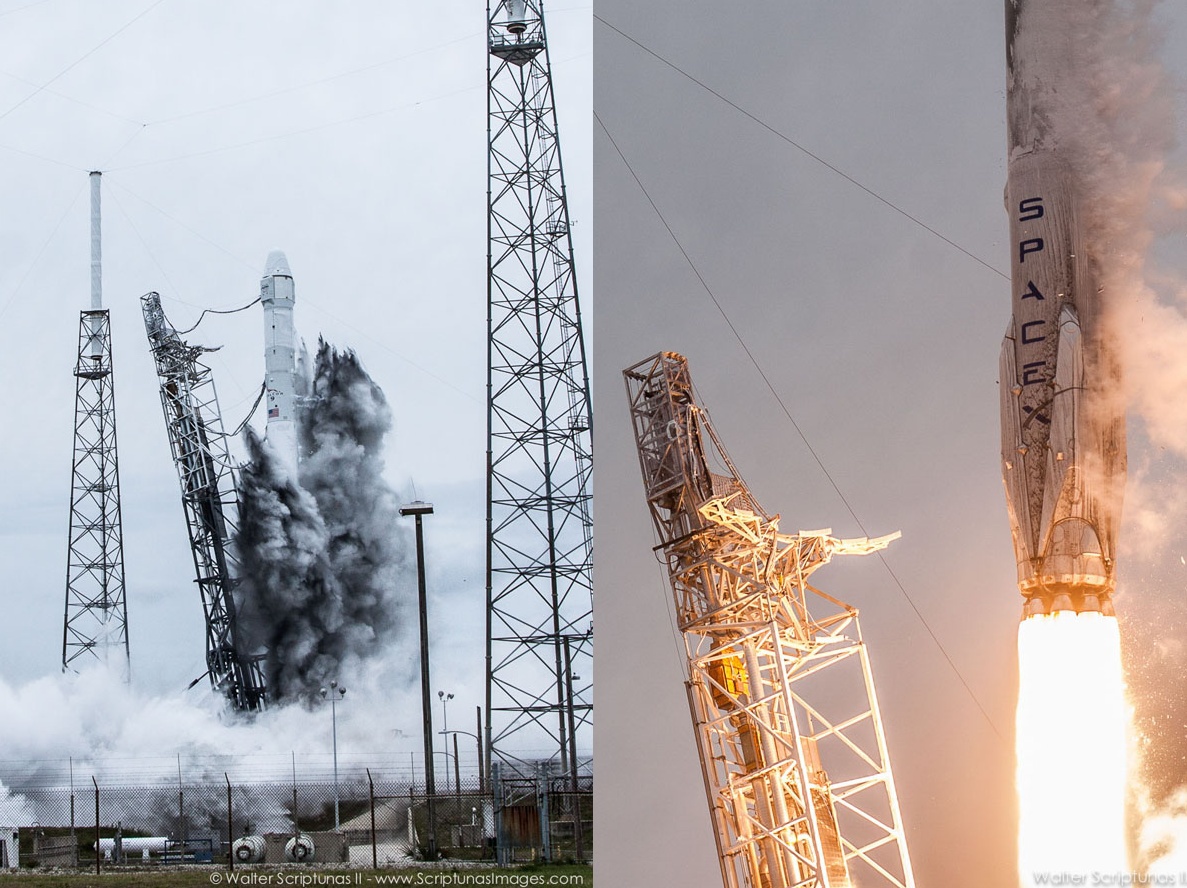
Conclusion
In conclusion, a beautiful Zenit slow-motion video at Sea Launch. The operation of the starting mechanisms and the evaporation of the falling ice are visible.
For navigation
This is the fifth post of the cycle. Direct links to previous ones:
- The first post.
- Solid propellant engines.
- Types of liquid fuel, geometric dimensions, transportation.
- Schemes of engines and insides of tanks.
Sources
- TsENKI. Starting and technical complexes.
- KIK USSR - unique photos.
- Panoramas of the FCA Roscosmos website.
- Special thanks for the fabulous photos site loveopium.ru and blogger Russos .