April 14, 2014 at 13:12
Idea Camp: the evolution of communications

Many scientists are inclined to believe that only a communicative mutation, or biological inheritance of signs, without which language proficiency is impossible (device of the speech apparatus, which involves a developed pharyngeal cavity; development of speech zones of the left hemisphere, and especially the frontal lobe, providing complex syntactic constructions, and semantic zones right hemisphere), entrenched with each new generation, and developing social skills of Homo Sapiens, allowed to survive and survive the "neighboring" branch - Homo neanderthalensis.
Despite the fact that Neanderthals had a larger cranial box than we did (1400-1600 cc. And above), the lack of a developed speech apparatus did not allow them to survive in the evolutionary struggle.
Millions of years of evolution have given us unique communication skills, a rich language and emotions.
We are sure that the evolution of smartphones follows the same principle: only those devices that can be most adapted to the communication mutations of our society will not die out and will be further developed.
As part of the Idea Camp, we tried to find directions for this development, which will allow the next generation of our smartphones to expand the communication (and not only) abilities of their owners.
Read how it went, read under the cut.

A few words about what a workshop is and why it is needed.
This is essentially a contest of ideas. We invited our guests to talk about what they would like to improve in the existing YotaPhone and fantasize about its new features, capabilities and forms.
The general management of the workshop took over
First stage
The guests were asked to complete the following task: to come up with the following allotted time:
a) Improvements and new use cases for the existing YotaPhone.
b) Functions and opportunities for new generations of the smartphone.
There were no other restrictions; one could offer anything. We did not set any conditions for the materials used and methods of application.

At first, the discussions were rather restrained. Someone looked closely at their unexpected colleagues, someone was shy. Someone, on the contrary, took the initiative into their own hands and began to put forward ideas. Gradually, a little stiffness disappeared, and people more and more actively began to participate in discussions, write, draw, argue.


After some time, we asked for a brief presentation of ideas from each group. What they want to improve in the existing smartphone, how to use the second screen, what features and functions they would like to receive in future YotaPhone.
The proposals touched on a variety of areas: new programs, new phone forms, including flexible and removable displays, many options for using the second screen, all kinds of “smart” accessories. The range of ideas ranged from very simple software improvements to conceptually new gadgets.

After the announcement of all the ideas, the floor was given to the staff engineers and developers of Yota Devices. Their task was to give their authoritative conclusion, what of the proposed has already been implemented, and what is under development.

Second phase
Next, we invited each group to choose from their ideas only one, the most interesting, in their opinion, and prepare for its defense. It was necessary to think through the essence of the idea in detail, draw explanatory illustrations or fashion a model. Someone lively, some focused, the participants again plunged into discussions.

During the defense of their projects, the speakers were noticeably worried. They could be understood, because it was no longer just a scattering of proposals. It was interesting to present my best idea, to show others its benefits and attractiveness. Each team prepared illustrations explaining the essence and advantages of the idea. Still, among us there are many talented people, we once again became convinced of this! Many of the drawings inventively and artistically conveyed the intention of the authors, perfectly complementing the explanations of the speakers. Some groups, in addition to interesting drawings, even managed to prepare models from plasticine.
Defense took place actively, it was felt that all participants in the workshop were truly passionate about this. How worried and worried the team members were about their performing comrades. For such a short period of time, people managed to rally and enjoyed creating together.


After the end of the protection of selected projects, voting began. Its essence was as follows: within each of the three main groups of guests, it was necessary to select the best projects for participation in the final by voting.
The final
As a result, several projects went to the finish line. Their authors alternately held their presentations for all participants in the workshop:
“Rear Sensor”. The essence of the idea is to use the second screen as an auxiliary control touch element when working with the main screen. For example, for zooming on a map, scrolling, etc.

"Library Local Area Network." Once in a place where there is no cellular connection (metro, basement), you can quickly turn your smartphone into a host of a local wireless network for the exchange of electronic books. At the same time, information on the created network is displayed on the second screen, a kind of sign inviting everyone. As a means of monetization, the authors proposed at the expense of publishers to distribute some books and teasers in this way.
"Active Note". An application in which you make a list of necessary purchases and deeds in advance. We often recall some necessary acquisitions or promises already retroactively, being far from the right place. This application monitors our situation, checking the list of tasks and its database of various institutions and organizations. If you find yourself in a radius of, for example, 2 km from the place where you can purchase or do something from the list of tasks, the application automatically notifies you of this, indicating also the route to the destination.

"Live Screen". An application that, based on data from various sensors (light, gravity, gyroscope, compass, etc.) determines where you are now: in the subway, in the car, on a run or at home. And depending on this, it automatically displays the relevant information: a book reader, navigator, calorie counter, or any other information or application that you need.

Gamified Learning. An application that uses the principles of gamification to display progress in achieving any goals you set, with the current status and encouraging instructions displayed on the second screen. Progress is controlled by intermediate tests. Most of the functions of the smartphone are blocked until the test is passed.

"Resolution Zap." A fitness application that blocks almost all the functions of a smartphone until the user performs the right amount of certain exercises.
The project of a modular smartphone. The device is assembled from full-sized, but very thin modules, like a sandwich. Thus, the user himself selects the necessary features depending on the current tasks.

Intelligent reference program / translator. When reading any text using the front camera, the movement of the user's eyes is tracked. If a person looks at a word for too long, the program determines the word that caused the difficulty and automatically displays its translation, the Wikipedia article, on the second screen. Or when viewing a music video, the program displays on the second screen an article about the artist, the lyrics.

After the presentation of the final projects, a vote was taken among the audience. You could cast your vote for just one project.
And now, an exciting moment - the announcement of the winners!
The first prize was awarded to the authors of the Active Note project.
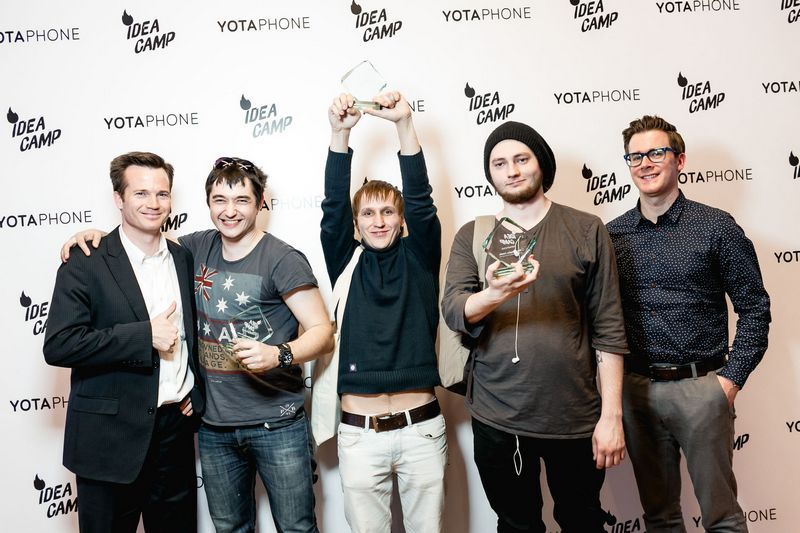
The second prize was awarded based on the results of voting among the Idea Camp participants to the authors of the Rear Sensor project.

And the third prize went to a group of girls who were the most active participants in the discussions throughout the workshop.

All winners were awarded YotaPhone smartphones, commemorative awards and all kinds of branded souvenirs. And most importantly - their ideas are very likely to be embodied in the next generations of YotaPhone.
Conclusion
The first Idea Camp gave us a very interesting and rewarding experience. We tried to give our guests the opportunity to invest a piece of themselves, their ideas and dreams in creating a new smartphone. So that they feel that for us they are not “faceless consumers”, but people for whom (and with whom) we work.
We were enriched with new ideas, energized, and once again convinced of the correctness of our chosen path. We saw and felt your support and interest in what we are doing. And this became the best recognition of the results of our work and a strong motivation for further work.
Thank you friends!