DIY slide duplicator
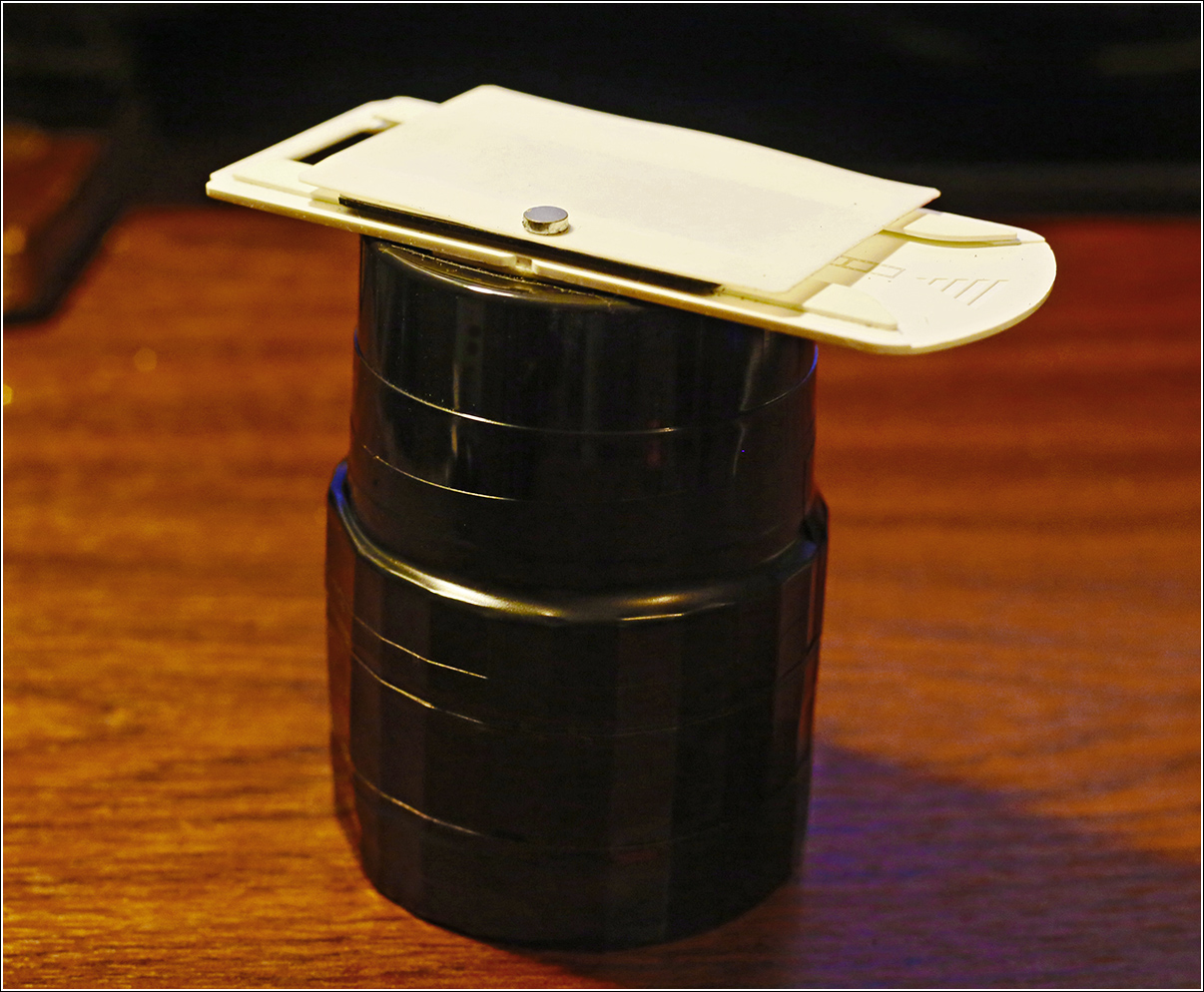
To shoot film negatives and positives, scanners and slide duplicators are used.
Like many born in the USSR, I have a box in which are old films and slides. For a long time I was going to reshoot them by a digit, or rather I was going to make a device for re-shooting for a long time, and in the end I gathered.
To start, I did an Internet search. There were homemade and factory options. Some are unreasonably complex, some are not very convenient for manufacture and use ... The
collected information allowed us to give birth to the design of our version.
For my version I need some sort of “medium” lens (30-70mm) and macro rings. I took a 50mm lens - 50 / 1.8, and also in the zahashnik there were macro rings, with focusing contacts, bought not very expensive on Ibei.
I conceived the design itself as a kind of tube, on which, on one side, a slide for drawing film or installing slides, and on the other side it should be worn on the lens.
There was no problem with the slide — I took it from an A4 scanner that had been blown away, in which a lamp had died a while ago, there was a slide module in its lid, with wonderful white slides. In fact, the slide can be easily made from a couple of three which thread of unnecessary plastic cards.
Next, it was necessary to find a pipe of the desired diameter. And there was a problem, because the pipe should fit tightly on the lens. At home, not a single plastic bottle or jar came up. The jar of cat food was the most suitable in diameter, but it was metal and corrugated, I did not want to hemorrhoids with it. Went to the household, look for the right jar. I bought some liquid soap and some cream, but when trying on, they didn’t come up. (sadness, sadness)
Suddenly, at the stationery store, I saw black plastic glasses for pens - one 30 rubles, the second 40 rubles. I bought both. They came up great!

The design consists of two glasses. The first is of a smaller diameter, its diameter coincides with the diameter of the lens, it is the base, and the second is of a larger diameter, one side is put on the lens, the other on the first glass. In the bottom of the first glass, a dremel cut a rectangular window. Here it was important to cut the window strictly in the middle of the bottom of the glass. Further, on a double-sided grip, a slider frame was attached. I cut a piece from the second glass so that it climbed onto the first glass and the other part onto the lens. It is very good that the second glass was slightly smaller in diameter than the lens. Cut it along, i.e. in length so that he can unclench fit on the lens. Then, placing the first glass on the lens and putting the second glass on top, wrapped it with black tape so that the connection is tight.

I thought for a long time how to attach a matte background plate. She made it by the way from the lid from disposable noodles. I came up with some loops and ets. But then it made it simpler and more efficient - I glued a steel plate to the slide frame, and I glued a small magnet to the background plate. As it turned out later, not only the film, but also the slides, right in the plastic frames, can be sharpened, only one more magnet is needed. inside view, so to speak, The assembly assembly (shot on a mobile because the camera is one and it is in the frame) It turned out that when shooting, it is best to use a monitor as a light source, especially if it is calibrated. A window with a white fill is displayed on the whole screen and on its background both bw negatives and color films and slides are retrieved. Color negatives are convenient to “reverse” in the viewer - FastStone


The quality of the shoot is quite high, it mainly depends on the quality of the digital camera and lens. For evaluation, I will show a few pictures.
Unfortunately, it turned out that many of my films were lost i.e. I naively thought that there would be more interesting material. I was hoping for pictures of the "old" Moscow, but alas, there were almost none, but I mostly shot personal photos of friends and acquaintances, I have no rights to show their faces, so my photos are only examples.
Here I am, in Soviet times, on the beach in Gantiadi (Abkhazia). There is a tape recorder in the frame - this is the electronics 302. I did a mod for her so to speak - sawed off half, lengthened a bit so that the batteries climbed up, replaced the board and speaker with my own, made a self-stop.

I am also in this picture. It is interesting because of the generally good quality that Zenith gave with a standard lens, but it was not realistic to pull out the quality when printing at home using a simple magnifier. Well, for starters, the Soviet beach, it can be seen that the positive film was very grainy. I was very pleased with the result, not too many films were preserved.