October 1, 2013 at 19:18
History of a pirate scene
- Transfer
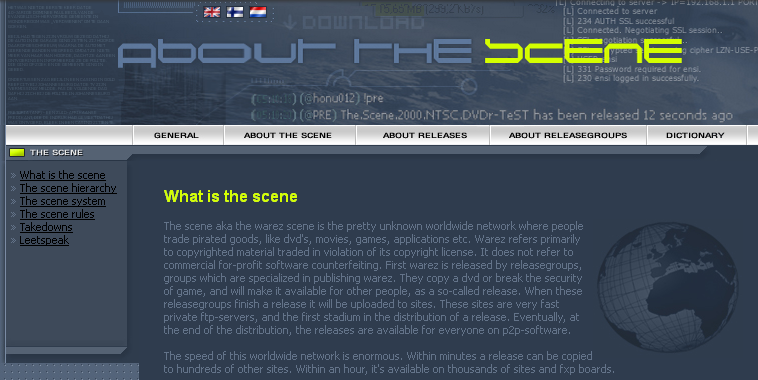
Over the past year I published on the Habré about a dozen articles about the scene . This is a pirate underground, thousands and tens of thousands of enthusiasts around the world who compete with each other in speed, making releases only internally - on the stage, without any financial gain. In 2007-2008 there was a site aboutthescene where basic information about the structure, mechanisms and rules of the scene, as well as the history of its occurrence and development, was published. Now site materials are available only in the online archive .
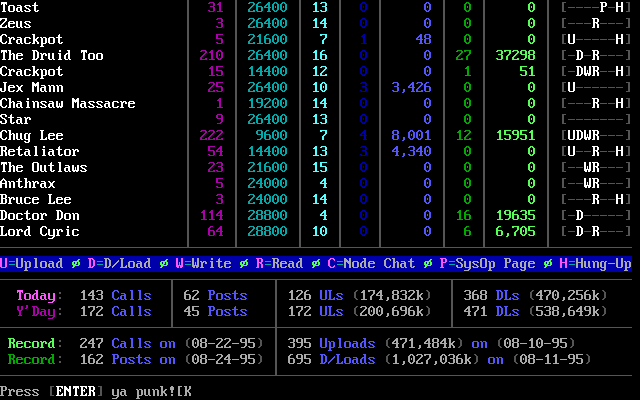
I started the translation with the story of the scene. The article was without illustrations, so I added to it historical screenshots of 1995 with the largest New York BBS "Park Central", which shows how up to 16 users simultaneously connect to it using modems at speeds from 9600 to 28800 baud.
1. The origin of the PC scene
Ever since the opportunity to store data on computers and sell commercial programs, there have always been pirates. The pirate scene originates in the late 70s, and maybe even earlier. By the beginning of the 80s, some computers (such as BBC Micro in Europe) were so occupied by pirates that software companies surrendered. They stopped making programs for these computers because they could not make money at all. But this article only applies to the PC scene.
In the early 80s, there were a huge number of different 8-bit computers, this time was called the Golden Era. Most people agree that at that time, the Commodore 64 scene was the best scene. But this was not the first international pirate scene organized. The first analogue of the modern warez Internet scene can most likely be called Apple II pirates in the very late 70s.
It was the pirate scene Commodore and Apple that introduced many of the standards that we see today, and the first IBM PC computers were released in mid-1981. The PC scene was then small and fragmented. There were several small groups and individuals who opened the programs and released them. However, these releases usually remained only within local communities. The national and then the international PC-scene started only in 1987. Then people began to exchange warez through long-distance lines and across the ocean. This event led to the formation of the PC BBS ( Bulletin Board System ) scene that has now become history .
2. The era of BBS
The first BBS program - CBBS (Community Bulletin Board System) was written for the Altair 8080 computer in 1987. She was slow, buggy, and purely textual. Gradually, it developed and gained popularity, but the main breakthrough came when it became possible to transfer files using the specially developed protocol X-Modem. This protocol was created by Ward Christenson and Randy Suess (authors of CBBS). It ensured error-free data transfer between users of most of the then existing systems. Then the exchange of “illegal” programs began, which ultimately devoted BBS to piracy.
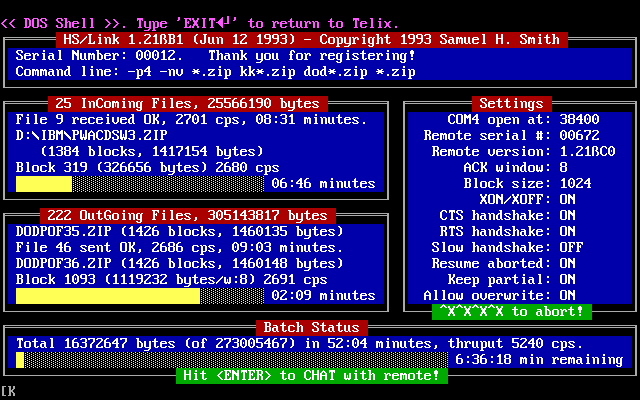
BBS began to appear in different cities and countries. Users who were bored with the local archives began trying to call other sites on the intercity. Unfortunately, such calls led to huge phone bills, so resourceful people quickly found ways to call for free. For this, special electronic devices known as “box” were used .
These first telephone hackers were called phreakers. Most of them were mainly engaged in HPAV (Hacking, Phreaking, Anarchy, Virus), and piracy for them was in the background. Because of this, the IBM PC scene was slow and fragmented, spreading the release across North America could take weeks. In the 80s, IBM PCs and Commodore 64s were common in ordinary American homes, while Amstrad, Spectrum, Commodore, and Atari dominated in Europe, and IBM PCs were rare.
The problem was that not many pirates knew what phreaking was, and paying for long distance was very expensive. However, around 1988, a new type of band appeared - NAP / PA. It was the North American Pirate Phreak Alliance and its goal was to spread the knowledge of phreaking among pirates. Many of the largest pirated BBSs collaborated with them, disseminating information, which allowed a closer integration of the scene.
Releases spread slowly - each BBS had to be called separately, and modem speeds were limited. From those times the famous phrase “0 day warez” went. This meant that you received the release on the same day it was released. The phrase was often used to denote good BBS-approx.
Gradually, with the expansion of the scene, the role of the phreaker turned into the role of a courier. The courier's only task was to transfer releases between BBSs. What exactly to shift and where it depended on the connections between release groups. In the early 90's, couriers were considered on the stage not as respected as the rest. Being a courier was easy, almost anyone could handle it. It was necessary to take risks and spend time on it, but no special skills or abilities were required.
At that time, many BBSs had to pay monthly fees for partnerships with groups. The links in the groups were important, as they made it possible to receive their releases first, which increased the prestige of the site. Sysops (BBS operators) usually did not like to pay out of pocket, so they created special accounts known as 'leech accounts'. These were users who received full access to Varese for money, because they had no connections in the pirate world, and could not offer anything else in return.
Money received from partner nodes was used by groups to purchase software and hardware, and to pay third parties. (Note: I don’t know what it means, maybe a seller in a store, so that he would give them to rewrite floppy disks?) A group that did not have money risked being left without releases. As a result, the BBS sysop had to pay these fees, pay telephone bills and still buy equipment that he himself needed. But this financial investment paid off with great respect from its users.
3. Legal issues
Keeping a BBS with illegal software was risky. Unlike today's Internet sites, they were usually located right at the sysop's home. Therefore, the police could easily determine the address of the operator. The phone number used to call the BBS was often registered in the name of its owner. For this reason, the scene was very secret and clandestine. Phone numbers and names were only shared with people you knew well. To gain access, it was necessary to find out the system password and the second password for registering a new user. The decision to accept a new member was made by voting or on a recommendation.
There were good reasons for this secrecy. Some companies were eager to block the illegal flow of their programs. These corporations, including Microsoft and Novell, worked with local and federal police in the hope of closing down pirated BBSs. For this, informants or undercover agents were used who collected evidence in order to then conduct a capture operation.
Interestingly, until the adoption of the Net Act in the United States in the late 1990s, piracy was not a criminal offense. Therefore, usually only people who tried to earn money on this were arrested. The police could not arrest you if you simply exchanged copies of the programs for free.
Another option for the fight against pirates was the institution of civil affairs. There was nothing good about this either, and usually the matter ended with the complete confiscation of all the computer equipment in the house. Large companies started such cases, and they were considered according to completely different rules, unlike criminal ones. It is difficult to judge how effective these measures were, let’s say, some companies were more successful than others. At one time in the mid-90s, many BBSs completely banned posting Novell product releases. This was the result of their successful anti-piracy activities, which over the course of several years destroyed several of the largest BBSs around the world.

4. Text files
Unfortunately, there are very few historical documents left from the PC scene of the 80s. Unlike Commodore 64, Amiga, and Atari, text files for releases were almost never made at that time. Programs were then opened by individuals, not groups. These people usually left their signature, for example, on the cracked by Lord Blix splash screen in the bottom corner. Towards the end of the 80s, more and more groups began to appear, and to maintain their prestige, they sometimes began to insert additional screens into the games, made specifically for each release. For example, Bentley Sidewell Productions, a well-known band from the late 80s, usually used a CGA-like picture or animation to show that it was they who opened the game. International Network of Crackers used ANSI graphics.
If the one who cracked the program wanted to add some information, he attached a text file to the release. Over time, all groups began to add explanatory text to their releases. Usually it was a message from the cracker, some information on how to play the game (for example, the keys used), and sometimes a list of BBS numbers is ok.
It was in the 80s that hacker groups were the first to use abbreviations to hide their name. Perhaps this confused one of the ill-wishers, but the main thing is that it was just so shorter to type the name. Reducing to 3 letters became the standard in the early 90s. This was due to the limitation of the length of the file name (8 characters, 3 characters of the extension). Around that time, groups began to stick to a consistent format in file names. The name of the program was reduced to 8 characters, with the extension .DOC, or a three-letter designation of the name of the group.
To our knowledge, the current .NFO standard was introduced in 1990 by The Humble Guys. At first, the 8-letter file name corresponded to the name of the game, over time it was replaced by the name of the group.
5. The death of floppy disks
Along with the development of the Internet, the gaming industry revolutionized the stage with CDROMs. Although PC games for CDs appeared back in 1989, the scene did not transfer to this new medium until the mid-90s. And even then no one took it seriously, and the groups basically created separate subgroups for CD-ROM releases. This was done so that all "junk" was released under a different name. They called it “crapware,” something like modern iND releases.
At first, the groups released the entire CD, but not in the ISO format, but simply all the files copied from the disk. But people are not accustomed to such large volumes, and then the European group Hybrid invented the first CD-Rip. They threw away unnecessary parts of the game, such as music or speech. People who rip thought in terms of floppy disks: the smaller the volume, the better. Therefore, the games turned out to be too circumcised, in addition, they did not spend too much effort opening them, so to run it often required third-party utilities - CD emulators.
When game makers began to use all the available space on a CD, most of the scene groups adopted the new standard. The release size limit has been increased. In 1997, when prices for recordable CDs fell and demand for full disc images appeared, ISO groups appeared, but this was already in a new era, the era of the Internet.
6. The death of BBS-ok and the advent of the Internet
Most would agree that the end of the old era came when Park Central in New York city closed in 1996. At that time, it was the most respected and famous BBS in the world, the center of communication of the whole scene. Groups always competed who would release first: if two groups released a program at the same time, the winner was the one that would extend its version to more BBS. Park Central was often in this process an unofficial arena and referee.

Some cunning groups were the first to decide to leave BBS-ok and distribute their releases only on the Internet. This put the scene in an incomprehensible situation when one group won a release among BBS and the other on the Internet. Although the BBS system had prestige and history, everyone understood that its departure is only a matter of time.
The last highlight in the coffin of the system was the notorious Cyberstrike campaign in February 1997, when the five largest BBSs were covered by the FBI in one week. Operation Cyber Strike was the result of an 8-month closed investigation by the FBI San Francisco International Computer Crime Unit. Searches were conducted at 10 locations in the United States. This caused many other BBSs and some sites to close forever, fearing that they might be the next victim.
For various reasons, the scene used the Internet, but until the beginning of the 90s no one took it seriously. At that time, people had no idea how much the Internet would change the scene and that piracy of a new generation would actually arise.
In the days of BBS, piracy was a secret affair defined underground. It was incredibly difficult for a beginner to access even the usual local BBS-ke. Most people faced the difficult task of obtaining a system password, only to go there, and then a second password to send a request for registration.
But the Internet has changed everything: everything that once was complex, he made incredibly simple. IRC, e-mail, FTP and web have opened up widespread piracy opportunities for ordinary users. And since 1994, they rushed there in herds, causing bouts of despair among many old stage participants. Many of them could not stand the fact that their territory was flooded with the so-called lamers, and closed their doors. But although the old doors were closing, new ones were opening: newsgroups, websites, anonymous FTP and IRC servers - they were ready to satisfy the needs of the masses.
The dominant among these new methods of piracy are IRC channels. Initially, they were created by stage groups to transfer releases to their friends, but one day FATE (Fast Action Transfer Exchange, the leading courier group in 1995) opened its #fatefiles channel to the public, and the audience did not refuse. Then many followed suit, which caused dissatisfaction on the stage, many groups completely disapproved of such a practice.
Over time, the popularity of these methods passed like a honeymoon, but they left a certain niche for themselves. Many of them turned out to be too complicated for the average public, while others, such as sites in the top100, often turned out to be just scammers whose owners made money from porno advertising.
As a result, the scene was finally fenced off from the public, and after numerous operations by the FBI in the early and mid-2000s, it became even more secret and closed than during the BBS. Piracy has become mainstream, millions of ordinary people participate in it, gradually mastering new technologies - peer-to-peer networks, starting with napster and ending with torrents. And the stage today retains its traditions: the stage is only for the sceners and no business.