January 10, 2013 at 22:14
All the most important thing for the next "killer Angry Birds"
I have a hobby - I develop mobile casual games. Therefore, I often have to analyze hits from the tops of Google Play and the AppStore, clone successful solutions and avoid other people's mistakes. As a result, I have identified all the most hit games with some similarities in gameplay and management. In this post I will present my observations on what exactly makes the game popular, and how best to implement it.
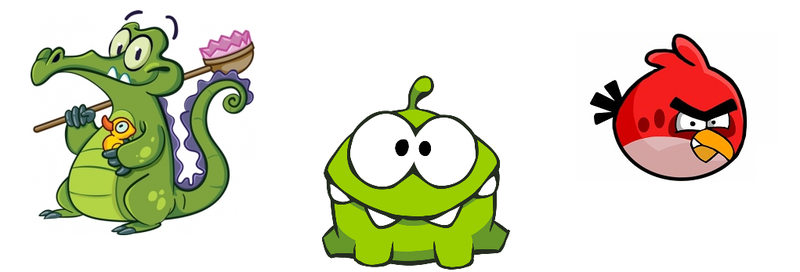
The main similarities of the gameplay of such hits of the mobile games market as Angry Birds, Ninja Jump, FruitNinja, Rope'n'Fly, Doodle Jump are simplicity and monotony. Minimum action and their constant repetition.
All the most popular games are extremely easy to play or in the actual process of the game. This is one of the main reasons for their frantic success. Most owners of phones and tablets are ordinary people, they do not find it interesting five times over the weekend to re-run Mario or Battletoads. Also remember the reasons people play mobile games. These reasons are boredom and fatigue. People sit at work, at boring lectures, ride the subway, and quite logically they have a desire to play. Therefore, in no case can you make huge difficulties in games - bored will not get fun (the Dwarf Fortress motto “Losing is fun” will not work here), and those tired of difficulties at work will not put a lot of effort into some kind of toy either.
You did not notice that most games for phones are extremely monotonous, and any appearance of a new element of gameplay in the middle of the game pours out?
The user repeats the same actions over and over again, but do not tear him from the game. Why so?
And the roots grow, as always, from our animal nature. We feel everything new in the gameplay as a change in the world around us, and the natural instincts developed during evolution include unpleasant feelings in us, forcing us to quickly adapt to the change. And when the gameplay is monotonous, then, once adapted, then we feel "like a fish in water." So come up with interesting gameplay and do not enter anything extra.
Also, in every successful game there is some kind of imaginary upward aspiration. The player can buy new, more expensive things, but still see some “carrot” ahead, a distant target (for example, an ultra-expensive twenty-barrel machine gun). And as he progresses along the path to his cherished dream, he accelerates more and more. That is, if at the beginning of the game the user collected 100 coins per minute, then in the middle he already collects 500 coins per minute. This gives the player a feeling (often false), which is still quite a bit, still quite a bit and he will get to the end. In games where there is nothing to buy, another motivation mechanism is created. As the player moves further and further new enemies begin to appear, new bonuses, etc. For example, this method is used by the creators of NinjaJump .

In most hit casual games, the user makes only one movement (touch) on the screen:
This is done in order to simplify the gameplay as much as possible and to make it possible to play on small phones on which it is not particularly convenient to poke a few small buttons. That is, in essence, such control reduces the whole gameplay to sometimes poking or not poking around the screen and getting some kind of feedback.
This item could be located both here and in the section on gameplay, but I decided to include it here, because it follows just from the previous paragraph on management.
The essence of the rule of rare interference is that the user does not always act, but only at certain points. At other times, the player simply watches the situation. For example, in Angry Birds you pull the slingshot, and the rest of the time you watch the birds crush the enemies, in Ninja Jump you watch the ninja run somewhere up, sometimes jumping him from one wall to another. At Jetpack Joyride, watch your character fly, sometimes including a jetpack. And the feedback is created. He pressed correctly or on time - he won, did not press or pressed incorrectly - he lost. Interestingly, this all recalls the experiments of Ivan Petrovich Pavlov on a poor little dog.
This is partly offtopic, explaining the popularity of only certain genres, but still I will write it. Why are casual games so successful on phones and tablets and other genres not particularly popular? It's all about management. The management interface of games for mobile platforms during its evolution is greatly simplified, recently reduced to a single touch, as I wrote above. And for non-casual genres such as shooters and strategies, such a simple control is unacceptable. For example, in a shooter you need to constantly monitor two aspects - moving the character and aiming, and constantly firing and doing other actions (throwing a grenade, for example). And a person has only two hands, and on the touch screen you cannot immediately control 3-4 aspects. This is not to mention the small size of the screens of the phones. So if you decide to make a 3D-super-mega-game about special forces, think carefully about whether you need it. Although I met one game of a serious genre with almost perfect control. It was a raceDrift Mania 2 . In them, gas is controlled by touching the screen, and turns are controlled by accelerometers. But still it’s terribly inconvenient to play.
What, what, and the graphics should be perfect without a doubt. If the gameplay makes the user stay in the game, then to simply download the game, you need to attract a person with beautiful art. Good graphics play the role of a certain threshold of entry, separating a complete treshak from more or less normal games.
The graphics for casual mobile games are drawn in a cartoon style, in no case in a realistic way. The models use minimalism techniques - a pair of lines and contours, a little bit of color and you're done.

Another important condition for success is the "high cost of graphics." This intuitive indicator can only be understood by example. Here's a look at the first two games that came across from one developer from Google Play:


In the first case, the graphics are drawn well, but it looks very "cheap." In the second, she looks at a very "expensive" level. Although, perhaps this is a very subjective question.
The tempo soundtrack should absolutely match the tempo of the gameplay and should not stand out much. Let him play in the background, create an atmosphere, but nothing more ... When I chose the soundtrack for my last game, one of the options was “The Magpie-Thief” by Joacchino Rossini. The composition was so breathtaking that at some points the heart jumped out of my chest, and I wanted to throw boxes all over the box-2d field instead of building a neat turret into the sky from them.
Another important point in the soundtrack of the game is a bunch of lose-sound / win-sound.
When losing, it is worth making a bad sound so that the user has a clear association in the brain between the loss and the discomfort of that sound. The horror of the lose-sound does not consist in the membranous groaning of the speakers, but simply this sound should stand out sharply from the main leitmotif of the soundtrack of the game.
When you win (well, or collect some kind of bonus), the game needs to publish a pleasant melodious tinkling sound. Thus, the player instills a desire to win and fear of losing.
A good example of lose-sound is the heart-rending scream of a falling ninja from NinjaJump , and a perfect example of win-sound is collecting coins in MegaJump (each coin is collected with a sound a note higher than the previous one; since coins are collected in long sequences in the game, the result is a very pleasant tune to the hearing).


There are still several off-game aspects of the success of the game. They are obvious, but still I will describe them.
The article was written under the impression of the posts of the ishledo habraiser : “Retention” , “Retention. Continuation " .
I hope this topic helps you if you decide to create a new “Angry Birds Killer”.
1. Gameplay
The main similarities of the gameplay of such hits of the mobile games market as Angry Birds, Ninja Jump, FruitNinja, Rope'n'Fly, Doodle Jump are simplicity and monotony. Minimum action and their constant repetition.
a) ease of passage
All the most popular games are extremely easy to play or in the actual process of the game. This is one of the main reasons for their frantic success. Most owners of phones and tablets are ordinary people, they do not find it interesting five times over the weekend to re-run Mario or Battletoads. Also remember the reasons people play mobile games. These reasons are boredom and fatigue. People sit at work, at boring lectures, ride the subway, and quite logically they have a desire to play. Therefore, in no case can you make huge difficulties in games - bored will not get fun (the Dwarf Fortress motto “Losing is fun” will not work here), and those tired of difficulties at work will not put a lot of effort into some kind of toy either.
b) Monotony
You did not notice that most games for phones are extremely monotonous, and any appearance of a new element of gameplay in the middle of the game pours out?
The user repeats the same actions over and over again, but do not tear him from the game. Why so?
And the roots grow, as always, from our animal nature. We feel everything new in the gameplay as a change in the world around us, and the natural instincts developed during evolution include unpleasant feelings in us, forcing us to quickly adapt to the change. And when the gameplay is monotonous, then, once adapted, then we feel "like a fish in water." So come up with interesting gameplay and do not enter anything extra.
c) Aspiration up
Also, in every successful game there is some kind of imaginary upward aspiration. The player can buy new, more expensive things, but still see some “carrot” ahead, a distant target (for example, an ultra-expensive twenty-barrel machine gun). And as he progresses along the path to his cherished dream, he accelerates more and more. That is, if at the beginning of the game the user collected 100 coins per minute, then in the middle he already collects 500 coins per minute. This gives the player a feeling (often false), which is still quite a bit, still quite a bit and he will get to the end. In games where there is nothing to buy, another motivation mechanism is created. As the player moves further and further new enemies begin to appear, new bonuses, etc. For example, this method is used by the creators of NinjaJump .
2. Management
a) The rule of one movement
In most hit casual games, the user makes only one movement (touch) on the screen:
- sometimes it's just a tap (instant touch) anywhere on the screen Examples: NinjaJump, Rope'n'Fly
- sometimes it's a long touch anywhere on the screen Examples: Jetpack Joyride
- sometimes it's a slide (sliding your finger across the screen) Examples: Angry Birds, FruitNinja, Cut the Rope
- sometimes it’s the rotation of accelerometers Examples: DoodleJump, MegaJump
This is done in order to simplify the gameplay as much as possible and to make it possible to play on small phones on which it is not particularly convenient to poke a few small buttons. That is, in essence, such control reduces the whole gameplay to sometimes poking or not poking around the screen and getting some kind of feedback.
b) Rule of rare interference
This item could be located both here and in the section on gameplay, but I decided to include it here, because it follows just from the previous paragraph on management.
The essence of the rule of rare interference is that the user does not always act, but only at certain points. At other times, the player simply watches the situation. For example, in Angry Birds you pull the slingshot, and the rest of the time you watch the birds crush the enemies, in Ninja Jump you watch the ninja run somewhere up, sometimes jumping him from one wall to another. At Jetpack Joyride, watch your character fly, sometimes including a jetpack. And the feedback is created. He pressed correctly or on time - he won, did not press or pressed incorrectly - he lost. Interestingly, this all recalls the experiments of Ivan Petrovich Pavlov on a poor little dog.
c) Management by genres
This is partly offtopic, explaining the popularity of only certain genres, but still I will write it. Why are casual games so successful on phones and tablets and other genres not particularly popular? It's all about management. The management interface of games for mobile platforms during its evolution is greatly simplified, recently reduced to a single touch, as I wrote above. And for non-casual genres such as shooters and strategies, such a simple control is unacceptable. For example, in a shooter you need to constantly monitor two aspects - moving the character and aiming, and constantly firing and doing other actions (throwing a grenade, for example). And a person has only two hands, and on the touch screen you cannot immediately control 3-4 aspects. This is not to mention the small size of the screens of the phones. So if you decide to make a 3D-super-mega-game about special forces, think carefully about whether you need it. Although I met one game of a serious genre with almost perfect control. It was a raceDrift Mania 2 . In them, gas is controlled by touching the screen, and turns are controlled by accelerometers. But still it’s terribly inconvenient to play.
3. Graphics
What, what, and the graphics should be perfect without a doubt. If the gameplay makes the user stay in the game, then to simply download the game, you need to attract a person with beautiful art. Good graphics play the role of a certain threshold of entry, separating a complete treshak from more or less normal games.
The graphics for casual mobile games are drawn in a cartoon style, in no case in a realistic way. The models use minimalism techniques - a pair of lines and contours, a little bit of color and you're done.
Another important condition for success is the "high cost of graphics." This intuitive indicator can only be understood by example. Here's a look at the first two games that came across from one developer from Google Play:
In the first case, the graphics are drawn well, but it looks very "cheap." In the second, she looks at a very "expensive" level. Although, perhaps this is a very subjective question.
4. Sound
The tempo soundtrack should absolutely match the tempo of the gameplay and should not stand out much. Let him play in the background, create an atmosphere, but nothing more ... When I chose the soundtrack for my last game, one of the options was “The Magpie-Thief” by Joacchino Rossini. The composition was so breathtaking that at some points the heart jumped out of my chest, and I wanted to throw boxes all over the box-2d field instead of building a neat turret into the sky from them.
Another important point in the soundtrack of the game is a bunch of lose-sound / win-sound.
When losing, it is worth making a bad sound so that the user has a clear association in the brain between the loss and the discomfort of that sound. The horror of the lose-sound does not consist in the membranous groaning of the speakers, but simply this sound should stand out sharply from the main leitmotif of the soundtrack of the game.
When you win (well, or collect some kind of bonus), the game needs to publish a pleasant melodious tinkling sound. Thus, the player instills a desire to win and fear of losing.
A good example of lose-sound is the heart-rending scream of a falling ninja from NinjaJump , and a perfect example of win-sound is collecting coins in MegaJump (each coin is collected with a sound a note higher than the previous one; since coins are collected in long sequences in the game, the result is a very pleasant tune to the hearing).
5. Off-game moments
There are still several off-game aspects of the success of the game. They are obvious, but still I will describe them.
- short catchy two-word name
- in the title and in the game itself, only the words "elementary English" are used
- beautiful memorable icon with a minimum drawn on it
- convenient interface
- live tech support
6. Conclusion
The article was written under the impression of the posts of the ishledo habraiser : “Retention” , “Retention. Continuation " .
I hope this topic helps you if you decide to create a new “Angry Birds Killer”.