
 June 30, 2012 at 17:08
Coinbase wants to make Bitcoin payments available to the mass user
Until now, the Bitcoin cryptocurrency has been popular only in relatively narrow circles. One of the reasons for this is to understand the principles of its work, install the client, wait for the block chain to load - all this is quite long and non-trivial, at least for the non-geek. The purpose of Coinbase is to make working with Bitcoin simpler and more similar to the usual means of payment. More interestingly, this startup grew up in the well-known and respectable business incubator Y Combinator. And this suggests that Bitcoin is becoming interesting not only for drug dealers from Silk Road and cryptanarchist enthusiasts.
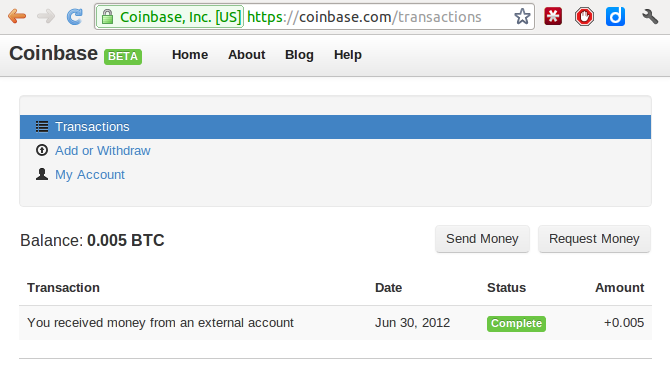
Coinbase has a nice and simple interface and so far quite limited functionality. The most important thing is that you can start accepting and sending payments literally a few seconds after registration, and even a baby can figure out Coinbase. Transfers between wallets are free, depositing and withdrawing funds will cost 0.5%. The service already has multi-factor authentication (one-time passwords sent to the phone). At first glance, this completely contradicts the ideology of Bitcoin, as an anonymous and decentralized means of payment. However, this greatly reduces the entry threshold and contributes to the popularization of cryptocurrency. This can play a decisive role in her fate.
The fact is that now, it seems, the second wave of Bitcoin popularity is starting. This wave arises in Europe, where the Euro is in a feverish order, and countries such as Greece or Spain generally hardly keep afloat. Europeans have less confidence in their currency and are actively looking for alternatives . One of them is Bitcoin. However, the difficulty of working with an official client and the security risks associated with storing wallets on your computer can scare off a fair amount of people. Coinbase takes care of these issues.
Bitcoin gained relatively wide popularity a little over a year ago. In June 2011, the price on the MtGox exchange reached $ 30 for 1 bitcoin. Many were afraid that this bubble would burst, leaving no stone on the stone from the cryptocurrency, however, Bitcoin survived, stabilized and for about six monthscosts about $ 6 . Money loves silence, and such stability is a much more encouraging signal for market participants than dizzying jumps that attract only speculators.
Stability is especially important on the eve of how the “equator” is reached in the generation of new coins - in December this year 10.5 million bitcoins will be generated - exactly half of the total, after which mining profitability will halve. For each block found, not 50, but 25 coins will be given. Nobody knows for sure what consequences this will have for the course and stability of the network as a whole. Optimists believe that nothing special will happen, as the number of freshly mined bitcoins is small compared to the usual daily trading volume. Pessimists fear that a sharp decrease in mining profitability will lead to a sudden decrease in the processing power of the network, which could theoretically destabilize its operation.
Coinbase has a nice and simple interface and so far quite limited functionality. The most important thing is that you can start accepting and sending payments literally a few seconds after registration, and even a baby can figure out Coinbase. Transfers between wallets are free, depositing and withdrawing funds will cost 0.5%. The service already has multi-factor authentication (one-time passwords sent to the phone). At first glance, this completely contradicts the ideology of Bitcoin, as an anonymous and decentralized means of payment. However, this greatly reduces the entry threshold and contributes to the popularization of cryptocurrency. This can play a decisive role in her fate.
The fact is that now, it seems, the second wave of Bitcoin popularity is starting. This wave arises in Europe, where the Euro is in a feverish order, and countries such as Greece or Spain generally hardly keep afloat. Europeans have less confidence in their currency and are actively looking for alternatives . One of them is Bitcoin. However, the difficulty of working with an official client and the security risks associated with storing wallets on your computer can scare off a fair amount of people. Coinbase takes care of these issues.
Bitcoin gained relatively wide popularity a little over a year ago. In June 2011, the price on the MtGox exchange reached $ 30 for 1 bitcoin. Many were afraid that this bubble would burst, leaving no stone on the stone from the cryptocurrency, however, Bitcoin survived, stabilized and for about six monthscosts about $ 6 . Money loves silence, and such stability is a much more encouraging signal for market participants than dizzying jumps that attract only speculators.
Stability is especially important on the eve of how the “equator” is reached in the generation of new coins - in December this year 10.5 million bitcoins will be generated - exactly half of the total, after which mining profitability will halve. For each block found, not 50, but 25 coins will be given. Nobody knows for sure what consequences this will have for the course and stability of the network as a whole. Optimists believe that nothing special will happen, as the number of freshly mined bitcoins is small compared to the usual daily trading volume. Pessimists fear that a sharp decrease in mining profitability will lead to a sudden decrease in the processing power of the network, which could theoretically destabilize its operation.